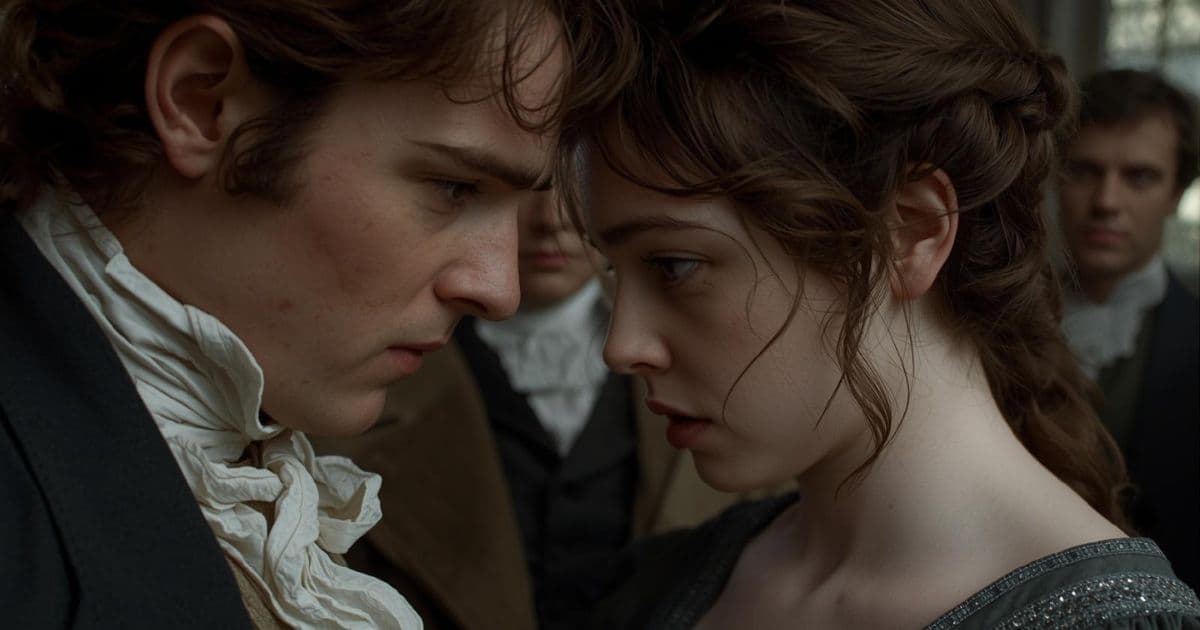
An excerpt from the original text.(complete · 1861 words)
he hair was curled, and the maid sent away, and Emma sat down to think
and be miserable.—It was a wretched business indeed!—Such an overthrow
of every thing she had been wishing for!—Such a development of every
thing most unwelcome!—Such a blow for Harriet!—that was the worst of
all. Every part of it brought pain and humiliation, of some sort or
other; but, compared with the evil to Harriet, all was light; and she
would gladly have submitted to feel yet more mistaken—more in
error—more disgraced by mis-judgment, than she actually was, could the
effects of her blunders have been confined to herself.
“If I had not persuaded Harriet into liking the man, I could have borne
any thing. He might have doubled his presumption to me—but poor
Harriet!”
How she could have been so deceived!—He protested that he had never
thought seriously of Harriet—never! She looked back as well as she
could; but it was all confusion. She had taken up the idea, she
supposed, and made every thing bend to it. His manners, however, must
have been unmarked, wavering, dubious, or she could not have been so
misled.
The picture!—How eager he had been about the picture!—and the
charade!—and an hundred other circumstances;—how clearly they had
seemed to point at Harriet. To be sure, the charade, with its “ready
wit”—but then the “soft eyes”—in fact it suited neither; it was a
jumble without taste or truth. Who could have seen through such
thick-headed nonsense?
Certainly she had often, especially of late, thought his manners to
herself unnecessarily gallant; but it had passed as his way, as a mere
error of judgment, of knowledge, of taste, as one proof among others
that he had not always lived in the best society, that with all the
gentleness of his address, true elegance was sometimes wanting; but,
till this very day, she had never, for an instant, suspected it to mean
any thing but grateful respect to her as Harriet’s friend.
To Mr. John Knightley was she indebted for her first idea on the
subject, for the first start of its possibility. There was no denying
that those brothers had penetration. She remembered what Mr. Knightley
had once said to her about Mr. Elton, the caution he had given, the
conviction he had professed that Mr. Elton would never marry
indiscreetly; and blushed to think how much truer a knowledge of his
character had been there shewn than any she had reached herself. It was
dreadfully mortifying; but Mr. Elton was proving himself, in many
respects, the very reverse of what she had meant and believed him;
proud, assuming, conceited; very full of his own claims, and little
concerned about the feelings of others.
Contrary to the usual course of things, Mr. Elton’s wanting to pay his
addresses to her had sunk him in her opinion. His professions and his
proposals did him no service. She thought nothing of his attachment,
and was insulted by his hopes. He wanted to marry well, and having the
arrogance to raise his eyes to her, pretended to be in love; but she
was perfectly easy as to his not suffering any disappointment that need
be cared for. There had been no real affection either in his language
or manners. Sighs and fine words had been given in abundance; but she
could hardly devise any set of expressions, or fancy any tone of voice,
less allied with real love. She need not trouble herself to pity him.
He only wanted to aggrandise and enrich himself; and if Miss Woodhouse
of Hartfield, the heiress of thirty thousand pounds, were not quite so
easily obtained as he had fancied, he would soon try for Miss Somebody
else with twenty, or with ten.
But—that he should talk of encouragement, should consider her as aware
of his views, accepting his attentions, meaning (in short), to marry
him!—should suppose himself her equal in connexion or mind!—look down
upon her friend, so well understanding the gradations of rank below
him, and be so blind to what rose above, as to fancy himself shewing no
presumption in addressing her!—It was most provoking.
Perhaps it was not fair to expect him to feel how very much he was her
inferior in talent, and all the elegancies of mind. The very want of
such equality might prevent his perception of it; but he must know that
in fortune and consequence she was greatly his superior. He must know
that the Woodhouses had been settled for several generations at
Hartfield, the younger branch of a very ancient family—and that the
Eltons were nobody. The landed property of Hartfield certainly was
inconsiderable, being but a sort of notch in the Donwell Abbey estate,
to which all the rest of Highbury belonged; but their fortune, from
other sources, was such as to make them scarcely secondary to Donwell
Abbey itself, in every other kind of consequence; and the Woodhouses
had long held a high place in the consideration of the neighbourhood
which Mr. Elton had first entered not two years ago, to make his way as
he could, without any alliances but in trade, or any thing to recommend
him to notice but his situation and his civility.—But he had fancied
her in love with him; that evidently must have been his dependence; and
after raving a little about the seeming incongruity of gentle manners
and a conceited head, Emma was obliged in common honesty to stop and
admit that her own behaviour to him had been so complaisant and
obliging, so full of courtesy and attention, as (supposing her real
motive unperceived) might warrant a man of ordinary observation and
delicacy, like Mr. Elton, in fancying himself a very decided favourite.
If she had so misinterpreted his feelings, she had little right to
wonder that he, with self-interest to blind him, should have mistaken
hers.
The first error and the worst lay at her door. It was foolish, it was
wrong, to take so active a part in bringing any two people together. It
was adventuring too far, assuming too much, making light of what ought
to be serious, a trick of what ought to be simple. She was quite
concerned and ashamed, and resolved to do such things no more.
“Here have I,” said she, “actually talked poor Harriet into being very
much attached to this man. She might never have thought of him but for
me; and certainly never would have thought of him with hope, if I had
not assured her of his attachment, for she is as modest and humble as I
used to think him. Oh! that I had been satisfied with persuading her
not to accept young Martin. There I was quite right. That was well done
of me; but there I should have stopped, and left the rest to time and
chance. I was introducing her into good company, and giving her the
opportunity of pleasing some one worth having; I ought not to have
attempted more. But now, poor girl, her peace is cut up for some time.
I have been but half a friend to her; and if she were not to feel
this disappointment so very much, I am sure I have not an idea of any
body else who would be at all desirable for her;—William Coxe—Oh! no, I
could not endure William Coxe—a pert young lawyer.”
She stopt to blush and laugh at her own relapse, and then resumed a
more serious, more dispiriting cogitation upon what had been, and might
be, and must be. The distressing explanation she had to make to
Harriet, and all that poor Harriet would be suffering, with the
awkwardness of future meetings, the difficulties of continuing or
discontinuing the acquaintance, of subduing feelings, concealing
resentment, and avoiding eclat, were enough to occupy her in most
unmirthful reflections some time longer, and she went to bed at last
with nothing settled but the conviction of her having blundered most
dreadfully.
To youth and natural cheerfulness like Emma’s, though under temporary
gloom at night, the return of day will hardly fail to bring return of
spirits. The youth and cheerfulness of morning are in happy analogy,
and of powerful operation; and if the distress be not poignant enough
to keep the eyes unclosed, they will be sure to open to sensations of
softened pain and brighter hope.
Emma got up on the morrow more disposed for comfort than she had gone
to bed, more ready to see alleviations of the evil before her, and to
depend on getting tolerably out of it.
It was a great consolation that Mr. Elton should not be really in love
with her, or so particularly amiable as to make it shocking to
disappoint him—that Harriet’s nature should not be of that superior
sort in which the feelings are most acute and retentive—and that there
could be no necessity for any body’s knowing what had passed except the
three principals, and especially for her father’s being given a
moment’s uneasiness about it.
These were very cheering thoughts; and the sight of a great deal of
snow on the ground did her further service, for any thing was welcome
that might justify their all three being quite asunder at present.
The weather was most favourable for her; though Christmas Day, she
could not go to church. Mr. Woodhouse would have been miserable had his
daughter attempted it, and she was therefore safe from either exciting
or receiving unpleasant and most unsuitable ideas. The ground covered
with snow, and the atmosphere in that unsettled state between frost and
thaw, which is of all others the most unfriendly for exercise, every
morning beginning in rain or snow, and every evening setting in to
freeze, she was for many days a most honourable prisoner. No
intercourse with Harriet possible but by note; no church for her on
Sunday any more than on Christmas Day; and no need to find excuses for
Mr. Elton’s absenting himself.
It was weather which might fairly confine every body at home; and
though she hoped and believed him to be really taking comfort in some
society or other, it was very pleasant to have her father so well
satisfied with his being all alone in his own house, too wise to stir
out; and to hear him say to Mr. Knightley, whom no weather could keep
entirely from them,—
“Ah! Mr. Knightley, why do not you stay at home like poor Mr. Elton?”
These days of confinement would have been, but for her private
perplexities, remarkably comfortable, as such seclusion exactly suited
her brother, whose feelings must always be of great importance to his
companions; and he had, besides, so thoroughly cleared off his
ill-humour at Randalls, that his amiableness never failed him during
the rest of his stay at Hartfield. He was always agreeable and
obliging, and speaking pleasantly of every body. But with all the hopes
of cheerfulness, and all the present comfort of delay, there was still
such an evil hanging over her in the hour of explanation with Harriet,
as made it impossible for Emma to be ever perfectly at ease.
Master this chapter. Complete your experience
Purchase the complete book to access all chapters and support classic literature
As an Amazon Associate, we earn a small commission from qualifying purchases at no additional cost to you.
Available in paperback, hardcover, and e-book formats
Let's Analyse the Pattern
Good intentions become harmful when they're based on assumptions rather than reality, especially when combined with social power or influence.
Why This Matters
Connect literature to life
This chapter teaches how to distinguish between genuine professional interest and personal agenda disguised as business.
Practice This Today
This week, notice when someone in authority shows interest in your ideas—ask yourself whether they're responding to your work or to what you can do for them personally.
Now let's explore the literary elements.
Key Quotes & Analysis
"If I had not persuaded Harriet into liking the man, I could have borne any thing."
Context: Emma reflects on her guilt while processing Elton's proposal
This shows Emma's first real moment of taking responsibility for her actions. She's more upset about hurting Harriet than about her own embarrassment, revealing genuine care beneath her meddling.
In Today's Words:
I could handle being wrong about everything if I hadn't gotten my friend's hopes up.
"How she could have been so deceived!—He protested that he had never thought seriously of Harriet—never!"
Context: Emma realizes Elton was never interested in Harriet at all
This captures the shock of discovering that an entire scenario you created in your head was completely false. Emma built a whole romance that existed only in her imagination.
In Today's Words:
How did I get this so wrong? He said he never even considered dating her!
"Who could have seen through such thick-headed nonsense?"
Context: Emma tries to justify how she misread all the signs
Even in her moment of self-awareness, Emma still tries to blame the situation rather than fully owning her mistakes. This shows how hard it is to completely abandon our defense mechanisms.
In Today's Words:
How was I supposed to know what he really meant with all those mixed signals?
Thematic Threads
Self-Awareness
In This Chapter
Emma experiences her first moment of genuine self-reflection, recognizing her own arrogance and meddling nature
Development
First major breakthrough - Emma has been oblivious to her flaws until this shocking wake-up call
In Your Life:
You might recognize this when feedback at work or in relationships forces you to see patterns you've been blind to in your own behavior.
Class
In This Chapter
Emma realizes Elton was interested in her wealth and status, not her person, revealing how money shapes romantic calculations
Development
Deepening from earlier hints about social hierarchy to explicit recognition of how class drives behavior
In Your Life:
You see this when someone treats you differently after learning about your job, income, or family background.
Pride
In This Chapter
Emma's pride in her matchmaking abilities crashes into reality, forcing her to confront her overconfidence
Development
Evolution from casual arrogance to devastating humiliation that might finally teach humility
In Your Life:
You experience this when expertise in one area makes you overconfident in another, leading to embarrassing mistakes.
Consequences
In This Chapter
Emma faces the painful reality that her meddling has hurt Harriet, someone she genuinely cares about
Development
First time Emma must confront that her actions have real emotional costs for others
In Your Life:
You feel this when your advice or interference backfires and hurts someone you were trying to help.
Reality vs Perception
In This Chapter
Emma discovers the vast gap between what she thought was happening and what was actually happening
Development
Introduced here as Emma's fundamental problem - living in her own constructed reality rather than the real world
In Your Life:
You encounter this when you realize you've completely misread a situation at work, in family dynamics, or in relationships.
You now have the context. Time to form your own thoughts.
Discussion Questions
- 1
What specific evidence does Emma finally see that proves Mr. Elton was never interested in Harriet?
analysis • surface - 2
Why did Emma's good intentions lead to such a painful outcome for everyone involved?
analysis • medium - 3
Where do you see this pattern of well-meaning interference backfiring in workplaces, families, or friendships today?
application • medium - 4
What three questions could Emma have asked before playing matchmaker that would have prevented this disaster?
application • deep - 5
What does Emma's blindness to Mr. Knightley's warnings reveal about how power and privilege can distort our judgment?
reflection • deep
Critical Thinking Exercise
The Assumption Audit
Think of a situation where you tried to help someone or fix a problem based on what you thought you knew. Write down what you assumed versus what you actually confirmed through direct conversation or evidence. Then identify what questions you should have asked first.
Consider:
- •Focus on your intentions versus your methods - good intentions don't automatically lead to good outcomes
- •Consider how your position or relationship to the situation might have created blind spots
- •Think about whether you asked the affected person what they actually wanted or needed
Journaling Prompt
Write about a time when someone tried to help you in a way that missed the mark. What did they assume about your situation, and what would you have preferred they ask you directly?
Coming Up Next...
Chapter 17: Facing the Fallout
Emma must now face the dreaded conversation with Harriet, breaking her friend's heart while trying to salvage their relationship. How do you tell someone you've accidentally destroyed their romantic hopes?