An excerpt from the original text.(complete · 4563 words)
R. SEWARD’S DIARY--continued
It was just a quarter before twelve o’clock when we got into the
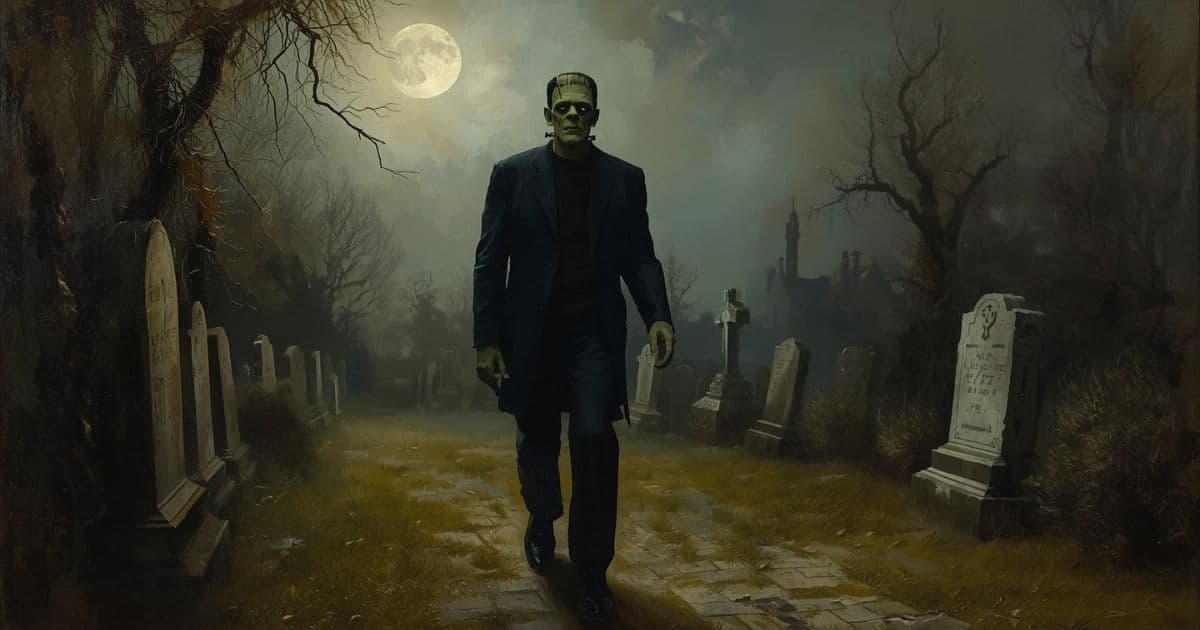
churchyard over the low wall. The night was dark with occasional gleams
of moonlight between the rents of the heavy clouds that scudded across
the sky. We all kept somehow close together, with Van Helsing slightly
in front as he led the way. When we had come close to the tomb I looked
well at Arthur, for I feared that the proximity to a place laden with so
sorrowful a memory would upset him; but he bore himself well. I took it
that the very mystery of the proceeding was in some way a counteractant
to his grief. The Professor unlocked the door, and seeing a natural
hesitation amongst us for various reasons, solved the difficulty by
entering first himself. The rest of us followed, and he closed the door.
He then lit a dark lantern and pointed to the coffin. Arthur stepped
forward hesitatingly; Van Helsing said to me:--
“You were with me here yesterday. Was the body of Miss Lucy in that
coffin?”
“It was.” The Professor turned to the rest saying:--
“You hear; and yet there is no one who does not believe with me.” He
took his screwdriver and again took off the lid of the coffin. Arthur
looked on, very pale but silent; when the lid was removed he stepped
forward. He evidently did not know that there was a leaden coffin, or,
at any rate, had not thought of it. When he saw the rent in the lead,
the blood rushed to his face for an instant, but as quickly fell away
again, so that he remained of a ghastly whiteness; he was still silent.
Van Helsing forced back the leaden flange, and we all looked in and
recoiled.
The coffin was empty!
For several minutes no one spoke a word. The silence was broken by
Quincey Morris:--
“Professor, I answered for you. Your word is all I want. I wouldn’t ask
such a thing ordinarily--I wouldn’t so dishonour you as to imply a
doubt; but this is a mystery that goes beyond any honour or dishonour.
Is this your doing?”
“I swear to you by all that I hold sacred that I have not removed nor
touched her. What happened was this: Two nights ago my friend Seward and
I came here--with good purpose, believe me. I opened that coffin, which
was then sealed up, and we found it, as now, empty. We then waited, and
saw something white come through the trees. The next day we came here in
day-time, and she lay there. Did she not, friend John?”
“Yes.”
“That night we were just in time. One more so small child was missing,
and we find it, thank God, unharmed amongst the graves. Yesterday I came
here before sundown, for at sundown the Un-Dead can move. I waited here
all the night till the sun rose, but I saw nothing. It was most probable
that it was because I had laid over the clamps of those doors garlic,
which the Un-Dead cannot bear, and other things which they shun. Last
night there was no exodus, so to-night before the sundown I took away my
garlic and other things. And so it is we find this coffin empty. But
bear with me. So far there is much that is strange. Wait you with me
outside, unseen and unheard, and things much stranger are yet to be.
So”--here he shut the dark slide of his lantern--“now to the outside.”
He opened the door, and we filed out, he coming last and locking the
door behind him.
Oh! but it seemed fresh and pure in the night air after the terror of
that vault. How sweet it was to see the clouds race by, and the passing
gleams of the moonlight between the scudding clouds crossing and
passing--like the gladness and sorrow of a man’s life; how sweet it was
to breathe the fresh air, that had no taint of death and decay; how
humanising to see the red lighting of the sky beyond the hill, and to
hear far away the muffled roar that marks the life of a great city. Each
in his own way was solemn and overcome. Arthur was silent, and was, I
could see, striving to grasp the purpose and the inner meaning of the
mystery. I was myself tolerably patient, and half inclined again to
throw aside doubt and to accept Van Helsing’s conclusions. Quincey
Morris was phlegmatic in the way of a man who accepts all things, and
accepts them in the spirit of cool bravery, with hazard of all he has to
stake. Not being able to smoke, he cut himself a good-sized plug of
tobacco and began to chew. As to Van Helsing, he was employed in a
definite way. First he took from his bag a mass of what looked like
thin, wafer-like biscuit, which was carefully rolled up in a white
napkin; next he took out a double-handful of some whitish stuff, like
dough or putty. He crumbled the wafer up fine and worked it into the
mass between his hands. This he then took, and rolling it into thin
strips, began to lay them into the crevices between the door and its
setting in the tomb. I was somewhat puzzled at this, and being close,
asked him what it was that he was doing. Arthur and Quincey drew near
also, as they too were curious. He answered:--
“I am closing the tomb, so that the Un-Dead may not enter.”
“And is that stuff you have put there going to do it?” asked Quincey.
“Great Scott! Is this a game?”
“It is.”
“What is that which you are using?” This time the question was by
Arthur. Van Helsing reverently lifted his hat as he answered:--
“The Host. I brought it from Amsterdam. I have an Indulgence.” It was an
answer that appalled the most sceptical of us, and we felt individually
that in the presence of such earnest purpose as the Professor’s, a
purpose which could thus use the to him most sacred of things, it was
impossible to distrust. In respectful silence we took the places
assigned to us close round the tomb, but hidden from the sight of any
one approaching. I pitied the others, especially Arthur. I had myself
been apprenticed by my former visits to this watching horror; and yet I,
who had up to an hour ago repudiated the proofs, felt my heart sink
within me. Never did tombs look so ghastly white; never did cypress, or
yew, or juniper so seem the embodiment of funereal gloom; never did tree
or grass wave or rustle so ominously; never did bough creak so
mysteriously; and never did the far-away howling of dogs send such a
woeful presage through the night.
There was a long spell of silence, a big, aching void, and then from the
Professor a keen “S-s-s-s!” He pointed; and far down the avenue of yews
we saw a white figure advance--a dim white figure, which held something
dark at its breast. The figure stopped, and at the moment a ray of
moonlight fell upon the masses of driving clouds and showed in startling
prominence a dark-haired woman, dressed in the cerements of the grave.
We could not see the face, for it was bent down over what we saw to be a
fair-haired child. There was a pause and a sharp little cry, such as a
child gives in sleep, or a dog as it lies before the fire and dreams. We
were starting forward, but the Professor’s warning hand, seen by us as
he stood behind a yew-tree, kept us back; and then as we looked the
white figure moved forwards again. It was now near enough for us to see
clearly, and the moonlight still held. My own heart grew cold as ice,
and I could hear the gasp of Arthur, as we recognised the features of
Lucy Westenra. Lucy Westenra, but yet how changed. The sweetness was
turned to adamantine, heartless cruelty, and the purity to voluptuous
wantonness. Van Helsing stepped out, and, obedient to his gesture, we
all advanced too; the four of us ranged in a line before the door of the
tomb. Van Helsing raised his lantern and drew the slide; by the
concentrated light that fell on Lucy’s face we could see that the lips
were crimson with fresh blood, and that the stream had trickled over her
chin and stained the purity of her lawn death-robe.
We shuddered with horror. I could see by the tremulous light that even
Van Helsing’s iron nerve had failed. Arthur was next to me, and if I had
not seized his arm and held him up, he would have fallen.
When Lucy--I call the thing that was before us Lucy because it bore her
shape--saw us she drew back with an angry snarl, such as a cat gives
when taken unawares; then her eyes ranged over us. Lucy’s eyes in form
and colour; but Lucy’s eyes unclean and full of hell-fire, instead of
the pure, gentle orbs we knew. At that moment the remnant of my love
passed into hate and loathing; had she then to be killed, I could have
done it with savage delight. As she looked, her eyes blazed with unholy
light, and the face became wreathed with a voluptuous smile. Oh, God,
how it made me shudder to see it! With a careless motion, she flung to
the ground, callous as a devil, the child that up to now she had
clutched strenuously to her breast, growling over it as a dog growls
over a bone. The child gave a sharp cry, and lay there moaning. There
was a cold-bloodedness in the act which wrung a groan from Arthur; when
she advanced to him with outstretched arms and a wanton smile he fell
back and hid his face in his hands.
She still advanced, however, and with a languorous, voluptuous grace,
said:--
“Come to me, Arthur. Leave these others and come to me. My arms are
hungry for you. Come, and we can rest together. Come, my husband, come!”
There was something diabolically sweet in her tones--something of the
tingling of glass when struck--which rang through the brains even of us
who heard the words addressed to another. As for Arthur, he seemed under
a spell; moving his hands from his face, he opened wide his arms. She
was leaping for them, when Van Helsing sprang forward and held between
them his little golden crucifix. She recoiled from it, and, with a
suddenly distorted face, full of rage, dashed past him as if to enter
the tomb.
When within a foot or two of the door, however, she stopped, as if
arrested by some irresistible force. Then she turned, and her face was
shown in the clear burst of moonlight and by the lamp, which had now no
quiver from Van Helsing’s iron nerves. Never did I see such baffled
malice on a face; and never, I trust, shall such ever be seen again by
mortal eyes. The beautiful colour became livid, the eyes seemed to throw
out sparks of hell-fire, the brows were wrinkled as though the folds of
the flesh were the coils of Medusa’s snakes, and the lovely,
blood-stained mouth grew to an open square, as in the passion masks of
the Greeks and Japanese. If ever a face meant death--if looks could
kill--we saw it at that moment.
And so for full half a minute, which seemed an eternity, she remained
between the lifted crucifix and the sacred closing of her means of
entry. Van Helsing broke the silence by asking Arthur:--
“Answer me, oh my friend! Am I to proceed in my work?”
Arthur threw himself on his knees, and hid his face in his hands, as he
answered:--
“Do as you will, friend; do as you will. There can be no horror like
this ever any more;” and he groaned in spirit. Quincey and I
simultaneously moved towards him, and took his arms. We could hear the
click of the closing lantern as Van Helsing held it down; coming close
to the tomb, he began to remove from the chinks some of the sacred
emblem which he had placed there. We all looked on in horrified
amazement as we saw, when he stood back, the woman, with a corporeal
body as real at that moment as our own, pass in through the interstice
where scarce a knife-blade could have gone. We all felt a glad sense of
relief when we saw the Professor calmly restoring the strings of putty
to the edges of the door.
When this was done, he lifted the child and said:
“Come now, my friends; we can do no more till to-morrow. There is a
funeral at noon, so here we shall all come before long after that. The
friends of the dead will all be gone by two, and when the sexton lock
the gate we shall remain. Then there is more to do; but not like this of
to-night. As for this little one, he is not much harm, and by to-morrow
night he shall be well. We shall leave him where the police will find
him, as on the other night; and then to home.” Coming close to Arthur,
he said:--
“My friend Arthur, you have had a sore trial; but after, when you look
back, you will see how it was necessary. You are now in the bitter
waters, my child. By this time to-morrow you will, please God, have
passed them, and have drunk of the sweet waters; so do not mourn
overmuch. Till then I shall not ask you to forgive me.”
Arthur and Quincey came home with me, and we tried to cheer each other
on the way. We had left the child in safety, and were tired; so we all
slept with more or less reality of sleep.
* * * * *
29 September, night.--A little before twelve o’clock we three--Arthur,
Quincey Morris, and myself--called for the Professor. It was odd to
notice that by common consent we had all put on black clothes. Of
course, Arthur wore black, for he was in deep mourning, but the rest of
us wore it by instinct. We got to the churchyard by half-past one, and
strolled about, keeping out of official observation, so that when the
gravediggers had completed their task and the sexton under the belief
that every one had gone, had locked the gate, we had the place all to
ourselves. Van Helsing, instead of his little black bag, had with him a
long leather one, something like a cricketing bag; it was manifestly of
fair weight.
When we were alone and had heard the last of the footsteps die out up
the road, we silently, and as if by ordered intention, followed the
Professor to the tomb. He unlocked the door, and we entered, closing it
behind us. Then he took from his bag the lantern, which he lit, and also
two wax candles, which, when lighted, he stuck, by melting their own
ends, on other coffins, so that they might give light sufficient to work
by. When he again lifted the lid off Lucy’s coffin we all looked--Arthur
trembling like an aspen--and saw that the body lay there in all its
death-beauty. But there was no love in my own heart, nothing but
loathing for the foul Thing which had taken Lucy’s shape without her
soul. I could see even Arthur’s face grow hard as he looked. Presently
he said to Van Helsing:--
“Is this really Lucy’s body, or only a demon in her shape?”
“It is her body, and yet not it. But wait a while, and you all see her
as she was, and is.”
She seemed like a nightmare of Lucy as she lay there; the pointed teeth,
the bloodstained, voluptuous mouth--which it made one shudder to
see--the whole carnal and unspiritual appearance, seeming like a
devilish mockery of Lucy’s sweet purity. Van Helsing, with his usual
methodicalness, began taking the various contents from his bag and
placing them ready for use. First he took out a soldering iron and some
plumbing solder, and then a small oil-lamp, which gave out, when lit in
a corner of the tomb, gas which burned at fierce heat with a blue
flame; then his operating knives, which he placed to hand; and last a
round wooden stake, some two and a half or three inches thick and about
three feet long. One end of it was hardened by charring in the fire, and
was sharpened to a fine point. With this stake came a heavy hammer, such
as in households is used in the coal-cellar for breaking the lumps. To
me, a doctor’s preparations for work of any kind are stimulating and
bracing, but the effect of these things on both Arthur and Quincey was
to cause them a sort of consternation. They both, however, kept their
courage, and remained silent and quiet.
When all was ready, Van Helsing said:--
“Before we do anything, let me tell you this; it is out of the lore and
experience of the ancients and of all those who have studied the powers
of the Un-Dead. When they become such, there comes with the change the
curse of immortality; they cannot die, but must go on age after age
adding new victims and multiplying the evils of the world; for all that
die from the preying of the Un-Dead becomes themselves Un-Dead, and prey
on their kind. And so the circle goes on ever widening, like as the
ripples from a stone thrown in the water. Friend Arthur, if you had met
that kiss which you know of before poor Lucy die; or again, last night
when you open your arms to her, you would in time, when you had died,
have become nosferatu, as they call it in Eastern Europe, and would
all time make more of those Un-Deads that so have fill us with horror.
The career of this so unhappy dear lady is but just begun. Those
children whose blood she suck are not as yet so much the worse; but if
she live on, Un-Dead, more and more they lose their blood and by her
power over them they come to her; and so she draw their blood with that
so wicked mouth. But if she die in truth, then all cease; the tiny
wounds of the throats disappear, and they go back to their plays
unknowing ever of what has been. But of the most blessed of all, when
this now Un-Dead be made to rest as true dead, then the soul of the poor
lady whom we love shall again be free. Instead of working wickedness by
night and growing more debased in the assimilating of it by day, she
shall take her place with the other Angels. So that, my friend, it will
be a blessed hand for her that shall strike the blow that sets her free.
To this I am willing; but is there none amongst us who has a better
right? Will it be no joy to think of hereafter in the silence of the
night when sleep is not: ‘It was my hand that sent her to the stars; it
was the hand of him that loved her best; the hand that of all she would
herself have chosen, had it been to her to choose?’ Tell me if there be
such a one amongst us?”
We all looked at Arthur. He saw, too, what we all did, the infinite
kindness which suggested that his should be the hand which would restore
Lucy to us as a holy, and not an unholy, memory; he stepped forward and
said bravely, though his hand trembled, and his face was as pale as
snow:--
“My true friend, from the bottom of my broken heart I thank you. Tell me
what I am to do, and I shall not falter!” Van Helsing laid a hand on his
shoulder, and said:--
“Brave lad! A moment’s courage, and it is done. This stake must be
driven through her. It will be a fearful ordeal--be not deceived in
that--but it will be only a short time, and you will then rejoice more
than your pain was great; from this grim tomb you will emerge as though
you tread on air. But you must not falter when once you have begun. Only
think that we, your true friends, are round you, and that we pray for
you all the time.”
“Go on,” said Arthur hoarsely. “Tell me what I am to do.”
“Take this stake in your left hand, ready to place the point over the
heart, and the hammer in your right. Then when we begin our prayer for
the dead--I shall read him, I have here the book, and the others shall
follow--strike in God’s name, that so all may be well with the dead that
we love and that the Un-Dead pass away.”
Arthur took the stake and the hammer, and when once his mind was set on
action his hands never trembled nor even quivered. Van Helsing opened
his missal and began to read, and Quincey and I followed as well as we
could. Arthur placed the point over the heart, and as I looked I could
see its dint in the white flesh. Then he struck with all his might.
The Thing in the coffin writhed; and a hideous, blood-curdling screech
came from the opened red lips. The body shook and quivered and twisted
in wild contortions; the sharp white teeth champed together till the
lips were cut, and the mouth was smeared with a crimson foam. But Arthur
never faltered. He looked like a figure of Thor as his untrembling arm
rose and fell, driving deeper and deeper the mercy-bearing stake, whilst
the blood from the pierced heart welled and spurted up around it. His
face was set, and high duty seemed to shine through it; the sight of it
gave us courage so that our voices seemed to ring through the little
vault.
And then the writhing and quivering of the body became less, and the
teeth seemed to champ, and the face to quiver. Finally it lay still. The
terrible task was over.
The hammer fell from Arthur’s hand. He reeled and would have fallen had
we not caught him. The great drops of sweat sprang from his forehead,
and his breath came in broken gasps. It had indeed been an awful strain
on him; and had he not been forced to his task by more than human
considerations he could never have gone through with it. For a few
minutes we were so taken up with him that we did not look towards the
coffin. When we did, however, a murmur of startled surprise ran from one
to the other of us. We gazed so eagerly that Arthur rose, for he had
been seated on the ground, and came and looked too; and then a glad,
strange light broke over his face and dispelled altogether the gloom of
horror that lay upon it.
There, in the coffin lay no longer the foul Thing that we had so dreaded
and grown to hate that the work of her destruction was yielded as a
privilege to the one best entitled to it, but Lucy as we had seen her in
her life, with her face of unequalled sweetness and purity. True that
there were there, as we had seen them in life, the traces of care and
pain and waste; but these were all dear to us, for they marked her truth
to what we knew. One and all we felt that the holy calm that lay like
sunshine over the wasted face and form was only an earthly token and
symbol of the calm that was to reign for ever.
Van Helsing came and laid his hand on Arthur’s shoulder, and said to
him:--
“And now, Arthur my friend, dear lad, am I not forgiven?”
The reaction of the terrible strain came as he took the old man’s hand
in his, and raising it to his lips, pressed it, and said:--
“Forgiven! God bless you that you have given my dear one her soul again,
and me peace.” He put his hands on the Professor’s shoulder, and laying
his head on his breast, cried for a while silently, whilst we stood
unmoving. When he raised his head Van Helsing said to him:--
“And now, my child, you may kiss her. Kiss her dead lips if you will, as
she would have you to, if for her to choose. For she is not a grinning
devil now--not any more a foul Thing for all eternity. No longer she is
the devil’s Un-Dead. She is God’s true dead, whose soul is with Him!”
Arthur bent and kissed her, and then we sent him and Quincey out of the
tomb; the Professor and I sawed the top off the stake, leaving the point
of it in the body. Then we cut off the head and filled the mouth with
garlic. We soldered up the leaden coffin, screwed on the coffin-lid,
and gathering up our belongings, came away. When the Professor locked
the door he gave the key to Arthur.
Outside the air was sweet, the sun shone, and the birds sang, and it
seemed as if all nature were tuned to a different pitch. There was
gladness and mirth and peace everywhere, for we were at rest ourselves
on one account, and we were glad, though it was with a tempered joy.
Before we moved away Van Helsing said:--
“Now, my friends, one step of our work is done, one the most harrowing
to ourselves. But there remains a greater task: to find out the author
of all this our sorrow and to stamp him out. I have clues which we can
follow; but it is a long task, and a difficult, and there is danger in
it, and pain. Shall you not all help me? We have learned to believe, all
of us--is it not so? And since so, do we not see our duty? Yes! And do
we not promise to go on to the bitter end?”
Each in turn, we took his hand, and the promise was made. Then said the
Professor as we moved off:--
“Two nights hence you shall meet with me and dine together at seven of
the clock with friend John. I shall entreat two others, two that you
know not as yet; and I shall be ready to all our work show and our plans
unfold. Friend John, you come with me home, for I have much to consult
about, and you can help me. To-night I leave for Amsterdam, but shall
return to-morrow night. And then begins our great quest. But first I
shall have much to say, so that you may know what is to do and to dread.
Then our promise shall be made to each other anew; for there is a
terrible task before us, and once our feet are on the ploughshare we
must not draw back.”
Master this chapter. Complete your experience
Purchase the complete book to access all chapters and support classic literature
As an Amazon Associate, we earn a small commission from qualifying purchases at no additional cost to you.
Available in paperback, hardcover, and e-book formats
Let's Analyse the Pattern
The recognition that true love sometimes requires causing immediate pain to prevent greater long-term harm.
Why This Matters
Connect literature to life
This chapter teaches how to recognize when protecting someone actually prevents their healing and spreads harm to others.
Practice This Today
This week, notice when someone asks for help that would protect them from consequences of their own choices—pause and ask whether this truly helps them or just delays their reckoning.
Now let's explore the literary elements.
Key Quotes & Analysis
"She seemed like a nightmare of Lucy as she lay there; the pointed teeth, the bloodstained, voluptuous mouth—which it made one shudder to see—the whole carnal and unspiritual appearance, seeming like a devilish mockery of Lucy's sweet purity."
Context: When they first see Lucy's vampiric form in the coffin
This shows how completely evil has corrupted Lucy's essential nature. Everything that made her beautiful and pure has been twisted into something predatory and horrible. It's a devastating image of how addiction or abuse can transform someone we love.
In Today's Words:
She looked like a twisted version of the Lucy we knew - everything that was sweet about her had turned cruel and hungry.
"My friend Arthur, you have had a sore trial; but after, when you look back, you will see how it was necessary. You are now in the bitter waters, my child. By this time to-morrow you will, please God, have passed them, and have drunk of the sweet waters."
Context: Comforting Arthur before he must stake Lucy
Van Helsing acknowledges that doing the right thing often requires going through hell first. He promises that the agony Arthur feels now will transform into peace and healing once the terrible duty is complete.
In Today's Words:
I know this is the hardest thing you'll ever do, but once it's over, you'll finally be able to heal and move on.
"There, in the coffin lay no longer the foul Thing that we had so dreaded and grown to hate that the work of her destruction was yielded as a privilege to the one best entitled to it, but Lucy as we had seen her in her life, with her face of unequalled sweetness and purity."
Context: After Arthur stakes Lucy and she finds peace
This moment shows that their terrible act was actually one of love and liberation. The monster is gone, and Lucy's true self is finally at rest. Sometimes the most loving thing we can do causes us the most pain.
In Today's Words:
The monster was gone, and Lucy looked like herself again - peaceful and beautiful, finally free from whatever had been tormenting her.
Thematic Threads
Love
In This Chapter
Arthur's love for Lucy requires him to destroy her vampiric form to free her soul
Development
Evolved from romantic idealization to mature love that accepts painful realities
In Your Life:
Real love sometimes means setting boundaries that feel cruel but prevent greater harm
Denial
In This Chapter
The group initially struggles to accept that Lucy has become a monster
Development
Continued from earlier denial about supernatural threats, now reaching crisis point
In Your Life:
You might resist accepting that someone you care about has become harmful or toxic
Sacrifice
In This Chapter
Arthur sacrifices his comfort and grief to perform the terrible but necessary act
Development
Built from earlier themes of duty, now requiring ultimate personal cost
In Your Life:
Sometimes doing the right thing costs you emotionally more than you think you can bear
Truth
In This Chapter
Van Helsing's knowledge proves correct despite how painful it is to accept
Development
Continued validation that facing hard truths leads to better outcomes than denial
In Your Life:
The people telling you difficult truths about your situation may be the ones who truly care
Transformation
In This Chapter
Lucy's peaceful appearance after the stake shows her true self restored
Development
Shows that confronting corruption can restore what was lost
In Your Life:
Ending toxic situations often reveals the peace and clarity that was hidden underneath
You now have the context. Time to form your own thoughts.
Discussion Questions
- 1
What does Arthur have to do to Lucy, and why is this presented as an act of love rather than violence?
analysis • surface - 2
Why does Van Helsing insist that Arthur be the one to drive the stake through Lucy's heart, rather than doing it himself?
analysis • medium - 3
Think about someone you know who's stuck in destructive behavior. How might 'protecting' them from consequences actually be enabling their harm?
application • medium - 4
When have you had to choose between keeping peace and doing what's truly helpful? How did you decide what to do?
application • deep - 5
What does this chapter reveal about the difference between love that enables and love that liberates?
reflection • deep
Critical Thinking Exercise
Draw the Enabling vs. Helping Map
Create two columns on paper. In the left column, list all the ways people typically 'help' someone with destructive behavior (making excuses, covering consequences, giving money, etc.). In the right column, write what truly helpful actions might look like, even if they feel harsh. Then circle one situation from your own life where you might be enabling rather than helping.
Consider:
- •Enabling feels like kindness in the moment but creates long-term harm
- •True help often requires the other person to feel uncomfortable consequences
- •Your own discomfort with their pain doesn't mean you're being cruel
Journaling Prompt
Write about a time when someone refused to enable your destructive behavior. How did it feel at the time versus how you see it now? What did you learn about the difference between protection and true support?
Coming Up Next...
Chapter 17: The Power of Shared Information
With Lucy finally at peace, the hunters turn their attention to the greater threat. Van Helsing prepares to reveal his master plan for tracking down Dracula, and two mysterious new allies will join their dangerous quest.