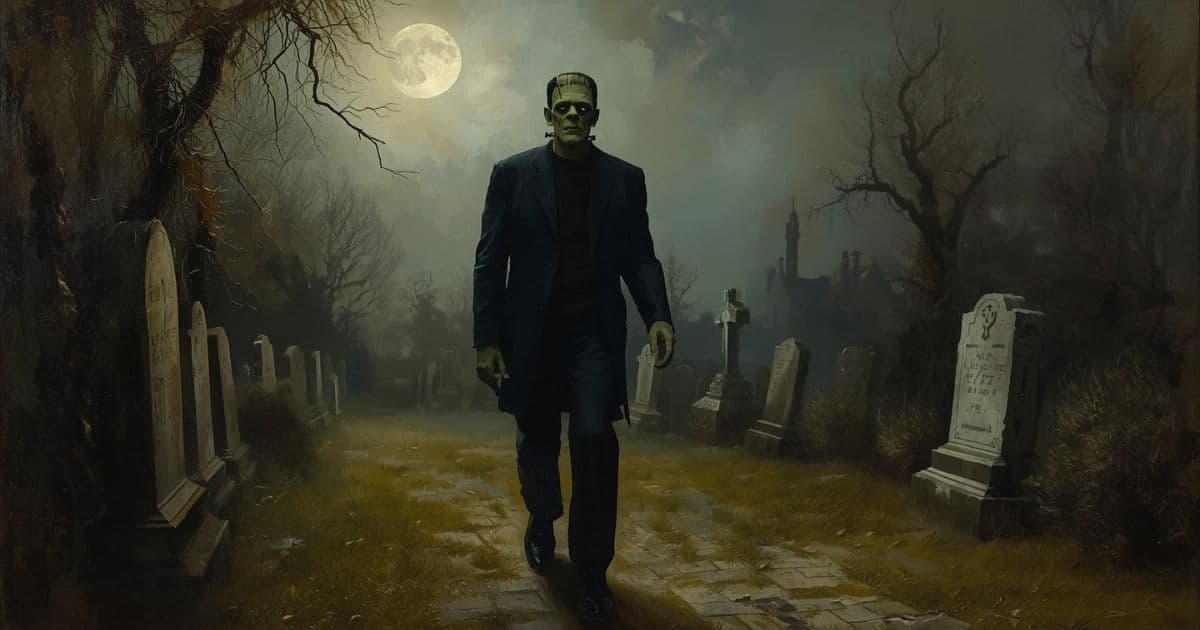
An excerpt from the original text.(complete · 6577 words)
R. SEWARD’S DIARY--continued.
The funeral was arranged for the next succeeding day, so that Lucy and
her mother might be buried together. I attended to all the ghastly
formalities, and the urbane undertaker proved that his staff were
afflicted--or blessed--with something of his own obsequious suavity.
Even the woman who performed the last offices for the dead remarked to
me, in a confidential, brother-professional way, when she had come out
from the death-chamber:--
“She makes a very beautiful corpse, sir. It’s quite a privilege to
attend on her. It’s not too much to say that she will do credit to our
establishment!”
I noticed that Van Helsing never kept far away. This was possible from
the disordered state of things in the household. There were no relatives
at hand; and as Arthur had to be back the next day to attend at his
father’s funeral, we were unable to notify any one who should have been
bidden. Under the circumstances, Van Helsing and I took it upon
ourselves to examine papers, etc. He insisted upon looking over Lucy’s
papers himself. I asked him why, for I feared that he, being a
foreigner, might not be quite aware of English legal requirements, and
so might in ignorance make some unnecessary trouble. He answered me:--
“I know; I know. You forget that I am a lawyer as well as a doctor. But
this is not altogether for the law. You knew that, when you avoided the
coroner. I have more than him to avoid. There may be papers more--such
as this.”
As he spoke he took from his pocket-book the memorandum which had been
in Lucy’s breast, and which she had torn in her sleep.
“When you find anything of the solicitor who is for the late Mrs.
Westenra, seal all her papers, and write him to-night. For me, I watch
here in the room and in Miss Lucy’s old room all night, and I myself
search for what may be. It is not well that her very thoughts go into
the hands of strangers.”
I went on with my part of the work, and in another half hour had found
the name and address of Mrs. Westenra’s solicitor and had written to
him. All the poor lady’s papers were in order; explicit directions
regarding the place of burial were given. I had hardly sealed the
letter, when, to my surprise, Van Helsing walked into the room,
saying:--
“Can I help you, friend John? I am free, and if I may, my service is to
you.”
“Have you got what you looked for?” I asked, to which he replied:--
“I did not look for any specific thing. I only hoped to find, and find I
have, all that there was--only some letters and a few memoranda, and a
diary new begun. But I have them here, and we shall for the present say
nothing of them. I shall see that poor lad to-morrow evening, and, with
his sanction, I shall use some.”
When we had finished the work in hand, he said to me:--
“And now, friend John, I think we may to bed. We want sleep, both you
and I, and rest to recuperate. To-morrow we shall have much to do, but
for the to-night there is no need of us. Alas!”
Before turning in we went to look at poor Lucy. The undertaker had
certainly done his work well, for the room was turned into a small
chapelle ardente. There was a wilderness of beautiful white flowers,
and death was made as little repulsive as might be. The end of the
winding-sheet was laid over the face; when the Professor bent over and
turned it gently back, we both started at the beauty before us, the tall
wax candles showing a sufficient light to note it well. All Lucy’s
loveliness had come back to her in death, and the hours that had passed,
instead of leaving traces of “decay’s effacing fingers,” had but
restored the beauty of life, till positively I could not believe my eyes
that I was looking at a corpse.
The Professor looked sternly grave. He had not loved her as I had, and
there was no need for tears in his eyes. He said to me: “Remain till I
return,” and left the room. He came back with a handful of wild garlic
from the box waiting in the hall, but which had not been opened, and
placed the flowers amongst the others on and around the bed. Then he
took from his neck, inside his collar, a little gold crucifix, and
placed it over the mouth. He restored the sheet to its place, and we
came away.
I was undressing in my own room, when, with a premonitory tap at the
door, he entered, and at once began to speak:--
“To-morrow I want you to bring me, before night, a set of post-mortem
knives.”
“Must we make an autopsy?” I asked.
“Yes and no. I want to operate, but not as you think. Let me tell you
now, but not a word to another. I want to cut off her head and take out
her heart. Ah! you a surgeon, and so shocked! You, whom I have seen with
no tremble of hand or heart, do operations of life and death that make
the rest shudder. Oh, but I must not forget, my dear friend John, that
you loved her; and I have not forgotten it, for it is I that shall
operate, and you must only help. I would like to do it to-night, but for
Arthur I must not; he will be free after his father’s funeral to-morrow,
and he will want to see her--to see it. Then, when she is coffined
ready for the next day, you and I shall come when all sleep. We shall
unscrew the coffin-lid, and shall do our operation: and then replace
all, so that none know, save we alone.”
“But why do it at all? The girl is dead. Why mutilate her poor body
without need? And if there is no necessity for a post-mortem and nothing
to gain by it--no good to her, to us, to science, to human
knowledge--why do it? Without such it is monstrous.”
For answer he put his hand on my shoulder, and said, with infinite
tenderness:--
“Friend John, I pity your poor bleeding heart; and I love you the more
because it does so bleed. If I could, I would take on myself the burden
that you do bear. But there are things that you know not, but that you
shall know, and bless me for knowing, though they are not pleasant
things. John, my child, you have been my friend now many years, and yet
did you ever know me to do any without good cause? I may err--I am but
man; but I believe in all I do. Was it not for these causes that you
send for me when the great trouble came? Yes! Were you not amazed, nay
horrified, when I would not let Arthur kiss his love--though she was
dying--and snatched him away by all my strength? Yes! And yet you saw
how she thanked me, with her so beautiful dying eyes, her voice, too, so
weak, and she kiss my rough old hand and bless me? Yes! And did you not
hear me swear promise to her, that so she closed her eyes grateful? Yes!
“Well, I have good reason now for all I want to do. You have for many
years trust me; you have believe me weeks past, when there be things so
strange that you might have well doubt. Believe me yet a little, friend
John. If you trust me not, then I must tell what I think; and that is
not perhaps well. And if I work--as work I shall, no matter trust or no
trust--without my friend trust in me, I work with heavy heart and feel,
oh! so lonely when I want all help and courage that may be!” He paused a
moment and went on solemnly: “Friend John, there are strange and
terrible days before us. Let us not be two, but one, that so we work to
a good end. Will you not have faith in me?”
I took his hand, and promised him. I held my door open as he went away,
and watched him go into his room and close the door. As I stood without
moving, I saw one of the maids pass silently along the passage--she had
her back towards me, so did not see me--and go into the room where Lucy
lay. The sight touched me. Devotion is so rare, and we are so grateful
to those who show it unasked to those we love. Here was a poor girl
putting aside the terrors which she naturally had of death to go watch
alone by the bier of the mistress whom she loved, so that the poor clay
might not be lonely till laid to eternal rest....
* * * * *
I must have slept long and soundly, for it was broad daylight when Van
Helsing waked me by coming into my room. He came over to my bedside and
said:--
“You need not trouble about the knives; we shall not do it.”
“Why not?” I asked. For his solemnity of the night before had greatly
impressed me.
“Because,” he said sternly, “it is too late--or too early. See!” Here he
held up the little golden crucifix. “This was stolen in the night.”
“How, stolen,” I asked in wonder, “since you have it now?”
“Because I get it back from the worthless wretch who stole it, from the
woman who robbed the dead and the living. Her punishment will surely
come, but not through me; she knew not altogether what she did and thus
unknowing, she only stole. Now we must wait.”
He went away on the word, leaving me with a new mystery to think of, a
new puzzle to grapple with.
The forenoon was a dreary time, but at noon the solicitor came: Mr.
Marquand, of Wholeman, Sons, Marquand & Lidderdale. He was very genial
and very appreciative of what we had done, and took off our hands all
cares as to details. During lunch he told us that Mrs. Westenra had for
some time expected sudden death from her heart, and had put her affairs
in absolute order; he informed us that, with the exception of a certain
entailed property of Lucy’s father’s which now, in default of direct
issue, went back to a distant branch of the family, the whole estate,
real and personal, was left absolutely to Arthur Holmwood. When he had
told us so much he went on:--
“Frankly we did our best to prevent such a testamentary disposition, and
pointed out certain contingencies that might leave her daughter either
penniless or not so free as she should be to act regarding a matrimonial
alliance. Indeed, we pressed the matter so far that we almost came into
collision, for she asked us if we were or were not prepared to carry out
her wishes. Of course, we had then no alternative but to accept. We were
right in principle, and ninety-nine times out of a hundred we should
have proved, by the logic of events, the accuracy of our judgment.
Frankly, however, I must admit that in this case any other form of
disposition would have rendered impossible the carrying out of her
wishes. For by her predeceasing her daughter the latter would have come
into possession of the property, and, even had she only survived her
mother by five minutes, her property would, in case there were no
will--and a will was a practical impossibility in such a case--have been
treated at her decease as under intestacy. In which case Lord Godalming,
though so dear a friend, would have had no claim in the world; and the
inheritors, being remote, would not be likely to abandon their just
rights, for sentimental reasons regarding an entire stranger. I assure
you, my dear sirs, I am rejoiced at the result, perfectly rejoiced.”
He was a good fellow, but his rejoicing at the one little part--in which
he was officially interested--of so great a tragedy, was an
object-lesson in the limitations of sympathetic understanding.
He did not remain long, but said he would look in later in the day and
see Lord Godalming. His coming, however, had been a certain comfort to
us, since it assured us that we should not have to dread hostile
criticism as to any of our acts. Arthur was expected at five o’clock, so
a little before that time we visited the death-chamber. It was so in
very truth, for now both mother and daughter lay in it. The undertaker,
true to his craft, had made the best display he could of his goods, and
there was a mortuary air about the place that lowered our spirits at
once. Van Helsing ordered the former arrangement to be adhered to,
explaining that, as Lord Godalming was coming very soon, it would be
less harrowing to his feelings to see all that was left of his fiancée
quite alone. The undertaker seemed shocked at his own stupidity and
exerted himself to restore things to the condition in which we left them
the night before, so that when Arthur came such shocks to his feelings
as we could avoid were saved.
Poor fellow! He looked desperately sad and broken; even his stalwart
manhood seemed to have shrunk somewhat under the strain of his
much-tried emotions. He had, I knew, been very genuinely and devotedly
attached to his father; and to lose him, and at such a time, was a
bitter blow to him. With me he was warm as ever, and to Van Helsing he
was sweetly courteous; but I could not help seeing that there was some
constraint with him. The Professor noticed it, too, and motioned me to
bring him upstairs. I did so, and left him at the door of the room, as I
felt he would like to be quite alone with her, but he took my arm and
led me in, saying huskily:--
“You loved her too, old fellow; she told me all about it, and there was
no friend had a closer place in her heart than you. I don’t know how to
thank you for all you have done for her. I can’t think yet....”
Here he suddenly broke down, and threw his arms round my shoulders and
laid his head on my breast, crying:--
“Oh, Jack! Jack! What shall I do! The whole of life seems gone from me
all at once, and there is nothing in the wide world for me to live for.”
I comforted him as well as I could. In such cases men do not need much
expression. A grip of the hand, the tightening of an arm over the
shoulder, a sob in unison, are expressions of sympathy dear to a man’s
heart. I stood still and silent till his sobs died away, and then I said
softly to him:--
“Come and look at her.”
Together we moved over to the bed, and I lifted the lawn from her face.
God! how beautiful she was. Every hour seemed to be enhancing her
loveliness. It frightened and amazed me somewhat; and as for Arthur, he
fell a-trembling, and finally was shaken with doubt as with an ague. At
last, after a long pause, he said to me in a faint whisper:--
“Jack, is she really dead?”
I assured him sadly that it was so, and went on to suggest--for I felt
that such a horrible doubt should not have life for a moment longer than
I could help--that it often happened that after death faces became
softened and even resolved into their youthful beauty; that this was
especially so when death had been preceded by any acute or prolonged
suffering. It seemed to quite do away with any doubt, and, after
kneeling beside the couch for a while and looking at her lovingly and
long, he turned aside. I told him that that must be good-bye, as the
coffin had to be prepared; so he went back and took her dead hand in his
and kissed it, and bent over and kissed her forehead. He came away,
fondly looking back over his shoulder at her as he came.
I left him in the drawing-room, and told Van Helsing that he had said
good-bye; so the latter went to the kitchen to tell the undertaker’s men
to proceed with the preparations and to screw up the coffin. When he
came out of the room again I told him of Arthur’s question, and he
replied:--
“I am not surprised. Just now I doubted for a moment myself!”
We all dined together, and I could see that poor Art was trying to make
the best of things. Van Helsing had been silent all dinner-time; but
when we had lit our cigars he said--
“Lord----”; but Arthur interrupted him:--
“No, no, not that, for God’s sake! not yet at any rate. Forgive me, sir:
I did not mean to speak offensively; it is only because my loss is so
recent.”
The Professor answered very sweetly:--
“I only used that name because I was in doubt. I must not call you
‘Mr.,’ and I have grown to love you--yes, my dear boy, to love you--as
Arthur.”
Arthur held out his hand, and took the old man’s warmly.
“Call me what you will,” he said. “I hope I may always have the title of
a friend. And let me say that I am at a loss for words to thank you for
your goodness to my poor dear.” He paused a moment, and went on: “I know
that she understood your goodness even better than I do; and if I was
rude or in any way wanting at that time you acted so--you remember”--the
Professor nodded--“you must forgive me.”
He answered with a grave kindness:--
“I know it was hard for you to quite trust me then, for to trust such
violence needs to understand; and I take it that you do not--that you
cannot--trust me now, for you do not yet understand. And there may be
more times when I shall want you to trust when you cannot--and may
not--and must not yet understand. But the time will come when your trust
shall be whole and complete in me, and when you shall understand as
though the sunlight himself shone through. Then you shall bless me from
first to last for your own sake, and for the sake of others and for her
dear sake to whom I swore to protect.”
“And, indeed, indeed, sir,” said Arthur warmly, “I shall in all ways
trust you. I know and believe you have a very noble heart, and you are
Jack’s friend, and you were hers. You shall do what you like.”
The Professor cleared his throat a couple of times, as though about to
speak, and finally said:--
“May I ask you something now?”
“Certainly.”
“You know that Mrs. Westenra left you all her property?”
“No, poor dear; I never thought of it.”
“And as it is all yours, you have a right to deal with it as you will. I
want you to give me permission to read all Miss Lucy’s papers and
letters. Believe me, it is no idle curiosity. I have a motive of which,
be sure, she would have approved. I have them all here. I took them
before we knew that all was yours, so that no strange hand might touch
them--no strange eye look through words into her soul. I shall keep
them, if I may; even you may not see them yet, but I shall keep them
safe. No word shall be lost; and in the good time I shall give them back
to you. It’s a hard thing I ask, but you will do it, will you not, for
Lucy’s sake?”
Arthur spoke out heartily, like his old self:--
“Dr. Van Helsing, you may do what you will. I feel that in saying this I
am doing what my dear one would have approved. I shall not trouble you
with questions till the time comes.”
The old Professor stood up as he said solemnly:--
“And you are right. There will be pain for us all; but it will not be
all pain, nor will this pain be the last. We and you too--you most of
all, my dear boy--will have to pass through the bitter water before we
reach the sweet. But we must be brave of heart and unselfish, and do our
duty, and all will be well!”
I slept on a sofa in Arthur’s room that night. Van Helsing did not go to
bed at all. He went to and fro, as if patrolling the house, and was
never out of sight of the room where Lucy lay in her coffin, strewn with
the wild garlic flowers, which sent, through the odour of lily and rose,
a heavy, overpowering smell into the night.
Mina Harker’s Journal.
22 September.--In the train to Exeter. Jonathan sleeping.
It seems only yesterday that the last entry was made, and yet how much
between then, in Whitby and all the world before me, Jonathan away and
no news of him; and now, married to Jonathan, Jonathan a solicitor, a
partner, rich, master of his business, Mr. Hawkins dead and buried, and
Jonathan with another attack that may harm him. Some day he may ask me
about it. Down it all goes. I am rusty in my shorthand--see what
unexpected prosperity does for us--so it may be as well to freshen it up
again with an exercise anyhow....
The service was very simple and very solemn. There were only ourselves
and the servants there, one or two old friends of his from Exeter, his
London agent, and a gentleman representing Sir John Paxton, the
President of the Incorporated Law Society. Jonathan and I stood hand in
hand, and we felt that our best and dearest friend was gone from us....
We came back to town quietly, taking a ’bus to Hyde Park Corner.
Jonathan thought it would interest me to go into the Row for a while, so
we sat down; but there were very few people there, and it was
sad-looking and desolate to see so many empty chairs. It made us think
of the empty chair at home; so we got up and walked down Piccadilly.
Jonathan was holding me by the arm, the way he used to in old days
before I went to school. I felt it very improper, for you can’t go on
for some years teaching etiquette and decorum to other girls without the
pedantry of it biting into yourself a bit; but it was Jonathan, and he
was my husband, and we didn’t know anybody who saw us--and we didn’t
care if they did--so on we walked. I was looking at a very beautiful
girl, in a big cart-wheel hat, sitting in a victoria outside Guiliano’s,
when I felt Jonathan clutch my arm so tight that he hurt me, and he said
under his breath: “My God!” I am always anxious about Jonathan, for I
fear that some nervous fit may upset him again; so I turned to him
quickly, and asked him what it was that disturbed him.
He was very pale, and his eyes seemed bulging out as, half in terror and
half in amazement, he gazed at a tall, thin man, with a beaky nose and
black moustache and pointed beard, who was also observing the pretty
girl. He was looking at her so hard that he did not see either of us,
and so I had a good view of him. His face was not a good face; it was
hard, and cruel, and sensual, and his big white teeth, that looked all
the whiter because his lips were so red, were pointed like an animal’s.
Jonathan kept staring at him, till I was afraid he would notice. I
feared he might take it ill, he looked so fierce and nasty. I asked
Jonathan why he was disturbed, and he answered, evidently thinking that
I knew as much about it as he did: “Do you see who it is?”
“No, dear,” I said; “I don’t know him; who is it?” His answer seemed to
shock and thrill me, for it was said as if he did not know that it was
to me, Mina, to whom he was speaking:--
“It is the man himself!”
The poor dear was evidently terrified at something--very greatly
terrified; I do believe that if he had not had me to lean on and to
support him he would have sunk down. He kept staring; a man came out of
the shop with a small parcel, and gave it to the lady, who then drove
off. The dark man kept his eyes fixed on her, and when the carriage
moved up Piccadilly he followed in the same direction, and hailed a
hansom. Jonathan kept looking after him, and said, as if to himself:--
“I believe it is the Count, but he has grown young. My God, if this be
so! Oh, my God! my God! If I only knew! if I only knew!” He was
distressing himself so much that I feared to keep his mind on the
subject by asking him any questions, so I remained silent. I drew him
away quietly, and he, holding my arm, came easily. We walked a little
further, and then went in and sat for a while in the Green Park. It was
a hot day for autumn, and there was a comfortable seat in a shady place.
After a few minutes’ staring at nothing, Jonathan’s eyes closed, and he
went quietly into a sleep, with his head on my shoulder. I thought it
was the best thing for him, so did not disturb him. In about twenty
minutes he woke up, and said to me quite cheerfully:--
“Why, Mina, have I been asleep! Oh, do forgive me for being so rude.
Come, and we’ll have a cup of tea somewhere.” He had evidently forgotten
all about the dark stranger, as in his illness he had forgotten all that
this episode had reminded him of. I don’t like this lapsing into
forgetfulness; it may make or continue some injury to the brain. I must
not ask him, for fear I shall do more harm than good; but I must somehow
learn the facts of his journey abroad. The time is come, I fear, when I
must open that parcel, and know what is written. Oh, Jonathan, you will,
I know, forgive me if I do wrong, but it is for your own dear sake.
* * * * *
Later.--A sad home-coming in every way--the house empty of the dear
soul who was so good to us; Jonathan still pale and dizzy under a slight
relapse of his malady; and now a telegram from Van Helsing, whoever he
may be:--
“You will be grieved to hear that Mrs. Westenra died five days ago, and
that Lucy died the day before yesterday. They were both buried to-day.”
Oh, what a wealth of sorrow in a few words! Poor Mrs. Westenra! poor
Lucy! Gone, gone, never to return to us! And poor, poor Arthur, to have
lost such sweetness out of his life! God help us all to bear our
troubles.
Dr. Seward’s Diary.
22 September.--It is all over. Arthur has gone back to Ring, and has
taken Quincey Morris with him. What a fine fellow is Quincey! I believe
in my heart of hearts that he suffered as much about Lucy’s death as any
of us; but he bore himself through it like a moral Viking. If America
can go on breeding men like that, she will be a power in the world
indeed. Van Helsing is lying down, having a rest preparatory to his
journey. He goes over to Amsterdam to-night, but says he returns
to-morrow night; that he only wants to make some arrangements which can
only be made personally. He is to stop with me then, if he can; he says
he has work to do in London which may take him some time. Poor old
fellow! I fear that the strain of the past week has broken down even his
iron strength. All the time of the burial he was, I could see, putting
some terrible restraint on himself. When it was all over, we were
standing beside Arthur, who, poor fellow, was speaking of his part in
the operation where his blood had been transfused to his Lucy’s veins; I
could see Van Helsing’s face grow white and purple by turns. Arthur was
saying that he felt since then as if they two had been really married
and that she was his wife in the sight of God. None of us said a word of
the other operations, and none of us ever shall. Arthur and Quincey went
away together to the station, and Van Helsing and I came on here. The
moment we were alone in the carriage he gave way to a regular fit of
hysterics. He has denied to me since that it was hysterics, and insisted
that it was only his sense of humour asserting itself under very
terrible conditions. He laughed till he cried, and I had to draw down
the blinds lest any one should see us and misjudge; and then he cried,
till he laughed again; and laughed and cried together, just as a woman
does. I tried to be stern with him, as one is to a woman under the
circumstances; but it had no effect. Men and women are so different in
manifestations of nervous strength or weakness! Then when his face grew
grave and stern again I asked him why his mirth, and why at such a time.
His reply was in a way characteristic of him, for it was logical and
forceful and mysterious. He said:--
“Ah, you don’t comprehend, friend John. Do not think that I am not sad,
though I laugh. See, I have cried even when the laugh did choke me. But
no more think that I am all sorry when I cry, for the laugh he come
just the same. Keep it always with you that laughter who knock at your
door and say, ‘May I come in?’ is not the true laughter. No! he is a
king, and he come when and how he like. He ask no person; he choose no
time of suitability. He say, ‘I am here.’ Behold, in example I grieve my
heart out for that so sweet young girl; I give my blood for her, though
I am old and worn; I give my time, my skill, my sleep; I let my other
sufferers want that so she may have all. And yet I can laugh at her very
grave--laugh when the clay from the spade of the sexton drop upon her
coffin and say ‘Thud! thud!’ to my heart, till it send back the blood
from my cheek. My heart bleed for that poor boy--that dear boy, so of
the age of mine own boy had I been so blessed that he live, and with his
hair and eyes the same. There, you know now why I love him so. And yet
when he say things that touch my husband-heart to the quick, and make my
father-heart yearn to him as to no other man--not even to you, friend
John, for we are more level in experiences than father and son--yet even
at such moment King Laugh he come to me and shout and bellow in my ear,
‘Here I am! here I am!’ till the blood come dance back and bring some of
the sunshine that he carry with him to my cheek. Oh, friend John, it is
a strange world, a sad world, a world full of miseries, and woes, and
troubles; and yet when King Laugh come he make them all dance to the
tune he play. Bleeding hearts, and dry bones of the churchyard, and
tears that burn as they fall--all dance together to the music that he
make with that smileless mouth of him. And believe me, friend John, that
he is good to come, and kind. Ah, we men and women are like ropes drawn
tight with strain that pull us different ways. Then tears come; and,
like the rain on the ropes, they brace us up, until perhaps the strain
become too great, and we break. But King Laugh he come like the
sunshine, and he ease off the strain again; and we bear to go on with
our labour, what it may be.”
I did not like to wound him by pretending not to see his idea; but, as I
did not yet understand the cause of his laughter, I asked him. As he
answered me his face grew stern, and he said in quite a different
tone:--
“Oh, it was the grim irony of it all--this so lovely lady garlanded with
flowers, that looked so fair as life, till one by one we wondered if she
were truly dead; she laid in that so fine marble house in that lonely
churchyard, where rest so many of her kin, laid there with the mother
who loved her, and whom she loved; and that sacred bell going ‘Toll!
toll! toll!’ so sad and slow; and those holy men, with the white
garments of the angel, pretending to read books, and yet all the time
their eyes never on the page; and all of us with the bowed head. And all
for what? She is dead; so! Is it not?”
“Well, for the life of me, Professor,” I said, “I can’t see anything to
laugh at in all that. Why, your explanation makes it a harder puzzle
than before. But even if the burial service was comic, what about poor
Art and his trouble? Why, his heart was simply breaking.”
“Just so. Said he not that the transfusion of his blood to her veins had
made her truly his bride?”
“Yes, and it was a sweet and comforting idea for him.”
“Quite so. But there was a difficulty, friend John. If so that, then
what about the others? Ho, ho! Then this so sweet maid is a polyandrist,
and me, with my poor wife dead to me, but alive by Church’s law, though
no wits, all gone--even I, who am faithful husband to this now-no-wife,
am bigamist.”
“I don’t see where the joke comes in there either!” I said; and I did
not feel particularly pleased with him for saying such things. He laid
his hand on my arm, and said:--
“Friend John, forgive me if I pain. I showed not my feeling to others
when it would wound, but only to you, my old friend, whom I can trust.
If you could have looked into my very heart then when I want to laugh;
if you could have done so when the laugh arrived; if you could do so
now, when King Laugh have pack up his crown, and all that is to him--for
he go far, far away from me, and for a long, long time--maybe you would
perhaps pity me the most of all.”
I was touched by the tenderness of his tone, and asked why.
“Because I know!”
And now we are all scattered; and for many a long day loneliness will
sit over our roofs with brooding wings. Lucy lies in the tomb of her
kin, a lordly death-house in a lonely churchyard, away from teeming
London; where the air is fresh, and the sun rises over Hampstead Hill,
and where wild flowers grow of their own accord.
So I can finish this diary; and God only knows if I shall ever begin
another. If I do, or if I even open this again, it will be to deal with
different people and different themes; for here at the end, where the
romance of my life is told, ere I go back to take up the thread of my
life-work, I say sadly and without hope,
“FINIS.”
“The Westminster Gazette,” 25 September.
A HAMPSTEAD MYSTERY.
The neighbourhood of Hampstead is just at present exercised with a
series of events which seem to run on lines parallel to those of what
was known to the writers of headlines as “The Kensington Horror,” or
“The Stabbing Woman,” or “The Woman in Black.” During the past two or
three days several cases have occurred of young children straying from
home or neglecting to return from their playing on the Heath. In all
these cases the children were too young to give any properly
intelligible account of themselves, but the consensus of their excuses
is that they had been with a “bloofer lady.” It has always been late in
the evening when they have been missed, and on two occasions the
children have not been found until early in the following morning. It is
generally supposed in the neighbourhood that, as the first child missed
gave as his reason for being away that a “bloofer lady” had asked him to
come for a walk, the others had picked up the phrase and used it as
occasion served. This is the more natural as the favourite game of the
little ones at present is luring each other away by wiles. A
correspondent writes us that to see some of the tiny tots pretending to
be the “bloofer lady” is supremely funny. Some of our caricaturists
might, he says, take a lesson in the irony of grotesque by comparing the
reality and the picture. It is only in accordance with general
principles of human nature that the “bloofer lady” should be the popular
rôle at these al fresco performances. Our correspondent naïvely says
that even Ellen Terry could not be so winningly attractive as some of
these grubby-faced little children pretend--and even imagine
themselves--to be.
There is, however, possibly a serious side to the question, for some of
the children, indeed all who have been missed at night, have been
slightly torn or wounded in the throat. The wounds seem such as might be
made by a rat or a small dog, and although of not much importance
individually, would tend to show that whatever animal inflicts them has
a system or method of its own. The police of the division have been
instructed to keep a sharp look-out for straying children, especially
when very young, in and around Hampstead Heath, and for any stray dog
which may be about.
“The Westminster Gazette,” 25 September.
Extra Special.
THE HAMPSTEAD HORROR.
ANOTHER CHILD INJURED.
The “Bloofer Lady.”
We have just received intelligence that another child, missed last
night, was only discovered late in the morning under a furze bush at the
Shooter’s Hill side of Hampstead Heath, which is, perhaps, less
frequented than the other parts. It has the same tiny wound in the
throat as has been noticed in other cases. It was terribly weak, and
looked quite emaciated. It too, when partially restored, had the common
story to tell of being lured away by the “bloofer lady.”
Master this chapter. Complete your experience
Purchase the complete book to access all chapters and support classic literature
As an Amazon Associate, we earn a small commission from qualifying purchases at no additional cost to you.
Available in paperback, hardcover, and e-book formats
Let's Analyse the Pattern
The mind's tendency to forget or deny threatening realities in order to maintain psychological stability, often leaving the person more vulnerable to the original threat.
Why This Matters
Connect literature to life
This chapter teaches how to identify when your mind is selectively forgetting threatening information to preserve your sanity.
Practice This Today
This week, notice when you 'forget' uncomfortable conversations or find yourself unable to remember disturbing incidents clearly—that's your mind protecting you, but also potentially leaving you vulnerable.
Now let's explore the literary elements.
Key Quotes & Analysis
"She makes a very beautiful corpse, sir. It's quite a privilege to attend on her."
Context: Said while preparing Lucy's body for burial
This unnatural beauty in death signals that Lucy is transforming into something inhuman. The casual, professional tone makes it more disturbing - treating supernatural horror as routine business.
In Today's Words:
She looks amazing for a dead person - we're lucky to work on someone this pretty.
"I know; I know. You forget that I am a lawyer as well as a doctor."
Context: When Seward questions his right to examine Lucy's papers
Van Helsing is establishing his authority while hiding his real motives. He needs those papers not for legal reasons but to understand how Dracula targeted Lucy.
In Today's Words:
Trust me, I know what I'm doing - I have the credentials to handle this.
"The children all said they had been with a 'bloofer lady.'"
Context: Describing missing children found with throat wounds on Hampstead Heath
This seemingly innocent news story reveals that Lucy is now preying on children. The childish mispronunciation makes it more chilling - innocence corrupted by evil.
In Today's Words:
All the kids said they were with a 'beautiful lady' before they went missing.
Thematic Threads
Memory
In This Chapter
Jonathan completely forgets seeing Dracula, his mind editing out traumatic recognition to preserve sanity
Development
Evolved from Jonathan's earlier journal gaps—now showing active memory suppression as survival mechanism
In Your Life:
You might find yourself 'forgetting' conversations or events that challenged your sense of safety or identity
Authority
In This Chapter
Van Helsing claims authority over Lucy's body and papers, making decisions others cannot understand or challenge
Development
Expanded from his medical authority—now wielding knowledge-based power that isolates him from others
In Your Life:
You might struggle with experts who make decisions affecting you but refuse to explain their reasoning
Class
In This Chapter
Arthur's grief is treated as more legitimate and protected, while Van Helsing's working-class directness is seen as crude
Development
Continued from earlier class tensions—showing how grief itself is stratified by social position
In Your Life:
You might notice how your emotional responses are judged differently based on your social status or profession
Vulnerability
In This Chapter
Children on Hampstead Heath become victims because adults dismiss their stories as fantasy
Development
New manifestation—showing how society's rational blindness creates victims among the most powerless
In Your Life:
You might see how being dismissed as 'irrational' leaves you or others exposed to real dangers
Truth
In This Chapter
Multiple characters possess pieces of dangerous truth but cannot share it—Van Helsing's knowledge, Jonathan's memories, children's experiences
Development
Intensified from earlier chapters—truth has become actively dangerous to possess or speak
In Your Life:
You might find yourself holding knowledge that others aren't ready to hear, creating isolation and burden
You now have the context. Time to form your own thoughts.
Discussion Questions
- 1
Why does Jonathan's mind completely erase his memory of seeing Dracula on Piccadilly, and what does this reveal about how our minds protect us from overwhelming truths?
analysis • surface - 2
What pattern do you see in how Van Helsing handles dangerous knowledge versus how Jonathan handles it, and why might each approach be both protective and problematic?
analysis • medium - 3
Where have you seen this same pattern of 'protective forgetting' in real life—people convincing themselves they didn't see red flags, warning signs, or dangerous behavior?
application • medium - 4
If you witnessed something that contradicted your fundamental beliefs about safety or reality, how would you handle that information without either breaking down or becoming dangerously blind to it?
application • deep - 5
What does this chapter suggest about the relationship between individual psychological survival and collective vulnerability to threats?
reflection • deep
Critical Thinking Exercise
Map Your Blind Spots
Think of a situation in your life where you might be using 'protective forgetting'—ignoring warning signs, minimizing problems, or convincing yourself you didn't see what you saw. Write down what you're avoiding acknowledging and why your mind might be protecting you from this truth. Then identify one small, manageable step you could take to address this reality without overwhelming yourself.
Consider:
- •Consider whether this forgetting is temporarily protective while you build strength, or if it's leaving you more vulnerable
- •Think about what support systems you'd need to face this truth safely
- •Remember that acknowledging difficult realities doesn't mean you have to solve everything at once
Journaling Prompt
Write about a time when you ignored your instincts about a person or situation. What were you protecting yourself from seeing, and what was the cost of that protective blindness? How might you handle similar situations differently now?
Coming Up Next...
Chapter 14: The Truth Comes to Light
Mina begins to piece together the truth about Jonathan's mysterious journey by reading his hidden diary, while the 'bloofer lady' continues to prey on Hampstead's children. Van Helsing prepares to reveal shocking truths that will challenge everything the characters believe about life and death.