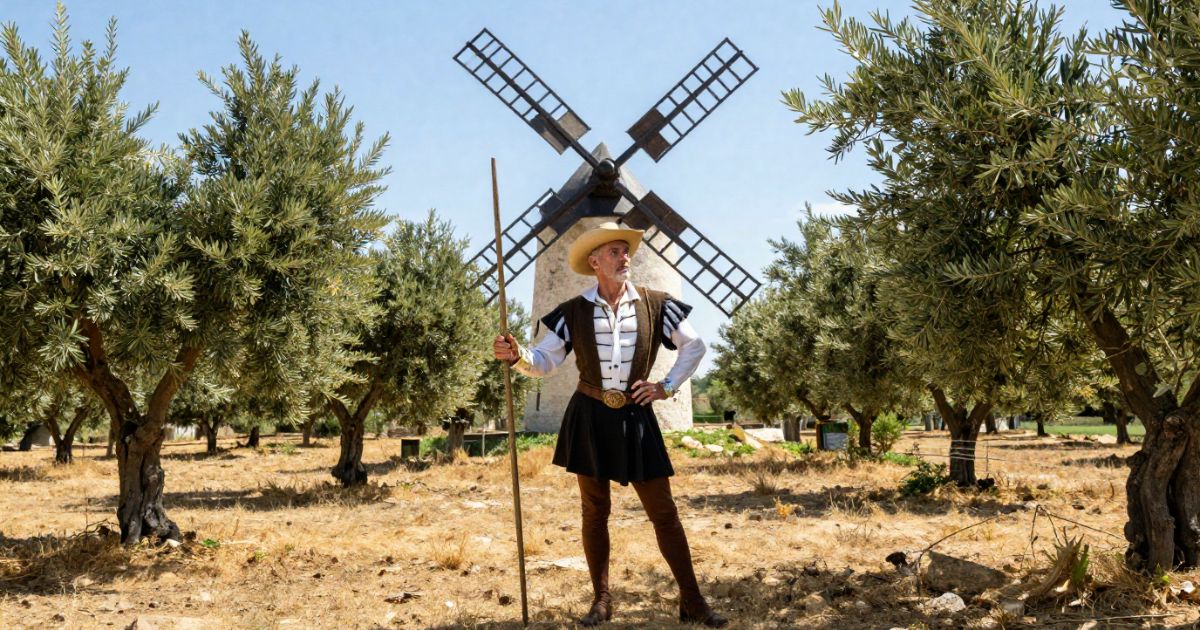
An excerpt from the original text.(complete · 2612 words)
OF THE SHREWD AND DROLL CONVERSATION THAT PASSED BETWEEN SANCHO PANZA
AND HIS WIFE TERESA PANZA, AND OTHER MATTERS WORTHY OF BEING DULY
RECORDED
The translator of this history, when he comes to write this fifth
chapter, says that he considers it apocryphal, because in it Sancho
Panza speaks in a style unlike that which might have been expected from
his limited intelligence, and says things so subtle that he does not
think it possible he could have conceived them; however, desirous of
doing what his task imposed upon him, he was unwilling to leave it
untranslated, and therefore he went on to say:
Sancho came home in such glee and spirits that his wife noticed his
happiness a bowshot off, so much so that it made her ask him, “What
have you got, Sancho friend, that you are so glad?”
To which he replied, “Wife, if it were God’s will, I should be very
glad not to be so well pleased as I show myself.”
“I don’t understand you, husband,” said she, “and I don’t know what you
mean by saying you would be glad, if it were God’s will, not to be well
pleased; for, fool as I am, I don’t know how one can find pleasure in
not having it.”
“Hark ye, Teresa,” replied Sancho, “I am glad because I have made up my
mind to go back to the service of my master Don Quixote, who means to
go out a third time to seek for adventures; and I am going with him
again, for my necessities will have it so, and also the hope that
cheers me with the thought that I may find another hundred crowns like
those we have spent; though it makes me sad to have to leave thee and
the children; and if God would be pleased to let me have my daily
bread, dry-shod and at home, without taking me out into the byways and
cross-roads—and he could do it at small cost by merely willing it—it is
clear my happiness would be more solid and lasting, for the happiness I
have is mingled with sorrow at leaving thee; so that I was right in
saying I would be glad, if it were God’s will, not to be well pleased.”
“Look here, Sancho,” said Teresa; “ever since you joined on to a
knight-errant you talk in such a roundabout way that there is no
understanding you.”
“It is enough that God understands me, wife,” replied Sancho; “for he
is the understander of all things; that will do; but mind, sister, you
must look to Dapple carefully for the next three days, so that he may
be fit to take arms; double his feed, and see to the pack-saddle and
other harness, for it is not to a wedding we are bound, but to go round
the world, and play at give and take with giants and dragons and
monsters, and hear hissings and roarings and bellowings and howlings;
and even all this would be lavender, if we had not to reckon with
Yanguesans and enchanted Moors.”
“I know well enough, husband,” said Teresa, “that squires-errant don’t
eat their bread for nothing, and so I will be always praying to our
Lord to deliver you speedily from all that hard fortune.”
“I can tell you, wife,” said Sancho, “if I did not expect to see myself
governor of an island before long, I would drop down dead on the spot.”
“Nay, then, husband,” said Teresa; “let the hen live, though it be with
her pip, live, and let the devil take all the governments in the world;
you came out of your mother’s womb without a government, you have lived
until now without a government, and when it is God’s will you will go,
or be carried, to your grave without a government. How many there are
in the world who live without a government, and continue to live all
the same, and are reckoned in the number of the people. The best sauce
in the world is hunger, and as the poor are never without that, they
always eat with a relish. But mind, Sancho, if by good luck you should
find yourself with some government, don’t forget me and your children.
Remember that Sanchico is now full fifteen, and it is right he should
go to school, if his uncle the abbot has a mind to have him trained for
the Church. Consider, too, that your daughter Mari-Sancha will not die
of grief if we marry her; for I have my suspicions that she is as eager
to get a husband as you to get a government; and, after all, a daughter
looks better ill married than well whored.”
“By my faith,” replied Sancho, “if God brings me to get any sort of a
government, I intend, wife, to make such a high match for Mari-Sancha
that there will be no approaching her without calling her ‘my lady.”
“Nay, Sancho,” returned Teresa; “marry her to her equal, that is the
safest plan; for if you put her out of wooden clogs into high-heeled
shoes, out of her grey flannel petticoat into hoops and silk gowns, out
of the plain ‘Marica’ and ‘thou,’ into ‘Doña So-and-so’ and ‘my lady,’
the girl won’t know where she is, and at every turn she will fall into
a thousand blunders that will show the thread of her coarse homespun
stuff.”
“Tut, you fool,” said Sancho; “it will be only to practise it for two
or three years; and then dignity and decorum will fit her as easily as
a glove; and if not, what matter? Let her be ‘my lady,’ and never mind
what happens.”
“Keep to your own station, Sancho,” replied Teresa; “don’t try to raise
yourself higher, and bear in mind the proverb that says, ‘wipe the nose
of your neigbbour’s son, and take him into your house.’ A fine thing it
would be, indeed, to marry our Maria to some great count or grand
gentleman, who, when the humour took him, would abuse her and call her
clown-bred and clodhopper’s daughter and spinning wench. I have not
been bringing up my daughter for that all this time, I can tell you,
husband. Do you bring home money, Sancho, and leave marrying her to my
care; there is Lope Tocho, Juan Tocho’s son, a stout, sturdy young
fellow that we know, and I can see he does not look sour at the girl;
and with him, one of our own sort, she will be well married, and we
shall have her always under our eyes, and be all one family, parents
and children, grandchildren and sons-in-law, and the peace and blessing
of God will dwell among us; so don’t you go marrying her in those
courts and grand palaces where they won’t know what to make of her, or
she what to make of herself.”
“Why, you idiot and wife for Barabbas,” said Sancho, “what do you mean
by trying, without why or wherefore, to keep me from marrying my
daughter to one who will give me grandchildren that will be called
‘your lordship’? Look ye, Teresa, I have always heard my elders say
that he who does not know how to take advantage of luck when it comes
to him, has no right to complain if it gives him the go-by; and now
that it is knocking at our door, it will not do to shut it out; let us
go with the favouring breeze that blows upon us.”
It is this sort of talk, and what Sancho says lower down, that made the
translator of the history say he considered this chapter apocryphal.
“Don’t you see, you animal,” continued Sancho, “that it will be well
for me to drop into some profitable government that will lift us out of
the mire, and marry Mari-Sancha to whom I like; and you yourself will
find yourself called ‘Doña Teresa Panza,’ and sitting in church on a
fine carpet and cushions and draperies, in spite and in defiance of all
the born ladies of the town? No, stay as you are, growing neither
greater nor less, like a tapestry figure—Let us say no more about it,
for Sanchica shall be a countess, say what you will.”
“Are you sure of all you say, husband?” replied Teresa. “Well, for all
that, I am afraid this rank of countess for my daughter will be her
ruin. You do as you like, make a duchess or a princess of her, but I
can tell you it will not be with my will and consent. I was always a
lover of equality, brother, and I can’t bear to see people give
themselves airs without any right. They called me Teresa at my baptism,
a plain, simple name, without any additions or tags or fringes of Dons
or Doñas; Cascajo was my father’s name, and as I am your wife, I am
called Teresa Panza, though by right I ought to be called Teresa
Cascajo; but ‘kings go where laws like,’ and I am content with this
name without having the ‘Don’ put on top of it to make it so heavy that
I cannot carry it; and I don’t want to make people talk about me when
they see me go dressed like a countess or governor’s wife; for they
will say at once, ‘See what airs the slut gives herself! Only yesterday
she was always spinning flax, and used to go to mass with the tail of
her petticoat over her head instead of a mantle, and there she goes
to-day in a hooped gown with her broaches and airs, as if we didn’t
know her!’ If God keeps me in my seven senses, or five, or whatever
number I have, I am not going to bring myself to such a pass; go you,
brother, and be a government or an island man, and swagger as much as
you like; for by the soul of my mother, neither my daughter nor I are
going to stir a step from our village; a respectable woman should have
a broken leg and keep at home; and to be busy at something is a
virtuous damsel’s holiday; be off to your adventures along with your
Don Quixote, and leave us to our misadventures, for God will mend them
for us according as we deserve it. I don’t know, I’m sure, who fixed
the ‘Don’ to him, what neither his father nor grandfather ever had.”
“I declare thou hast a devil of some sort in thy body!” said Sancho.
“God help thee, what a lot of things thou hast strung together, one
after the other, without head or tail! What have Cascajo, and the
broaches and the proverbs and the airs, to do with what I say? Look
here, fool and dolt (for so I may call you, when you don’t understand
my words, and run away from good fortune), if I had said that my
daughter was to throw herself down from a tower, or go roaming the
world, as the Infanta Doña Urraca wanted to do, you would be right in
not giving way to my will; but if in an instant, in less than the
twinkling of an eye, I put the ‘Don’ and ‘my lady’ on her back, and
take her out of the stubble, and place her under a canopy, on a dais,
and on a couch, with more velvet cushions than all the Almohades of
Morocco ever had in their family, why won’t you consent and fall in
with my wishes?”
“Do you know why, husband?” replied Teresa; “because of the proverb
that says ‘who covers thee, discovers thee.’ At the poor man people
only throw a hasty glance; on the rich man they fix their eyes; and if
the said rich man was once on a time poor, it is then there is the
sneering and the tattle and spite of backbiters; and in the streets
here they swarm as thick as bees.”
“Look here, Teresa,” said Sancho, “and listen to what I am now going to
say to you; maybe you never heard it in all your life; and I do not
give my own notions, for what I am about to say are the opinions of his
reverence the preacher, who preached in this town last Lent, and who
said, if I remember rightly, that all things present that our eyes
behold, bring themselves before us, and remain and fix themselves on
our memory much better and more forcibly than things past.”
These observations which Sancho makes here are the other ones on
account of which the translator says he regards this chapter as
apocryphal, inasmuch as they are beyond Sancho’s capacity.
“Whence it arises,” he continued, “that when we see any person well
dressed and making a figure with rich garments and retinue of servants,
it seems to lead and impel us perforce to respect him, though memory
may at the same moment recall to us some lowly condition in which we
have seen him, but which, whether it may have been poverty or low
birth, being now a thing of the past, has no existence; while the only
thing that has any existence is what we see before us; and if this
person whom fortune has raised from his original lowly state (these
were the very words the padre used) to his present height of
prosperity, be well bred, generous, courteous to all, without seeking
to vie with those whose nobility is of ancient date, depend upon it,
Teresa, no one will remember what he was, and everyone will respect
what he is, except indeed the envious, from whom no fair fortune is
safe.”
“I do not understand you, husband,” replied Teresa; “do as you like,
and don’t break my head with any more speechifying and rethoric; and if
you have revolved to do what you say—”
“Resolved, you should say, woman,” said Sancho, “not revolved.”
“Don’t set yourself to wrangle with me, husband,” said Teresa; “I speak
as God pleases, and don’t deal in out-of-the-way phrases; and I say if
you are bent upon having a government, take your son Sancho with you,
and teach him from this time on how to hold a government; for sons
ought to inherit and learn the trades of their fathers.”
“As soon as I have the government,” said Sancho, “I will send for him
by post, and I will send thee money, of which I shall have no lack, for
there is never any want of people to lend it to governors when they
have not got it; and do thou dress him so as to hide what he is and
make him look what he is to be.”
“You send the money,” said Teresa, “and I’ll dress him up for you as
fine as you please.”
“Then we are agreed that our daughter is to be a countess,” said
Sancho.
“The day that I see her a countess,” replied Teresa, “it will be the
same to me as if I was burying her; but once more I say do as you
please, for we women are born to this burden of being obedient to our
husbands, though they be dogs;” and with this she began to weep in
earnest, as if she already saw Sanchica dead and buried.
Sancho consoled her by saying that though he must make her a countess,
he would put it off as long as possible. Here their conversation came
to an end, and Sancho went back to see Don Quixote, and make
arrangements for their departure.
Master this chapter. Complete your experience
Purchase the complete book to access all chapters and support classic literature
As an Amazon Associate, we earn a small commission from qualifying purchases at no additional cost to you.
Available in paperback, hardcover, and e-book formats
Let's Analyse the Pattern
When partners have different visions of success, their relationship becomes a battlefield of competing values rather than a collaboration toward shared goals.
Why This Matters
Connect literature to life
This chapter teaches how to identify when partners are protecting different values rather than simply disagreeing about surface issues.
Practice This Today
This week, notice when arguments with loved ones are really about competing definitions of success or safety—then name what each person is actually trying to protect.
Now let's explore the literary elements.
Key Quotes & Analysis
"Wife, if it were God's will, I should be very glad not to be so well pleased as I show myself."
Context: Teresa asks why he seems so happy when he first comes home
This confusing statement reveals Sancho's internal conflict - he's excited about the adventure but knows it will worry his wife. He's trying to hide his enthusiasm while also expressing it, showing the complexity of his emotions.
In Today's Words:
Honey, I wish I wasn't as excited as I obviously am right now.
"I don't know how one can find pleasure in not having it."
Context: Responding to Sancho's confusing statement about being glad not to be pleased
Teresa's straightforward logic cuts through Sancho's verbal gymnastics. Her simple, direct response shows she won't be fooled by his attempt to downplay his excitement about leaving again.
In Today's Words:
That makes absolutely no sense whatsoever.
"Who covers thee, discovers thee."
Context: Warning against putting on airs above their social station
This proverb means fancy clothes can't hide your true origins - people will see through pretense. Teresa uses folk wisdom to argue that social climbing will only expose them to ridicule and failure.
In Today's Words:
You can't fake where you came from - people will see right through you.
Thematic Threads
Class
In This Chapter
Sancho wants to elevate their social status while Teresa fears the consequences of pretending to be something they're not
Development
Evolved from Sancho's governorship experience—he now sees class mobility as possible rather than fantasy
In Your Life:
You might feel this tension when considering moves that would change your social circle or lifestyle expectations.
Identity
In This Chapter
Teresa warns that fancy clothes can't hide true origins—'who covers thee, discovers thee'
Development
Deepened from earlier themes about authentic self versus performed self
In Your Life:
You face this when deciding whether to adapt your personality for different social or professional contexts.
Ambition
In This Chapter
Sancho believes in seizing opportunity when it knocks, regardless of social barriers
Development
Transformed from simple loyalty to Don Quixote into personal vision of advancement
In Your Life:
You experience this when weighing safe choices against opportunities that could change your life trajectory.
Marriage
In This Chapter
The couple reaches grudging compromise despite fundamental disagreement about their future
Development
Shows mature relationship dynamics compared to earlier simple obedience patterns
In Your Life:
You see this when you and your partner have different risk tolerances or life goals.
Wisdom
In This Chapter
Teresa's practical folk wisdom clashes with Sancho's newfound sophistication and big dreams
Development
Continues the book's exploration of different types of intelligence and knowledge
In Your Life:
You encounter this when your lived experience conflicts with new ideas or opportunities you're considering.
You now have the context. Time to form your own thoughts.
Discussion Questions
- 1
What specific dreams does Sancho have for his family, and how does Teresa react to them?
analysis • surface - 2
Why does Teresa believe that social climbing will hurt their family rather than help them?
analysis • medium - 3
Where have you seen this same conflict play out in modern families - one person wanting to 'move up' while another wants to stay grounded?
application • medium - 4
When partners have completely different definitions of success, what practical steps can help them navigate the conflict without destroying their relationship?
application • deep - 5
What does this chapter reveal about the hidden costs of ambition on the people who love us most?
reflection • deep
Critical Thinking Exercise
Map Your Values Collision
Think of a time when you and someone close to you had completely different ideas about what would make life better. Write down what each of you was really trying to protect (not just what you wanted, but what you feared losing). Then identify one specific compromise that could honor both concerns.
Consider:
- •Focus on underlying fears, not surface arguments
- •Consider what each person's background taught them about risk and safety
- •Look for solutions that don't require anyone to completely abandon their values
Journaling Prompt
Write about a dream you've had to give up or modify because someone you love couldn't support it. What did you learn about the relationship between individual ambition and family loyalty?
Coming Up Next...
Chapter 78: The Family Intervention
While Sancho negotiates with his wife, Don Quixote faces his own domestic crisis. His niece and housekeeper have discovered his plans for a third adventure and are plotting to stop him by any means necessary.