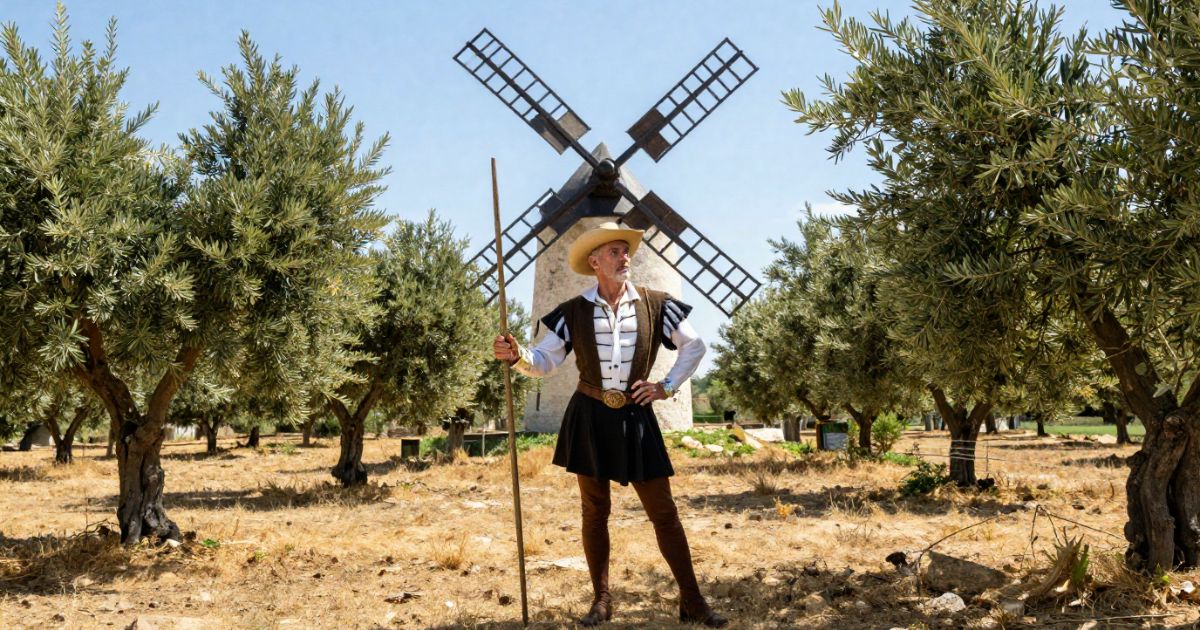
An excerpt from the original text.(complete · 3032 words)
F THE LAUGHABLE CONVERSATION THAT PASSED BETWEEN DON QUIXOTE, SANCHO
PANZA, AND THE BACHELOR SAMSON CARRASCO
Don Quixote remained very deep in thought, waiting for the bachelor
Carrasco, from whom he was to hear how he himself had been put into a
book as Sancho said; and he could not persuade himself that any such
history could be in existence, for the blood of the enemies he had
slain was not yet dry on the blade of his sword, and now they wanted to
make out that his mighty achievements were going about in print. For
all that, he fancied some sage, either a friend or an enemy, might, by
the aid of magic, have given them to the press; if a friend, in order
to magnify and exalt them above the most famous ever achieved by any
knight-errant; if an enemy, to bring them to naught and degrade them
below the meanest ever recorded of any low squire, though as he said to
himself, the achievements of squires never were recorded. If, however,
it were the fact that such a history were in existence, it must
necessarily, being the story of a knight-errant, be grandiloquent,
lofty, imposing, grand and true. With this he comforted himself
somewhat, though it made him uncomfortable to think that the author was
a Moor, judging by the title of “Cide;” and that no truth was to be
looked for from Moors, as they are all impostors, cheats, and schemers.
He was afraid he might have dealt with his love affairs in some
indecorous fashion, that might tend to the discredit and prejudice of
the purity of his lady Dulcinea del Toboso; he would have had him set
forth the fidelity and respect he had always observed towards her,
spurning queens, empresses, and damsels of all sorts, and keeping in
check the impetuosity of his natural impulses. Absorbed and wrapped up
in these and divers other cogitations, he was found by Sancho and
Carrasco, whom Don Quixote received with great courtesy.
The bachelor, though he was called Samson, was of no great bodily size,
but he was a very great wag; he was of a sallow complexion, but very
sharp-witted, somewhere about four-and-twenty years of age, with a
round face, a flat nose, and a large mouth, all indications of a
mischievous disposition and a love of fun and jokes; and of this he
gave a sample as soon as he saw Don Quixote, by falling on his knees
before him and saying, “Let me kiss your mightiness’s hand, Señor Don
Quixote of La Mancha, for, by the habit of St. Peter that I wear,
though I have no more than the first four orders, your worship is one
of the most famous knights-errant that have ever been, or will be, all
the world over. A blessing on Cide Hamete Benengeli, who has written
the history of your great deeds, and a double blessing on that
connoisseur who took the trouble of having it translated out of the
Arabic into our Castilian vulgar tongue for the universal entertainment
of the people!”
Don Quixote made him rise, and said, “So, then, it is true that there
is a history of me, and that it was a Moor and a sage who wrote it?”
“So true is it, señor,” said Samson, “that my belief is there are more
than twelve thousand volumes of the said history in print this very
day. Only ask Portugal, Barcelona, and Valencia, where they have been
printed, and moreover there is a report that it is being printed at
Antwerp, and I am persuaded there will not be a country or language in
which there will not be a translation of it.”
“One of the things,” here observed Don Quixote, “that ought to give
most pleasure to a virtuous and eminent man is to find himself in his
lifetime in print and in type, familiar in people’s mouths with a good
name; I say with a good name, for if it be the opposite, then there is
no death to be compared to it.”
“If it goes by good name and fame,” said the bachelor, “your worship
alone bears away the palm from all the knights-errant; for the Moor in
his own language, and the Christian in his, have taken care to set
before us your gallantry, your high courage in encountering dangers,
your fortitude in adversity, your patience under misfortunes as well as
wounds, the purity and continence of the platonic loves of your worship
and my lady Doña Dulcinea del Toboso—”
“I never heard my lady Dulcinea called Doña,” observed Sancho here;
“nothing more than the lady Dulcinea del Toboso; so here already the
history is wrong.”
“That is not an objection of any importance,” replied Carrasco.
“Certainly not,” said Don Quixote; “but tell me, señor bachelor, what
deeds of mine are they that are made most of in this history?”
“On that point,” replied the bachelor, “opinions differ, as tastes do;
some swear by the adventure of the windmills that your worship took to
be Briareuses and giants; others by that of the fulling mills; one
cries up the description of the two armies that afterwards took the
appearance of two droves of sheep; another that of the dead body on its
way to be buried at Segovia; a third says the liberation of the galley
slaves is the best of all, and a fourth that nothing comes up to the
affair with the Benedictine giants, and the battle with the valiant
Biscayan.”
“Tell me, señor bachelor,” said Sancho at this point, “does the
adventure with the Yanguesans come in, when our good Rocinante went
hankering after dainties?”
“The sage has left nothing in the ink-bottle,” replied Samson; “he
tells all and sets down everything, even to the capers that worthy
Sancho cut in the blanket.”
“I cut no capers in the blanket,” returned Sancho; “in the air I did,
and more of them than I liked.”
“There is no human history in the world, I suppose,” said Don Quixote,
“that has not its ups and downs, but more than others such as deal with
chivalry, for they can never be entirely made up of prosperous
adventures.”
“For all that,” replied the bachelor, “there are those who have read
the history who say they would have been glad if the author had left
out some of the countless cudgellings that were inflicted on Señor Don
Quixote in various encounters.”
“That’s where the truth of the history comes in,” said Sancho.
“At the same time they might fairly have passed them over in silence,”
observed Don Quixote; “for there is no need of recording events which
do not change or affect the truth of a history, if they tend to bring
the hero of it into contempt. Æneas was not in truth and earnest so
pious as Virgil represents him, nor Ulysses so wise as Homer describes
him.”
“That is true,” said Samson; “but it is one thing to write as a poet,
another to write as a historian; the poet may describe or sing things,
not as they were, but as they ought to have been; but the historian has
to write them down, not as they ought to have been, but as they were,
without adding anything to the truth or taking anything from it.”
“Well then,” said Sancho, “if this señor Moor goes in for telling the
truth, no doubt among my master’s drubbings mine are to be found; for
they never took the measure of his worship’s shoulders without doing
the same for my whole body; but I have no right to wonder at that, for,
as my master himself says, the members must share the pain of the
head.”
“You are a sly dog, Sancho,” said Don Quixote; “i’ faith, you have no
want of memory when you choose to remember.”
“If I were to try to forget the thwacks they gave me,” said Sancho, “my
weals would not let me, for they are still fresh on my ribs.”
“Hush, Sancho,” said Don Quixote, “and don’t interrupt the bachelor,
whom I entreat to go on and tell all that is said about me in this
history.”
“And about me,” said Sancho, “for they say, too, that I am one of the
principal presonages in it.”
“Personages, not presonages, friend Sancho,” said Samson.
“What! Another word-catcher!” said Sancho; “if that’s to be the way we
shall not make an end in a lifetime.”
“May God shorten mine, Sancho,” returned the bachelor, “if you are not
the second person in the history, and there are even some who would
rather hear you talk than the cleverest in the whole book; though there
are some, too, who say you showed yourself over-credulous in believing
there was any possibility in the government of that island offered you
by Señor Don Quixote.”
“There is still sunshine on the wall,” said Don Quixote; “and when
Sancho is somewhat more advanced in life, with the experience that
years bring, he will be fitter and better qualified for being a
governor than he is at present.”
“By God, master,” said Sancho, “the island that I cannot govern with
the years I have, I’ll not be able to govern with the years of
Methuselah; the difficulty is that the said island keeps its distance
somewhere, I know not where; and not that there is any want of head in
me to govern it.”
“Leave it to God, Sancho,” said Don Quixote, “for all will be and
perhaps better than you think; no leaf on the tree stirs but by God’s
will.”
“That is true,” said Samson; “and if it be God’s will, there will not
be any want of a thousand islands, much less one, for Sancho to
govern.”
“I have seen governors in these parts,” said Sancho, “that are not to
be compared to my shoe-sole; and for all that they are called ‘your
lordship’ and served on silver.”
“Those are not governors of islands,” observed Samson, “but of other
governments of an easier kind: those that govern islands must at least
know grammar.”
“I could manage the gram well enough,” said Sancho; “but for the mar I
have neither leaning nor liking, for I don’t know what it is; but
leaving this matter of the government in God’s hands, to send me
wherever it may be most to his service, I may tell you, señor bachelor
Samson Carrasco, it has pleased me beyond measure that the author of
this history should have spoken of me in such a way that what is said
of me gives no offence; for, on the faith of a true squire, if he had
said anything about me that was at all unbecoming an old Christian,
such as I am, the deaf would have heard of it.”
“That would be working miracles,” said Samson.
“Miracles or no miracles,” said Sancho, “let everyone mind how he
speaks or writes about people, and not set down at random the first
thing that comes into his head.”
“One of the faults they find with this history,” said the bachelor, “is
that its author inserted in it a novel called ‘The Ill-advised
Curiosity;’ not that it is bad or ill-told, but that it is out of place
and has nothing to do with the history of his worship Señor Don
Quixote.”
“I will bet the son of a dog has mixed the cabbages and the baskets,”
said Sancho.
“Then, I say,” said Don Quixote, “the author of my history was no sage,
but some ignorant chatterer, who, in a haphazard and heedless way, set
about writing it, let it turn out as it might, just as Orbaneja, the
painter of Úbeda, used to do, who, when they asked him what he was
painting, answered, ‘What it may turn out.’ Sometimes he would paint a
cock in such a fashion, and so unlike, that he had to write alongside
of it in Gothic letters, ‘This is a cock;’ and so it will be with my
history, which will require a commentary to make it intelligible.”
“No fear of that,” returned Samson, “for it is so plain that there is
nothing in it to puzzle over; the children turn its leaves, the young
people read it, the grown men understand it, the old folk praise it; in
a word, it is so thumbed, and read, and got by heart by people of all
sorts, that the instant they see any lean hack, they say, ‘There goes
Rocinante.’ And those that are most given to reading it are the pages,
for there is not a lord’s ante-chamber where there is not a ‘Don
Quixote’ to be found; one takes it up if another lays it down; this one
pounces upon it, and that begs for it. In short, the said history is
the most delightful and least injurious entertainment that has been
hitherto seen, for there is not to be found in the whole of it even the
semblance of an immodest word, or a thought that is other than
Catholic.”
“To write in any other way,” said Don Quixote, “would not be to write
truth, but falsehood, and historians who have recourse to falsehood
ought to be burned, like those who coin false money; and I know not
what could have led the author to have recourse to novels and
irrelevant stories, when he had so much to write about in mine; no
doubt he must have gone by the proverb ‘with straw or with hay, &c.,’
for by merely setting forth my thoughts, my sighs, my tears, my lofty
purposes, my enterprises, he might have made a volume as large, or
larger than all the works of El Tostado would make up. In fact, the
conclusion I arrive at, señor bachelor, is, that to write histories, or
books of any kind, there is need of great judgment and a ripe
understanding. To give expression to humour, and write in a strain of
graceful pleasantry, is the gift of great geniuses. The cleverest
character in comedy is the clown, for he who would make people take him
for a fool, must not be one. History is in a measure a sacred thing,
for it should be true, and where the truth is, there God is; but
notwithstanding this, there are some who write and fling books
broadcast on the world as if they were fritters.”
“There is no book so bad but it has something good in it,” said the
bachelor.
“No doubt of that,” replied Don Quixote; “but it often happens that
those who have acquired and attained a well-deserved reputation by
their writings, lose it entirely, or damage it in some degree, when
they give them to the press.”
“The reason of that,” said Samson, “is, that as printed works are
examined leisurely, their faults are easily seen; and the greater the
fame of the writer, the more closely are they scrutinised. Men famous
for their genius, great poets, illustrious historians, are always, or
most commonly, envied by those who take a particular delight and
pleasure in criticising the writings of others, without having produced
any of their own.”
“That is no wonder,” said Don Quixote; “for there are many divines who
are no good for the pulpit, but excellent in detecting the defects or
excesses of those who preach.”
“All that is true, Señor Don Quixote,” said Carrasco; “but I wish such
fault-finders were more lenient and less exacting, and did not pay so
much attention to the spots on the bright sun of the work they grumble
at; for if aliquando bonus dormitat Homerus, they should remember how
long he remained awake to shed the light of his work with as little
shade as possible; and perhaps it may be that what they find fault with
may be moles, that sometimes heighten the beauty of the face that bears
them; and so I say very great is the risk to which he who prints a book
exposes himself, for of all impossibilities the greatest is to write
one that will satisfy and please all readers.”
“That which treats of me must have pleased few,” said Don Quixote.
“Quite the contrary,” said the bachelor; “for, as stultorum infinitum
est numerus, innumerable are those who have relished the said history;
but some have brought a charge against the author’s memory, inasmuch as
he forgot to say who the thief was who stole Sancho’s Dapple; for it is
not stated there, but only to be inferred from what is set down, that
he was stolen, and a little farther on we see Sancho mounted on the
same ass, without any reappearance of it. They say, too, that he forgot
to state what Sancho did with those hundred crowns that he found in the
valise in the Sierra Morena, as he never alludes to them again, and
there are many who would be glad to know what he did with them, or what
he spent them on, for it is one of the serious omissions of the work.”
“Señor Samson, I am not in a humour now for going into accounts or
explanations,” said Sancho; “for there’s a sinking of the stomach come
over me, and unless I doctor it with a couple of sups of the old stuff
it will put me on the thorn of Santa Lucia. I have it at home, and my
old woman is waiting for me; after dinner I’ll come back, and will
answer you and all the world every question you may choose to ask, as
well about the loss of the ass as about the spending of the hundred
crowns;” and without another word or waiting for a reply he made off
home.
Don Quixote begged and entreated the bachelor to stay and do penance
with him. The bachelor accepted the invitation and remained, a couple
of young pigeons were added to the ordinary fare, at dinner they talked
chivalry, Carrasco fell in with his host’s humour, the banquet came to
an end, they took their afternoon sleep, Sancho returned, and their
conversation was resumed.
p03e.jpg (49K)
Master this chapter. Complete your experience
Purchase the complete book to access all chapters and support classic literature
As an Amazon Associate, we earn a small commission from qualifying purchases at no additional cost to you.
Available in paperback, hardcover, and e-book formats
Let's Analyse the Pattern
The Recognition Trap - When Your Story Becomes Everyone Else's
When we achieve visibility or recognition, we lose control over how our story is told and interpreted by others.
Why This Matters
Connect literature to life
This chapter teaches how to maintain personal integrity when others control your narrative and how to distinguish between meaningful feedback and mere entertainment consumption.
Practice This Today
This week, notice when you modify your behavior because you're worried about what others might say, then ask yourself whose opinions actually matter to your goals.
Now let's explore the literary elements.
Key Quotes & Analysis
"The blood of the enemies he had slain was not yet dry on the blade of his sword, and now they wanted to make out that his mighty achievements were going about in print."
Context: Don Quixote can't believe his recent adventures are already published
Shows how Don Quixote sees himself as a real hero whose deeds deserve immediate recognition. He can't grasp that others might view his 'battles' differently.
In Today's Words:
I just did something amazing and people are already talking about it online.
"No truth was to be looked for from Moors, as they are all impostors, cheats, and schemers."
Context: Worrying that the author might be Muslim based on the name 'Cide'
Reveals the prejudices of the time while showing how Don Quixote uses bias to dismiss criticism. He'd rather blame the messenger than question his own actions.
In Today's Words:
I can't trust anything from those people - they're all liars anyway.
"Some are fonder of the adventure of the windmills, others of that of the fulling mills."
Context: Explaining how different readers prefer different episodes from the book
Shows how audiences pick and choose what entertains them, often missing the deeper meaning. People enjoy Don Quixote's failures as comedy.
In Today's Words:
Everyone has their favorite episode - some like when you messed up this way, others when you messed up that way.
Thematic Threads
Identity
In This Chapter
Don Quixote struggles between his self-perception as a noble knight and how others see him as entertainment
Development
Deepened from earlier chapters where identity was about personal delusion versus reality
In Your Life:
You might feel this when coworkers know you as 'the reliable one' but you want recognition for your clinical skills
Class
In This Chapter
The bachelor represents educated society analyzing and categorizing Don Quixote's working-class adventures
Development
Evolved from physical class barriers to intellectual and cultural judgment
In Your Life:
You see this when people with degrees assume they understand your job better than you do
Social Expectations
In This Chapter
Don Quixote must now live up to his literary reputation while readers have specific expectations about his behavior
Development
Shifted from defying expectations to being trapped by new ones created by fame
In Your Life:
This happens when family expects you to always be the problem-solver because you handled one crisis well
Human Relationships
In This Chapter
The relationship between Don Quixote and Sancho is now public property, subject to reader criticism and interpretation
Development
Expanded from private partnership to public scrutiny of their dynamic
In Your Life:
You experience this when friends comment on your relationship choices based on limited information
Personal Growth
In This Chapter
Don Quixote must confront how others perceive his journey and decide whether external validation matters
Development
Introduced here as a new dimension of self-awareness through others' eyes
In Your Life:
This emerges when you realize your personal growth journey looks different from the outside than it feels from within
You now have the context. Time to form your own thoughts.
Discussion Questions
- 1
How does Don Quixote react when he discovers there's a book about his adventures, and what does this reveal about his character?
analysis • surface - 2
Why does Don Quixote feel both proud and worried about being famous, and what does this suggest about the nature of public recognition?
analysis • medium - 3
Where do you see this same pattern today - people becoming famous but losing control of how they're portrayed?
application • medium - 4
If you suddenly became well-known at work or in your community, how would you handle the gap between how you see yourself and how others might perceive you?
application • deep - 5
What does this chapter teach us about the relationship between seeking recognition and maintaining our sense of self?
reflection • deep
Critical Thinking Exercise
Map Your Recognition Zones
Think about different areas where you might seek or receive recognition - at work, in your family, in your community, or online. For each area, identify what kind of recognition you want versus what kind you actually get. Then consider: which opinions actually matter to your goals, and which are just noise?
Consider:
- •Recognition often comes with interpretation - others will create their version of your story
- •The gap between how you see yourself and how others see you is normal and manageable
- •You can choose which feedback to take seriously based on the source and your goals
Journaling Prompt
Write about a time when you received recognition (positive or negative) that didn't match how you saw the situation. How did you handle the disconnect, and what would you do differently now?
Coming Up Next...
Chapter 76: Sancho's Defense and New Adventures Ahead
Sancho returns with his own perspective on fame and storytelling, ready to defend his actions and explain those mysterious plot holes that have readers scratching their heads. His down-to-earth wisdom about being written into history promises to add another layer to this exploration of truth, reputation, and the stories we tell about ourselves.