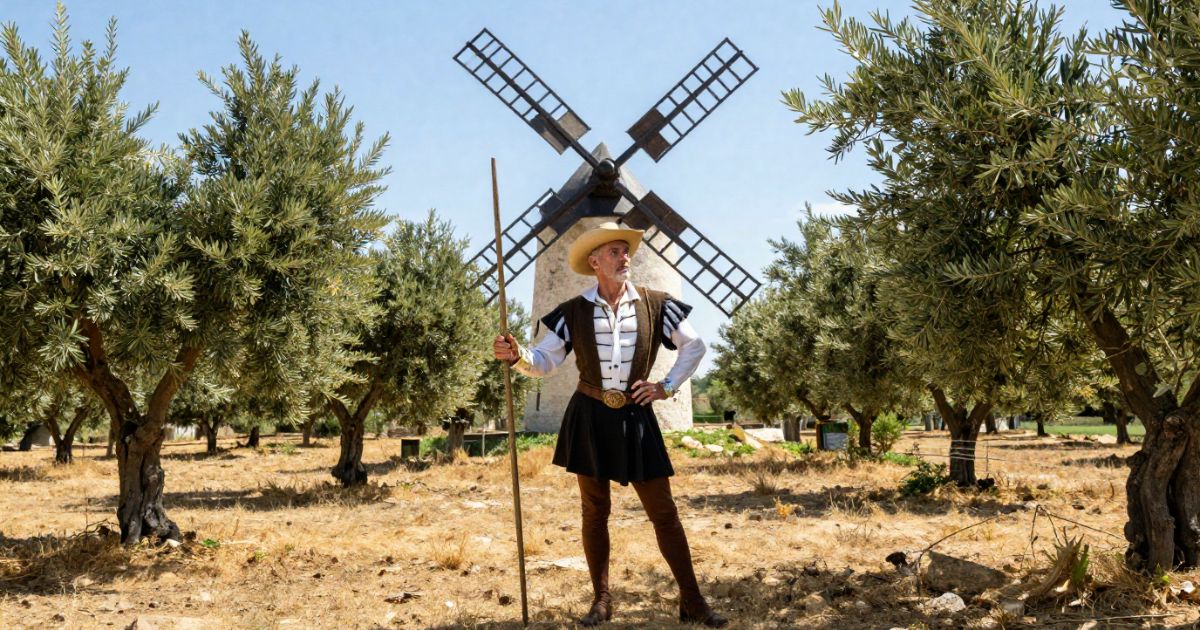
An excerpt from the original text.(complete · 4355 words)
OF THE INTERVIEW THE CURATE AND THE BARBER HAD WITH DON QUIXOTE ABOUT
HIS MALADY
Cide Hamete Benengeli, in the Second Part of this history, and third
sally of Don Quixote, says that the curate and the barber remained
nearly a month without seeing him, lest they should recall or bring
back to his recollection what had taken place. They did not, however,
omit to visit his niece and housekeeper, and charge them to be careful
to treat him with attention, and give him comforting things to eat, and
such as were good for the heart and the brain, whence, it was plain to
see, all his misfortune proceeded. The niece and housekeeper replied
that they did so, and meant to do so with all possible care and
assiduity, for they could perceive that their master was now and then
beginning to show signs of being in his right mind. This gave great
satisfaction to the curate and the barber, for they concluded they had
taken the right course in carrying him off enchanted on the ox-cart, as
has been described in the First Part of this great as well as accurate
history, in the last chapter thereof. So they resolved to pay him a
visit and test the improvement in his condition, although they thought
it almost impossible that there could be any; and they agreed not to
touch upon any point connected with knight-errantry so as not to run
the risk of reopening wounds which were still so tender.
They came to see him consequently, and found him sitting up in bed in a
green baize waistcoat and a red Toledo cap, and so withered and dried
up that he looked as if he had been turned into a mummy. They were very
cordially received by him; they asked him after his health, and he
talked to them about himself very naturally and in very well-chosen
language. In the course of their conversation they fell to discussing
what they call State-craft and systems of government, correcting this
abuse and condemning that, reforming one practice and abolishing
another, each of the three setting up for a new legislator, a modern
Lycurgus, or a brand-new Solon; and so completely did they remodel the
State, that they seemed to have thrust it into a furnace and taken out
something quite different from what they had put in; and on all the
subjects they dealt with, Don Quixote spoke with such good sense that
the pair of examiners were fully convinced that he was quite recovered
and in his full senses.
The niece and housekeeper were present at the conversation and could
not find words enough to express their thanks to God at seeing their
master so clear in his mind; the curate, however, changing his original
plan, which was to avoid touching upon matters of chivalry, resolved to
test Don Quixote’s recovery thoroughly, and see whether it were genuine
or not; and so, from one subject to another, he came at last to talk of
the news that had come from the capital, and, among other things, he
said it was considered certain that the Turk was coming down with a
powerful fleet, and that no one knew what his purpose was, or when the
great storm would burst; and that all Christendom was in apprehension
of this, which almost every year calls us to arms, and that his Majesty
had made provision for the security of the coasts of Naples and Sicily
and the island of Malta.
To this Don Quixote replied, “His Majesty has acted like a prudent
warrior in providing for the safety of his realms in time, so that the
enemy may not find him unprepared; but if my advice were taken I would
recommend him to adopt a measure which at present, no doubt, his
Majesty is very far from thinking of.”
The moment the curate heard this he said to himself, “God keep thee in
his hand, poor Don Quixote, for it seems to me thou art precipitating
thyself from the height of thy madness into the profound abyss of thy
simplicity.”
But the barber, who had the same suspicion as the curate, asked Don
Quixote what would be his advice as to the measures that he said ought
to be adopted; for perhaps it might prove to be one that would have to
be added to the list of the many impertinent suggestions that people
were in the habit of offering to princes.
“Mine, master shaver,” said Don Quixote, “will not be impertinent, but,
on the contrary, pertinent.”
“I don’t mean that,” said the barber, “but that experience has shown
that all or most of the expedients which are proposed to his Majesty
are either impossible, or absurd, or injurious to the King and to the
kingdom.”
“Mine, however,” replied Don Quixote, “is neither impossible nor
absurd, but the easiest, the most reasonable, the readiest and most
expeditious that could suggest itself to any projector’s mind.”
“You take a long time to tell it, Señor Don Quixote,” said the curate.
“I don’t choose to tell it here, now,” said Don Quixote, “and have it
reach the ears of the lords of the council to-morrow morning, and some
other carry off the thanks and rewards of my trouble.”
“For my part,” said the barber, “I give my word here and before God
that I will not repeat what your worship says, to King, Rook or earthly
man—an oath I learned from the ballad of the curate, who, in the
prelude, told the king of the thief who had robbed him of the hundred
gold crowns and his pacing mule.”
“I am not versed in stories,” said Don Quixote; “but I know the oath is
a good one, because I know the barber to be an honest fellow.”
“Even if he were not,” said the curate, “I will go bail and answer for
him that in this matter he will be as silent as a dummy, under pain of
paying any penalty that may be pronounced.”
“And who will be security for you, señor curate?” said Don Quixote.
“My profession,” replied the curate, “which is to keep secrets.”
“Ods body!” said Don Quixote at this, “what more has his Majesty to do
but to command, by public proclamation, all the knights-errant that are
scattered over Spain to assemble on a fixed day in the capital, for
even if no more than half a dozen come, there may be one among them who
alone will suffice to destroy the entire might of the Turk. Give me
your attention and follow me. Is it, pray, any new thing for a single
knight-errant to demolish an army of two hundred thousand men, as if
they all had but one throat or were made of sugar paste? Nay, tell me,
how many histories are there filled with these marvels? If only (in an
evil hour for me: I don’t speak for anyone else) the famous Don
Belianis were alive now, or anyone of the innumerable progeny of Amadis
of Gaul! If any these were alive to-day, and were to come face to face
with the Turk, by my faith, I would not give much for the Turk’s
chance. But God will have regard for his people, and will provide
someone, who, if not so valiant as the knights-errant of yore, at least
will not be inferior to them in spirit; but God knows what I mean, and
I say no more.”
“Alas!” exclaimed the niece at this, “may I die if my master does not
want to turn knight-errant again;” to which Don Quixote replied, “A
knight-errant I shall die, and let the Turk come down or go up when he
likes, and in as strong force as he can, once more I say, God knows
what I mean.” But here the barber said, “I ask your worships to give me
leave to tell a short story of something that happened in Seville,
which comes so pat to the purpose just now that I should like greatly
to tell it.” Don Quixote gave him leave, and the rest prepared to
listen, and he began thus:
“In the madhouse at Seville there was a man whom his relations had
placed there as being out of his mind. He was a graduate of Osuna in
canon law; but even if he had been of Salamanca, it was the opinion of
most people that he would have been mad all the same. This graduate,
after some years of confinement, took it into his head that he was sane
and in his full senses, and under this impression wrote to the
Archbishop, entreating him earnestly, and in very correct language, to
have him released from the misery in which he was living; for by God’s
mercy he had now recovered his lost reason, though his relations, in
order to enjoy his property, kept him there, and, in spite of the
truth, would make him out to be mad until his dying day. The
Archbishop, moved by repeated sensible, well-written letters, directed
one of his chaplains to make inquiry of the madhouse as to the truth of
the licentiate’s statements, and to have an interview with the madman
himself, and, if it should appear that he was in his senses, to take
him out and restore him to liberty. The chaplain did so, and the
governor assured him that the man was still mad, and that though he
often spoke like a highly intelligent person, he would in the end break
out into nonsense that in quantity and quality counterbalanced all the
sensible things he had said before, as might be easily tested by
talking to him. The chaplain resolved to try the experiment, and
obtaining access to the madman conversed with him for an hour or more,
during the whole of which time he never uttered a word that was
incoherent or absurd, but, on the contrary, spoke so rationally that
the chaplain was compelled to believe him to be sane. Among other
things, he said the governor was against him, not to lose the presents
his relations made him for reporting him still mad but with lucid
intervals; and that the worst foe he had in his misfortune was his
large property; for in order to enjoy it his enemies disparaged and
threw doubts upon the mercy our Lord had shown him in turning him from
a brute beast into a man. In short, he spoke in such a way that he cast
suspicion on the governor, and made his relations appear covetous and
heartless, and himself so rational that the chaplain determined to take
him away with him that the Archbishop might see him, and ascertain for
himself the truth of the matter. Yielding to this conviction, the
worthy chaplain begged the governor to have the clothes in which the
licentiate had entered the house given to him. The governor again bade
him beware of what he was doing, as the licentiate was beyond a doubt
still mad; but all his cautions and warnings were unavailing to
dissuade the chaplain from taking him away. The governor, seeing that
it was the order of the Archbishop, obeyed, and they dressed the
licentiate in his own clothes, which were new and decent. He, as soon
as he saw himself clothed like one in his senses, and divested of the
appearance of a madman, entreated the chaplain to permit him in charity
to go and take leave of his comrades the madmen. The chaplain said he
would go with him to see what madmen there were in the house; so they
went upstairs, and with them some of those who were present.
Approaching a cage in which there was a furious madman, though just at
that moment calm and quiet, the licentiate said to him, ‘Brother, think
if you have any commands for me, for I am going home, as God has been
pleased, in his infinite goodness and mercy, without any merit of mine,
to restore me my reason. I am now cured and in my senses, for with
God’s power nothing is impossible. Have strong hope and trust in him,
for as he has restored me to my original condition, so likewise he will
restore you if you trust in him. I will take care to send you some good
things to eat; and be sure you eat them; for I would have you know I am
convinced, as one who has gone through it, that all this madness of
ours comes of having the stomach empty and the brains full of wind.
Take courage! take courage! for despondency in misfortune breaks down
health and brings on death.’
“To all these words of the licentiate another madman in a cage opposite
that of the furious one was listening; and raising himself up from an
old mat on which he lay stark naked, he asked in a loud voice who it
was that was going away cured and in his senses. The licentiate
answered, ‘It is I, brother, who am going; I have now no need to remain
here any longer, for which I return infinite thanks to Heaven that has
had so great mercy upon me.’
“‘Mind what you are saying, licentiate; don’t let the devil deceive
you,’ replied the madman. ‘Keep quiet, stay where you are, and you will
save yourself the trouble of coming back.’
“‘I know I am cured,’ returned the licentiate, ‘and that I shall not
have to go stations again.’
“‘You cured!’ said the madman; ‘well, we shall see; God be with you;
but I swear to you by Jupiter, whose majesty I represent on earth, that
for this crime alone, which Seville is committing to-day in releasing
you from this house, and treating you as if you were in your senses, I
shall have to inflict such a punishment on it as will be remembered for
ages and ages, amen. Dost thou not know, thou miserable little
licentiate, that I can do it, being, as I say, Jupiter the Thunderer,
who hold in my hands the fiery bolts with which I am able and am wont
to threaten and lay waste the world? But in one way only will I punish
this ignorant town, and that is by not raining upon it, nor on any part
of its district or territory, for three whole years, to be reckoned
from the day and moment when this threat is pronounced. Thou free, thou
cured, thou in thy senses! and I mad, I disordered, I bound! I will as
soon think of sending rain as of hanging myself.
“Those present stood listening to the words and exclamations of the
madman; but our licentiate, turning to the chaplain and seizing him by
the hands, said to him, ‘Be not uneasy, señor; attach no importance to
what this madman has said; for if he is Jupiter and will not send rain,
I, who am Neptune, the father and god of the waters, will rain as often
as it pleases me and may be needful.’
“The governor and the bystanders laughed, and at their laughter the
chaplain was half ashamed, and he replied, ‘For all that, Señor
Neptune, it will not do to vex Señor Jupiter; remain where you are, and
some other day, when there is a better opportunity and more time, we
will come back for you.’ So they stripped the licentiate, and he was
left where he was; and that’s the end of the story.”
“So that’s the story, master barber,” said Don Quixote, “which came in
so pat to the purpose that you could not help telling it? Master
shaver, master shaver! how blind is he who cannot see through a sieve.
Is it possible that you do not know that comparisons of wit with wit,
valour with valour, beauty with beauty, birth with birth, are always
odious and unwelcome? I, master barber, am not Neptune, the god of the
waters, nor do I try to make anyone take me for an astute man, for I am
not one. My only endeavour is to convince the world of the mistake it
makes in not reviving in itself the happy time when the order of
knight-errantry was in the field. But our depraved age does not deserve
to enjoy such a blessing as those ages enjoyed when knights-errant took
upon their shoulders the defence of kingdoms, the protection of
damsels, the succour of orphans and minors, the chastisement of the
proud, and the recompense of the humble. With the knights of these
days, for the most part, it is the damask, brocade, and rich stuffs
they wear, that rustle as they go, not the chain mail of their armour;
no knight now-a-days sleeps in the open field exposed to the inclemency
of heaven, and in full panoply from head to foot; no one now takes a
nap, as they call it, without drawing his feet out of the stirrups, and
leaning upon his lance, as the knights-errant used to do; no one now,
issuing from the wood, penetrates yonder mountains, and then treads the
barren, lonely shore of the sea—mostly a tempestuous and stormy one—and
finding on the beach a little bark without oars, sail, mast, or
tackling of any kind, in the intrepidity of his heart flings himself
into it and commits himself to the wrathful billows of the deep sea,
that one moment lift him up to heaven and the next plunge him into the
depths; and opposing his breast to the irresistible gale, finds
himself, when he least expects it, three thousand leagues and more away
from the place where he embarked; and leaping ashore in a remote and
unknown land has adventures that deserve to be written, not on
parchment, but on brass. But now sloth triumphs over energy, indolence
over exertion, vice over virtue, arrogance over courage, and theory
over practice in arms, which flourished and shone only in the golden
ages and in knights-errant. For tell me, who was more virtuous and more
valiant than the famous Amadis of Gaul? Who more discreet than Palmerin
of England? Who more gracious and easy than Tirante el Blanco? Who more
courtly than Lisuarte of Greece? Who more slashed or slashing than Don
Belianis? Who more intrepid than Perion of Gaul? Who more ready to face
danger than Felixmarte of Hircania? Who more sincere than Esplandian?
Who more impetuous than Don Cirongilio of Thrace? Who more bold than
Rodamonte? Who more prudent than King Sobrino? Who more daring than
Reinaldos? Who more invincible than Roland? and who more gallant and
courteous than Ruggiero, from whom the dukes of Ferrara of the present
day are descended, according to Turpin in his ‘Cosmography.’ All these
knights, and many more that I could name, señor curate, were
knights-errant, the light and glory of chivalry. These, or such as
these, I would have to carry out my plan, and in that case his Majesty
would find himself well served and would save great expense, and the
Turk would be left tearing his beard. And so I will stay where I am, as
the chaplain does not take me away; and if Jupiter, as the barber has
told us, will not send rain, here am I, and I will rain when I please.
I say this that Master Basin may know that I understand him.”
“Indeed, Señor Don Quixote,” said the barber, “I did not mean it in
that way, and, so help me God, my intention was good, and your worship
ought not to be vexed.”
“As to whether I ought to be vexed or not,” returned Don Quixote, “I
myself am the best judge.”
Hereupon the curate observed, “I have hardly said a word as yet; and I
would gladly be relieved of a doubt, arising from what Don Quixote has
said, that worries and works my conscience.”
“The señor curate has leave for more than that,” returned Don Quixote,
“so he may declare his doubt, for it is not pleasant to have a doubt on
one’s conscience.”
“Well then, with that permission,” said the curate, “I say my doubt is
that, all I can do, I cannot persuade myself that the whole pack of
knights-errant you, Señor Don Quixote, have mentioned, were really and
truly persons of flesh and blood, that ever lived in the world; on the
contrary, I suspect it to be all fiction, fable, and falsehood, and
dreams told by men awakened from sleep, or rather still half asleep.”
“That is another mistake,” replied Don Quixote, “into which many have
fallen who do not believe that there ever were such knights in the
world, and I have often, with divers people and on divers occasions,
tried to expose this almost universal error to the light of truth.
Sometimes I have not been successful in my purpose, sometimes I have,
supporting it upon the shoulders of the truth; which truth is so clear
that I can almost say I have with my own eyes seen Amadis of Gaul, who
was a man of lofty stature, fair complexion, with a handsome though
black beard, of a countenance between gentle and stern in expression,
sparing of words, slow to anger, and quick to put it away from him; and
as I have depicted Amadis, so I could, I think, portray and describe
all the knights-errant that are in all the histories in the world; for
by the perception I have that they were what their histories describe,
and by the deeds they did and the dispositions they displayed, it is
possible, with the aid of sound philosophy, to deduce their features,
complexion, and stature.”
“How big, in your worship’s opinion, may the giant Morgante have been,
Señor Don Quixote?” asked the barber.
“With regard to giants,” replied Don Quixote, “opinions differ as to
whether there ever were any or not in the world; but the Holy
Scripture, which cannot err by a jot from the truth, shows us that
there were, when it gives us the history of that big Philistine,
Goliath, who was seven cubits and a half in height, which is a huge
size. Likewise, in the island of Sicily, there have been found
leg-bones and arm-bones so large that their size makes it plain that
their owners were giants, and as tall as great towers; geometry puts
this fact beyond a doubt. But, for all that, I cannot speak with
certainty as to the size of Morgante, though I suspect he cannot have
been very tall; and I am inclined to be of this opinion because I find
in the history in which his deeds are particularly mentioned, that he
frequently slept under a roof and as he found houses to contain him, it
is clear that his bulk could not have been anything excessive.”
“That is true,” said the curate, and yielding to the enjoyment of
hearing such nonsense, he asked him what was his notion of the features
of Reinaldos of Montalban, and Don Roland and the rest of the Twelve
Peers of France, for they were all knights-errant.
“As for Reinaldos,” replied Don Quixote, “I venture to say that he was
broad-faced, of ruddy complexion, with roguish and somewhat prominent
eyes, excessively punctilious and touchy, and given to the society of
thieves and scapegraces. With regard to Roland, or Rotolando, or
Orlando (for the histories call him by all these names), I am of
opinion, and hold, that he was of middle height, broad-shouldered,
rather bow-legged, swarthy-complexioned, red-bearded, with a hairy body
and a severe expression of countenance, a man of few words, but very
polite and well-bred.”
“If Roland was not a more graceful person than your worship has
described,” said the curate, “it is no wonder that the fair Lady
Angelica rejected him and left him for the gaiety, liveliness, and
grace of that budding-bearded little Moor to whom she surrendered
herself; and she showed her sense in falling in love with the gentle
softness of Medoro rather than the roughness of Roland.”
“That Angelica, señor curate,” returned Don Quixote, “was a giddy
damsel, flighty and somewhat wanton, and she left the world as full of
her vagaries as of the fame of her beauty. She treated with scorn a
thousand gentlemen, men of valour and wisdom, and took up with a
smooth-faced sprig of a page, without fortune or fame, except such
reputation for gratitude as the affection he bore his friend got for
him. The great poet who sang her beauty, the famous Ariosto, not caring
to sing her adventures after her contemptible surrender (which probably
were not over and above creditable), dropped her where he says:
How she received the sceptre of Cathay,
Some bard of defter quill may sing some day;
and this was no doubt a kind of prophecy, for poets are also called
vates, that is to say diviners; and its truth was made plain; for
since then a famous Andalusian poet has lamented and sung her tears,
and another famous and rare poet, a Castilian, has sung her beauty.”
“Tell me, Señor Don Quixote,” said the barber here, “among all those
who praised her, has there been no poet to write a satire on this Lady
Angelica?”
“I can well believe,” replied Don Quixote, “that if Sacripante or
Roland had been poets they would have given the damsel a trimming; for
it is naturally the way with poets who have been scorned and rejected
by their ladies, whether fictitious or not, in short by those whom they
select as the ladies of their thoughts, to avenge themselves in satires
and libels—a vengeance, to be sure, unworthy of generous hearts; but up
to the present I have not heard of any defamatory verse against the
Lady Angelica, who turned the world upside down.”
“Strange,” said the curate; but at this moment they heard the
housekeeper and the niece, who had previously withdrawn from the
conversation, exclaiming aloud in the courtyard, and at the noise they
all ran out.
p01e.jpg (15K)
Master this chapter. Complete your experience
Purchase the complete book to access all chapters and support classic literature
As an Amazon Associate, we earn a small commission from qualifying purchases at no additional cost to you.
Available in paperback, hardcover, and e-book formats
Let's Analyse the Pattern
The ability to think clearly about everything except the beliefs most central to our identity or worldview.
Why This Matters
Connect literature to life
This chapter teaches how intelligence can coexist with delusion, making us brilliant analysts of everything except our own blind spots.
Practice This Today
This week, notice when you give perfect advice to others about problems you have yourself—that's where your selective sanity lives.
Now let's explore the literary elements.
Key Quotes & Analysis
"I have almost seen Amadis of Gaul with my own eyes"
Context: When the curate questions whether the knights he admires ever really existed
This reveals how completely Don Quixote has merged fantasy with reality. He's so deep in his delusion that fictional characters feel as real as his own memories.
In Today's Words:
I swear I've practically met Batman in person
"There was a madman in Seville who hit upon one of the drollest absurdities that ever madman in the world hit upon"
Context: Beginning his story about the madman who claimed to be Neptune
The barber uses this story as a mirror to show Don Quixote his own condition. It's an indirect way of saying 'this is how you look to the rest of us.'
In Today's Words:
Let me tell you about this crazy person I heard about who sounds exactly like someone we know
"Knight-errantry is a science that embraces in itself all or most of the sciences in the world"
Context: Defending the nobility and importance of knight-errantry
Don Quixote elevates his fantasy to the level of academic study, showing how intelligent people can rationalize even the most irrational beliefs.
In Today's Words:
My hobby is actually the most important thing in the world and everyone should respect it
Thematic Threads
Identity
In This Chapter
Don Quixote's identity as knight-errant remains untouchable despite his rationality in other areas
Development
Evolved from early chapters where identity was purely fantasy to now showing how identity creates selective blindness
In Your Life:
You might cling to outdated versions of yourself even when evidence suggests it's time to evolve
Social Expectations
In This Chapter
The curate and barber expect complete recovery, not understanding that partial sanity might be more dangerous
Development
Developed from earlier themes about society's binary view of sanity/madness to show the complexity of human psychology
In Your Life:
Others may expect you to change completely or not at all, missing the nuanced reality of personal growth
Class
In This Chapter
Don Quixote's eloquent discussion of governance shows his education and social position remain intact despite his delusions
Development
Continued exploration of how class privileges can mask or protect dysfunction
In Your Life:
Your education or position might make others overlook your blind spots or enable your harmful patterns
Human Relationships
In This Chapter
The friends' genuine concern clashes with their inability to understand the complexity of Don Quixote's condition
Development
Evolved from simple friendship dynamics to showing how good intentions can miss the mark
In Your Life:
People who care about you might oversimplify your struggles or expect linear progress
Personal Growth
In This Chapter
Don Quixote shows growth in some areas while remaining completely stuck in others
Development
Introduced here as a new complexity—growth isn't uniform or predictable
In Your Life:
You might make progress in some life areas while remaining completely stuck in others
You now have the context. Time to form your own thoughts.
Discussion Questions
- 1
Why were the curate and barber initially hopeful about Don Quixote's recovery, and what made them realize their hopes were misplaced?
analysis • surface - 2
What does the barber's story about the madman who claimed to be Neptune reveal about the relationship between intelligence and delusion?
analysis • medium - 3
Think of someone you know who gives excellent advice to others but struggles with similar problems in their own life. What pattern do you notice?
application • medium - 4
How would you help someone recognize their own blind spots without triggering their defenses or making them feel attacked?
application • deep - 5
What does Don Quixote's ability to be rational about everything except knight-errantry teach us about how our minds protect our core beliefs?
reflection • deep
Critical Thinking Exercise
Map Your Blind Spot Territory
Think of three areas where you consider yourself knowledgeable or experienced. For each area, write down one piece of advice you frequently give others. Then honestly ask yourself: do you follow this advice in your own life? Identify which advice you're worst at taking yourself—that's likely where your biggest blind spot lives.
Consider:
- •The areas where you're most confident might be where you're most blind to your own contradictions
- •Notice if you get defensive when someone suggests you're not following your own advice
- •Consider whether your expertise in one area makes you overconfident in related areas
Journaling Prompt
Write about a time when someone pointed out that you weren't following advice you regularly give others. How did it feel, and what did you learn about yourself?
Coming Up Next...
Chapter 74: Truth-Telling and Public Opinion
The peaceful conversation is shattered by shouting from the courtyard. Sancho Panza has arrived and is fighting with the housekeeper and niece to see his master, setting up a confrontation that will test everyone's resolve.