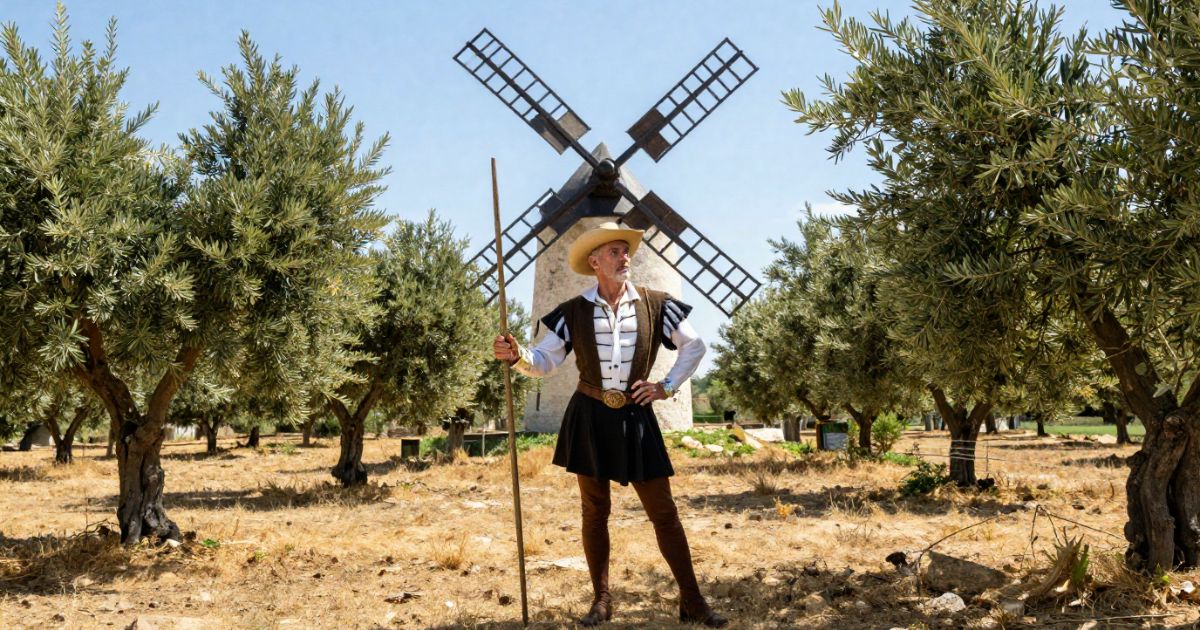
An excerpt from the original text.(complete · 6162 words)
F THE QUARREL THAT DON QUIXOTE HAD WITH THE GOATHERD, TOGETHER WITH
THE RARE ADVENTURE OF THE PENITENTS, WHICH WITH AN EXPENDITURE OF SWEAT
HE BROUGHT TO A HAPPY CONCLUSION
The goatherd’s tale gave great satisfaction to all the hearers, and the
canon especially enjoyed it, for he had remarked with particular
attention the manner in which it had been told, which was as unlike the
manner of a clownish goatherd as it was like that of a polished city
wit; and he observed that the curate had been quite right in saying
that the woods bred men of learning. They all offered their services to
Eugenio but he who showed himself most liberal in this way was Don
Quixote, who said to him, “Most assuredly, brother goatherd, if I found
myself in a position to attempt any adventure, I would, this very
instant, set out on your behalf, and would rescue Leandra from that
convent (where no doubt she is kept against her will), in spite of the
abbess and all who might try to prevent me, and would place her in your
hands to deal with her according to your will and pleasure, observing,
however, the laws of chivalry which lay down that no violence of any
kind is to be offered to any damsel. But I trust in God our Lord that
the might of one malignant enchanter may not prove so great but that
the power of another better disposed may prove superior to it, and then
I promise you my support and assistance, as I am bound to do by my
profession, which is none other than to give aid to the weak and
needy.”
The goatherd eyed him, and noticing Don Quixote’s sorry appearance and
looks, he was filled with wonder, and asked the barber, who was next
him, “Señor, who is this man who makes such a figure and talks in such
a strain?”
“Who should it be,” said the barber, “but the famous Don Quixote of La
Mancha, the undoer of injustice, the righter of wrongs, the protector
of damsels, the terror of giants, and the winner of battles?”
“That,” said the goatherd, “sounds like what one reads in the books of
the knights-errant, who did all that you say this man does; though it
is my belief that either you are joking, or else this gentleman has
empty lodgings in his head.”
“You are a great scoundrel,” said Don Quixote, “and it is you who are
empty and a fool. I am fuller than ever was the whoreson bitch that
bore you;” and passing from words to deeds, he caught up a loaf that
was near him and sent it full in the goatherd’s face, with such force
that he flattened his nose; but the goatherd, who did not understand
jokes, and found himself roughly handled in such good earnest, paying
no respect to carpet, tablecloth, or diners, sprang upon Don Quixote,
and seizing him by the throat with both hands would no doubt have
throttled him, had not Sancho Panza that instant come to the rescue,
and grasping him by the shoulders flung him down on the table, smashing
plates, breaking glasses, and upsetting and scattering everything on
it. Don Quixote, finding himself free, strove to get on top of the
goatherd, who, with his face covered with blood, and soundly kicked by
Sancho, was on all fours feeling about for one of the table-knives to
take a bloody revenge with. The canon and the curate, however,
prevented him, but the barber so contrived it that he got Don Quixote
under him, and rained down upon him such a shower of fisticuffs that
the poor knight’s face streamed with blood as freely as his own. The
canon and the curate were bursting with laughter, the officers were
capering with delight, and both the one and the other hissed them on as
they do dogs that are worrying one another in a fight. Sancho alone was
frantic, for he could not free himself from the grasp of one of the
canon’s servants, who kept him from going to his master’s assistance.
At last, while they were all, with the exception of the two bruisers
who were mauling each other, in high glee and enjoyment, they heard a
trumpet sound a note so doleful that it made them all look in the
direction whence the sound seemed to come. But the one that was most
excited by hearing it was Don Quixote, who though sorely against his
will he was under the goatherd, and something more than pretty well
pummelled, said to him, “Brother devil (for it is impossible but that
thou must be one since thou hast had might and strength enough to
overcome mine), I ask thee to agree to a truce for but one hour for the
solemn note of yonder trumpet that falls on our ears seems to me to
summon me to some new adventure.” The goatherd, who was by this time
tired of pummelling and being pummelled, released him at once, and Don
Quixote rising to his feet and turning his eyes to the quarter where
the sound had been heard, suddenly saw coming down the slope of a hill
several men clad in white like penitents.
The fact was that the clouds had that year withheld their moisture from
the earth, and in all the villages of the district they were organising
processions, rogations, and penances, imploring God to open the hands
of his mercy and send the rain; and to this end the people of a village
that was hard by were going in procession to a holy hermitage there was
on one side of that valley. Don Quixote when he saw the strange garb of
the penitents, without reflecting how often he had seen it before, took
it into his head that this was a case of adventure, and that it fell to
him alone as a knight-errant to engage in it; and he was all the more
confirmed in this notion, by the idea that an image draped in black
they had with them was some illustrious lady that these villains and
discourteous thieves were carrying off by force. As soon as this
occurred to him he ran with all speed to Rocinante who was grazing at
large, and taking the bridle and the buckler from the saddle-bow, he
had him bridled in an instant, and calling to Sancho for his sword he
mounted Rocinante, braced his buckler on his arm, and in a loud voice
exclaimed to those who stood by, “Now, noble company, ye shall see how
important it is that there should be knights in the world professing
the order of knight-errantry; now, I say, ye shall see, by the
deliverance of that worthy lady who is borne captive there, whether
knights-errant deserve to be held in estimation,” and so saying he
brought his legs to bear on Rocinante—for he had no spurs—and at a full
canter (for in all this veracious history we never read of Rocinante
fairly galloping) set off to encounter the penitents, though the
curate, the canon, and the barber ran to prevent him. But it was out of
their power, nor did he even stop for the shouts of Sancho calling
after him, “Where are you going, Señor Don Quixote? What devils have
possessed you to set you on against our Catholic faith? Plague take me!
mind, that is a procession of penitents, and the lady they are carrying
on that stand there is the blessed image of the immaculate Virgin. Take
care what you are doing, señor, for this time it may be safely said you
don’t know what you are about.” Sancho laboured in vain, for his master
was so bent on coming to quarters with these sheeted figures and
releasing the lady in black that he did not hear a word; and even had
he heard, he would not have turned back if the king had ordered him. He
came up with the procession and reined in Rocinante, who was already
anxious enough to slacken speed a little, and in a hoarse, excited
voice he exclaimed, “You who hide your faces, perhaps because you are
not good subjects, pay attention and listen to what I am about to say
to you.” The first to halt were those who were carrying the image, and
one of the four ecclesiastics who were chanting the Litany, struck by
the strange figure of Don Quixote, the leanness of Rocinante, and the
other ludicrous peculiarities he observed, said in reply to him,
“Brother, if you have anything to say to us say it quickly, for these
brethren are whipping themselves, and we cannot stop, nor is it
reasonable we should stop to hear anything, unless indeed it is short
enough to be said in two words.”
“I will say it in one,” replied Don Quixote, “and it is this; that at
once, this very instant, ye release that fair lady whose tears and sad
aspect show plainly that ye are carrying her off against her will, and
that ye have committed some scandalous outrage against her; and I, who
was born into the world to redress all such like wrongs, will not
permit you to advance another step until you have restored to her the
liberty she pines for and deserves.”
From these words all the hearers concluded that he must be a madman,
and began to laugh heartily, and their laughter acted like gunpowder on
Don Quixote’s fury, for drawing his sword without another word he made
a rush at the stand. One of those who supported it, leaving the burden
to his comrades, advanced to meet him, flourishing a forked stick that
he had for propping up the stand when resting, and with this he caught
a mighty cut Don Quixote made at him that severed it in two; but with
the portion that remained in his hand he dealt such a thwack on the
shoulder of Don Quixote’s sword arm (which the buckler could not
protect against the clownish assault) that poor Don Quixote came to the
ground in a sad plight.
Sancho Panza, who was coming on close behind puffing and blowing,
seeing him fall, cried out to his assailant not to strike him again,
for he was a poor enchanted knight, who had never harmed anyone all the
days of his life; but what checked the clown was, not Sancho’s
shouting, but seeing that Don Quixote did not stir hand or foot; and
so, fancying he had killed him, he hastily hitched up his tunic under
his girdle and took to his heels across the country like a deer.
By this time all Don Quixote’s companions had come up to where he lay;
but the processionists seeing them come running, and with them the
officers of the Brotherhood with their crossbows, apprehended mischief,
and clustering round the image, raised their hoods, and grasped their
scourges, as the priests did their tapers, and awaited the attack,
resolved to defend themselves and even to take the offensive against
their assailants if they could. Fortune, however, arranged the matter
better than they expected, for all Sancho did was to fling himself on
his master’s body, raising over him the most doleful and laughable
lamentation that ever was heard, for he believed he was dead. The
curate was known to another curate who walked in the procession, and
their recognition of one another set at rest the apprehensions of both
parties; the first then told the other in two words who Don Quixote
was, and he and the whole troop of penitents went to see if the poor
gentleman was dead, and heard Sancho Panza saying, with tears in his
eyes, “Oh flower of chivalry, that with one blow of a stick hast ended
the course of thy well-spent life! Oh pride of thy race, honour and
glory of all La Mancha, nay, of all the world, that for want of thee
will be full of evil-doers, no longer in fear of punishment for their
misdeeds! Oh thou, generous above all the Alexanders, since for only
eight months of service thou hast given me the best island the sea
girds or surrounds! Humble with the proud, haughty with the humble,
encounterer of dangers, endurer of outrages, enamoured without reason,
imitator of the good, scourge of the wicked, enemy of the mean, in
short, knight-errant, which is all that can be said!”
At the cries and moans of Sancho, Don Quixote came to himself, and the
first word he said was, “He who lives separated from you, sweetest
Dulcinea, has greater miseries to endure than these. Aid me, friend
Sancho, to mount the enchanted cart, for I am not in a condition to
press the saddle of Rocinante, as this shoulder is all knocked to
pieces.”
“That I will do with all my heart, señor,” said Sancho; “and let us
return to our village with these gentlemen, who seek your good, and
there we will prepare for making another sally, which may turn out more
profitable and creditable to us.”
“Thou art right, Sancho,” returned Don Quixote; “It will be wise to let
the malign influence of the stars which now prevails pass off.”
The canon, the curate, and the barber told him he would act very wisely
in doing as he said; and so, highly amused at Sancho Panza’s
simplicities, they placed Don Quixote in the cart as before. The
procession once more formed itself in order and proceeded on its road;
the goatherd took his leave of the party; the officers of the
Brotherhood declined to go any farther, and the curate paid them what
was due to them; the canon begged the curate to let him know how Don
Quixote did, whether he was cured of his madness or still suffered from
it, and then begged leave to continue his journey; in short, they all
separated and went their ways, leaving to themselves the curate and the
barber, Don Quixote, Sancho Panza, and the good Rocinante, who regarded
everything with as great resignation as his master. The carter yoked
his oxen and made Don Quixote comfortable on a truss of hay, and at his
usual deliberate pace took the road the curate directed, and at the end
of six days they reached Don Quixote’s village, and entered it about
the middle of the day, which it so happened was a Sunday, and the
people were all in the plaza, through which Don Quixote’s cart passed.
They all flocked to see what was in the cart, and when they recognised
their townsman they were filled with amazement, and a boy ran off to
bring the news to his housekeeper and his niece that their master and
uncle had come back all lean and yellow and stretched on a truss of hay
on an ox-cart. It was piteous to hear the cries the two good ladies
raised, how they beat their breasts and poured out fresh maledictions
on those accursed books of chivalry; all which was renewed when they
saw Don Quixote coming in at the gate.
At the news of Don Quixote’s arrival Sancho Panza’s wife came running,
for she by this time knew that her husband had gone away with him as
his squire, and on seeing Sancho, the first thing she asked him was if
the ass was well. Sancho replied that he was, better than his master
was.
“Thanks be to God,” said she, “for being so good to me; but now tell
me, my friend, what have you made by your squirings? What gown have you
brought me back? What shoes for your children?”
“I bring nothing of that sort, wife,” said Sancho; “though I bring
other things of more consequence and value.”
“I am very glad of that,” returned his wife; “show me these things of
more value and consequence, my friend; for I want to see them to cheer
my heart that has been so sad and heavy all these ages that you have
been away.”
“I will show them to you at home, wife,” said Sancho; “be content for
the present; for if it please God that we should again go on our
travels in search of adventures, you will soon see me a count, or
governor of an island, and that not one of those everyday ones, but the
best that is to be had.”
“Heaven grant it, husband,” said she, “for indeed we have need of it.
But tell me, what’s this about islands, for I don’t understand it?”
“Honey is not for the mouth of the ass,” returned Sancho; “all in good
time thou shalt see, wife—nay, thou wilt be surprised to hear thyself
called ‘your ladyship’ by all thy vassals.”
“What are you talking about, Sancho, with your ladyships, islands, and
vassals?” returned Teresa Panza—for so Sancho’s wife was called, though
they were not relations, for in La Mancha it is customary for wives to
take their husbands’ surnames.
“Don’t be in such a hurry to know all this, Teresa,” said Sancho; “it
is enough that I am telling you the truth, so shut your mouth. But I
may tell you this much by the way, that there is nothing in the world
more delightful than to be a person of consideration, squire to a
knight-errant, and a seeker of adventures. To be sure most of those one
finds do not end as pleasantly as one could wish, for out of a hundred,
ninety-nine will turn out cross and contrary. I know it by experience,
for out of some I came blanketed, and out of others belaboured. Still,
for all that, it is a fine thing to be on the look-out for what may
happen, crossing mountains, searching woods, climbing rocks, visiting
castles, putting up at inns, all at free quarters, and devil take the
maravedi to pay.”
While this conversation passed between Sancho Panza and his wife, Don
Quixote’s housekeeper and niece took him in and undressed him and laid
him in his old bed. He eyed them askance, and could not make out where
he was. The curate charged his niece to be very careful to make her
uncle comfortable and to keep a watch over him lest he should make his
escape from them again, telling her what they had been obliged to do to
bring him home. On this the pair once more lifted up their voices and
renewed their maledictions upon the books of chivalry, and implored
heaven to plunge the authors of such lies and nonsense into the midst
of the bottomless pit. They were, in short, kept in anxiety and dread
lest their uncle and master should give them the slip the moment he
found himself somewhat better, and as they feared so it fell out.
But the author of this history, though he has devoted research and
industry to the discovery of the deeds achieved by Don Quixote in his
third sally, has been unable to obtain any information respecting them,
at any rate derived from authentic documents; tradition has merely
preserved in the memory of La Mancha the fact that Don Quixote, the
third time he sallied forth from his home, betook himself to Saragossa,
where he was present at some famous jousts which came off in that city,
and that he had adventures there worthy of his valour and high
intelligence. Of his end and death he could learn no particulars, nor
would he have ascertained it or known of it, if good fortune had not
produced an old physician for him who had in his possession a leaden
box, which, according to his account, had been discovered among the
crumbling foundations of an ancient hermitage that was being rebuilt;
in which box were found certain parchment manuscripts in Gothic
character, but in Castilian verse, containing many of his achievements,
and setting forth the beauty of Dulcinea, the form of Rocinante, the
fidelity of Sancho Panza, and the burial of Don Quixote himself,
together with sundry epitaphs and eulogies on his life and character;
but all that could be read and deciphered were those which the
trustworthy author of this new and unparalleled history here presents.
And the said author asks of those that shall read it nothing in return
for the vast toil which it has cost him in examining and searching the
Manchegan archives in order to bring it to light, save that they give
him the same credit that people of sense give to the books of chivalry
that pervade the world and are so popular; for with this he will
consider himself amply paid and fully satisfied, and will be encouraged
to seek out and produce other histories, if not as truthful, at least
equal in invention and not less entertaining. The first words written
on the parchment found in the leaden box were these:
THE ACADEMICIANS OF ARGAMASILLA,
A VILLAGE OF LA MANCHA,
ON THE LIFE AND DEATH OF DON QUIXOTE OF LA MANCHA,
HOC SCRIPSERUNT
MONICONGO, ACADEMICIAN OF ARGAMASILLA,
ON THE TOMB OF DON QUIXOTE
EPITAPH
The scatterbrain that gave La Mancha more
Rich spoils than Jason’s; who a point so keen
Had to his wit, and happier far had been
If his wit’s weathercock a blunter bore;
The arm renowned far as Gaeta’s shore,
Cathay, and all the lands that lie between;
The muse discreet and terrible in mien
As ever wrote on brass in days of yore;
He who surpassed the Amadises all,
And who as naught the Galaors accounted,
Supported by his love and gallantry:
Who made the Belianises sing small,
And sought renown on Rocinante mounted;
Here, underneath this cold stone, doth he lie.
PANIAGUADO, ACADEMICIAN OF ARGAMASILLA,
IN LAUDEM DULCINEAE DEL TOBOSO
SONNET
She, whose full features may be here descried,
High-bosomed, with a bearing of disdain,
Is Dulcinea, she for whom in vain
The great Don Quixote of La Mancha sighed.
For her, Toboso’s queen, from side to side
He traversed the grim sierra, the champaign
Of Aranjuez, and Montiel’s famous plain:
On Rocinante oft a weary ride.
Malignant planets, cruel destiny,
Pursued them both, the fair Manchegan dame,
And the unconquered star of chivalry.
Nor youth nor beauty saved her from the claim
Of death; he paid love’s bitter penalty,
And left the marble to preserve his name.
CAPRICHOSO, A MOST ACUTE ACADEMICIAN OF ARGAMASILLA,
IN PRAISE OF ROCINANTE, STEED OF DON QUIXOTE OF LA MANCHA
SONNET
On that proud throne of diamantine sheen,
Which the blood-reeking feet of Mars degrade,
The mad Manchegan’s banner now hath been
By him in all its bravery displayed.
There hath he hung his arms and trenchant blade
Wherewith, achieving deeds till now unseen,
He slays, lays low, cleaves, hews; but art hath made
A novel style for our new paladin.
If Amadis be the proud boast of Gaul,
If by his progeny the fame of Greece
Through all the regions of the earth be spread,
Great Quixote crowned in grim Bellona’s hall
To-day exalts La Mancha over these,
And above Greece or Gaul she holds her head.
Nor ends his glory here, for his good steed
Doth Brillador and Bayard far exceed;
As mettled steeds compared with Rocinante,
The reputation they have won is scanty.
BURLADOR, ACADEMICIAN OF ARGAMASILLA,
ON SANCHO PANZA
SONNET
The worthy Sancho Panza here you see;
A great soul once was in that body small,
Nor was there squire upon this earthly ball
So plain and simple, or of guile so free.
Within an ace of being Count was he,
And would have been but for the spite and gall
Of this vile age, mean and illiberal,
That cannot even let a donkey be.
For mounted on an ass (excuse the word),
By Rocinante’s side this gentle squire
Was wont his wandering master to attend.
Delusive hopes that lure the common herd
With promises of ease, the heart’s desire,
In shadows, dreams, and smoke ye always end.
CACHIDIABLO, ACADEMICIAN OF ARGAMASILLA,
ON THE TOMB OF DON QUIXOTE
EPITAPH
The knight lies here below,
Ill-errant and bruised sore,
Whom Rocinante bore
In his wanderings to and fro.
By the side of the knight is laid
Stolid man Sancho too,
Than whom a squire more true
Was not in the esquire trade.
TIQUITOC, ACADEMICIAN OF ARGAMASILLA,
ON THE TOMB OF DULCINEA DEL TOBOSO
EPITAPH
Here Dulcinea lies.
Plump was she and robust:
Now she is ashes and dust:
The end of all flesh that dies.
A lady of high degree,
With the port of a lofty dame,
And the great Don Quixote’s flame,
And the pride of her village was she.
These were all the verses that could be deciphered; the rest, the
writing being worm-eaten, were handed over to one of the Academicians
to make out their meaning conjecturally. We have been informed that at
the cost of many sleepless nights and much toil he has succeeded, and
that he means to publish them in hopes of Don Quixote’s third sally.
“Forse altro cantera con miglior plettro.”
c52e.jpg (54K)
Volume II
DEDICATION OF VOLUME II.
TO THE COUNT OF LEMOS:
These days past, when sending Your Excellency my plays, that had
appeared in print before being shown on the stage, I said, if I
remember well, that Don Quixote was putting on his spurs to go and
render homage to Your Excellency. Now I say that “with his spurs, he is
on his way.” Should he reach destination methinks I shall have rendered
some service to Your Excellency, as from many parts I am urged to send
him off, so as to dispel the loathing and disgust caused by another Don
Quixote who, under the name of Second Part, has run masquerading
through the whole world. And he who has shown the greatest longing for
him has been the great Emperor of China, who wrote me a letter in
Chinese a month ago and sent it by a special courier. He asked me, or
to be truthful, he begged me to send him Don Quixote, for he intended
to found a college where the Spanish tongue would be taught, and it was
his wish that the book to be read should be the History of Don Quixote.
He also added that I should go and be the rector of this college. I
asked the bearer if His Majesty had afforded a sum in aid of my travel
expenses. He answered, “No, not even in thought.”
“Then, brother,” I replied, “you can return to your China, post haste
or at whatever haste you are bound to go, as I am not fit for so long a
travel and, besides being ill, I am very much without money, while
Emperor for Emperor and Monarch for Monarch, I have at Naples the great
Count of Lemos, who, without so many petty titles of colleges and
rectorships, sustains me, protects me and does me more favour than I
can wish for.”
Thus I gave him his leave and I beg mine from you, offering Your
Excellency the “Trabajos de Persiles y Sigismunda,” a book I shall
finish within four months, Deo volente, and which will be either the
worst or the best that has been composed in our language, I mean of
those intended for entertainment; at which I repent of having called it
the worst, for, in the opinion of friends, it is bound to attain the
summit of possible quality. May Your Excellency return in such health
that is wished you; Persiles will be ready to kiss your hand and I your
feet, being as I am, Your Excellency’s most humble servant.
From Madrid, this last day of October of the year one thousand six
hundred and fifteen.
At the service of Your Excellency:
MIGUEL DE CERVANTES SAAVEDRA
THE AUTHOR’S PREFACE
God bless me, gentle (or it may be plebeian) reader, how eagerly must
thou be looking forward to this preface, expecting to find there
retaliation, scolding, and abuse against the author of the second Don
Quixote—I mean him who was, they say, begotten at Tordesillas and born
at Tarragona! Well then, the truth is, I am not going to give thee that
satisfaction; for, though injuries stir up anger in humbler breasts, in
mine the rule must admit of an exception. Thou wouldst have me call him
ass, fool, and malapert, but I have no such intention; let his offence
be his punishment, with his bread let him eat it, and there’s an end of
it. What I cannot help taking amiss is that he charges me with being
old and one-handed, as if it had been in my power to keep time from
passing over me, or as if the loss of my hand had been brought about in
some tavern, and not on the grandest occasion the past or present has
seen, or the future can hope to see. If my wounds have no beauty to the
beholder’s eye, they are, at least, honourable in the estimation of
those who know where they were received; for the soldier shows to
greater advantage dead in battle than alive in flight; and so strongly
is this my feeling, that if now it were proposed to perform an
impossibility for me, I would rather have had my share in that mighty
action, than be free from my wounds this minute without having been
present at it. Those the soldier shows on his face and breast are stars
that direct others to the heaven of honour and ambition of merited
praise; and moreover it is to be observed that it is not with grey
hairs that one writes, but with the understanding, and that commonly
improves with years. I take it amiss, too, that he calls me envious,
and explains to me, as if I were ignorant, what envy is; for really and
truly, of the two kinds there are, I only know that which is holy,
noble, and high-minded; and if that be so, as it is, I am not likely to
attack a priest, above all if, in addition, he holds the rank of
familiar of the Holy Office. And if he said what he did on account of
him on whose behalf it seems he spoke, he is entirely mistaken; for I
worship the genius of that person, and admire his works and his
unceasing and strenuous industry. After all, I am grateful to this
gentleman, the author, for saying that my novels are more satirical
than exemplary, but that they are good; for they could not be that
unless there was a little of everything in them.
I suspect thou wilt say that I am taking a very humble line, and
keeping myself too much within the bounds of my moderation, from a
feeling that additional suffering should not be inflicted upon a
sufferer, and that what this gentleman has to endure must doubtless be
very great, as he does not dare to come out into the open field and
broad daylight, but hides his name and disguises his country as if he
had been guilty of some lese majesty. If perchance thou shouldst come
to know him, tell him from me that I do not hold myself aggrieved; for
I know well what the temptations of the devil are, and that one of the
greatest is putting it into a man’s head that he can write and print a
book by which he will get as much fame as money, and as much money as
fame; and to prove it I will beg of you, in your own sprightly,
pleasant way, to tell him this story.
There was a madman in Seville who took to one of the drollest
absurdities and vagaries that ever madman in the world gave way to. It
was this: he made a tube of reed sharp at one end, and catching a dog
in the street, or wherever it might be, he with his foot held one of
its legs fast, and with his hand lifted up the other, and as best he
could fixed the tube where, by blowing, he made the dog as round as a
ball; then holding it in this position, he gave it a couple of slaps on
the belly, and let it go, saying to the bystanders (and there were
always plenty of them): “Do your worships think, now, that it is an
easy thing to blow up a dog?”—Does your worship think now, that it is
an easy thing to write a book?
And if this story does not suit him, you may, dear reader, tell him
this one, which is likewise of a madman and a dog.
In Cordova there was another madman, whose way it was to carry a piece
of marble slab or a stone, not of the lightest, on his head, and when
he came upon any unwary dog he used to draw close to him and let the
weight fall right on top of him; on which the dog in a rage, barking
and howling, would run three streets without stopping. It so happened,
however, that one of the dogs he discharged his load upon was a
cap-maker’s dog, of which his master was very fond. The stone came down
hitting it on the head, the dog raised a yell at the blow, the master
saw the affair and was wroth, and snatching up a measuring-yard rushed
out at the madman and did not leave a sound bone in his body, and at
every stroke he gave him he said, “You dog, you thief! my lurcher!
Don’t you see, you brute, that my dog is a lurcher?” and so, repeating
the word “lurcher” again and again, he sent the madman away beaten to a
jelly. The madman took the lesson to heart, and vanished, and for more
than a month never once showed himself in public; but after that he
came out again with his old trick and a heavier load than ever. He came
up to where there was a dog, and examining it very carefully without
venturing to let the stone fall, he said: “This is a lurcher; ware!” In
short, all the dogs he came across, be they mastiffs or terriers, he
said were lurchers; and he discharged no more stones. Maybe it will be
the same with this historian; that he will not venture another time to
discharge the weight of his wit in books, which, being bad, are harder
than stones. Tell him, too, that I do not care a farthing for the
threat he holds out to me of depriving me of my profit by means of his
book; for, to borrow from the famous interlude of “The Perendenga,” I
say in answer to him, “Long life to my lord the Veintiquatro, and
Christ be with us all.” Long life to the great Conde de Lemos, whose
Christian charity and well-known generosity support me against all the
strokes of my curst fortune; and long life to the supreme benevolence
of His Eminence of Toledo, Don Bernardo de Sandoval y Rojas; and what
matter if there be no printing-presses in the world, or if they print
more books against me than there are letters in the verses of Mingo
Revulgo! These two princes, unsought by any adulation or flattery of
mine, of their own goodness alone, have taken it upon them to show me
kindness and protect me, and in this I consider myself happier and
richer than if Fortune had raised me to her greatest height in the
ordinary way. The poor man may retain honour, but not the vicious;
poverty may cast a cloud over nobility, but cannot hide it altogether;
and as virtue of itself sheds a certain light, even though it be
through the straits and chinks of penury, it wins the esteem of lofty
and noble spirits, and in consequence their protection. Thou needst say
no more to him, nor will I say anything more to thee, save to tell thee
to bear in mind that this Second Part of “Don Quixote” which I offer
thee is cut by the same craftsman and from the same cloth as the First,
and that in it I present thee Don Quixote continued, and at length dead
and buried, so that no one may dare to bring forward any further
evidence against him, for that already produced is sufficient; and
suffice it, too, that some reputable person should have given an
account of all these shrewd lunacies of his without going into the
matter again; for abundance, even of good things, prevents them from
being valued; and scarcity, even in the case of what is bad, confers a
certain value. I was forgetting to tell thee that thou mayest expect
the “Persiles,” which I am now finishing, and also the Second Part of
“Galatea.”
part2e.jpg (37K)
Master this chapter. Complete your experience
Purchase the complete book to access all chapters and support classic literature
As an Amazon Associate, we earn a small commission from qualifying purchases at no additional cost to you.
Available in paperback, hardcover, and e-book formats
Let's Analyse the Pattern
The more convinced we are of our noble purpose, the more blind we become to reality and deaf to wisdom from those who care about us.
Why This Matters
Connect literature to life
This chapter teaches how moral certainty can make us see enemies where none exist and ignore wise counsel from people who care about us.
Practice This Today
This week, notice when you're the only one who sees a 'problem' that requires your heroic intervention—pause and ask someone you trust what they actually observe.
Now let's explore the literary elements.
Key Quotes & Analysis
"Most assuredly, brother goatherd, if I found myself in a position to attempt any adventure, I would, this very instant, set out on your behalf"
Context: Don Quixote offers to help the goatherd rescue Leandra from the convent
Shows Don Quixote's compulsive need to turn every situation into a chivalric adventure. He can't simply offer emotional support or practical advice - everything must become a quest requiring knightly intervention.
In Today's Words:
If I could help you out, I'd totally go rescue your girlfriend right now
"Release instantly that beauteous lady whose tears and doleful countenance clearly show that ye are carrying her off against her will"
Context: Don Quixote demands the penitents release what he thinks is a kidnapped woman
Demonstrates how Don Quixote's preconceptions completely override reality. He sees a religious statue and immediately constructs an elaborate rescue fantasy, ignoring all evidence that contradicts his delusion.
In Today's Words:
Let that woman go - I can see she doesn't want to be here
"They are not carrying off anybody, but it is an image of the blessed Virgin without spot, whom they bear in procession"
Context: Sancho desperately tries to prevent Don Quixote from attacking the religious procession
Shows Sancho's role as the voice of practical wisdom and his growing desperation as Don Quixote becomes more dangerous. His warning goes unheeded, leading to disaster.
In Today's Words:
That's not a real person - it's a religious statue in a parade
"Ah, Sancho, we are born to suffer"
Context: Don Quixote reflects on his beating after attacking the procession
Reveals Don Quixote's inability to learn from consequences. Instead of recognizing his mistake, he frames his suffering as noble and inevitable, maintaining his delusions even after brutal reality checks.
In Today's Words:
Life is just hard, Sancho - we're meant to struggle
Thematic Threads
Identity
In This Chapter
Don Quixote's knight identity forces him to see enemies and captives everywhere, even in holy processions
Development
His delusions are becoming more violent and disconnected from reality as the story progresses
In Your Life:
When your professional or personal identity requires you to always be right or always be the hero, you stop seeing situations clearly
Class
In This Chapter
The religious procession represents established social and spiritual order that Don Quixote attacks in his delusion
Development
Continues the theme of Don Quixote challenging social hierarchies through his misguided adventures
In Your Life:
Sometimes what you think is fighting injustice is actually attacking systems that serve important community functions
Loyalty
In This Chapter
Sancho desperately tries to prevent disaster but his warnings are ignored; he mourns his fallen master with genuine grief
Development
Sancho's loyalty has deepened into true friendship despite repeated disappointments and dangers
In Your Life:
The people who try to stop your destructive crusades often love you most, even when you can't hear them
Social Expectations
In This Chapter
The community shows surprising compassion for the 'mad' knight, treating him gently despite his attack on their sacred ceremony
Development
Throughout the story, society has been more tolerant of Don Quixote's madness than expected
In Your Life:
Communities often show more grace for people struggling with delusions than the deluded person shows themselves
Personal Growth
In This Chapter
Don Quixote learns nothing from this beating, remaining unconscious both literally and figuratively
Development
His inability to learn from consequences has remained constant throughout his adventures
In Your Life:
Growth requires admitting when you're wrong, something that becomes harder the more invested you are in being the hero
You now have the context. Time to form your own thoughts.
Discussion Questions
- 1
What triggers Don Quixote to attack the religious procession, and how does Sancho try to stop him?
analysis • surface - 2
Why does Don Quixote refuse to listen to Sancho's warnings about the procession being a religious ceremony?
analysis • medium - 3
Think of someone you know who gets so convinced they're right that they can't hear good advice. What does their 'righteous blindness' look like?
application • medium - 4
When you're fired up about something important to you, how can you tell the difference between standing up for what's right and being blind to reality?
application • deep - 5
What does this chapter reveal about the relationship between moral certainty and our ability to see clearly?
reflection • deep
Critical Thinking Exercise
Check Your Blind Spots
Think of a time when you were absolutely certain you were right about something important, but someone close to you kept trying to warn you or slow you down. Write about what you were fighting for, who was trying to stop you, and what happened. Then honestly assess: were you Don Quixote charging at windmills, or were you actually right to stand your ground?
Consider:
- •What made you so certain you were right in that moment?
- •How did you respond to the person trying to warn you?
- •What would you do differently now with the same situation?
Journaling Prompt
Write about someone in your life who serves as your 'Sancho'—the person who loves you enough to question your crusades. How do you typically respond when they try to slow you down or offer a different perspective?
Coming Up Next...
Chapter 73: Testing Don Quixote's Sanity
Back in his own bed but far from cured, Don Quixote faces concerned visits from the curate and barber who hope to help him recover his sanity. But can a man so committed to his vision of the world be reasoned back to reality?