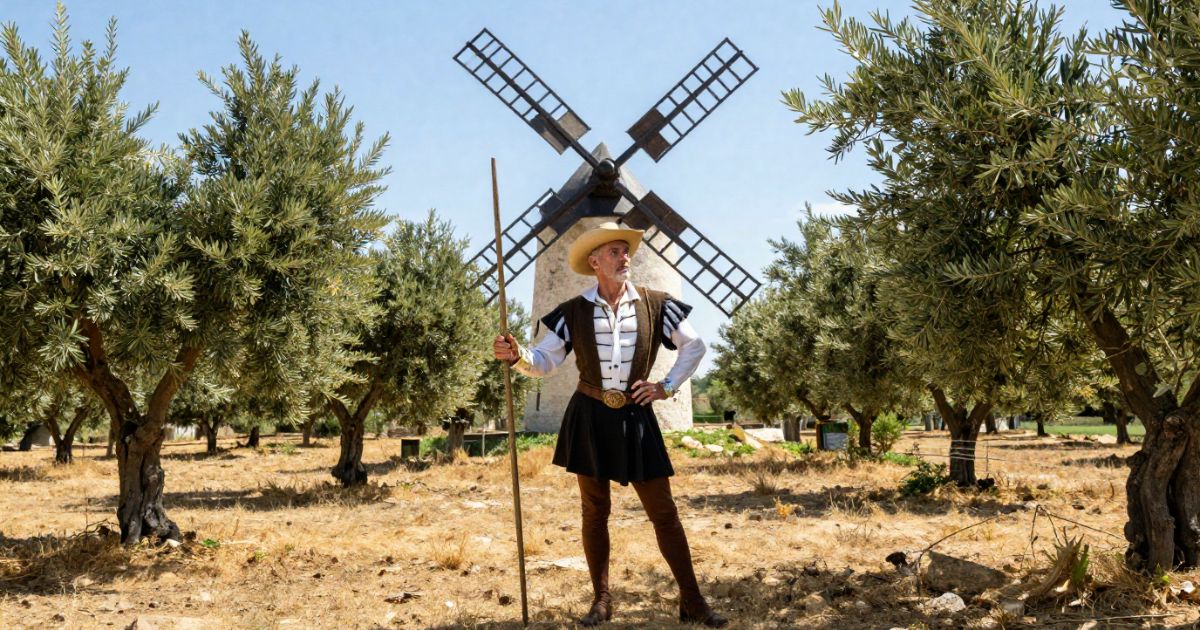
An excerpt from the original text.(complete · 4176 words)
HICH TREATS OF ADDRESS DISPLAYED BY THE FAIR DOROTHEA, WITH OTHER
MATTERS PLEASANT AND AMUSING
The curate had hardly ceased speaking, when Sancho said, “In faith,
then, señor licentiate, he who did that deed was my master; and it was
not for want of my telling him beforehand and warning him to mind what
he was about, and that it was a sin to set them at liberty, as they
were all on the march there because they were special scoundrels.”
“Blockhead!” said Don Quixote at this, “it is no business or concern of
knights-errant to inquire whether any persons in affliction, in chains,
or oppressed that they may meet on the high roads go that way and
suffer as they do because of their faults or because of their
misfortunes. It only concerns them to aid them as persons in need of
help, having regard to their sufferings and not to their rascalities. I
encountered a chaplet or string of miserable and unfortunate people,
and did for them what my sense of duty demands of me, and as for the
rest be that as it may; and whoever takes objection to it, saving the
sacred dignity of the señor licentiate and his honoured person, I say
he knows little about chivalry and lies like a whoreson villain, and
this I will give him to know to the fullest extent with my sword;” and
so saying he settled himself in his stirrups and pressed down his
morion; for the barber’s basin, which according to him was Mambrino’s
helmet, he carried hanging at the saddle-bow until he could repair the
damage done to it by the galley slaves.
Dorothea, who was shrewd and sprightly, and by this time thoroughly
understood Don Quixote’s crazy turn, and that all except Sancho Panza
were making game of him, not to be behind the rest said to him, on
observing his irritation, “Sir Knight, remember the boon you have
promised me, and that in accordance with it you must not engage in any
other adventure, be it ever so pressing; calm yourself, for if the
licentiate had known that the galley slaves had been set free by that
unconquered arm he would have stopped his mouth thrice over, or even
bitten his tongue three times before he would have said a word that
tended towards disrespect of your worship.”
“That I swear heartily,” said the curate, “and I would have even
plucked off a moustache.”
“I will hold my peace, señora,” said Don Quixote, “and I will curb the
natural anger that had arisen in my breast, and will proceed in peace
and quietness until I have fulfilled my promise; but in return for this
consideration I entreat you to tell me, if you have no objection to do
so, what is the nature of your trouble, and how many, who, and what are
the persons of whom I am to require due satisfaction, and on whom I am
to take vengeance on your behalf?”
“That I will do with all my heart,” replied Dorothea, “if it will not
be wearisome to you to hear of miseries and misfortunes.”
“It will not be wearisome, señora,” said Don Quixote; to which Dorothea
replied, “Well, if that be so, give me your attention.” As soon as she
said this, Cardenio and the barber drew close to her side, eager to
hear what sort of story the quick-witted Dorothea would invent for
herself; and Sancho did the same, for he was as much taken in by her as
his master; and she having settled herself comfortably in the saddle,
and with the help of coughing and other preliminaries taken time to
think, began with great sprightliness of manner in this fashion.
“First of all, I would have you know, sirs, that my name is—” and here
she stopped for a moment, for she forgot the name the curate had given
her; but he came to her relief, seeing what her difficulty was, and
said, “It is no wonder, señora, that your highness should be confused
and embarrassed in telling the tale of your misfortunes; for such
afflictions often have the effect of depriving the sufferers of memory,
so that they do not even remember their own names, as is the case now
with your ladyship, who has forgotten that she is called the Princess
Micomicona, lawful heiress of the great kingdom of Micomicon; and with
this cue your highness may now recall to your sorrowful recollection
all you may wish to tell us.”
“That is the truth,” said the damsel; “but I think from this on I shall
have no need of any prompting, and I shall bring my true story safe
into port, and here it is. The king my father, who was called Tinacrio
the Sapient, was very learned in what they call magic arts, and became
aware by his craft that my mother, who was called Queen Jaramilla, was
to die before he did, and that soon after he too was to depart this
life, and I was to be left an orphan without father or mother. But all
this, he declared, did not so much grieve or distress him as his
certain knowledge that a prodigious giant, the lord of a great island
close to our kingdom, Pandafilando of the Scowl by name—for it is
averred that, though his eyes are properly placed and straight, he
always looks askew as if he squinted, and this he does out of
malignity, to strike fear and terror into those he looks at—that he
knew, I say, that this giant on becoming aware of my orphan condition
would overrun my kingdom with a mighty force and strip me of all, not
leaving me even a small village to shelter me; but that I could avoid
all this ruin and misfortune if I were willing to marry him; however,
as far as he could see, he never expected that I would consent to a
marriage so unequal; and he said no more than the truth in this, for it
has never entered my mind to marry that giant, or any other, let him be
ever so great or enormous. My father said, too, that when he was dead,
and I saw Pandafilando about to invade my kingdom, I was not to wait
and attempt to defend myself, for that would be destructive to me, but
that I should leave the kingdom entirely open to him if I wished to
avoid the death and total destruction of my good and loyal vassals, for
there would be no possibility of defending myself against the giant’s
devilish power; and that I should at once with some of my followers set
out for Spain, where I should obtain relief in my distress on finding a
certain knight-errant whose fame by that time would extend over the
whole kingdom, and who would be called, if I remember rightly, Don
Azote or Don Gigote.”
“‘Don Quixote,’ he must have said, señora,” observed Sancho at this,
“otherwise called the Knight of the Rueful Countenance.”
“That is it,” said Dorothea; “he said, moreover, that he would be tall
of stature and lank featured; and that on his right side under the left
shoulder, or thereabouts, he would have a grey mole with hairs like
bristles.”
On hearing this, Don Quixote said to his squire, “Here, Sancho my son,
bear a hand and help me to strip, for I want to see if I am the knight
that sage king foretold.”
“What does your worship want to strip for?” said Dorothea.
“To see if I have that mole your father spoke of,” answered Don
Quixote.
“There is no occasion to strip,” said Sancho; “for I know your worship
has just such a mole on the middle of your backbone, which is the mark
of a strong man.”
“That is enough,” said Dorothea, “for with friends we must not look too
closely into trifles; and whether it be on the shoulder or on the
backbone matters little; it is enough if there is a mole, be it where
it may, for it is all the same flesh; no doubt my good father hit the
truth in every particular, and I have made a lucky hit in commending
myself to Don Quixote; for he is the one my father spoke of, as the
features of his countenance correspond with those assigned to this
knight by that wide fame he has acquired not only in Spain but in all
La Mancha; for I had scarcely landed at Osuna when I heard such
accounts of his achievements, that at once my heart told me he was the
very one I had come in search of.”
“But how did you land at Osuna, señora,” asked Don Quixote, “when it is
not a seaport?”
But before Dorothea could reply the curate anticipated her, saying,
“The princess meant to say that after she had landed at Malaga the
first place where she heard of your worship was Osuna.”
“That is what I meant to say,” said Dorothea.
“And that would be only natural,” said the curate. “Will your majesty
please proceed?”
“There is no more to add,” said Dorothea, “save that in finding Don
Quixote I have had such good fortune, that I already reckon and regard
myself queen and mistress of my entire dominions, since of his courtesy
and magnanimity he has granted me the boon of accompanying me
whithersoever I may conduct him, which will be only to bring him face
to face with Pandafilando of the Scowl, that he may slay him and
restore to me what has been unjustly usurped by him: for all this must
come to pass satisfactorily since my good father Tinacrio the Sapient
foretold it, who likewise left it declared in writing in Chaldee or
Greek characters (for I cannot read them), that if this predicted
knight, after having cut the giant’s throat, should be disposed to
marry me I was to offer myself at once without demur as his lawful
wife, and yield him possession of my kingdom together with my person.”
“What thinkest thou now, friend Sancho?” said Don Quixote at this.
“Hearest thou that? Did I not tell thee so? See how we have already got
a kingdom to govern and a queen to marry!”
“On my oath it is so,” said Sancho; “and foul fortune to him who won’t
marry after slitting Señor Pandahilado’s windpipe! And then, how
illfavoured the queen is! I wish the fleas in my bed were that sort!”
And so saying he cut a couple of capers in the air with every sign of
extreme satisfaction, and then ran to seize the bridle of Dorothea’s
mule, and checking it fell on his knees before her, begging her to give
him her hand to kiss in token of his acknowledgment of her as his queen
and mistress. Which of the bystanders could have helped laughing to see
the madness of the master and the simplicity of the servant? Dorothea
therefore gave her hand, and promised to make him a great lord in her
kingdom, when Heaven should be so good as to permit her to recover and
enjoy it, for which Sancho returned thanks in words that set them all
laughing again.
“This, sirs,” continued Dorothea, “is my story; it only remains to tell
you that of all the attendants I took with me from my kingdom I have
none left except this well-bearded squire, for all were drowned in a
great tempest we encountered when in sight of port; and he and I came
to land on a couple of planks as if by a miracle; and indeed the whole
course of my life is a miracle and a mystery as you may have observed;
and if I have been over minute in any respect or not as precise as I
ought, let it be accounted for by what the licentiate said at the
beginning of my tale, that constant and excessive troubles deprive the
sufferers of their memory.”
“They shall not deprive me of mine, exalted and worthy princess,” said
Don Quixote, “however great and unexampled those which I shall endure
in your service may be; and here I confirm anew the boon I have
promised you, and I swear to go with you to the end of the world until
I find myself in the presence of your fierce enemy, whose haughty head
I trust by the aid of my arm to cut off with the edge of this—I will
not say good sword, thanks to Gines de Pasamonte who carried away
mine”—(this he said between his teeth, and then continued), “and when
it has been cut off and you have been put in peaceful possession of
your realm it shall be left to your own decision to dispose of your
person as may be most pleasing to you; for so long as my memory is
occupied, my will enslaved, and my understanding enthralled by her—I
say no more—it is impossible for me for a moment to contemplate
marriage, even with a Phœnix.”
The last words of his master about not wanting to marry were so
disagreeable to Sancho that raising his voice he exclaimed with great
irritation:
“By my oath, Señor Don Quixote, you are not in your right senses; for
how can your worship possibly object to marrying such an exalted
princess as this? Do you think Fortune will offer you behind every
stone such a piece of luck as is offered you now? Is my lady Dulcinea
fairer, perchance? Not she; nor half as fair; and I will even go so far
as to say she does not come up to the shoe of this one here. A poor
chance I have of getting that county I am waiting for if your worship
goes looking for dainties in the bottom of the sea. In the devil’s
name, marry, marry, and take this kingdom that comes to hand without
any trouble, and when you are king make me a marquis or governor of a
province, and for the rest let the devil take it all.”
Don Quixote, when he heard such blasphemies uttered against his lady
Dulcinea, could not endure it, and lifting his pike, without saying
anything to Sancho or uttering a word, he gave him two such thwacks
that he brought him to the ground; and had it not been that Dorothea
cried out to him to spare him he would have no doubt taken his life on
the spot.
“Do you think,” he said to him after a pause, “you scurvy clown, that
you are to be always interfering with me, and that you are to be always
offending and I always pardoning? Don’t fancy it, impious scoundrel,
for that beyond a doubt thou art, since thou hast set thy tongue going
against the peerless Dulcinea. Know you not, lout, vagabond, beggar,
that were it not for the might that she infuses into my arm I should
not have strength enough to kill a flea? Say, scoffer with a viper’s
tongue, what think you has won this kingdom and cut off this giant’s
head and made you a marquis (for all this I count as already
accomplished and decided), but the might of Dulcinea, employing my arm
as the instrument of her achievements? She fights in me and conquers in
me, and I live and breathe in her, and owe my life and being to her. O
whoreson scoundrel, how ungrateful you are, you see yourself raised
from the dust of the earth to be a titled lord, and the return you make
for so great a benefit is to speak evil of her who has conferred it
upon you!”
Sancho was not so stunned but that he heard all his master said, and
rising with some degree of nimbleness he ran to place himself behind
Dorothea’s palfrey, and from that position he said to his master:
“Tell me, señor; if your worship is resolved not to marry this great
princess, it is plain the kingdom will not be yours; and not being so,
how can you bestow favours upon me? That is what I complain of. Let
your worship at any rate marry this queen, now that we have got her
here as if showered down from heaven, and afterwards you may go back to
my lady Dulcinea; for there must have been kings in the world who kept
mistresses. As to beauty, I have nothing to do with it; and if the
truth is to be told, I like them both; though I have never seen the
lady Dulcinea.”
“How! never seen her, blasphemous traitor!” exclaimed Don Quixote;
“hast thou not just now brought me a message from her?”
“I mean,” said Sancho, “that I did not see her so much at my leisure
that I could take particular notice of her beauty, or of her charms
piecemeal; but taken in the lump I like her.”
“Now I forgive thee,” said Don Quixote; “and do thou forgive me the
injury I have done thee; for our first impulses are not in our
control.”
“That I see,” replied Sancho, “and with me the wish to speak is always
the first impulse, and I cannot help saying, once at any rate, what I
have on the tip of my tongue.”
“For all that, Sancho,” said Don Quixote, “take heed of what thou
sayest, for the pitcher goes so often to the well—I need say no more to
thee.”
“Well, well,” said Sancho, “God is in heaven, and sees all tricks, and
will judge who does most harm, I in not speaking right, or your worship
in not doing it.”
“That is enough,” said Dorothea; “run, Sancho, and kiss your lord’s
hand and beg his pardon, and henceforward be more circumspect with your
praise and abuse; and say nothing in disparagement of that lady Toboso,
of whom I know nothing save that I am her servant; and put your trust
in God, for you will not fail to obtain some dignity so as to live like
a prince.”
Sancho advanced hanging his head and begged his master’s hand, which
Don Quixote with dignity presented to him, giving him his blessing as
soon as he had kissed it; he then bade him go on ahead a little, as he
had questions to ask him and matters of great importance to discuss
with him. Sancho obeyed, and when the two had gone some distance in
advance Don Quixote said to him, “Since thy return I have had no
opportunity or time to ask thee many particulars touching thy mission
and the answer thou hast brought back, and now that chance has granted
us the time and opportunity, deny me not the happiness thou canst give
me by such good news.”
“Let your worship ask what you will,” answered Sancho, “for I shall
find a way out of all as I found a way in; but I implore you, señor,
not to be so revengeful in future.”
“Why dost thou say that, Sancho?” said Don Quixote.
“I say it,” he returned, “because those blows just now were more
because of the quarrel the devil stirred up between us both the other
night, than for what I said against my lady Dulcinea, whom I love and
reverence as I would a relic—though there is nothing of that about
her—merely as something belonging to your worship.”
“Say no more on that subject for thy life, Sancho,” said Don Quixote,
“for it is displeasing to me; I have already pardoned thee for that,
and thou knowest the common saying, ‘for a fresh sin a fresh penance.’”
While this was going on they saw coming along the road they were
following a man mounted on an ass, who when he came close seemed to be
a gipsy; but Sancho Panza, whose eyes and heart were there wherever he
saw asses, no sooner beheld the man than he knew him to be Gines de
Pasamonte; and by the thread of the gipsy he got at the ball, his ass,
for it was, in fact, Dapple that carried Pasamonte, who to escape
recognition and to sell the ass had disguised himself as a gipsy, being
able to speak the gipsy language, and many more, as well as if they
were his own. Sancho saw him and recognised him, and the instant he did
so he shouted to him, “Ginesillo, you thief, give up my treasure,
release my life, embarrass thyself not with my repose, quit my ass,
leave my delight, be off, rip, get thee gone, thief, and give up what
is not thine.”
There was no necessity for so many words or objurgations, for at the
first one Gines jumped down, and at a like racing speed made off and
got clear of them all. Sancho hastened to his Dapple, and embracing him
he said, “How hast thou fared, my blessing, Dapple of my eyes, my
comrade?” all the while kissing him and caressing him as if he were a
human being. The ass held his peace, and let himself be kissed and
caressed by Sancho without answering a single word. They all came up
and congratulated him on having found Dapple, Don Quixote especially,
who told him that notwithstanding this he would not cancel the order
for the three ass-colts, for which Sancho thanked him.
While the two had been going along conversing in this fashion, the
curate observed to Dorothea that she had shown great cleverness, as
well in the story itself as in its conciseness, and the resemblance it
bore to those of the books of chivalry. She said that she had many
times amused herself reading them; but that she did not know the
situation of the provinces or seaports, and so she had said at
haphazard that she had landed at Osuna.
“So I saw,” said the curate, “and for that reason I made haste to say
what I did, by which it was all set right. But is it not a strange
thing to see how readily this unhappy gentleman believes all these
figments and lies, simply because they are in the style and manner of
the absurdities of his books?”
“So it is,” said Cardenio; “and so uncommon and unexampled, that were
one to attempt to invent and concoct it in fiction, I doubt if there be
any wit keen enough to imagine it.”
“But another strange thing about it,” said the curate, “is that, apart
from the silly things which this worthy gentleman says in connection
with his craze, when other subjects are dealt with, he can discuss them
in a perfectly rational manner, showing that his mind is quite clear
and composed; so that, provided his chivalry is not touched upon, no
one would take him to be anything but a man of thoroughly sound
understanding.”
While they were holding this conversation Don Quixote continued his
with Sancho, saying:
“Friend Panza, let us forgive and forget as to our quarrels, and tell
me now, dismissing anger and irritation, where, how, and when didst
thou find Dulcinea? What was she doing? What didst thou say to her?
What did she answer? How did she look when she was reading my letter?
Who copied it out for thee? and everything in the matter that seems to
thee worth knowing, asking, and learning; neither adding nor falsifying
to give me pleasure, nor yet curtailing lest you should deprive me of
it.”
“Señor,” replied Sancho, “if the truth is to be told, nobody copied out
the letter for me, for I carried no letter at all.”
“It is as thou sayest,” said Don Quixote, “for the notebook in which I
wrote it I found in my own possession two days after thy departure,
which gave me very great vexation, as I knew not what thou wouldst do
on finding thyself without any letter; and I made sure thou wouldst
return from the place where thou didst first miss it.”
“So I should have done,” said Sancho, “if I had not got it by heart
when your worship read it to me, so that I repeated it to a sacristan,
who copied it out for me from hearing it, so exactly that he said in
all the days of his life, though he had read many a letter of
excommunication, he had never seen or read so pretty a letter as that.”
“And hast thou got it still in thy memory, Sancho?” said Don Quixote.
“No, señor,” replied Sancho, “for as soon as I had repeated it, seeing
there was no further use for it, I set about forgetting it; and if I
recollect any of it, it is that about ‘Scrubbing,’ I mean to say
‘Sovereign Lady,’ and the end ‘Yours till death, the Knight of the
Rueful Countenance;’ and between these two I put into it more than
three hundred ‘my souls’ and ‘my life’s’ and ‘my eyes.”
c30e.jpg (13K)
Master this chapter. Complete your experience
Purchase the complete book to access all chapters and support classic literature
As an Amazon Associate, we earn a small commission from qualifying purchases at no additional cost to you.
Available in paperback, hardcover, and e-book formats
Let's Analyse the Pattern
Using shared, temporary deceptions to guide someone away from harmful delusions while preserving their dignity and sense of purpose.
Why This Matters
Connect literature to life
This chapter teaches how to help someone navigate away from harmful delusions without triggering defensive reactions.
Practice This Today
Next time someone you care about is pursuing something unrealistic, try entering their world first—ask about their deeper goals, then suggest ways to achieve those goals through more viable paths.
Now let's explore the literary elements.
Key Quotes & Analysis
"It is no business or concern of knights-errant to inquire whether any persons in affliction go that way because of their faults or because of their misfortunes. It only concerns them to aid them as persons in need of help."
Context: He's defending his decision to free the galley slaves to Sancho and the curate.
This reveals Don Quixote's rigid moral code that ignores practical consequences. He sees only suffering, not the reasons behind punishment, showing both his compassion and his dangerous naivety.
In Today's Words:
I don't care why people are in trouble - if they're suffering, I'm going to help them.
"Whoever takes objection to it lies like a whoreson villain, and this I will give him to know to the fullest extent with my sword."
Context: He's threatening violence against anyone who criticizes his actions.
This shows how Don Quixote's delusions can turn dangerous when challenged. His fantasy world is so fragile that any criticism triggers violent threats, revealing the instability beneath his noble pretensions.
In Today's Words:
Anyone who disagrees with me is a liar and I'll fight them.
"My father, who was skilled in what they call magic, knew by his art that Pandafilando would cut off my father's head and leave me without inheritance."
Context: She's inventing the backstory of Princess Micomicona to convince Don Quixote to help her.
This demonstrates Dorothea's quick wit and understanding of what appeals to Don Quixote. She creates exactly the kind of magical, chivalric adventure story that will motivate him while serving her real purpose of getting him home.
In Today's Words:
My dad knew this bad guy was going to destroy our family and leave me with nothing.
Thematic Threads
Improvisation
In This Chapter
Dorothea brilliantly invents Princess Micomicona's entire backstory on the spot, adapting when the curate helps with her forgotten fake name
Development
Builds on earlier themes of performance and role-playing, showing how quick thinking can solve complex social problems
In Your Life:
You might need to think fast when your boss asks you to explain a project you're behind on, or when family asks about your dating life at dinner.
Collaboration
In This Chapter
The curate smoothly assists Dorothea when she forgets her character's name, showing how teamwork makes deception more effective
Development
Expands from individual trickery to coordinated group effort for a common good
In Your Life:
You might coordinate with coworkers to handle a difficult client, or work with family members to manage an aging parent's needs.
Violence
In This Chapter
Don Quixote's explosive reaction to Sancho's marriage suggestion reveals how quickly delusions can turn dangerous when challenged
Development
Shows the dark side of Don Quixote's fantasies that previous chapters only hinted at
In Your Life:
You might see this when questioning someone's conspiracy theories or challenging a family member's addiction denial.
Simple Joys
In This Chapter
Sancho's pure happiness at reuniting with his stolen donkey Dapple provides comic relief and emotional grounding
Development
Continues Sancho's role as the practical, emotionally honest counterpoint to elaborate schemes and fantasies
In Your Life:
You might find that small pleasures—your morning coffee, a text from a friend—matter more than you realize during stressful times.
Strategic Kindness
In This Chapter
Dorothea chooses to work within Don Quixote's delusions rather than shatter them, showing compassion through clever accommodation
Development
Introduces the concept that kindness sometimes requires sophisticated deception rather than brutal honesty
In Your Life:
You might need to frame difficult conversations carefully with family members, or find ways to redirect rather than confront problematic behavior.
You now have the context. Time to form your own thoughts.
Discussion Questions
- 1
Why does Dorothea create such an elaborate fake story instead of just telling Don Quixote the truth about who she is?
analysis • surface - 2
What makes Dorothea's performance so effective that even Sancho believes her completely?
analysis • medium - 3
When have you seen someone use a 'helpful fiction' to deal with a difficult person or situation in your own life?
application • medium - 4
How do you tell the difference between kindly going along with someone's fantasy and enabling behavior that might hurt them?
application • deep - 5
What does Don Quixote's violent reaction to Sancho's marriage suggestion reveal about how people protect their delusions?
reflection • deep
Critical Thinking Exercise
Navigate the Therapeutic Fiction
Think of someone in your life who holds onto a belief or plan that seems unrealistic or potentially harmful. Write a brief script for how you might enter their world first, then gently guide them toward a better outcome. Consider what they really need underneath their surface position.
Consider:
- •What deeper need might their unrealistic belief be serving?
- •How could you acknowledge their feelings while redirecting their actions?
- •What would happen if you confronted them directly versus working within their framework?
Journaling Prompt
Write about a time when someone helped you by meeting you where you were instead of where they thought you should be. How did their approach affect your willingness to change?
Coming Up Next...
Chapter 51: When Good Intentions Go Wrong
Don Quixote presses Sancho for details about his supposed visit to Dulcinea, setting up a conversation that will test Sancho's ability to maintain his own elaborate fiction about delivering his master's love letter.