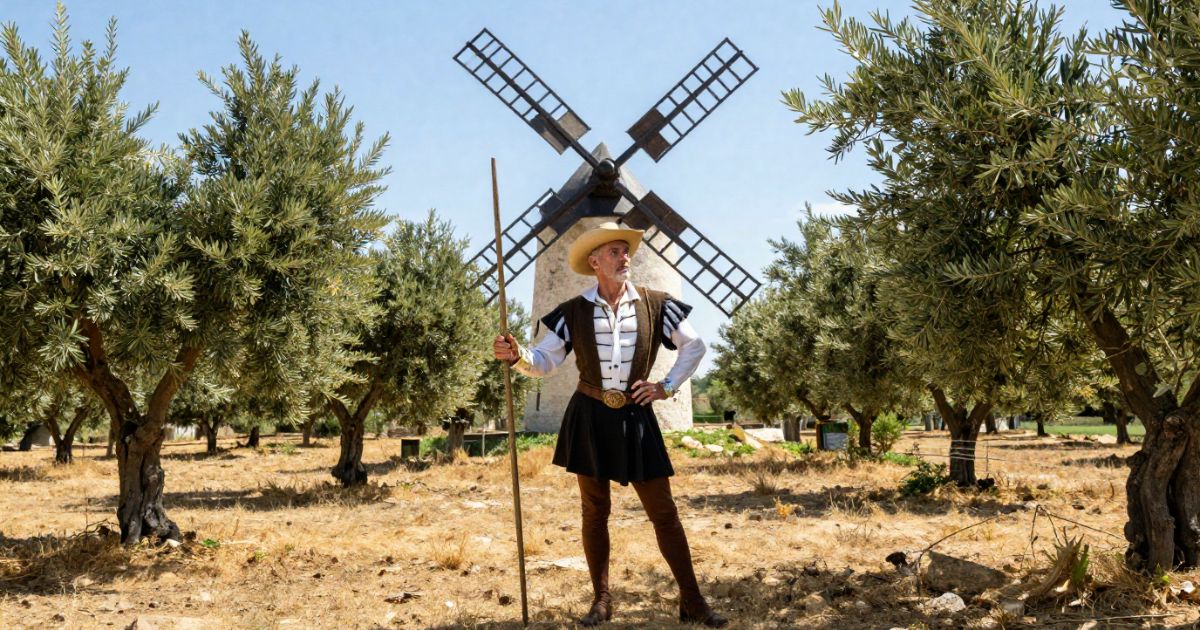
An excerpt from the original text.(complete · 4838 words)
WHICH TREATS OF THE DROLL DEVICE AND METHOD ADOPTED TO EXTRICATE OUR
LOVE-STRICKEN KNIGHT FROM THE SEVERE PENANCE HE HAD IMPOSED UPON
HIMSELF
“Such, sirs, is the true story of my sad adventures; judge for
yourselves now whether the sighs and lamentations you heard, and the
tears that flowed from my eyes, had not sufficient cause even if I had
indulged in them more freely; and if you consider the nature of my
misfortune you will see that consolation is idle, as there is no
possible remedy for it. All I ask of you is, what you may easily and
reasonably do, to show me where I may pass my life unharassed by the
fear and dread of discovery by those who are in search of me; for
though the great love my parents bear me makes me feel sure of being
kindly received by them, so great is my feeling of shame at the mere
thought that I cannot present myself before them as they expect, that I
had rather banish myself from their sight for ever than look them in
the face with the reflection that they beheld mine stripped of that
purity they had a right to expect in me.”
With these words she became silent, and the colour that overspread her
face showed plainly the pain and shame she was suffering at heart. In
theirs the listeners felt as much pity as wonder at her misfortunes;
but as the curate was just about to offer her some consolation and
advice Cardenio forestalled him, saying, “So then, señora, you are the
fair Dorothea, the only daughter of the rich Clenardo?” Dorothea was
astonished at hearing her father’s name, and at the miserable
appearance of him who mentioned it, for it has been already said how
wretchedly clad Cardenio was; so she said to him:
“And who may you be, brother, who seem to know my father’s name so
well? For so far, if I remember rightly, I have not mentioned it in the
whole story of my misfortunes.”
“I am that unhappy being, señora,” replied Cardenio, “whom, as you have
said, Luscinda declared to be her husband; I am the unfortunate
Cardenio, whom the wrong-doing of him who has brought you to your
present condition has reduced to the state you see me in, bare, ragged,
bereft of all human comfort, and what is worse, of reason, for I only
possess it when Heaven is pleased for some short space to restore it to
me. I, Dorothea, am he who witnessed the wrong done by Don Fernando,
and waited to hear the ‘Yes’ uttered by which Luscinda owned herself
his betrothed: I am he who had not courage enough to see how her
fainting fit ended, or what came of the paper that was found in her
bosom, because my heart had not the fortitude to endure so many strokes
of ill-fortune at once; and so losing patience I quitted the house, and
leaving a letter with my host, which I entreated him to place in
Luscinda’s hands, I betook myself to these solitudes, resolved to end
here the life I hated as if it were my mortal enemy. But fate would not
rid me of it, contenting itself with robbing me of my reason, perhaps
to preserve me for the good fortune I have had in meeting you; for if
that which you have just told us be true, as I believe it to be, it may
be that Heaven has yet in store for both of us a happier termination to
our misfortunes than we look for; because seeing that Luscinda cannot
marry Don Fernando, being mine, as she has herself so openly declared,
and that Don Fernando cannot marry her as he is yours, we may
reasonably hope that Heaven will restore to us what is ours, as it is
still in existence and not yet alienated or destroyed. And as we have
this consolation springing from no very visionary hope or wild fancy, I
entreat you, señora, to form new resolutions in your better mind, as I
mean to do in mine, preparing yourself to look forward to happier
fortunes; for I swear to you by the faith of a gentleman and a
Christian not to desert you until I see you in possession of Don
Fernando, and if I cannot by words induce him to recognise his
obligation to you, in that case to avail myself of the right which my
rank as a gentleman gives me, and with just cause challenge him on
account of the injury he has done you, not regarding my own wrongs,
which I shall leave to Heaven to avenge, while I on earth devote myself
to yours.”
Cardenio’s words completed the astonishment of Dorothea, and not
knowing how to return thanks for such an offer, she attempted to kiss
his feet; but Cardenio would not permit it, and the licentiate replied
for both, commended the sound reasoning of Cardenio, and lastly,
begged, advised, and urged them to come with him to his village, where
they might furnish themselves with what they needed, and take measures
to discover Don Fernando, or restore Dorothea to her parents, or do
what seemed to them most advisable. Cardenio and Dorothea thanked him,
and accepted the kind offer he made them; and the barber, who had been
listening to all attentively and in silence, on his part some kindly
words also, and with no less good-will than the curate offered his
services in any way that might be of use to them. He also explained to
them in a few words the object that had brought them there, and the
strange nature of Don Quixote’s madness, and how they were waiting for
his squire, who had gone in search of him. Like the recollection of a
dream, the quarrel he had had with Don Quixote came back to Cardenio’s
memory, and he described it to the others; but he was unable to say
what the dispute was about.
At this moment they heard a shout, and recognised it as coming from
Sancho Panza, who, not finding them where he had left them, was calling
aloud to them. They went to meet him, and in answer to their inquiries
about Don Quixote, he told them how he had found him stripped to his
shirt, lank, yellow, half dead with hunger, and sighing for his lady
Dulcinea; and although he had told him that she commanded him to quit
that place and come to El Toboso, where she was expecting him, he had
answered that he was determined not to appear in the presence of her
beauty until he had done deeds to make him worthy of her favour; and if
this went on, Sancho said, he ran the risk of not becoming an emperor
as in duty bound, or even an archbishop, which was the least he could
be; for which reason they ought to consider what was to be done to get
him away from there. The licentiate in reply told him not to be uneasy,
for they would fetch him away in spite of himself. He then told
Cardenio and Dorothea what they had proposed to do to cure Don Quixote,
or at any rate take him home; upon which Dorothea said that she could
play the distressed damsel better than the barber; especially as she
had there the dress in which to do it to the life, and that they might
trust to her acting the part in every particular requisite for carrying
out their scheme, for she had read a great many books of chivalry, and
knew exactly the style in which afflicted damsels begged boons of
knights-errant.
“In that case,” said the curate, “there is nothing more required than
to set about it at once, for beyond a doubt fortune is declaring itself
in our favour, since it has so unexpectedly begun to open a door for
your relief, and smoothed the way for us to our object.”
Dorothea then took out of her pillow-case a complete petticoat of some
rich stuff, and a green mantle of some other fine material, and a
necklace and other ornaments out of a little box, and with these in an
instant she so arrayed herself that she looked like a great and rich
lady. All this, and more, she said, she had taken from home in case of
need, but that until then she had had no occasion to make use of it.
They were all highly delighted with her grace, air, and beauty, and
declared Don Fernando to be a man of very little taste when he rejected
such charms. But the one who admired her most was Sancho Panza, for it
seemed to him (what indeed was true) that in all the days of his life
he had never seen such a lovely creature; and he asked the curate with
great eagerness who this beautiful lady was, and what she wanted in
these out-of-the-way quarters.
“This fair lady, brother Sancho,” replied the curate, “is no less a
personage than the heiress in the direct male line of the great kingdom
of Micomicon, who has come in search of your master to beg a boon of
him, which is that he redress a wrong or injury that a wicked giant has
done her; and from the fame as a good knight which your master has
acquired far and wide, this princess has come from Guinea to seek him.”
“A lucky seeking and a lucky finding!” said Sancho Panza at this;
“especially if my master has the good fortune to redress that injury,
and right that wrong, and kill that son of a bitch of a giant your
worship speaks of; as kill him he will if he meets him, unless, indeed,
he happens to be a phantom; for my master has no power at all against
phantoms. But one thing among others I would beg of you, señor
licentiate, which is, that, to prevent my master taking a fancy to be
an archbishop, for that is what I’m afraid of, your worship would
recommend him to marry this princess at once; for in this way he will
be disabled from taking archbishop’s orders, and will easily come into
his empire, and I to the end of my desires; I have been thinking over
the matter carefully, and by what I can make out I find it will not do
for me that my master should become an archbishop, because I am no good
for the Church, as I am married; and for me now, having as I have a
wife and children, to set about obtaining dispensations to enable me to
hold a place of profit under the Church, would be endless work; so
that, señor, it all turns on my master marrying this lady at once—for
as yet I do not know her grace, and so I cannot call her by her name.”
“She is called the Princess Micomicona,” said the curate; “for as her
kingdom is Micomicon, it is clear that must be her name.”
“There’s no doubt of that,” replied Sancho, “for I have known many to
take their name and title from the place where they were born and call
themselves Pedro of Alcalá, Juan of Úbeda, and Diego of Valladolid; and
it may be that over there in Guinea queens have the same way of taking
the names of their kingdoms.”
“So it may,” said the curate; “and as for your master’s marrying, I
will do all in my power towards it:” with which Sancho was as much
pleased as the curate was amazed at his simplicity and at seeing what a
hold the absurdities of his master had taken of his fancy, for he had
evidently persuaded himself that he was going to be an emperor.
By this time Dorothea had seated herself upon the curate’s mule, and
the barber had fitted the ox-tail beard to his face, and they now told
Sancho to conduct them to where Don Quixote was, warning him not to say
that he knew either the licentiate or the barber, as his master’s
becoming an emperor entirely depended on his not recognising them;
neither the curate nor Cardenio, however, thought fit to go with them;
Cardenio lest he should remind Don Quixote of the quarrel he had with
him, and the curate as there was no necessity for his presence just
yet, so they allowed the others to go on before them, while they
themselves followed slowly on foot. The curate did not forget to
instruct Dorothea how to act, but she said they might make their minds
easy, as everything would be done exactly as the books of chivalry
required and described.
They had gone about three-quarters of a league when they discovered Don
Quixote in a wilderness of rocks, by this time clothed, but without his
armour; and as soon as Dorothea saw him and was told by Sancho that
that was Don Quixote, she whipped her palfrey, the well-bearded barber
following her, and on coming up to him her squire sprang from his mule
and came forward to receive her in his arms, and she dismounting with
great ease of manner advanced to kneel before the feet of Don Quixote;
and though he strove to raise her up, she without rising addressed him
in this fashion:
“From this spot I will not rise, valiant and doughty knight, until your
goodness and courtesy grant me a boon, which will redound to the honour
and renown of your person and render a service to the most disconsolate
and afflicted damsel the sun has seen; and if the might of your strong
arm corresponds to the repute of your immortal fame, you are bound to
aid the helpless being who, led by the savour of your renowned name,
hath come from far distant lands to seek your aid in her misfortunes.”
“I will not answer a word, beauteous lady,” replied Don Quixote, “nor
will I listen to anything further concerning you, until you rise from
the earth.”
“I will not rise, señor,” answered the afflicted damsel, “unless of
your courtesy the boon I ask is first granted me.”
“I grant and accord it,” said Don Quixote, “provided without detriment
or prejudice to my king, my country, or her who holds the key of my
heart and freedom, it may be complied with.”
“It will not be to the detriment or prejudice of any of them, my worthy
lord,” said the afflicted damsel; and here Sancho Panza drew close to
his master’s ear and said to him very softly, “Your worship may very
safely grant the boon she asks; it’s nothing at all; only to kill a big
giant; and she who asks it is the exalted Princess Micomicona, queen of
the great kingdom of Micomicon of Ethiopia.”
“Let her be who she may,” replied Don Quixote, “I will do what is my
bounden duty, and what my conscience bids me, in conformity with what I
have professed;” and turning to the damsel he said, “Let your great
beauty rise, for I grant the boon which you would ask of me.”
“Then what I ask,” said the damsel, “is that your magnanimous person
accompany me at once whither I will conduct you, and that you promise
not to engage in any other adventure or quest until you have avenged me
of a traitor who against all human and divine law, has usurped my
kingdom.”
“I repeat that I grant it,” replied Don Quixote; “and so, lady, you may
from this day forth lay aside the melancholy that distresses you, and
let your failing hopes gather new life and strength, for with the help
of God and of my arm you will soon see yourself restored to your
kingdom, and seated upon the throne of your ancient and mighty realm,
notwithstanding and despite of the felons who would gainsay it; and now
hands to the work, for in delay there is apt to be danger.”
The distressed damsel strove with much pertinacity to kiss his hands;
but Don Quixote, who was in all things a polished and courteous knight,
would by no means allow it, but made her rise and embraced her with
great courtesy and politeness, and ordered Sancho to look to
Rocinante’s girths, and to arm him without a moment’s delay. Sancho
took down the armour, which was hung up on a tree like a trophy, and
having seen to the girths armed his master in a trice, who as soon as
he found himself in his armour exclaimed:
“Let us be gone in the name of God to bring aid to this great lady.”
The barber was all this time on his knees at great pains to hide his
laughter and not let his beard fall, for had it fallen maybe their fine
scheme would have come to nothing; but now seeing the boon granted, and
the promptitude with which Don Quixote prepared to set out in
compliance with it, he rose and took his lady’s hand, and between them
they placed her upon the mule. Don Quixote then mounted Rocinante, and
the barber settled himself on his beast, Sancho being left to go on
foot, which made him feel anew the loss of his Dapple, finding the want
of him now. But he bore all with cheerfulness, being persuaded that his
master had now fairly started and was just on the point of becoming an
emperor; for he felt no doubt at all that he would marry this princess,
and be king of Micomicon at least. The only thing that troubled him was
the reflection that this kingdom was in the land of the blacks, and
that the people they would give him for vassals would be all black; but
for this he soon found a remedy in his fancy, and said he to himself,
“What is it to me if my vassals are blacks? What more have I to do than
make a cargo of them and carry them to Spain, where I can sell them and
get ready money for them, and with it buy some title or some office in
which to live at ease all the days of my life? Not unless you go to
sleep and haven’t the wit or skill to turn things to account and sell
three, six, or ten thousand vassals while you would be talking about
it! By God I will stir them up, big and little, or as best I can, and
let them be ever so black I’ll turn them into white or yellow. Come,
come, what a fool I am!” And so he jogged on, so occupied with his
thoughts and easy in his mind that he forgot all about the hardship of
travelling on foot.
Cardenio and the curate were watching all this from among some bushes,
not knowing how to join company with the others; but the curate, who
was very fertile in devices, soon hit upon a way of effecting their
purpose, and with a pair of scissors he had in a case he quickly cut
off Cardenio’s beard, and putting on him a grey jerkin of his own he
gave him a black cloak, leaving himself in his breeches and doublet,
while Cardenio’s appearance was so different from what it had been that
he would not have known himself had he seen himself in a mirror. Having
effected this, although the others had gone on ahead while they were
disguising themselves, they easily came out on the high road before
them, for the brambles and awkward places they encountered did not
allow those on horseback to go as fast as those on foot. They then
posted themselves on the level ground at the outlet of the Sierra, and
as soon as Don Quixote and his companions emerged from it the curate
began to examine him very deliberately, as though he were striving to
recognise him, and after having stared at him for some time he hastened
towards him with open arms exclaiming, “A happy meeting with the mirror
of chivalry, my worthy compatriot Don Quixote of La Mancha, the flower
and cream of high breeding, the protection and relief of the
distressed, the quintessence of knights-errant!” And so saying he
clasped in his arms the knee of Don Quixote’s left leg. He, astonished
at the stranger’s words and behaviour, looked at him attentively, and
at length recognised him, very much surprised to see him there, and
made great efforts to dismount. This, however, the curate would not
allow, on which Don Quixote said, “Permit me, señor licentiate, for it
is not fitting that I should be on horseback and so reverend a person
as your worship on foot.”
“On no account will I allow it,” said the curate; “your mightiness must
remain on horseback, for it is on horseback you achieve the greatest
deeds and adventures that have been beheld in our age; as for me, an
unworthy priest, it will serve me well enough to mount on the haunches
of one of the mules of these gentlefolk who accompany your worship, if
they have no objection, and I will fancy I am mounted on the steed
Pegasus, or on the zebra or charger that bore the famous Moor,
Muzaraque, who to this day lies enchanted in the great hill of Zulema,
a little distance from the great Complutum.”
“Nor even that will I consent to, señor licentiate,” answered Don
Quixote, “and I know it will be the good pleasure of my lady the
princess, out of love for me, to order her squire to give up the saddle
of his mule to your worship, and he can sit behind if the beast will
bear it.”
“It will, I am sure,” said the princess, “and I am sure, too, that I
need not order my squire, for he is too courteous and considerate to
allow a Churchman to go on foot when he might be mounted.”
“That he is,” said the barber, and at once alighting, he offered his
saddle to the curate, who accepted it without much entreaty; but
unfortunately as the barber was mounting behind, the mule, being as it
happened a hired one, which is the same thing as saying
ill-conditioned, lifted its hind hoofs and let fly a couple of kicks in
the air, which would have made Master Nicholas wish his expedition in
quest of Don Quixote at the devil had they caught him on the breast or
head. As it was, they so took him by surprise that he came to the
ground, giving so little heed to his beard that it fell off, and all he
could do when he found himself without it was to cover his face hastily
with both his hands and moan that his teeth were knocked out. Don
Quixote when he saw all that bundle of beard detached, without jaws or
blood, from the face of the fallen squire, exclaimed:
“By the living God, but this is a great miracle! it has knocked off and
plucked away the beard from his face as if it had been shaved off
designedly.”
The curate, seeing the danger of discovery that threatened his scheme,
at once pounced upon the beard and hastened with it to where Master
Nicholas lay, still uttering moans, and drawing his head to his breast
had it on in an instant, muttering over him some words which he said
were a certain special charm for sticking on beards, as they would see;
and as soon as he had it fixed he left him, and the squire appeared
well bearded and whole as before, whereat Don Quixote was beyond
measure astonished, and begged the curate to teach him that charm when
he had an opportunity, as he was persuaded its virtue must extend
beyond the sticking on of beards, for it was clear that where the beard
had been stripped off the flesh must have remained torn and lacerated,
and when it could heal all that it must be good for more than beards.
“And so it is,” said the curate, and he promised to teach it to him on
the first opportunity. They then agreed that for the present the curate
should mount, and that the three should ride by turns until they
reached the inn, which might be about six leagues from where they were.
Three then being mounted, that is to say, Don Quixote, the princess,
and the curate, and three on foot, Cardenio, the barber, and Sancho
Panza, Don Quixote said to the damsel:
“Let your highness, lady, lead on whithersoever is most pleasing to
you;” but before she could answer the licentiate said:
“Towards what kingdom would your ladyship direct our course? Is it
perchance towards that of Micomicon? It must be, or else I know little
about kingdoms.”
She, being ready on all points, understood that she was to answer
“Yes,” so she said “Yes, señor, my way lies towards that kingdom.”
“In that case,” said the curate, “we must pass right through my
village, and there your worship will take the road to Cartagena, where
you will be able to embark, fortune favouring; and if the wind be fair
and the sea smooth and tranquil, in somewhat less than nine years you
may come in sight of the great lake Meona, I mean Meotides, which is
little more than a hundred days’ journey this side of your highness’s
kingdom.”
“Your worship is mistaken, señor,” said she; “for it is not two years
since I set out from it, and though I never had good weather,
nevertheless I am here to behold what I so longed for, and that is my
lord Don Quixote of La Mancha, whose fame came to my ears as soon as I
set foot in Spain and impelled me to go in search of him, to commend
myself to his courtesy, and entrust the justice of my cause to the
might of his invincible arm.”
“Enough; no more praise,” said Don Quixote at this, “for I hate all
flattery; and though this may not be so, still language of the kind is
offensive to my chaste ears. I will only say, señora, that whether it
has might or not, that which it may or may not have shall be devoted to
your service even to death; and now, leaving this to its proper season,
I would ask the señor licentiate to tell me what it is that has brought
him into these parts, alone, unattended, and so lightly clad that I am
filled with amazement.”
“I will answer that briefly,” replied the curate; “you must know then,
Señor Don Quixote, that Master Nicholas, our friend and barber, and I
were going to Seville to receive some money that a relative of mine who
went to the Indies many years ago had sent me, and not such a small sum
but that it was over sixty thousand pieces of eight, full weight, which
is something; and passing by this place yesterday we were attacked by
four footpads, who stripped us even to our beards, and them they
stripped off so that the barber found it necessary to put on a false
one, and even this young man here”—pointing to Cardenio—“they
completely transformed. But the best of it is, the story goes in the
neighbourhood that those who attacked us belong to a number of galley
slaves who, they say, were set free almost on the very same spot by a
man of such valour that, in spite of the commissary and of the guards,
he released the whole of them; and beyond all doubt he must have been
out of his senses, or he must be as great a scoundrel as they, or some
man without heart or conscience to let the wolf loose among the sheep,
the fox among the hens, the fly among the honey. He has defrauded
justice, and opposed his king and lawful master, for he opposed his
just commands; he has, I say, robbed the galleys of their feet, stirred
up the Holy Brotherhood which for many years past has been quiet, and,
lastly, has done a deed by which his soul may be lost without any gain
to his body.” Sancho had told the curate and the barber of the
adventure of the galley slaves, which, so much to his glory, his master
had achieved, and hence the curate in alluding to it made the most of
it to see what would be said or done by Don Quixote; who changed colour
at every word, not daring to say that it was he who had been the
liberator of those worthy people. “These, then,” said the curate, “were
they who robbed us; and God in his mercy pardon him who would not let
them go to the punishment they deserved.”
Master this chapter. Complete your experience
Purchase the complete book to access all chapters and support classic literature
As an Amazon Associate, we earn a small commission from qualifying purchases at no additional cost to you.
Available in paperback, hardcover, and e-book formats
Let's Analyse the Pattern
The most effective influence comes from working within someone's existing worldview rather than fighting against it.
Why This Matters
Connect literature to life
This chapter teaches how to identify what someone really wants beneath what they say they want, then use that insight to help them.
Practice This Today
This week, notice when someone resists help—ask yourself what they value most and how you might frame assistance in terms of their priorities rather than yours.
Now let's explore the literary elements.
Key Quotes & Analysis
"All I ask of you is, what you may easily and reasonably do, to show me where I may pass my life unharassed by the fear and dread of discovery by those who are in search of me"
Context: She's explaining why she can't go home despite her parents' love
This shows how shame can be more powerful than love. Even knowing her parents would welcome her, Dorothea would rather live in exile than face their disappointment. It reveals how honor culture destroys lives.
In Today's Words:
I just need somewhere to hide where no one will find me and judge me for what happened
"I had rather banish myself from their sight for ever than look them in the face with the reflection that they beheld mine stripped of that purity they had a right to expect in me"
Context: Explaining why she cannot return to her loving parents
Dorothea has internalized society's judgment so completely that she punishes herself more harshly than anyone else would. Her self-exile shows how victim-blaming becomes self-blame.
In Today's Words:
I'd rather never see them again than have them look at me knowing what happened to me
"The colour that overspread her face showed plainly the pain and shame she was suffering at heart"
Context: Describing Dorothea's reaction after telling her story
Physical manifestations of emotional pain show how trauma lives in the body. Her blushing reveals that telling her story doesn't bring relief - it brings fresh shame.
In Today's Words:
You could see in her face how much this was still hurting her
Thematic Threads
Compassionate Deception
In This Chapter
The friends create an elaborate fiction to help Don Quixote, showing how sometimes kindness requires working with delusion rather than against it
Development
Builds on earlier themes of helpful lies, now showing organized community effort
In Your Life:
You might recognize this when family members coordinate to help an aging parent who won't admit they need assistance
Class Mobility Dreams
In This Chapter
Sancho's excitement about becoming a governor reveals how the promise of advancement motivates endurance of current hardship
Development
Continues Sancho's consistent focus on material improvement and social climbing
In Your Life:
You see this in your own willingness to endure difficult jobs or situations when they promise future advancement
Performance of Identity
In This Chapter
Dorothea successfully performs the role of distressed princess, showing how identity can be consciously constructed for specific purposes
Development
Develops the ongoing theme of characters adopting roles to achieve their goals
In Your Life:
You might recognize this when you adjust your presentation for job interviews, family gatherings, or different social contexts
Shared Suffering Bonds
In This Chapter
Cardenio and Dorothea's recognition that they share the same betrayer creates instant alliance and mutual understanding
Development
Introduced here as a new dimension of how pain can create connection
In Your Life:
You experience this when meeting someone who's gone through similar struggles—divorce, job loss, illness—and feeling immediate kinship
Strategic Kindness
In This Chapter
The friends' plan shows how genuine care sometimes requires elaborate strategy rather than simple honesty
Development
Evolves the theme of friendship from simple loyalty to active, thoughtful intervention
In Your Life:
You might use this when helping a friend who won't accept direct help, finding indirect ways to provide support
You now have the context. Time to form your own thoughts.
Discussion Questions
- 1
Why do the curate and barber decide to work within Don Quixote's delusions rather than try to convince him he's wrong?
analysis • surface - 2
What makes the Princess Micomicona plan so effective at motivating both Don Quixote and Sancho?
analysis • medium - 3
Think of someone in your life who sees things very differently than you do. How might you 'speak their language' to reach a common goal?
application • medium - 4
When is it helpful to work within someone else's reality, and when might it become harmful enabling?
application • deep - 5
What does this chapter reveal about the difference between changing someone's mind and changing their behavior?
reflection • deep
Critical Thinking Exercise
Translate Your Message
Think of a situation where you need someone to do something but they keep resisting your approach. Write down what you want them to do, then rewrite your request three different ways using their values, priorities, or language instead of yours. Focus on what motivates them, not what makes sense to you.
Consider:
- •What does this person care about most - status, security, fun, recognition, or something else?
- •What language do they naturally use - practical, emotional, logical, or story-based?
- •How can you frame your request as helping them get what they want?
Journaling Prompt
Write about a time when someone successfully motivated you by speaking your language. What did they understand about you that others missed? How did it feel different from being lectured or argued with?
Coming Up Next...
Chapter 50: Dorothea's Clever Performance
The elaborate deception continues as the group travels toward the inn, but maintaining the charade proves more challenging than expected. Sancho's loose tongue threatens to expose the truth, while Don Quixote's keen eye for chivalric detail puts the amateur actors to the test.