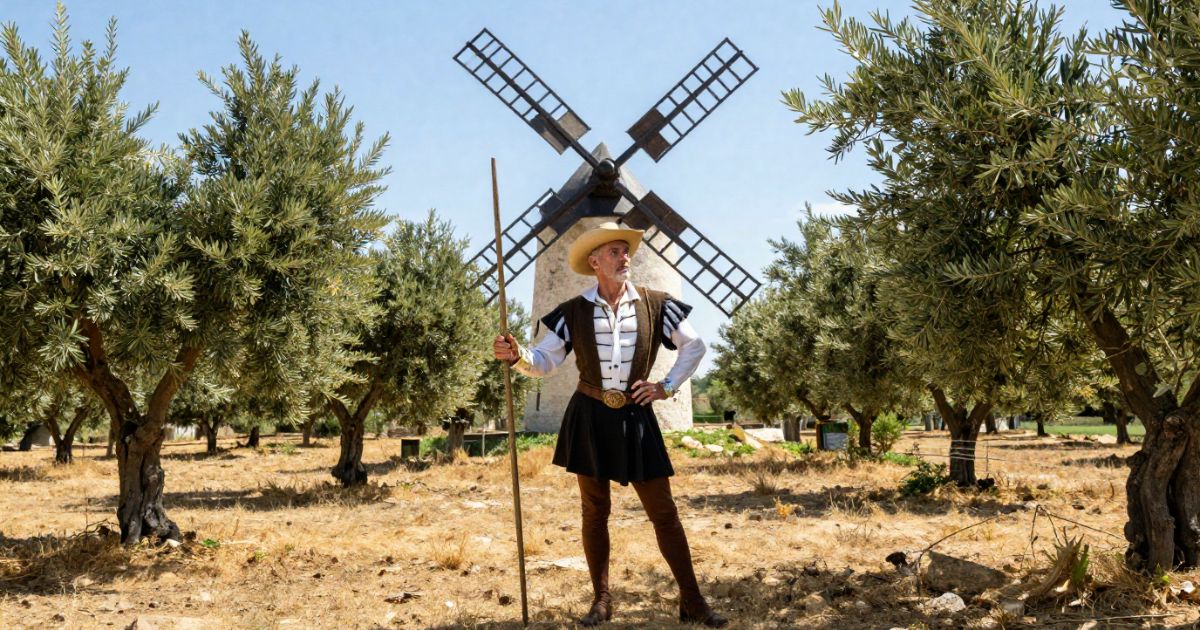
An excerpt from the original text.(complete · 538 words)
: N WHICH THE NARRATIVE OF OUR KNIGHT'S MISHAP IS CONTINUED
Lying beaten in the road, unable to move, Don Quixote's 'usual remedy' kicked in: he thought of passages from his books. His mind found the story of Baldwin and the Marquis of Mantua—a wounded knight left on a mountainside. This fit his situation perfectly. He began rolling on the ground, reciting the ballad in feeble breath.
A peasant from his village, Pedro Alonso, was returning from the mill with a load of wheat. He saw someone stretched on the ground complaining dolefully and came to investigate. Don Quixote was firmly convinced this was the Marquis of Mantua, his uncle from the ballad. He kept reciting poetry, telling the tale of his misfortune exactly as the ballad sang it.
Pedro stood amazed. He removed Quixote's battered visor, wiped his dusty face, and recognized him: "Señor Quixada, who has brought your worship to this pass?" But Quixote only continued his ballad. Pedro removed his breastplate to check for wounds—no blood, no marks, just bruises. He hoisted the delusional knight onto his ass, collected all the armor pieces and splinters of the broken lance, tied them on Rocinante, and led both animals toward the village, very sad to hear the absurd stuff pouring out.
On the journey, Quixote couldn't sit upright and kept sighing to heaven. Pedro asked what ailed him. Quixote, forgetting the Baldwin story, switched to another ballad—now he was the Moor Abindarraez taken captive by Rodrigo de Narvaez. He recited this with such aptness that Pedro cursed his fate at having to listen, concluding his neighbor was completely mad and hurrying to reach the village.
At the end of the recitation, Pedro tried once more: "Señor—sinner that I am!—cannot your worship see that I am not Don Rodrigo de Narvaez nor the Marquis of Mantua, but Pedro Alonso your neighbour, and that your worship is neither Baldwin nor Abindarraez, but the worthy gentleman Señor Quixada?"
Quixote replied with perfect certainty: "I know who I am, and I know that I may be not only those I have named, but all the Twelve Peers of France and even all the Nine Worthies, since my achievements surpass all that they have done."
They reached the village at dusk. Pedro waited until it was darker so the beaten gentleman wouldn't be seen in such miserable trim. At Don Quixote's house, they found chaos. The curate and barber were there with the housekeeper and niece, who were frantic—three days without word, and they knew the chivalric books had ruined his mind. The niece described how he'd stay up two nights reading, then slash the walls with his sword claiming he'd killed four giants, drink water and call it a magic potion.
Pedro called out, announcing "Señor Baldwin" and "the Marquis of Mantua" arriving wounded. They all rushed out. Quixote, unable to dismount, asked to be carried to bed and for the wise Urganda to treat his wounds. The housekeeper cursed the books again. They searched for wounds—found only bruises. Quixote explained he'd fallen fighting ten giants. The curate swore to burn the books. They fed him and let him sleep while the curate questioned Pedro about the nonsense Quixote had spoken.
Master this chapter. Complete your experience
Purchase the complete book to access all chapters and support classic literature
As an Amazon Associate, we earn a small commission from qualifying purchases at no additional cost to you.
Available in paperback, hardcover, and e-book formats
Let's Analyse the Pattern
When disconfirming evidence triggers increasingly elaborate explanations that preserve your original belief rather than updating it.
Why This Matters
Connect literature to life
This chapter teaches you to notice when you're generating increasingly complex explanations to protect your ego from simple, uncomfortable truths.
Practice This Today
This week, when something goes wrong, notice your first explanation. Then ask: what's the explanation that requires me to admit error? If you're building a theory, you're probably protecting yourself from a truth.
Now let's explore the literary elements.
Key Quotes & Analysis
"Finding, then, that, in fact he could not move, he thought himself of having recourse to his usual remedy, which was to think of some passage in his books."
Context: Quixote lying helpless after being beaten
His 'usual remedy' for crisis isn't problem-solving or reality-checking—it's finding a book passage that matches. This reveals how deeply literature has become his operating system. Books aren't entertainment; they're his brain's search function for meaning.
In Today's Words:
Unable to move, he did what he always did when things went wrong: found a story to explain it.
"I know who I am, and I know that I may be not only those I have named, but all the Twelve Peers of France and even all the Nine Worthies, since my achievements surpass all that they have done."
Context: Responding to Pedro's attempt to make him recognize reality
Perhaps the most famous line in the novel. It's both profound and delusional. He knows he's constructing his identity—'I know who I am' acknowledges choice. But his chosen identity encompasses every hero ever, and his 'achievements' so far are causing harm and getting beaten. Pure assertion of will over fact.
In Today's Words:
I know exactly who I am, and I can be anyone I choose to be—all of them at once—because I say so.
"Did not my heart tell the truth as to which foot my master went lame of? ...A curse I say once more, and a hundred times more, on those books of chivalry that have brought your worship to such a pass."
Context: Seeing Quixote brought home beaten and delusional
She knew this was coming. The 'heart telling truth' means her intuition warned her. She's watched him deteriorate and now he's come home broken. Her curse is specific: not books generally, but chivalric romances specifically. She sees the causal chain clearly.
In Today's Words:
I knew it! I knew something terrible would happen! Damn those fantasy books for destroying his mind!
"He said they were all bruises from having had a severe fall with his horse Rocinante when in combat with ten giants, the biggest and the boldest to be found on earth."
Context: Explaining his injuries
His explanation keeps escalating—not one giant, ten. The biggest and boldest on earth. When reality injures you, make the fictional explanation match the scope of the injury. Bigger wounds require bigger battles in the protective narrative.
In Today's Words:
He blamed his injuries on fighting ten giants, making his defeat sound like an epic battle.
Thematic Threads
Identity
In This Chapter
Quixote's identity is now so fixed that no amount of physical evidence can shake it—he'd rather be ten fictional heroes than admit he's one failed old man
Development
From choosing identity to performing it to defending it against all evidence—the final stage where identity becomes prison
In Your Life:
You might notice yourself defending your self-image even when everyone around you is trying to show you it's not accurate
Class
In This Chapter
Even broken and beaten, riding home on a donkey, Quixote maintains his nobility through language—he speaks as a knight even when everything else contradicts it
Development
Showing how class performance persists even after every other support has collapsed
In Your Life:
You might catch yourself clinging to status markers when your actual position has changed
Social Expectations
In This Chapter
Pedro waits until dark to bring Quixote home to avoid public shame. Even caregivers protect the delusional person's reputation while managing their disaster.
Development
Introducing the social management of private crisis—hiding problems to preserve face
In Your Life:
You might recognize times when you hid someone's crisis to protect their image, or when others did that for you
Personal Growth
In This Chapter
Total absence of growth—Quixote learns nothing from being beaten because his narrative shields prevent reality from registering
Development
Demonstrating how protection mechanisms that preserve ego also prevent learning
In Your Life:
You might notice patterns where your ego protection prevents you from learning lessons that could actually help you
You now have the context. Time to form your own thoughts.
Discussion Questions
- 1
What 'usual remedy' does Don Quixote use when reality becomes too difficult to handle?
analysis • surface - 2
Why does Pedro Alonso stop trying to make Quixote recognize reality and just focus on getting him home?
analysis • medium - 3
How does the housekeeper's description of Quixote's behavior at home reveal the progression of his madness?
analysis • medium - 4
Have you ever had to take care of someone who couldn't or wouldn't see their situation clearly? What was that like?
reflection • deep - 5
What's the difference between supporting someone's dreams and enabling their delusions?
application • deep
Critical Thinking Exercise
Explanation Complexity Check
Think of something that didn't work out the way you wanted—a relationship, job opportunity, project, investment. Write down your explanation for why it failed. Then count how many external factors you're blaming. If your explanation has more than two reasons, rewrite it with just one simple reason that centers your own choices or limitations. Notice how that feels different.
Consider:
- •Notice if your explanation gets more complex when someone questions it
- •Ask whether you'd accept this explanation from someone else or if you'd think they were in denial
- •Consider whether your explanation allows for learning or just protects your ego
Journaling Prompt
Write about a time when you finally stopped making excuses for why something didn't work and just admitted the simple truth. What changed when you stopped protecting yourself with complicated explanations?
Coming Up Next...
Chapter 6: The Book Burning
While Don Quixote recovers in bed, his friends raid his library. Book by book, they'll judge which chivalric romances are responsible for his madness and which might be salvaged. But can you cure someone by burning their books, or does that just make the martyr stronger?