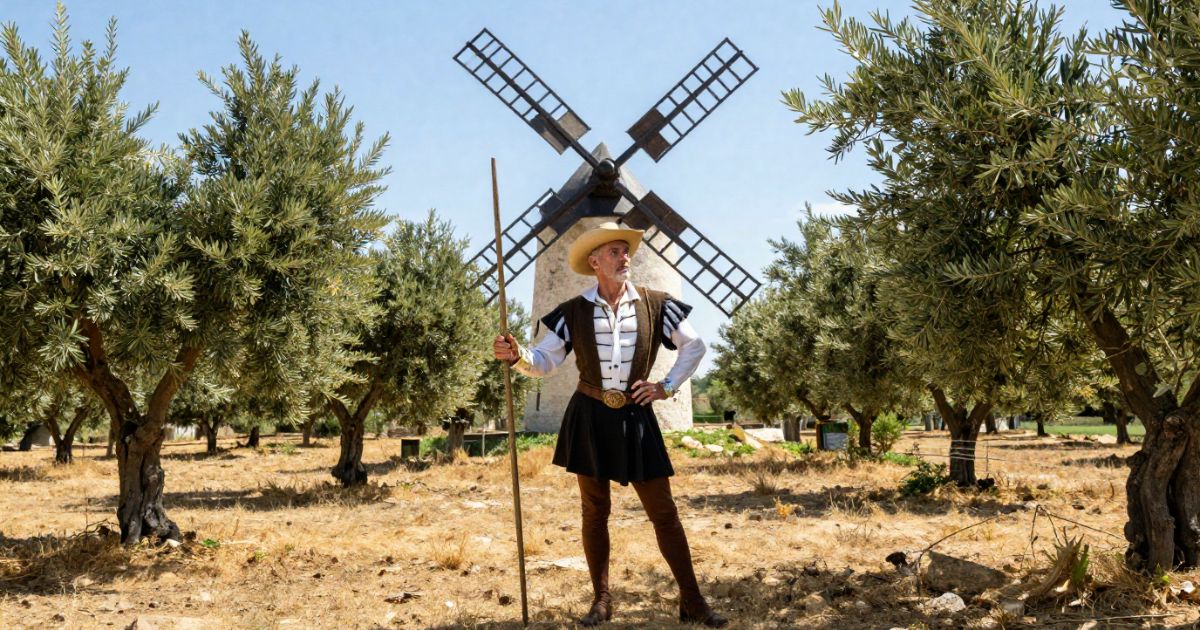
An excerpt from the original text.(complete · 436 words)
: F WHAT HAPPENED TO OUR KNIGHT WHEN HE LEFT THE INN
Don Quixote left the inn at dawn, exhilarated at being dubbed a knight. Recalling the innkeeper's advice about money and supplies, he decided to go home first and recruit a squire. But he hadn't gone far when he heard cries from a thicket. "Thanks be to heaven!" he exclaimed. His first opportunity to help someone in distress!
In the wood, a farmer was flogging a fifteen-year-old boy named Andres who was tied to a tree. The farmer claimed Andres was careless with the sheep. Don Quixote challenged the farmer like a knight challenging another knight. The terrified farmer explained Andres was his servant. Quixote demanded payment of back wages: nine months at seven reals—sixty-three reals total. The farmer mentioned shoes and medical expenses. Quixote declared those offset by the beating. The farmer said he had no money with him. Andres refused to go home with his master: "he would flay me like Saint Bartholomew!" Quixote insisted the farmer had sworn by knighthood (the farmer wasn't a knight). Andres protested, but Quixote rode off satisfied, congratulating himself for righting "the greatest wrong and grievance that ever injustice conceived."
The moment Quixote was out of sight, the farmer tied Andres back up and beat him so badly he left him for dead, mocking: "Now call on the undoer of wrongs!" Andres went off swearing to tell Quixote what happened. The farmer laughed.
Quixote, completely unaware his intervention made things catastrophically worse, rode on in perfect self-content. At a crossroads, he let Rocinante choose the direction (toward home/stable). He soon encountered Toledo traders heading to Murcia. He planted himself in the middle of the road and demanded they confess that Dulcinea del Toboso was the fairest maiden in the world. The traders, seeing his madness, asked to see her portrait first. One joked they'd confess her beauty even if she were blind in one eye and dripping sulfur from the other. Quixote, burning with rage, charged with his lance. Rocinante stumbled mid-charge. Quixote crashed to the ground, unable to rise under the weight of his armor. A muleteer, irritated by his blustering, beat him mercilessly with pieces of his own broken lance.
The traders rode off. Quixote lay there, battered and unable to move, but still believing this was a proper knight-errant mishap. He began quoting ballads. A neighbor, Pedro Alonso, found him and tried to help. Quixote thought Pedro was the Marquis of Mantua from a romantic ballad and kept reciting poetry. Pedro loaded the delusional, beaten knight onto his donkey and headed for their village.
Master this chapter. Complete your experience
Purchase the complete book to access all chapters and support classic literature
As an Amazon Associate, we earn a small commission from qualifying purchases at no additional cost to you.
Available in paperback, hardcover, and e-book formats
Let's Analyse the Pattern
When we intervene in situations based on narrative templates and good intentions, without understanding context or staying to ensure positive outcomes.
Why This Matters
Connect literature to life
This chapter teaches you to think past your immediate intervention to ask what happens next. Before you 'help,' consider the power dynamics that remain after you leave.
Practice This Today
This week, before offering help or advice, ask yourself: Do I understand the full situation? What happens after my involvement ends? Who bears the risk if I'm wrong?
Now let's explore the literary elements.
Key Quotes & Analysis
"Thus did the valiant Don Quixote right that wrong, and, thoroughly satisfied with what had taken place, as he considered he had made a very happy and noble beginning with his knighthood."
Context: Quixote's self-assessment after the Andres incident
The narrative irony is brutal. We just saw the farmer beat Andres worse than before, but Quixote is 'thoroughly satisfied' because he doesn't know. He's judging by intentions and feelings, not outcomes. This is how we avoid accountability—we evaluate based on how we think it went, not how it actually went.
In Today's Words:
He thought he'd done something amazing, having no idea he'd made everything worse.
"I go with him! Nay, God forbid! No, señor, not for the world; for once alone with me, he would flay me like a Saint Bartholomew."
Context: Begging Quixote not to leave him with his master
Andres knows exactly what will happen. He's trying to tell Quixote the power dynamics. But Quixote, operating from storybook logic, doesn't understand real-world consequences. The reference to Saint Bartholomew (flayed alive) shows Andres isn't exaggerating—he's terrified.
In Today's Words:
Please don't leave me alone with him—he'll destroy me once you're gone!
"All the world stand, unless all the world confess that in all the world there is no maiden fairer than the Empress of La Mancha, the peerless Dulcinea del Toboso."
Context: Demanding the traders make a confession of faith
He's demanding blind belief without evidence—the essence of fundamentalism. The traders reasonably ask to see her. But Quixote insists the merit lies in believing without seeing. This is faith-based thinking: the less evidence, the more virtuous the belief.
In Today's Words:
Everyone stop! Admit that my fantasy girlfriend is the most beautiful woman alive—without any proof!
"And yet he esteemed himself fortunate, as it seemed to him that this was a regular knight-errant's mishap, and entirely, he considered, the fault of his horse."
Context: Quixote lying beaten in the road
Even in total defeat, his brain finds a way to preserve the narrative. It's a 'regular mishap' (all knights face setbacks), and it's the horse's fault (not my recklessness). Zero accountability, complete narrative protection.
In Today's Words:
Even though he'd been destroyed, he convinced himself this was normal and not his fault.
Thematic Threads
Identity
In This Chapter
Quixote's knight identity requires him to intervene when he sees injustice, but his interventions are disastrous. Identity drives behavior regardless of competence.
Development
From self-creation to ritual legitimation to catastrophic action—showing how constructed identities demand performance
In Your Life:
You might notice how your self-image requires certain actions even when you're not capable of executing them well
Class
In This Chapter
Quixote assumes the farmer and traders are knights because that fits his worldview. Class confusion drives both conflicts—he treats a working farmer as a fellow knight and merchants as rabble.
Development
Expanding to show how misreading class creates conflict and harm
In Your Life:
You might catch yourself making assumptions about people's roles or status that lead to miscommunication and conflict
Social Expectations
In This Chapter
Quixote expects gratitude for his intervention (from Andres) and immediate confession of faith (from traders). Both groups have different expectations. The gap produces disaster.
Development
Showing how conflicting social expectations create unavoidable collision
In Your Life:
You might realize your expectations for how people 'should' respond to your help are causing problems
Personal Growth
In This Chapter
Despite catastrophic failure on both encounters, Quixote learns nothing. His narrative protection prevents growth by reframing every failure as external factors.
Development
Demonstrating how delusion blocks learning from experience
In Your Life:
You might notice patterns in your life where you keep making the same mistakes because you never truly acknowledge them as mistakes
You now have the context. Time to form your own thoughts.
Discussion Questions
- 1
What specific mistakes does Don Quixote make in trying to help Andres?
analysis • surface - 2
Why does Quixote ride away satisfied even though Andres begs him to stay?
analysis • medium - 3
How does Quixote's demand that the traders confess Dulcinea's beauty without proof relate to faith-based versus evidence-based thinking?
analysis • deep - 4
Have you ever tried to help someone and accidentally made their situation worse? What did you learn?
reflection • medium - 5
When should you intervene in a situation versus when should you acknowledge you don't understand enough to help?
application • deep
Critical Thinking Exercise
Intervention Checklist
Think of a situation where you want to intervene or give advice (personal, work, community issue). Before acting, answer these questions: 1) Do I understand the power dynamics that will exist after I leave? 2) What happens if the person I'm trying to help follows my advice and it goes wrong? 3) Am I committing to follow-through or just offering one-time input? 4) Am I helping them or helping my self-image? 5) What would the person I'm 'helping' say about what they actually need?
Consider:
- •Notice if your intervention plan centers your role as helper more than their actual needs
- •Consider whether you're applying a template from a similar situation rather than understanding this specific one
- •Be honest about whether you're willing to share responsibility for the outcome
Journaling Prompt
Write about a time someone tried to help you but made things worse. What did they misunderstand about your situation? What would have actually helped?
Coming Up Next...
Chapter 5: Coming Home Broken
The neighbor brings Quixote home beaten and barely conscious, still reciting ballads and mistaking everyone for fictional characters. His housekeeper, niece, and friends will have to decide what to do with a man who won't admit reality even when reality has literally beaten him unconscious.