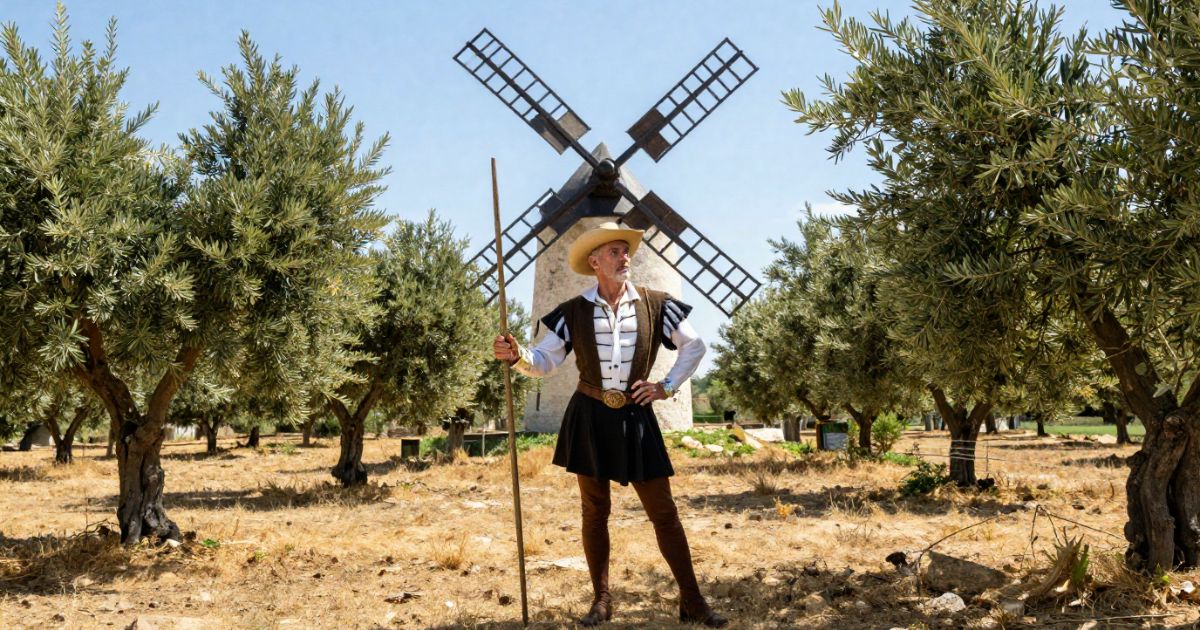
An excerpt from the original text.(complete · 4363 words)
OF THE FREEDOM DON QUIXOTE CONFERRED ON SEVERAL UNFORTUNATES WHO
AGAINST THEIR WILL WERE BEING CARRIED WHERE THEY HAD NO WISH TO GO
Cid Hamete Benengeli, the Arab and Manchegan author, relates in this
most grave, high-sounding, minute, delightful, and original history
that after the discussion between the famous Don Quixote of La Mancha
and his squire Sancho Panza which is set down at the end of chapter
twenty-one, Don Quixote raised his eyes and saw coming along the road
he was following some dozen men on foot strung together by the neck,
like beads, on a great iron chain, and all with manacles on their
hands. With them there came also two men on horseback and two on foot;
those on horseback with wheel-lock muskets, those on foot with javelins
and swords, and as soon as Sancho saw them he said:
“That is a chain of galley slaves, on the way to the galleys by force
of the king’s orders.”
“How by force?” asked Don Quixote; “is it possible that the king uses
force against anyone?”
“I do not say that,” answered Sancho, “but that these are people
condemned for their crimes to serve by force in the king’s galleys.”
“In fact,” replied Don Quixote, “however it may be, these people are
going where they are taking them by force, and not of their own will.”
“Just so,” said Sancho.
“Then if so,” said Don Quixote, “here is a case for the exercise of my
office, to put down force and to succour and help the wretched.”
“Recollect, your worship,” said Sancho, “Justice, which is the king
himself, is not using force or doing wrong to such persons, but
punishing them for their crimes.”
The chain of galley slaves had by this time come up, and Don Quixote in
very courteous language asked those who were in custody of it to be
good enough to tell him the reason or reasons for which they were
conducting these people in this manner. One of the guards on horseback
answered that they were galley slaves belonging to his majesty, that
they were going to the galleys, and that was all that was to be said
and all he had any business to know.
“Nevertheless,” replied Don Quixote, “I should like to know from each
of them separately the reason of his misfortune;” to this he added more
to the same effect to induce them to tell him what he wanted so civilly
that the other mounted guard said to him:
“Though we have here the register and certificate of the sentence of
every one of these wretches, this is no time to take them out or read
them; come and ask themselves; they can tell if they choose, and they
will, for these fellows take a pleasure in doing and talking about
rascalities.”
With this permission, which Don Quixote would have taken even had they
not granted it, he approached the chain and asked the first for what
offences he was now in such a sorry case.
He made answer that it was for being a lover.
“For that only?” replied Don Quixote; “why, if for being lovers they
send people to the galleys I might have been rowing in them long ago.”
“The love is not the sort your worship is thinking of,” said the galley
slave; “mine was that I loved a washerwoman’s basket of clean linen so
well, and held it so close in my embrace, that if the arm of the law
had not forced it from me, I should never have let it go of my own will
to this moment; I was caught in the act, there was no occasion for
torture, the case was settled, they treated me to a hundred lashes on
the back, and three years of gurapas besides, and that was the end of
it.”
“What are gurapas?” asked Don Quixote.
“Gurapas are galleys,” answered the galley slave, who was a young man
of about four-and-twenty, and said he was a native of Piedrahita.
Don Quixote asked the same question of the second, who made no reply,
so downcast and melancholy was he; but the first answered for him, and
said, “He, sir, goes as a canary, I mean as a musician and a singer.”
“What!” said Don Quixote, “for being musicians and singers are people
sent to the galleys too?”
“Yes, sir,” answered the galley slave, “for there is nothing worse than
singing under suffering.”
“On the contrary, I have heard say,” said Don Quixote, “that he who
sings scares away his woes.”
“Here it is the reverse,” said the galley slave; “for he who sings once
weeps all his life.”
“I do not understand it,” said Don Quixote; but one of the guards said
to him, “Sir, to sing under suffering means with the non sancta
fraternity to confess under torture; they put this sinner to the
torture and he confessed his crime, which was being a cuatrero, that is
a cattle-stealer, and on his confession they sentenced him to six years
in the galleys, besides two hundred lashes that he has already had on
the back; and he is always dejected and downcast because the other
thieves that were left behind and that march here ill-treat, and snub,
and jeer, and despise him for confessing and not having spirit enough
to say nay; for, say they, ‘nay’ has no more letters in it than ‘yea,’
and a culprit is well off when life or death with him depends on his
own tongue and not on that of witnesses or evidence; and to my thinking
they are not very far out.”
“And I think so too,” answered Don Quixote; then passing on to the
third he asked him what he had asked the others, and the man answered
very readily and unconcernedly, “I am going for five years to their
ladyships the gurapas for the want of ten ducats.”
“I will give twenty with pleasure to get you out of that trouble,” said
Don Quixote.
“That,” said the galley slave, “is like a man having money at sea when
he is dying of hunger and has no way of buying what he wants; I say so
because if at the right time I had had those twenty ducats that your
worship now offers me, I would have greased the notary’s pen and
freshened up the attorney’s wit with them, so that to-day I should be
in the middle of the plaza of the Zocodover at Toledo, and not on this
road coupled like a greyhound. But God is great; patience—there, that’s
enough of it.”
Don Quixote passed on to the fourth, a man of venerable aspect with a
white beard falling below his breast, who on hearing himself asked the
reason of his being there began to weep without answering a word, but
the fifth acted as his tongue and said, “This worthy man is going to
the galleys for four years, after having gone the rounds in ceremony
and on horseback.”
“That means,” said Sancho Panza, “as I take it, to have been exposed to
shame in public.”
“Just so,” replied the galley slave, “and the offence for which they
gave him that punishment was having been an ear-broker, nay
body-broker; I mean, in short, that this gentleman goes as a pimp, and
for having besides a certain touch of the sorcerer about him.”
“If that touch had not been thrown in,” said Don Quixote, “he would not
deserve, for mere pimping, to row in the galleys, but rather to command
and be admiral of them; for the office of pimp is no ordinary one,
being the office of persons of discretion, one very necessary in a
well-ordered state, and only to be exercised by persons of good birth;
nay, there ought to be an inspector and overseer of them, as in other
offices, and recognised number, as with the brokers on change; in this
way many of the evils would be avoided which are caused by this office
and calling being in the hands of stupid and ignorant people, such as
women more or less silly, and pages and jesters of little standing and
experience, who on the most urgent occasions, and when ingenuity of
contrivance is needed, let the crumbs freeze on the way to their
mouths, and know not which is their right hand. I should like to go
farther, and give reasons to show that it is advisable to choose those
who are to hold so necessary an office in the state, but this is not
the fit place for it; some day I will expound the matter to someone
able to see to and rectify it; all I say now is, that the additional
fact of his being a sorcerer has removed the sorrow it gave me to see
these white hairs and this venerable countenance in so painful a
position on account of his being a pimp; though I know well there are
no sorceries in the world that can move or compel the will as some
simple folk fancy, for our will is free, nor is there herb or charm
that can force it. All that certain silly women and quacks do is to
turn men mad with potions and poisons, pretending that they have power
to cause love, for, as I say, it is an impossibility to compel the
will.”
“It is true,” said the good old man, “and indeed, sir, as far as the
charge of sorcery goes I was not guilty; as to that of being a pimp I
cannot deny it; but I never thought I was doing any harm by it, for my
only object was that all the world should enjoy itself and live in
peace and quiet, without quarrels or troubles; but my good intentions
were unavailing to save me from going where I never expect to come back
from, with this weight of years upon me and a urinary ailment that
never gives me a moment’s ease;” and again he fell to weeping as
before, and such compassion did Sancho feel for him that he took out a
real of four from his bosom and gave it to him in alms.
Don Quixote went on and asked another what his crime was, and the man
answered with no less but rather much more sprightliness than the last
one.
“I am here because I carried the joke too far with a couple of cousins
of mine, and with a couple of other cousins who were none of mine; in
short, I carried the joke so far with them all that it ended in such a
complicated increase of kindred that no accountant could make it clear:
it was all proved against me, I got no favour, I had no money, I was
near having my neck stretched, they sentenced me to the galleys for six
years, I accepted my fate, it is the punishment of my fault; I am a
young man; let life only last, and with that all will come right. If
you, sir, have anything wherewith to help the poor, God will repay it
to you in heaven, and we on earth will take care in our petitions to
him to pray for the life and health of your worship, that they may be
as long and as good as your amiable appearance deserves.”
This one was in the dress of a student, and one of the guards said he
was a great talker and a very elegant Latin scholar.
Behind all these there came a man of thirty, a very personable fellow,
except that when he looked, his eyes turned in a little one towards the
other. He was bound differently from the rest, for he had to his leg a
chain so long that it was wound all round his body, and two rings on
his neck, one attached to the chain, the other to what they call a
“keep-friend” or “friend’s foot,” from which hung two irons reaching to
his waist with two manacles fixed to them in which his hands were
secured by a big padlock, so that he could neither raise his hands to
his mouth nor lower his head to his hands. Don Quixote asked why this
man carried so many more chains than the others. The guard replied that
it was because he alone had committed more crimes than all the rest put
together, and was so daring and such a villain, that though they
marched him in that fashion they did not feel sure of him, but were in
dread of his making his escape.
“What crimes can he have committed,” said Don Quixote, “if they have
not deserved a heavier punishment than being sent to the galleys?”
“He goes for ten years,” replied the guard, “which is the same thing as
civil death, and all that need be said is that this good fellow is the
famous Gines de Pasamonte, otherwise called Ginesillo de Parapilla.”
“Gently, señor commissary,” said the galley slave at this, “let us have
no fixing of names or surnames; my name is Gines, not Ginesillo, and my
family name is Pasamonte, not Parapilla as you say; let each one mind
his own business, and he will be doing enough.”
“Speak with less impertinence, master thief of extra measure,” replied
the commissary, “if you don’t want me to make you hold your tongue in
spite of your teeth.”
“It is easy to see,” returned the galley slave, “that man goes as God
pleases, but someone shall know some day whether I am called Ginesillo
de Parapilla or not.”
“Don’t they call you so, you liar?” said the guard.
“They do,” returned Gines, “but I will make them give over calling me
so, or I will be shaved, where, I only say behind my teeth. If you,
sir, have anything to give us, give it to us at once, and God speed
you, for you are becoming tiresome with all this inquisitiveness about
the lives of others; if you want to know about mine, let me tell you I
am Gines de Pasamonte, whose life is written by these fingers.”
“He says true,” said the commissary, “for he has himself written his
story as grand as you please, and has left the book in the prison in
pawn for two hundred reals.”
“And I mean to take it out of pawn,” said Gines, “though it were in for
two hundred ducats.”
“Is it so good?” said Don Quixote.
“So good is it,” replied Gines, “that a fig for ‘Lazarillo de Tormes,’
and all of that kind that have been written, or shall be written
compared with it: all I will say about it is that it deals with facts,
and facts so neat and diverting that no lies could match them.”
“And how is the book entitled?” asked Don Quixote.
“The ‘Life of Gines de Pasamonte,’” replied the subject of it.
“And is it finished?” asked Don Quixote.
“How can it be finished,” said the other, “when my life is not yet
finished? All that is written is from my birth down to the point when
they sent me to the galleys this last time.”
“Then you have been there before?” said Don Quixote.
“In the service of God and the king I have been there for four years
before now, and I know by this time what the biscuit and courbash are
like,” replied Gines; “and it is no great grievance to me to go back to
them, for there I shall have time to finish my book; I have still many
things left to say, and in the galleys of Spain there is more than
enough leisure; though I do not want much for what I have to write, for
I have it by heart.”
“You seem a clever fellow,” said Don Quixote.
“And an unfortunate one,” replied Gines, “for misfortune always
persecutes good wit.”
“It persecutes rogues,” said the commissary.
“I told you already to go gently, master commissary,” said Pasamonte;
“their lordships yonder never gave you that staff to ill-treat us
wretches here, but to conduct and take us where his majesty orders you;
if not, by the life of—never mind—; it may be that some day the stains
made in the inn will come out in the scouring; let everyone hold his
tongue and behave well and speak better; and now let us march on, for
we have had quite enough of this entertainment.”
The commissary lifted his staff to strike Pasamonte in return for his
threats, but Don Quixote came between them, and begged him not to
ill-use him, as it was not too much to allow one who had his hands tied
to have his tongue a trifle free; and turning to the whole chain of
them he said:
“From all you have told me, dear brethren, I make out clearly that
though they have punished you for your faults, the punishments you are
about to endure do not give you much pleasure, and that you go to them
very much against the grain and against your will, and that perhaps
this one’s want of courage under torture, that one’s want of money, the
other’s want of advocacy, and lastly the perverted judgment of the
judge may have been the cause of your ruin and of your failure to
obtain the justice you had on your side. All which presents itself now
to my mind, urging, persuading, and even compelling me to demonstrate
in your case the purpose for which Heaven sent me into the world and
caused me to make profession of the order of chivalry to which I
belong, and the vow I took therein to give aid to those in need and
under the oppression of the strong. But as I know that it is a mark of
prudence not to do by foul means what may be done by fair, I will ask
these gentlemen, the guards and commissary, to be so good as to release
you and let you go in peace, as there will be no lack of others to
serve the king under more favourable circumstances; for it seems to me
a hard case to make slaves of those whom God and nature have made free.
Moreover, sirs of the guard,” added Don Quixote, “these poor fellows
have done nothing to you; let each answer for his own sins yonder;
there is a God in Heaven who will not forget to punish the wicked or
reward the good; and it is not fitting that honest men should be the
instruments of punishment to others, they being therein no way
concerned. This request I make thus gently and quietly, that, if you
comply with it, I may have reason for thanking you; and, if you will
not voluntarily, this lance and sword together with the might of my arm
shall compel you to comply with it by force.”
“Nice nonsense!” said the commissary; “a fine piece of pleasantry he
has come out with at last! He wants us to let the king’s prisoners go,
as if we had any authority to release them, or he to order us to do so!
Go your way, sir, and good luck to you; put that basin straight that
you’ve got on your head, and don’t go looking for three feet on a cat.”
“’Tis you that are the cat, rat, and rascal,” replied Don Quixote, and
acting on the word he fell upon him so suddenly that without giving him
time to defend himself he brought him to the ground sorely wounded with
a lance-thrust; and lucky it was for him that it was the one that had
the musket. The other guards stood thunderstruck and amazed at this
unexpected event, but recovering presence of mind, those on horseback
seized their swords, and those on foot their javelins, and attacked Don
Quixote, who was waiting for them with great calmness; and no doubt it
would have gone badly with him if the galley slaves, seeing the chance
before them of liberating themselves, had not effected it by contriving
to break the chain on which they were strung. Such was the confusion,
that the guards, now rushing at the galley slaves who were breaking
loose, now to attack Don Quixote who was waiting for them, did nothing
at all that was of any use. Sancho, on his part, gave a helping hand to
release Gines de Pasamonte, who was the first to leap forth upon the
plain free and unfettered, and who, attacking the prostrate commissary,
took from him his sword and the musket, with which, aiming at one and
levelling at another, he, without ever discharging it, drove every one
of the guards off the field, for they took to flight, as well to escape
Pasamonte’s musket, as the showers of stones the now released galley
slaves were raining upon them. Sancho was greatly grieved at the
affair, because he anticipated that those who had fled would report the
matter to the Holy Brotherhood, who at the summons of the alarm-bell
would at once sally forth in quest of the offenders; and he said so to
his master, and entreated him to leave the place at once, and go into
hiding in the sierra that was close by.
“That is all very well,” said Don Quixote, “but I know what must be
done now;” and calling together all the galley slaves, who were now
running riot, and had stripped the commissary to the skin, he collected
them round him to hear what he had to say, and addressed them as
follows: “To be grateful for benefits received is the part of persons
of good birth, and one of the sins most offensive to God is
ingratitude; I say so because, sirs, ye have already seen by manifest
proof the benefit ye have received of me; in return for which I desire,
and it is my good pleasure that, laden with that chain which I have
taken off your necks, ye at once set out and proceed to the city of El
Toboso, and there present yourselves before the lady Dulcinea del
Toboso, and say to her that her knight, he of the Rueful Countenance,
sends to commend himself to her; and that ye recount to her in full
detail all the particulars of this notable adventure, up to the
recovery of your longed-for liberty; and this done ye may go where ye
will, and good fortune attend you.”
Gines de Pasamonte made answer for all, saying, “That which you, sir,
our deliverer, demand of us, is of all impossibilities the most
impossible to comply with, because we cannot go together along the
roads, but only singly and separate, and each one his own way,
endeavouring to hide ourselves in the bowels of the earth to escape the
Holy Brotherhood, which, no doubt, will come out in search of us. What
your worship may do, and fairly do, is to change this service and
tribute as regards the lady Dulcinea del Toboso for a certain quantity
of ave-marias and credos which we will say for your worship’s
intention, and this is a condition that can be complied with by night
as by day, running or resting, in peace or in war; but to imagine that
we are going now to return to the flesh-pots of Egypt, I mean to take
up our chain and set out for El Toboso, is to imagine that it is now
night, though it is not yet ten in the morning, and to ask this of us
is like asking pears of the elm tree.”
“Then by all that’s good,” said Don Quixote (now stirred to wrath),
“Don son of a bitch, Don Ginesillo de Paropillo, or whatever your name
is, you will have to go yourself alone, with your tail between your
legs and the whole chain on your back.”
Pasamonte, who was anything but meek (being by this time thoroughly
convinced that Don Quixote was not quite right in his head as he had
committed such a vagary as to set them free), finding himself abused in
this fashion, gave the wink to his companions, and falling back they
began to shower stones on Don Quixote at such a rate that he was quite
unable to protect himself with his buckler, and poor Rocinante no more
heeded the spur than if he had been made of brass. Sancho planted
himself behind his ass, and with him sheltered himself from the
hailstorm that poured on both of them. Don Quixote was unable to shield
himself so well but that more pebbles than I could count struck him
full on the body with such force that they brought him to the ground;
and the instant he fell the student pounced upon him, snatched the
basin from his head, and with it struck three or four blows on his
shoulders, and as many more on the ground, knocking it almost to
pieces. They then stripped him of a jacket that he wore over his
armour, and they would have stripped off his stockings if his greaves
had not prevented them. From Sancho they took his coat, leaving him in
his shirt-sleeves; and dividing among themselves the remaining spoils
of the battle, they went each one his own way, more solicitous about
keeping clear of the Holy Brotherhood they dreaded, than about
burdening themselves with the chain, or going to present themselves
before the lady Dulcinea del Toboso. The ass and Rocinante, Sancho and
Don Quixote, were all that were left upon the spot; the ass with
drooping head, serious, shaking his ears from time to time as if he
thought the storm of stones that assailed them was not yet over;
Rocinante stretched beside his master, for he too had been brought to
the ground by a stone; Sancho stripped, and trembling with fear of the
Holy Brotherhood; and Don Quixote fuming to find himself so served by
the very persons for whom he had done so much.
c22e.jpg (44K)
Master this chapter. Complete your experience
Purchase the complete book to access all chapters and support classic literature
As an Amazon Associate, we earn a small commission from qualifying purchases at no additional cost to you.
Available in paperback, hardcover, and e-book formats
Let's Analyse the Pattern
When our desire to help others becomes more about our heroic identity than their actual needs.
Why This Matters
Connect literature to life
This chapter teaches how to recognize when someone's help comes with strings attached or serves their ego more than your needs.
Practice This Today
This week, notice when someone offers unsolicited help or advice—ask yourself what they might be getting out of it besides the satisfaction of helping you.
Now let's explore the literary elements.
Key Quotes & Analysis
"These people are going where they are taking them by force, and not of their own will."
Context: When Sancho explains these are convicted criminals being legally transported to the galleys
Don Quixote reduces a complex legal situation to a simple matter of force versus free will. He ignores that their crimes led to this consequence, focusing only on their current lack of choice.
In Today's Words:
Nobody wants to be here, so they must be victims who need rescuing.
"I was condemned to the galleys for six years for loving a laundry basket too much."
Context: When Don Quixote asks each prisoner about their crimes
The prisoner euphemistically describes his theft, making it sound romantic rather than criminal. This shows how people reframe their wrongdoing to avoid responsibility.
In Today's Words:
I got six years for stealing, but I'm making it sound cute and harmless.
"It is impossible for us to go and present ourselves before the lady Dulcinea del Toboso, because we are being hunted by the Holy Brotherhood."
Context: When Don Quixote demands the freed prisoners present themselves to his imaginary lady as proof of his heroic deed
Ginés points out the practical impossibility of Don Quixote's demand, revealing how the knight's fantasy world clashes with reality. The criminals must now flee, not perform chivalric ceremonies.
In Today's Words:
We can't do your weird publicity stunt because we're fugitives now, thanks to you.
Thematic Threads
Identity
In This Chapter
Don Quixote's identity as knight-errant requires him to see injustice everywhere, even where it doesn't exist
Development
Deepening from earlier chapters where he fought windmills—now his delusions actively harm real people
In Your Life:
You might cling to being 'the helpful one' even when your help isn't wanted or needed
Class
In This Chapter
Don Quixote, from minor nobility, assumes he knows better than both the working-class guards and criminal prisoners
Development
Consistent pattern of his class assumptions overriding practical wisdom
In Your Life:
You might dismiss others' expertise because of their job title or background
Social Expectations
In This Chapter
Don Quixote expects gratitude and compliance from those he 'rescues' without their consent
Development
His chivalric code creates impossible expectations that reality cannot meet
In Your Life:
You might feel angry when people don't appreciate your unsolicited help or advice
Human Relationships
In This Chapter
The freed prisoners' ingratitude reveals how forced 'help' creates resentment rather than connection
Development
Shows the consequences of Don Quixote's inability to form genuine partnerships
In Your Life:
Your relationships might suffer when you try to fix people instead of understanding them
Personal Growth
In This Chapter
Don Quixote learns nothing from this disaster, doubling down on his worldview instead of questioning it
Development
His refusal to adapt or learn from consequences becomes more pronounced
In Your Life:
You might blame others for not appreciating you instead of examining whether you're actually helping
You now have the context. Time to form your own thoughts.
Discussion Questions
- 1
Don Quixote interviews each prisoner about their crimes but still decides they all deserve freedom. What does this tell us about how he processes information that contradicts his beliefs?
analysis • surface - 2
Why does Don Quixote demand that the freed prisoners present themselves to Dulcinea? What does this reveal about his true motivations for helping them?
analysis • medium - 3
Think about someone you know who always offers unsolicited advice or help. How is their behavior similar to Don Quixote's rescue of the prisoners?
application • medium - 4
When have you offered help that wasn't actually wanted or needed? How did you react when your help wasn't appreciated the way you expected?
reflection • deep - 5
What's the difference between genuine service and performing heroism? How can you tell when someone is helping others versus helping their own image?
analysis • deep
Critical Thinking Exercise
Rewrite the Scene from Ginés's Perspective
Imagine you're Ginés de Pasamonte, the career criminal and aspiring writer. Write a brief account of this incident from your point of view. How would you describe this strange knight who 'rescued' you? What were your real thoughts when he demanded you report to some imaginary lady?
Consider:
- •Consider what Ginés actually wanted versus what Don Quixote assumed he wanted
- •Think about how it feels to be 'helped' by someone who doesn't understand your situation
- •Reflect on the gap between the helper's intentions and the recipient's experience
Journaling Prompt
Write about a time when someone tried to help you in a way that felt more about them than about you. How did it make you feel, and what would genuine help have looked like instead?
Coming Up Next...
Chapter 43: The Mystery of the Sierra Morena
Beaten, robbed, and humiliated by the very people he tried to help, Don Quixote retreats into the wild Sierra Morena mountains. There, nursing his wounds and his wounded pride, he will attempt one of the most elaborate acts of knight-errantry yet—a dramatic penance that will test the limits of both his sanity and Sancho's patience.