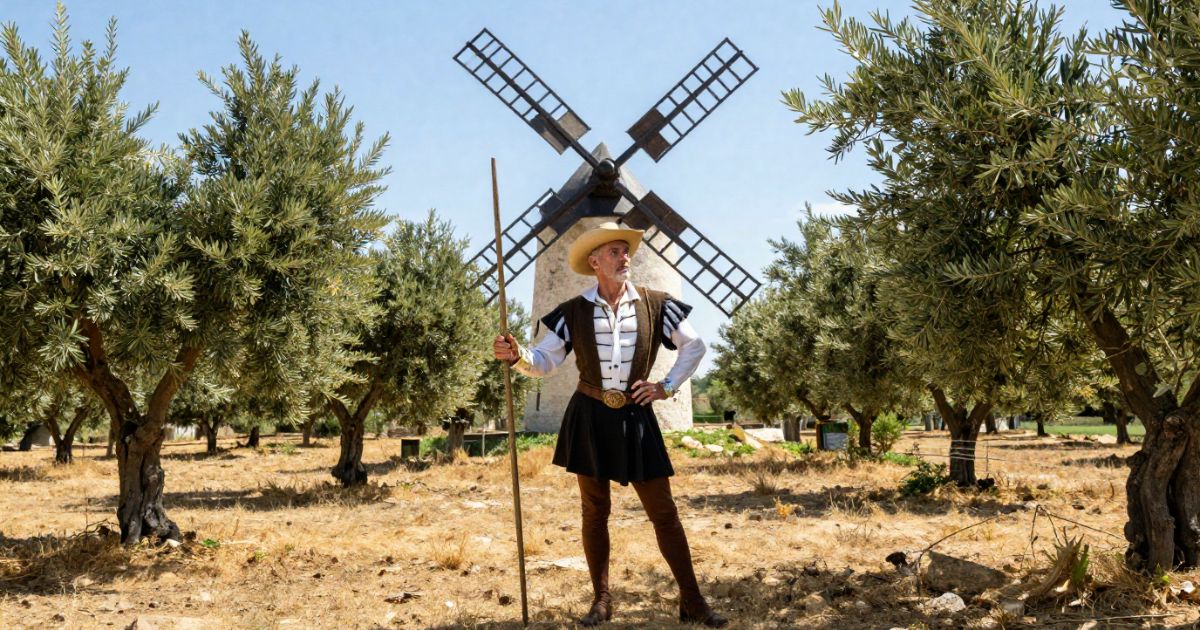
An excerpt from the original text.(complete · 4765 words)
HICH TREATS OF THE EXALTED ADVENTURE AND RICH PRIZE OF MAMBRINO’S
HELMET, TOGETHER WITH OTHER THINGS THAT HAPPENED TO OUR INVINCIBLE
KNIGHT
It now began to rain a little, and Sancho was for going into the
fulling mills, but Don Quixote had taken such an abhorrence to them on
account of the late joke that he would not enter them on any account;
so turning aside to right they came upon another road, different from
that which they had taken the night before. Shortly afterwards Don
Quixote perceived a man on horseback who wore on his head something
that shone like gold, and the moment he saw him he turned to Sancho and
said:
“I think, Sancho, there is no proverb that is not true, all being
maxims drawn from experience itself, the mother of all the sciences,
especially that one that says, ‘Where one door shuts, another opens.’ I
say so because if last night fortune shut the door of the adventure we
were looking for against us, cheating us with the fulling mills, it now
opens wide another one for another better and more certain adventure,
and if I do not contrive to enter it, it will be my own fault, and I
cannot lay it to my ignorance of fulling mills, or the darkness of the
night. I say this because, if I mistake not, there comes towards us one
who wears on his head the helmet of Mambrino, concerning which I took
the oath thou rememberest.”
“Mind what you say, your worship, and still more what you do,” said
Sancho, “for I don’t want any more fulling mills to finish off fulling
and knocking our senses out.”
“The devil take thee, man,” said Don Quixote; “what has a helmet to do
with fulling mills?”
“I don’t know,” replied Sancho, “but, faith, if I might speak as I
used, perhaps I could give such reasons that your worship would see you
were mistaken in what you say.”
“How can I be mistaken in what I say, unbelieving traitor?” returned
Don Quixote; “tell me, seest thou not yonder knight coming towards us
on a dappled grey steed, who has upon his head a helmet of gold?”
“What I see and make out,” answered Sancho, “is only a man on a grey
ass like my own, who has something that shines on his head.”
“Well, that is the helmet of Mambrino,” said Don Quixote; “stand to one
side and leave me alone with him; thou shalt see how, without saying a
word, to save time, I shall bring this adventure to an issue and
possess myself of the helmet I have so longed for.”
“I will take care to stand aside,” said Sancho; “but God grant, I say
once more, that it may be marjoram and not fulling mills.”
“I have told thee, brother, on no account to mention those fulling
mills to me again,” said Don Quixote, “or I vow—and I say no more—I’ll
full the soul out of you.”
Sancho held his peace in dread lest his master should carry out the vow
he had hurled like a bowl at him.
The fact of the matter as regards the helmet, steed, and knight that
Don Quixote saw, was this. In that neighbourhood there were two
villages, one of them so small that it had neither apothecary’s shop
nor barber, which the other that was close to it had, so the barber of
the larger served the smaller, and in it there was a sick man who
required to be bled and another man who wanted to be shaved, and on
this errand the barber was going, carrying with him a brass basin; but
as luck would have it, as he was on the way it began to rain, and not
to spoil his hat, which probably was a new one, he put the basin on his
head, and being clean it glittered at half a league’s distance. He rode
upon a grey ass, as Sancho said, and this was what made it seem to Don
Quixote to be a dapple-grey steed and a knight and a golden helmet; for
everything he saw he made to fall in with his crazy chivalry and
ill-errant notions; and when he saw the poor knight draw near, without
entering into any parley with him, at Rocinante’s top speed he bore
down upon him with the pike pointed low, fully determined to run him
through and through, and as he reached him, without checking the fury
of his charge, he cried to him:
“Defend thyself, miserable being, or yield me of thine own accord that
which is so reasonably my due.”
The barber, who without any expectation or apprehension of it saw this
apparition coming down upon him, had no other way of saving himself
from the stroke of the lance but to let himself fall off his ass; and
no sooner had he touched the ground than he sprang up more nimbly than
a deer and sped away across the plain faster than the wind.
He left the basin on the ground, with which Don Quixote contented
himself, saying that the pagan had shown his discretion and imitated
the beaver, which finding itself pressed by the hunters bites and cuts
off with its teeth that for which, by its natural instinct, it knows it
is pursued.
He told Sancho to pick up the helmet, and he taking it in his hands
said:
“By God the basin is a good one, and worth a real of eight if it is
worth a maravedis,” and handed it to his master, who immediately put it
on his head, turning it round, now this way, now that, in search of
fitment, and not finding it he said, “Clearly the pagan to whose
measure this famous head-piece was first forged must have had a very
large head; but the worst of it is half of it is wanting.”
When Sancho heard him call the basin a headpiece he was unable to
restrain his laughter, but remembering his master’s wrath he checked
himself in the midst of it.
“What art thou laughing at, Sancho?” said Don Quixote.
“I am laughing,” said he, “to think of the great head the pagan must
have had who owned this helmet, for it looks exactly like a regular
barber’s basin.”
“Dost thou know what I suspect, Sancho?” said Don Quixote; “that this
wonderful piece of this enchanted helmet must by some strange accident
have come into the hands of someone who was unable to recognise or
realise its value, and who, not knowing what he did, and seeing it to
be of the purest gold, must have melted down one half for the sake of
what it might be worth, and of the other made this which is like a
barber’s basin as thou sayest; but be it as it may, to me who recognise
it, its transformation makes no difference, for I will set it to rights
at the first village where there is a blacksmith, and in such style
that that helmet the god of smithies forged for the god of battles
shall not surpass it or even come up to it; and in the meantime I will
wear it as well as I can, for something is better than nothing; all the
more as it will be quite enough to protect me from any chance blow of a
stone.”
“That is,” said Sancho, “if it is not shot with a sling as they were in
the battle of the two armies, when they signed the cross on your
worship’s grinders and smashed the flask with that blessed draught that
made me vomit my bowels up.”
“It does not grieve me much to have lost it,” said Don Quixote, “for
thou knowest, Sancho, that I have the receipt in my memory.”
“So have I,” answered Sancho, “but if ever I make it, or try it again
as long as I live, may this be my last hour; moreover, I have no
intention of putting myself in the way of wanting it, for I mean, with
all my five senses, to keep myself from being wounded or from wounding
anyone: as to being blanketed again I say nothing, for it is hard to
prevent mishaps of that sort, and if they come there is nothing for it
but to squeeze our shoulders together, hold our breath, shut our eyes,
and let ourselves go where luck and the blanket may send us.”
“Thou art a bad Christian, Sancho,” said Don Quixote on hearing this,
“for once an injury has been done thee thou never forgettest it: but
know that it is the part of noble and generous hearts not to attach
importance to trifles. What lame leg hast thou got by it, what broken
rib, what cracked head, that thou canst not forget that jest? For jest
and sport it was, properly regarded, and had I not seen it in that
light I would have returned and done more mischief in revenging thee
than the Greeks did for the rape of Helen, who, if she were alive now,
or if my Dulcinea had lived then, might depend upon it she would not be
so famous for her beauty as she is;” and here he heaved a sigh and sent
it aloft; and said Sancho, “Let it pass for a jest as it cannot be
revenged in earnest, but I know what sort of jest and earnest it was,
and I know it will never be rubbed out of my memory any more than off
my shoulders. But putting that aside, will your worship tell me what
are we to do with this dapple-grey steed that looks like a grey ass,
which that Martino that your worship overthrew has left deserted here?
for, from the way he took to his heels and bolted, he is not likely
ever to come back for it; and by my beard but the grey is a good one.”
“I have never been in the habit,” said Don Quixote, “of taking spoil of
those whom I vanquish, nor is it the practice of chivalry to take away
their horses and leave them to go on foot, unless indeed it be that the
victor have lost his own in the combat, in which case it is lawful to
take that of the vanquished as a thing won in lawful war; therefore,
Sancho, leave this horse, or ass, or whatever thou wilt have it to be;
for when its owner sees us gone hence he will come back for it.”
“God knows I should like to take it,” returned Sancho, “or at least to
change it for my own, which does not seem to me as good a one: verily
the laws of chivalry are strict, since they cannot be stretched to let
one ass be changed for another; I should like to know if I might at
least change trappings.”
“On that head I am not quite certain,” answered Don Quixote, “and the
matter being doubtful, pending better information, I say thou mayest
change them, if so be thou hast urgent need of them.”
“So urgent is it,” answered Sancho, “that if they were for my own
person I could not want them more;” and forthwith, fortified by this
licence, he effected the mutatio capparum, and rigged out his beast
to the ninety-nines and making quite another thing of it. This done,
they broke their fast on the remains of the spoils of war plundered
from the sumpter mule, and drank of the brook that flowed from the
fulling mills, without casting a look in that direction, in such
loathing did they hold them for the alarm they had caused them; and,
all anger and gloom removed, they mounted and, without taking any fixed
road (not to fix upon any being the proper thing for true
knights-errant), they set out, guided by Rocinante’s will, which
carried along with it that of his master, not to say that of the ass,
which always followed him wherever he led, lovingly and sociably;
nevertheless they returned to the high road, and pursued it at a
venture without any other aim.
As they went along, then, in this way Sancho said to his master,
“Señor, would your worship give me leave to speak a little to you? For
since you laid that hard injunction of silence on me several things
have gone to rot in my stomach, and I have now just one on the tip of
my tongue that I don’t want to be spoiled.”
“Say, on, Sancho,” said Don Quixote, “and be brief in thy discourse,
for there is no pleasure in one that is long.”
“Well then, señor,” returned Sancho, “I say that for some days past I
have been considering how little is got or gained by going in search of
these adventures that your worship seeks in these wilds and
cross-roads, where, even if the most perilous are victoriously
achieved, there is no one to see or know of them, and so they must be
left untold for ever, to the loss of your worship’s object and the
credit they deserve; therefore it seems to me it would be better
(saving your worship’s better judgment) if we were to go and serve some
emperor or other great prince who may have some war on hand, in whose
service your worship may prove the worth of your person, your great
might, and greater understanding, on perceiving which the lord in whose
service we may be will perforce have to reward us, each according to
his merits; and there you will not be at a loss for someone to set down
your achievements in writing so as to preserve their memory for ever.
Of my own I say nothing, as they will not go beyond squirely limits,
though I make bold to say that, if it be the practice in chivalry to
write the achievements of squires, I think mine must not be left out.”
“Thou speakest not amiss, Sancho,” answered Don Quixote, “but before
that point is reached it is requisite to roam the world, as it were on
probation, seeking adventures, in order that, by achieving some, name
and fame may be acquired, such that when he betakes himself to the
court of some great monarch the knight may be already known by his
deeds, and that the boys, the instant they see him enter the gate of
the city, may all follow him and surround him, crying, ‘This is the
Knight of the Sun’—or the Serpent, or any other title under which he
may have achieved great deeds. ‘This,’ they will say, ‘is he who
vanquished in single combat the gigantic Brocabruno of mighty strength;
he who delivered the great Mameluke of Persia out of the long
enchantment under which he had been for almost nine hundred years.’ So
from one to another they will go proclaiming his achievements; and
presently at the tumult of the boys and the others the king of that
kingdom will appear at the windows of his royal palace, and as soon as
he beholds the knight, recognising him by his arms and the device on
his shield, he will as a matter of course say, ‘What ho! Forth all ye,
the knights of my court, to receive the flower of chivalry who cometh
hither!’ At which command all will issue forth, and he himself,
advancing half-way down the stairs, will embrace him closely, and
salute him, kissing him on the cheek, and will then lead him to the
queen’s chamber, where the knight will find her with the princess her
daughter, who will be one of the most beautiful and accomplished
damsels that could with the utmost pains be discovered anywhere in the
known world. Straightway it will come to pass that she will fix her
eyes upon the knight and he his upon her, and each will seem to the
other something more divine than human, and, without knowing how or why
they will be taken and entangled in the inextricable toils of love, and
sorely distressed in their hearts not to see any way of making their
pains and sufferings known by speech. Thence they will lead him, no
doubt, to some richly adorned chamber of the palace, where, having
removed his armour, they will bring him a rich mantle of scarlet
wherewith to robe himself, and if he looked noble in his armour he will
look still more so in a doublet. When night comes he will sup with the
king, queen, and princess; and all the time he will never take his eyes
off her, stealing stealthy glances, unnoticed by those present, and she
will do the same, and with equal cautiousness, being, as I have said, a
damsel of great discretion. The tables being removed, suddenly through
the door of the hall there will enter a hideous and diminutive dwarf
followed by a fair dame, between two giants, who comes with a certain
adventure, the work of an ancient sage; and he who shall achieve it
shall be deemed the best knight in the world.
“The king will then command all those present to essay it, and none
will bring it to an end and conclusion save the stranger knight, to the
great enhancement of his fame, whereat the princess will be overjoyed
and will esteem herself happy and fortunate in having fixed and placed
her thoughts so high. And the best of it is that this king, or prince,
or whatever he is, is engaged in a very bitter war with another as
powerful as himself, and the stranger knight, after having been some
days at his court, requests leave from him to go and serve him in the
said war. The king will grant it very readily, and the knight will
courteously kiss his hands for the favour done to him; and that night
he will take leave of his lady the princess at the grating of the
chamber where she sleeps, which looks upon a garden, and at which he
has already many times conversed with her, the go-between and
confidante in the matter being a damsel much trusted by the princess.
He will sigh, she will swoon, the damsel will fetch water, much
distressed because morning approaches, and for the honour of her lady
he would not that they were discovered; at last the princess will come
to herself and will present her white hands through the grating to the
knight, who will kiss them a thousand and a thousand times, bathing
them with his tears. It will be arranged between them how they are to
inform each other of their good or evil fortunes, and the princess will
entreat him to make his absence as short as possible, which he will
promise to do with many oaths; once more he kisses her hands, and takes
his leave in such grief that he is well-nigh ready to die. He betakes
him thence to his chamber, flings himself on his bed, cannot sleep for
sorrow at parting, rises early in the morning, goes to take leave of
the king, queen, and princess, and, as he takes his leave of the pair,
it is told him that the princess is indisposed and cannot receive a
visit; the knight thinks it is from grief at his departure, his heart
is pierced, and he is hardly able to keep from showing his pain. The
confidante is present, observes all, goes to tell her mistress, who
listens with tears and says that one of her greatest distresses is not
knowing who this knight is, and whether he is of kingly lineage or not;
the damsel assures her that so much courtesy, gentleness, and gallantry
of bearing as her knight possesses could not exist in any save one who
was royal and illustrious; her anxiety is thus relieved, and she
strives to be of good cheer lest she should excite suspicion in her
parents, and at the end of two days she appears in public. Meanwhile
the knight has taken his departure; he fights in the war, conquers the
king’s enemy, wins many cities, triumphs in many battles, returns to
the court, sees his lady where he was wont to see her, and it is agreed
that he shall demand her in marriage of her parents as the reward of
his services; the king is unwilling to give her, as he knows not who he
is, but nevertheless, whether carried off or in whatever other way it
may be, the princess comes to be his bride, and her father comes to
regard it as very good fortune; for it so happens that this knight is
proved to be the son of a valiant king of some kingdom, I know not
what, for I fancy it is not likely to be on the map. The father dies,
the princess inherits, and in two words the knight becomes king. And
here comes in at once the bestowal of rewards upon his squire and all
who have aided him in rising to so exalted a rank. He marries his
squire to a damsel of the princess’s, who will be, no doubt, the one
who was confidante in their amour, and is daughter of a very great
duke.”
“That’s what I want, and no mistake about it!” said Sancho. “That’s
what I’m waiting for; for all this, word for word, is in store for your
worship under the title of the Knight of the Rueful Countenance.”
“Thou needst not doubt it, Sancho,” replied Don Quixote, “for in the
same manner, and by the same steps as I have described here,
knights-errant rise and have risen to be kings and emperors; all we
want now is to find out what king, Christian or pagan, is at war and
has a beautiful daughter; but there will be time enough to think of
that, for, as I have told thee, fame must be won in other quarters
before repairing to the court. There is another thing, too, that is
wanting; for supposing we find a king who is at war and has a beautiful
daughter, and that I have won incredible fame throughout the universe,
I know not how it can be made out that I am of royal lineage, or even
second cousin to an emperor; for the king will not be willing to give
me his daughter in marriage unless he is first thoroughly satisfied on
this point, however much my famous deeds may deserve it; so that by
this deficiency I fear I shall lose what my arm has fairly earned. True
it is I am a gentleman of known house, of estate and property, and
entitled to the five hundred sueldos mulet; and it may be that the sage
who shall write my history will so clear up my ancestry and pedigree
that I may find myself fifth or sixth in descent from a king; for I
would have thee know, Sancho, that there are two kinds of lineages in
the world; some there be tracing and deriving their descent from kings
and princes, whom time has reduced little by little until they end in a
point like a pyramid upside down; and others who spring from the common
herd and go on rising step by step until they come to be great lords;
so that the difference is that the one were what they no longer are,
and the others are what they formerly were not. And I may be of such
that after investigation my origin may prove great and famous, with
which the king, my father-in-law that is to be, ought to be satisfied;
and should he not be, the princess will so love me that even though she
well knew me to be the son of a water-carrier, she will take me for her
lord and husband in spite of her father; if not, then it comes to
seizing her and carrying her off where I please; for time or death will
put an end to the wrath of her parents.”
“It comes to this, too,” said Sancho, “what some naughty people say,
‘Never ask as a favour what thou canst take by force;’ though it would
fit better to say, ‘A clear escape is better than good men’s prayers.’
I say so because if my lord the king, your worship’s father-in-law,
will not condescend to give you my lady the princess, there is nothing
for it but, as your worship says, to seize her and transport her. But
the mischief is that until peace is made and you come into the peaceful
enjoyment of your kingdom, the poor squire is famishing as far as
rewards go, unless it be that the confidante damsel that is to be his
wife comes with the princess, and that with her he tides over his bad
luck until Heaven otherwise orders things; for his master, I suppose,
may as well give her to him at once for a lawful wife.”
“Nobody can object to that,” said Don Quixote.
“Then since that may be,” said Sancho, “there is nothing for it but to
commend ourselves to God, and let fortune take what course it will.”
“God guide it according to my wishes and thy wants,” said Don Quixote,
“and mean be he who thinks himself mean.”
“In God’s name let him be so,” said Sancho: “I am an old Christian, and
to fit me for a count that’s enough.”
“And more than enough for thee,” said Don Quixote; “and even wert thou
not, it would make no difference, because I being the king can easily
give thee nobility without purchase or service rendered by thee, for
when I make thee a count, then thou art at once a gentleman; and they
may say what they will, but by my faith they will have to call thee
‘your lordship,’ whether they like it or not.”
“Not a doubt of it; and I’ll know how to support the tittle,” said
Sancho.
“Title thou shouldst say, not tittle,” said his master.
“So be it,” answered Sancho. “I say I will know how to behave, for once
in my life I was beadle of a brotherhood, and the beadle’s gown sat so
well on me that all said I looked as if I was to be steward of the same
brotherhood. What will it be, then, when I put a duke’s robe on my
back, or dress myself in gold and pearls like a count? I believe
they’ll come a hundred leagues to see me.”
“Thou wilt look well,” said Don Quixote, “but thou must shave thy beard
often, for thou hast it so thick and rough and unkempt, that if thou
dost not shave it every second day at least, they will see what thou
art at the distance of a musket shot.”
“What more will it be,” said Sancho, “than having a barber, and keeping
him at wages in the house? and even if it be necessary, I will make him
go behind me like a nobleman’s equerry.”
“Why, how dost thou know that noblemen have equerries behind them?”
asked Don Quixote.
“I will tell you,” answered Sancho. “Years ago I was for a month at the
capital and there I saw taking the air a very small gentleman who they
said was a very great man, and a man following him on horseback in
every turn he took, just as if he was his tail. I asked why this man
did not join the other man, instead of always going behind him; they
answered me that he was his equerry, and that it was the custom with
nobles to have such persons behind them, and ever since then I know it,
for I have never forgotten it.”
“Thou art right,” said Don Quixote, “and in the same way thou mayest
carry thy barber with thee, for customs did not come into use all
together, nor were they all invented at once, and thou mayest be the
first count to have a barber to follow him; and, indeed, shaving one’s
beard is a greater trust than saddling one’s horse.”
“Let the barber business be my look-out,” said Sancho; “and your
worship’s be it to strive to become a king, and make me a count.”
“So it shall be,” answered Don Quixote, and raising his eyes he saw
what will be told in the following chapter.
c20e.jpg (18K)
Master this chapter. Complete your experience
Purchase the complete book to access all chapters and support classic literature
As an Amazon Associate, we earn a small commission from qualifying purchases at no additional cost to you.
Available in paperback, hardcover, and e-book formats
Let's Analyse the Pattern
When our identity depends on being right, we'll create elaborate explanations to reshape contradictory evidence rather than question our core beliefs.
Why This Matters
Connect literature to life
This chapter teaches how to recognize when we're reshaping reality to protect our ego rather than facing uncomfortable truths.
Practice This Today
This week, notice when you catch yourself creating complex explanations for simple contradictions—that's usually your brain protecting a belief you're not ready to question.
Now let's explore the literary elements.
Key Quotes & Analysis
"Where one door shuts, another opens."
Context: After being humiliated by the fulling mills, he spots the barber and sees a new opportunity for glory.
Shows how Don Quixote reframes every setback as setup for something better. His optimism is admirable but disconnected from reality - he learns nothing from failure.
In Today's Words:
When one opportunity falls through, another one always comes along.
"There comes towards us one who wears on his head the helmet of Mambrino."
Context: Seeing the barber with a brass basin on his head to keep his hat dry.
Perfect example of how powerful beliefs can completely reshape what we see. Don Quixote isn't lying - he genuinely sees a legendary helmet where others see kitchen equipment.
In Today's Words:
Look, there's someone wearing that famous designer item I've been wanting.
"What adventures can we find in remote places where no one will witness our deeds?"
Context: Questioning why they seek adventures in isolated areas where no one will see their supposed heroics.
Sancho cuts to the heart of a key issue - what's the point of great deeds if no one knows about them? Shows his practical understanding that reputation requires witnesses.
In Today's Words:
What's the point of doing amazing things if nobody's going to see them and give us credit?
Thematic Threads
Identity
In This Chapter
Don Quixote's knight identity is so central that he'll transform a barber's basin into a magical helmet rather than question his role
Development
Deepening from earlier chapters - his identity delusions are becoming more elaborate and defensive
In Your Life:
You might recognize this when you find yourself making excuses to preserve how you see yourself rather than facing uncomfortable truths.
Class
In This Chapter
Don Quixote promises Sancho noble titles and lands, using class mobility as motivation to maintain loyalty
Development
Evolved from simple master-servant to complex dreams of social advancement through adventure
In Your Life:
You see this when people use promises of advancement or status to keep you invested in their unrealistic plans.
Recognition
In This Chapter
Sancho worries their deeds won't be witnessed; Don Quixote spins fantasies about fame and princess brides
Development
New focus on the need for external validation of their adventures
In Your Life:
You experience this when you question whether your hard work matters if no one important notices it.
Ambition
In This Chapter
Both characters become intoxicated by visions of future glory - Don Quixote as legendary knight, Sancho as count
Development
Introduced here as a shared delusion that bonds them despite reality
In Your Life:
You might find yourself drawn into unrealistic schemes when they promise escape from your current struggles.
Perception
In This Chapter
The brass basin becomes a golden helmet through sheer force of will and elaborate justification
Development
Escalating from simple misperception to active reality reconstruction
In Your Life:
You see this when you realize you've been interpreting situations to fit what you want to believe rather than what's actually happening.
You now have the context. Time to form your own thoughts.
Discussion Questions
- 1
What does Don Quixote see when he looks at the barber's basin, and how does he explain away the obvious contradiction when Sancho points out what it really is?
analysis • surface - 2
Why does Don Quixote create the 'enchantment' theory instead of simply admitting he made a mistake about the helmet?
analysis • medium - 3
Think about someone you know who refuses to accept obvious facts about their situation. How do they explain away contradictions to protect their beliefs?
application • medium - 4
When you catch yourself making elaborate excuses for why something isn't working in your life, what's usually the belief or identity you're trying to protect?
application • deep - 5
What does this chapter reveal about why people choose comfortable delusions over uncomfortable truths?
reflection • deep
Critical Thinking Exercise
Reality Check Audit
Think of one area in your life where things aren't going as planned—a relationship, job, goal, or project. Write down the simple, obvious explanation for why it's not working. Then write down the more complex explanations you've been telling yourself. Notice which explanation requires fewer mental gymnastics.
Consider:
- •The more elaborate your explanation, the more likely you're protecting your ego rather than solving the problem
- •Ask yourself: 'What would I tell a friend in this exact situation?'
- •Consider what identity or belief you might be protecting with your complex explanations
Journaling Prompt
Write about a time when you finally accepted a simple, uncomfortable truth instead of clinging to a complex, comfortable explanation. What changed when you stopped editing reality to protect your feelings?
Coming Up Next...
Chapter 42: The Liberation of the Chain Gang
Don Quixote and Sancho encounter a chain gang of galley slaves being transported to their punishment, setting up another opportunity for the knight to intervene in what he sees as an injustice requiring his heroic attention.