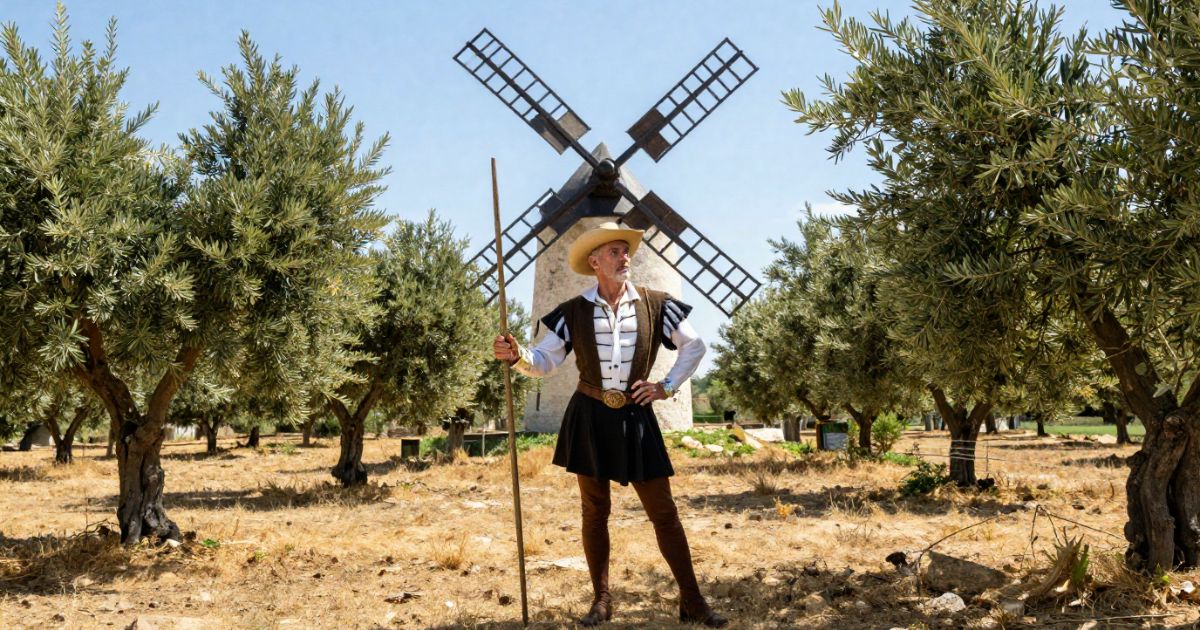
An excerpt from the original text.(complete · 5363 words)
OF THE UNEXAMPLED AND UNHEARD-OF ADVENTURE WHICH WAS ACHIEVED BY THE
VALIANT DON QUIXOTE OF LA MANCHA WITH LESS PERIL THAN ANY EVER ACHIEVED
BY ANY FAMOUS KNIGHT IN THE WORLD
“It cannot be, señor, but that this grass is a proof that there must be
hard by some spring or brook to give it moisture, so it would be well
to move a little farther on, that we may find some place where we may
quench this terrible thirst that plagues us, which beyond a doubt is
more distressing than hunger.”
The advice seemed good to Don Quixote, and, he leading Rocinante by the
bridle and Sancho the ass by the halter, after he had packed away upon
him the remains of the supper, they advanced the meadow feeling their
way, for the darkness of the night made it impossible to see anything;
but they had not gone two hundred paces when a loud noise of water, as
if falling from great rocks, struck their ears. The sound cheered them
greatly; but halting to make out by listening from what quarter it came
they heard unseasonably another noise which spoiled the satisfaction
the sound of the water gave them, especially for Sancho, who was by
nature timid and faint-hearted. They heard, I say, strokes falling with
a measured beat, and a certain rattling of iron and chains that,
together with the furious din of the water, would have struck terror
into any heart but Don Quixote’s. The night was, as has been said,
dark, and they had happened to reach a spot in among some tall trees,
whose leaves stirred by a gentle breeze made a low ominous sound; so
that, what with the solitude, the place, the darkness, the noise of the
water, and the rustling of the leaves, everything inspired awe and
dread; more especially as they perceived that the strokes did not
cease, nor the wind lull, nor morning approach; to all which might be
added their ignorance as to where they were.
But Don Quixote, supported by his intrepid heart, leaped on Rocinante,
and bracing his buckler on his arm, brought his pike to the slope, and
said, “Friend Sancho, know that I by Heaven’s will have been born in
this our iron age to revive in it the age of gold, or the golden as it
is called; I am he for whom perils, mighty achievements, and valiant
deeds are reserved; I am, I say again, he who is to revive the Knights
of the Round Table, the Twelve of France and the Nine Worthies; and he
who is to consign to oblivion the Platirs, the Tablantes, the Olivantes
and Tirantes, the Phœbuses and Belianises, with the whole herd of
famous knights-errant of days gone by, performing in these in which I
live such exploits, marvels, and feats of arms as shall obscure their
brightest deeds. Thou dost mark well, faithful and trusty squire, the
gloom of this night, its strange silence, the dull confused murmur of
those trees, the awful sound of that water in quest of which we came,
that seems as though it were precipitating and dashing itself down from
the lofty mountains of the Moon, and that incessant hammering that
wounds and pains our ears; which things all together and each of itself
are enough to instil fear, dread, and dismay into the breast of Mars
himself, much more into one not used to hazards and adventures of the
kind. Well, then, all this that I put before thee is but an incentive
and stimulant to my spirit, making my heart burst in my bosom through
eagerness to engage in this adventure, arduous as it promises to be;
therefore tighten Rocinante’s girths a little, and God be with thee;
wait for me here three days and no more, and if in that time I come not
back, thou canst return to our village, and thence, to do me a favour
and a service, thou wilt go to El Toboso, where thou shalt say to my
incomparable lady Dulcinea that her captive knight hath died in
attempting things that might make him worthy of being called hers.”
When Sancho heard his master’s words he began to weep in the most
pathetic way, saying:
“Señor, I know not why your worship wants to attempt this so dreadful
adventure; it is night now, no one sees us here, we can easily turn
about and take ourselves out of danger, even if we don’t drink for
three days to come; and as there is no one to see us, all the less will
there be anyone to set us down as cowards; besides, I have many a time
heard the curate of our village, whom your worship knows well, preach
that he who seeks danger perishes in it; so it is not right to tempt
God by trying so tremendous a feat from which there can be no escape
save by a miracle, and Heaven has performed enough of them for your
worship in delivering you from being blanketed as I was, and bringing
you out victorious and safe and sound from among all those enemies that
were with the dead man; and if all this does not move or soften that
hard heart, let this thought and reflection move it, that you will have
hardly quitted this spot when from pure fear I shall yield my soul up
to anyone that will take it. I left home and wife and children to come
and serve your worship, trusting to do better and not worse; but as
covetousness bursts the bag, it has rent my hopes asunder, for just as
I had them highest about getting that wretched unlucky island your
worship has so often promised me, I see that instead and in lieu of it
you mean to desert me now in a place so far from human reach: for God’s
sake, master mine, deal not so unjustly by me, and if your worship will
not entirely give up attempting this feat, at least put it off till
morning, for by what the lore I learned when I was a shepherd tells me
it cannot want three hours of dawn now, because the mouth of the Horn
is overhead and makes midnight in the line of the left arm.”
“How canst thou see, Sancho,” said Don Quixote, “where it makes that
line, or where this mouth or this occiput is that thou talkest of, when
the night is so dark that there is not a star to be seen in the whole
heaven?”
“That’s true,” said Sancho, “but fear has sharp eyes, and sees things
underground, much more above in heavens; besides, there is good reason
to show that it now wants but little of day.”
“Let it want what it may,” replied Don Quixote, “it shall not be said
of me now or at any time that tears or entreaties turned me aside from
doing what was in accordance with knightly usage; and so I beg of thee,
Sancho, to hold thy peace, for God, who has put it into my heart to
undertake now this so unexampled and terrible adventure, will take care
to watch over my safety and console thy sorrow; what thou hast to do is
to tighten Rocinante’s girths well, and wait here, for I shall come
back shortly, alive or dead.”
Sancho perceiving it his master’s final resolve, and how little his
tears, counsels, and entreaties prevailed with him, determined to have
recourse to his own ingenuity and compel him, if he could, to wait till
daylight; and so, while tightening the girths of the horse, he quietly
and without being felt, with his ass’ halter tied both Rocinante’s
legs, so that when Don Quixote strove to go he was unable as the horse
could only move by jumps. Seeing the success of his trick, Sancho Panza
said:
“See there, señor! Heaven, moved by my tears and prayers, has so
ordered it that Rocinante cannot stir; and if you will be obstinate,
and spur and strike him, you will only provoke fortune, and kick, as
they say, against the pricks.”
Don Quixote at this grew desperate, but the more he drove his heels
into the horse, the less he stirred him; and not having any suspicion
of the tying, he was fain to resign himself and wait till daybreak or
until Rocinante could move, firmly persuaded that all this came of
something other than Sancho’s ingenuity. So he said to him, “As it is
so, Sancho, and as Rocinante cannot move, I am content to wait till
dawn smiles upon us, even though I weep while it delays its coming.”
“There is no need to weep,” answered Sancho, “for I will amuse your
worship by telling stories from this till daylight, unless indeed you
like to dismount and lie down to sleep a little on the green grass
after the fashion of knights-errant, so as to be fresher when day comes
and the moment arrives for attempting this extraordinary adventure you
are looking forward to.”
“What art thou talking about dismounting or sleeping for?” said Don
Quixote. “Am I, thinkest thou, one of those knights that take their
rest in the presence of danger? Sleep thou who art born to sleep, or do
as thou wilt, for I will act as I think most consistent with my
character.”
“Be not angry, master mine,” replied Sancho, “I did not mean to say
that;” and coming close to him he laid one hand on the pommel of the
saddle and the other on the cantle so that he held his master’s left
thigh in his embrace, not daring to separate a finger’s width from him;
so much afraid was he of the strokes which still resounded with a
regular beat. Don Quixote bade him tell some story to amuse him as he
had proposed, to which Sancho replied that he would if his dread of
what he heard would let him; “Still,” said he, “I will strive to tell a
story which, if I can manage to relate it, and nobody interferes with
the telling, is the best of stories, and let your worship give me your
attention, for here I begin. What was, was; and may the good that is to
come be for all, and the evil for him who goes to look for it—your
worship must know that the beginning the old folk used to put to their
tales was not just as each one pleased; it was a maxim of Cato
Zonzorino the Roman, that says ‘the evil for him that goes to look for
it,’ and it comes as pat to the purpose now as ring to finger, to show
that your worship should keep quiet and not go looking for evil in any
quarter, and that we should go back by some other road, since nobody
forces us to follow this in which so many terrors affright us.”
“Go on with thy story, Sancho,” said Don Quixote, “and leave the choice
of our road to my care.”
“I say then,” continued Sancho, “that in a village of Estremadura there
was a goat-shepherd—that is to say, one who tended goats—which shepherd
or goatherd, as my story goes, was called Lope Ruiz, and this Lope Ruiz
was in love with a shepherdess called Torralva, which shepherdess
called Torralva was the daughter of a rich grazier, and this rich
grazier—”
“If that is the way thou tellest thy tale, Sancho,” said Don Quixote,
“repeating twice all thou hast to say, thou wilt not have done these
two days; go straight on with it, and tell it like a reasonable man, or
else say nothing.”
“Tales are always told in my country in the very way I am telling
this,” answered Sancho, “and I cannot tell it in any other, nor is it
right of your worship to ask me to make new customs.”
“Tell it as thou wilt,” replied Don Quixote; “and as fate will have it
that I cannot help listening to thee, go on.”
“And so, lord of my soul,” continued Sancho, as I have said, this
shepherd was in love with Torralva the shepherdess, who was a wild
buxom lass with something of the look of a man about her, for she had
little moustaches; I fancy I see her now.”
“Then you knew her?” said Don Quixote.
“I did not know her,” said Sancho, “but he who told me the story said
it was so true and certain that when I told it to another I might
safely declare and swear I had seen it all myself. And so in course of
time, the devil, who never sleeps and puts everything in confusion,
contrived that the love the shepherd bore the shepherdess turned into
hatred and ill-will, and the reason, according to evil tongues, was
some little jealousy she caused him that crossed the line and
trespassed on forbidden ground; and so much did the shepherd hate her
from that time forward that, in order to escape from her, he determined
to quit the country and go where he should never set eyes on her again.
Torralva, when she found herself spurned by Lope, was immediately
smitten with love for him, though she had never loved him before.”
“That is the natural way of women,” said Don Quixote, “to scorn the one
that loves them, and love the one that hates them: go on, Sancho.”
“It came to pass,” said Sancho, “that the shepherd carried out his
intention, and driving his goats before him took his way across the
plains of Estremadura to pass over into the Kingdom of Portugal.
Torralva, who knew of it, went after him, and on foot and barefoot
followed him at a distance, with a pilgrim’s staff in her hand and a
scrip round her neck, in which she carried, it is said, a bit of
looking-glass and a piece of a comb and some little pot or other of
paint for her face; but let her carry what she did, I am not going to
trouble myself to prove it; all I say is, that the shepherd, they say,
came with his flock to cross over the river Guadiana, which was at that
time swollen and almost overflowing its banks, and at the spot he came
to there was neither ferry nor boat nor anyone to carry him or his
flock to the other side, at which he was much vexed, for he perceived
that Torralva was approaching and would give him great annoyance with
her tears and entreaties; however, he went looking about so closely
that he discovered a fisherman who had alongside of him a boat so small
that it could only hold one person and one goat; but for all that he
spoke to him and agreed with him to carry himself and his three hundred
goats across. The fisherman got into the boat and carried one goat
over; he came back and carried another over; he came back again, and
again brought over another—let your worship keep count of the goats the
fisherman is taking across, for if one escapes the memory there will be
an end of the story, and it will be impossible to tell another word of
it. To proceed, I must tell you the landing place on the other side was
miry and slippery, and the fisherman lost a great deal of time in going
and coming; still he returned for another goat, and another, and
another.”
“Take it for granted he brought them all across,” said Don Quixote,
“and don’t keep going and coming in this way, or thou wilt not make an
end of bringing them over this twelvemonth.”
“How many have gone across so far?” said Sancho.
“How the devil do I know?” replied Don Quixote.
“There it is,” said Sancho, “what I told you, that you must keep a good
count; well then, by God, there is an end of the story, for there is no
going any farther.”
“How can that be?” said Don Quixote; “is it so essential to the story
to know to a nicety the goats that have crossed over, that if there be
a mistake of one in the reckoning, thou canst not go on with it?”
“No, señor, not a bit,” replied Sancho; “for when I asked your worship
to tell me how many goats had crossed, and you answered you did not
know, at that very instant all I had to say passed away out of my
memory, and, faith, there was much virtue in it, and entertainment.”
“So, then,” said Don Quixote, “the story has come to an end?”
“As much as my mother has,” said Sancho.
“In truth,” said Don Quixote, “thou hast told one of the rarest
stories, tales, or histories, that anyone in the world could have
imagined, and such a way of telling it and ending it was never seen nor
will be in a lifetime; though I expected nothing else from thy
excellent understanding. But I do not wonder, for perhaps those
ceaseless strokes may have confused thy wits.”
“All that may be,” replied Sancho, “but I know that as to my story, all
that can be said is that it ends there where the mistake in the count
of the passage of the goats begins.”
“Let it end where it will, well and good,” said Don Quixote, “and let
us see if Rocinante can go;” and again he spurred him, and again
Rocinante made jumps and remained where he was, so well tied was he.
Just then, whether it was the cold of the morning that was now
approaching, or that he had eaten something laxative at supper, or that
it was only natural (as is most likely), Sancho felt a desire to do
what no one could do for him; but so great was the fear that had
penetrated his heart, he dared not separate himself from his master by
as much as the black of his nail; to escape doing what he wanted was,
however, also impossible; so what he did for peace’s sake was to remove
his right hand, which held the back of the saddle, and with it to untie
gently and silently the running string which alone held up his
breeches, so that on loosening it they at once fell down round his feet
like fetters; he then raised his shirt as well as he could and bared
his hind quarters, no slim ones. But, this accomplished, which he
fancied was all he had to do to get out of this terrible strait and
embarrassment, another still greater difficulty presented itself, for
it seemed to him impossible to relieve himself without making some
noise, and he ground his teeth and squeezed his shoulders together,
holding his breath as much as he could; but in spite of his precautions
he was unlucky enough after all to make a little noise, very different
from that which was causing him so much fear.
Don Quixote, hearing it, said, “What noise is that, Sancho?”
“I don’t know, señor,” said he; “it must be something new, for
adventures and misadventures never begin with a trifle.” Once more he
tried his luck, and succeeded so well, that without any further noise
or disturbance he found himself relieved of the burden that had given
him so much discomfort. But as Don Quixote’s sense of smell was as
acute as his hearing, and as Sancho was so closely linked with him that
the fumes rose almost in a straight line, it could not be but that some
should reach his nose, and as soon as they did he came to its relief by
compressing it between his fingers, saying in a rather snuffing tone,
“Sancho, it strikes me thou art in great fear.”
“I am,” answered Sancho; “but how does your worship perceive it now
more than ever?”
“Because just now thou smellest stronger than ever, and not of
ambergris,” answered Don Quixote.
“Very likely,” said Sancho, “but that’s not my fault, but your
worship’s, for leading me about at unseasonable hours and at such
unwonted paces.”
“Then go back three or four, my friend,” said Don Quixote, all the time
with his fingers to his nose; “and for the future pay more attention to
thy person and to what thou owest to mine; for it is my great
familiarity with thee that has bred this contempt.”
“I’ll bet,” replied Sancho, “that your worship thinks I have done
something I ought not with my person.”
“It makes it worse to stir it, friend Sancho,” returned Don Quixote.
With this and other talk of the same sort master and man passed the
night, till Sancho, perceiving that daybreak was coming on apace, very
cautiously untied Rocinante and tied up his breeches. As soon as
Rocinante found himself free, though by nature he was not at all
mettlesome, he seemed to feel lively and began pawing—for as to
capering, begging his pardon, he knew not what it meant. Don Quixote,
then, observing that Rocinante could move, took it as a good sign and a
signal that he should attempt the dread adventure. By this time day had
fully broken and everything showed distinctly, and Don Quixote saw that
he was among some tall trees, chestnuts, which cast a very deep shade;
he perceived likewise that the sound of the strokes did not cease, but
could not discover what caused it, and so without any further delay he
let Rocinante feel the spur, and once more taking leave of Sancho, he
told him to wait for him there three days at most, as he had said
before, and if he should not have returned by that time, he might feel
sure it had been God’s will that he should end his days in that
perilous adventure. He again repeated the message and commission with
which he was to go on his behalf to his lady Dulcinea, and said he was
not to be uneasy as to the payment of his services, for before leaving
home he had made his will, in which he would find himself fully
recompensed in the matter of wages in due proportion to the time he had
served; but if God delivered him safe, sound, and unhurt out of that
danger, he might look upon the promised island as much more than
certain. Sancho began to weep afresh on again hearing the affecting
words of his good master, and resolved to stay with him until the final
issue and end of the business. From these tears and this honourable
resolve of Sancho Panza’s the author of this history infers that he
must have been of good birth and at least an old Christian; and the
feeling he displayed touched his but not so much as to make him show
any weakness; on the contrary, hiding what he felt as well as he could,
he began to move towards that quarter whence the sound of the water and
of the strokes seemed to come.
Sancho followed him on foot, leading by the halter, as his custom was,
his ass, his constant comrade in prosperity or adversity; and advancing
some distance through the shady chestnut trees they came upon a little
meadow at the foot of some high rocks, down which a mighty rush of
water flung itself. At the foot of the rocks were some rudely
constructed houses looking more like ruins than houses, from among
which came, they perceived, the din and clatter of blows, which still
continued without intermission. Rocinante took fright at the noise of
the water and of the blows, but quieting him Don Quixote advanced step
by step towards the houses, commending himself with all his heart to
his lady, imploring her support in that dread pass and enterprise, and
on the way commending himself to God, too, not to forget him. Sancho
who never quitted his side, stretched his neck as far as he could and
peered between the legs of Rocinante to see if he could now discover
what it was that caused him such fear and apprehension. They went it
might be a hundred paces farther, when on turning a corner the true
cause, beyond the possibility of any mistake, of that dread-sounding
and to them awe-inspiring noise that had kept them all the night in
such fear and perplexity, appeared plain and obvious; and it was (if,
reader, thou art not disgusted and disappointed) six fulling hammers
which by their alternate strokes made all the din.
When Don Quixote perceived what it was, he was struck dumb and rigid
from head to foot. Sancho glanced at him and saw him with his head bent
down upon his breast in manifest mortification; and Don Quixote glanced
at Sancho and saw him with his cheeks puffed out and his mouth full of
laughter, and evidently ready to explode with it, and in spite of his
vexation he could not help laughing at the sight of him; and when
Sancho saw his master begin he let go so heartily that he had to hold
his sides with both hands to keep himself from bursting with laughter.
Four times he stopped, and as many times did his laughter break out
afresh with the same violence as at first, whereat Don Quixote grew
furious, above all when he heard him say mockingly, “Thou must know,
friend Sancho, that of Heaven’s will I was born in this our iron age to
revive in it the golden or age of gold; I am he for whom are reserved
perils, mighty achievements, valiant deeds;” and here he went on
repeating the words that Don Quixote uttered the first time they heard
the awful strokes.
Don Quixote, then, seeing that Sancho was turning him into ridicule,
was so mortified and vexed that he lifted up his pike and smote him two
such blows that if, instead of catching them on his shoulders, he had
caught them on his head there would have been no wages to pay, unless
indeed to his heirs. Sancho seeing that he was getting an awkward
return in earnest for his jest, and fearing his master might carry it
still further, said to him very humbly, “Calm yourself, sir, for by God
I am only joking.”
“Well, then, if you are joking I am not,” replied Don Quixote. “Look
here, my lively gentleman, if these, instead of being fulling hammers,
had been some perilous adventure, have I not, think you, shown the
courage required for the attempt and achievement? Am I, perchance,
being, as I am, a gentleman, bound to know and distinguish sounds and
tell whether they come from fulling mills or not; and that, when
perhaps, as is the case, I have never in my life seen any as you have,
low boor as you are, that have been born and bred among them? But turn
me these six hammers into six giants, and bring them to beard me, one
by one or all together, and if I do not knock them head over heels,
then make what mockery you like of me.”
“No more of that, señor,” returned Sancho; “I own I went a little too
far with the joke. But tell me, your worship, now that peace is made
between us (and may God bring you out of all the adventures that may
befall you as safe and sound as he has brought you out of this one),
was it not a thing to laugh at, and is it not a good story, the great
fear we were in?—at least that I was in; for as to your worship I see
now that you neither know nor understand what either fear or dismay
is.”
“I do not deny,” said Don Quixote, “that what happened to us may be
worth laughing at, but it is not worth making a story about, for it is
not everyone that is shrewd enough to hit the right point of a thing.”
“At any rate,” said Sancho, “your worship knew how to hit the right
point with your pike, aiming at my head and hitting me on the
shoulders, thanks be to God and my own smartness in dodging it. But let
that pass; all will come out in the scouring; for I have heard say ‘he
loves thee well that makes thee weep;’ and moreover that it is the way
with great lords after any hard words they give a servant to give him a
pair of breeches; though I do not know what they give after blows,
unless it be that knights-errant after blows give islands, or kingdoms
on the mainland.”
“It may be on the dice,” said Don Quixote, “that all thou sayest will
come true; overlook the past, for thou art shrewd enough to know that
our first movements are not in our own control; and one thing for the
future bear in mind, that thou curb and restrain thy loquacity in my
company; for in all the books of chivalry that I have read, and they
are innumerable, I never met with a squire who talked so much to his
lord as thou dost to thine; and in fact I feel it to be a great fault
of thine and of mine: of thine, that thou hast so little respect for
me; of mine, that I do not make myself more respected. There was
Gandalin, the squire of Amadis of Gaul, that was Count of the Insula
Firme, and we read of him that he always addressed his lord with his
cap in his hand, his head bowed down and his body bent double, more
turquesco. And then, what shall we say of Gasabal, the squire of
Galaor, who was so silent that in order to indicate to us the greatness
of his marvellous taciturnity his name is only once mentioned in the
whole of that history, as long as it is truthful? From all I have said
thou wilt gather, Sancho, that there must be a difference between
master and man, between lord and lackey, between knight and squire: so
that from this day forward in our intercourse we must observe more
respect and take less liberties, for in whatever way I may be provoked
with you it will be bad for the pitcher. The favours and benefits that
I have promised you will come in due time, and if they do not your
wages at least will not be lost, as I have already told you.”
“All that your worship says is very well,” said Sancho, “but I should
like to know (in case the time of favours should not come, and it might
be necessary to fall back upon wages) how much did the squire of a
knight-errant get in those days, and did they agree by the month, or by
the day like bricklayers?”
“I do not believe,” replied Don Quixote, “that such squires were ever
on wages, but were dependent on favour; and if I have now mentioned
thine in the sealed will I have left at home, it was with a view to
what may happen; for as yet I know not how chivalry will turn out in
these wretched times of ours, and I do not wish my soul to suffer for
trifles in the other world; for I would have thee know, Sancho, that in
this there is no condition more hazardous than that of adventurers.”
“That is true,” said Sancho, “since the mere noise of the hammers of a
fulling mill can disturb and disquiet the heart of such a valiant
errant adventurer as your worship; but you may be sure I will not open
my lips henceforward to make light of anything of your worship’s, but
only to honour you as my master and natural lord.”
“By so doing,” replied Don Quixote, “shalt thou live long on the face
of the earth; for next to parents, masters are to be respected as
though they were parents.”
c19e.jpg (33K)
Master this chapter. Complete your experience
Purchase the complete book to access all chapters and support classic literature
As an Amazon Associate, we earn a small commission from qualifying purchases at no additional cost to you.
Available in paperback, hardcover, and e-book formats
Let's Analyse the Pattern
When caught looking foolish, people with power often punish those who witnessed their vulnerability rather than acknowledge their mistake.
Why This Matters
Connect literature to life
This chapter teaches how to recognize when someone's anger is really about their own embarrassment, not your actual behavior.
Practice This Today
This week, notice when someone gets disproportionately angry after being wrong—watch for the moment they redirect shame into blame.
Now let's explore the literary elements.
Key Quotes & Analysis
"The sound cheered them greatly; but halting to make out by listening from what quarter it came they heard unseasonably another noise which spoiled the satisfaction the sound of the water gave them"
Context: When they first hear the mysterious hammering sounds in the darkness
Shows how our minds can turn relief into fear instantly. They were happy to find water, but unknown sounds made everything threatening. Fear changes how we interpret everything around us.
In Today's Words:
Just when things were looking up, they heard something that made their blood run cold.
"It cannot be, señor, but that this grass is a proof that there must be hard by some spring or brook to give it moisture"
Context: Sancho uses practical observation to find water
Demonstrates Sancho's common sense and real-world knowledge. While Don Quixote sees everything through the lens of romance and adventure, Sancho reads the actual environment and solves practical problems.
In Today's Words:
Look, if there's green grass here, there's got to be water nearby.
"Would have struck terror into any heart but Don Quixote's"
Context: Describing the fearsome sounds in the night
Reveals Don Quixote's complex nature - he's not brave because he's fearless, but because his delusions make him interpret danger as opportunity for glory. His 'courage' comes from misunderstanding reality.
In Today's Words:
Anyone else would have been scared out of their mind, but not Don Quixote.
Thematic Threads
Pride
In This Chapter
Don Quixote cannot admit he was wrong about the hammering sounds, so he strikes Sancho for laughing
Development
Evolved from earlier grandiose speeches to active punishment of those who challenge his self-image
In Your Life:
You might see this when someone doubles down on a bad decision rather than admit they were wrong
Class
In This Chapter
Don Quixote lectures Sancho about 'proper respect' between master and servant after being humiliated
Development
The class dynamic becomes a weapon—hierarchy used to silence rather than guide
In Your Life:
You might experience this when a boss or authority figure uses their position to avoid accountability
Reality vs Imagination
In This Chapter
Terrifying night sounds turn out to be ordinary textile mill hammers—imagination creates false drama
Development
The gap between Don Quixote's romantic vision and mundane reality continues to widen
In Your Life:
You might see this in your own tendency to catastrophize normal situations or create drama where none exists
Practical Wisdom
In This Chapter
Sancho ties up the horse to prevent unnecessary danger, showing street-smart problem-solving
Development
Sancho's practical intelligence increasingly contrasts with his master's impractical idealism
In Your Life:
You might recognize this in knowing when to quietly prevent someone from making a bad decision
Power Dynamics
In This Chapter
Don Quixote uses physical force and lectures about hierarchy when his authority is questioned through laughter
Development
Power becomes a tool for ego protection rather than leadership or guidance
In Your Life:
You might see this when someone uses their position to shut down feedback rather than learn from it
You now have the context. Time to form your own thoughts.
Discussion Questions
- 1
What actually caused the terrifying sounds that kept Don Quixote and Sancho awake all night?
analysis • surface - 2
Why does Don Quixote get angry at Sancho for laughing, instead of laughing at himself for being wrong?
analysis • medium - 3
Where have you seen someone lash out at others when they were embarrassed about being wrong?
application • medium - 4
If you were Sancho, how would you handle your boss's anger without making things worse for yourself?
application • deep - 5
What does this scene reveal about how power affects our ability to admit mistakes?
reflection • deep
Critical Thinking Exercise
Map the Ego Protection Pattern
Think of a recent situation where someone got defensive or angry when they were wrong. Draw a simple timeline: What happened first? When did they realize they were wrong? What did they do instead of admitting it? Who did they blame or lash out at? Now flip it - recall a time when you did this yourself.
Consider:
- •Notice how the person with more power (boss, parent, teacher) usually gets to redirect their embarrassment onto someone else
- •Pay attention to the exact moment when embarrassment transforms into anger - it happens fast
- •Consider how the relationship between the people affects whether someone can safely laugh or must stay silent
Journaling Prompt
Write about a time when you were wrong about something important. How did you handle it? What would you do differently now that you recognize this pattern?
Coming Up Next...
Chapter 41: The Barber's Basin and Dreams of Glory
A chance encounter on the road leads Don Quixote to believe he's found one of chivalry's most famous treasures. But what appears to be a golden helmet may be something far more ordinary, setting up another clash between perception and reality.