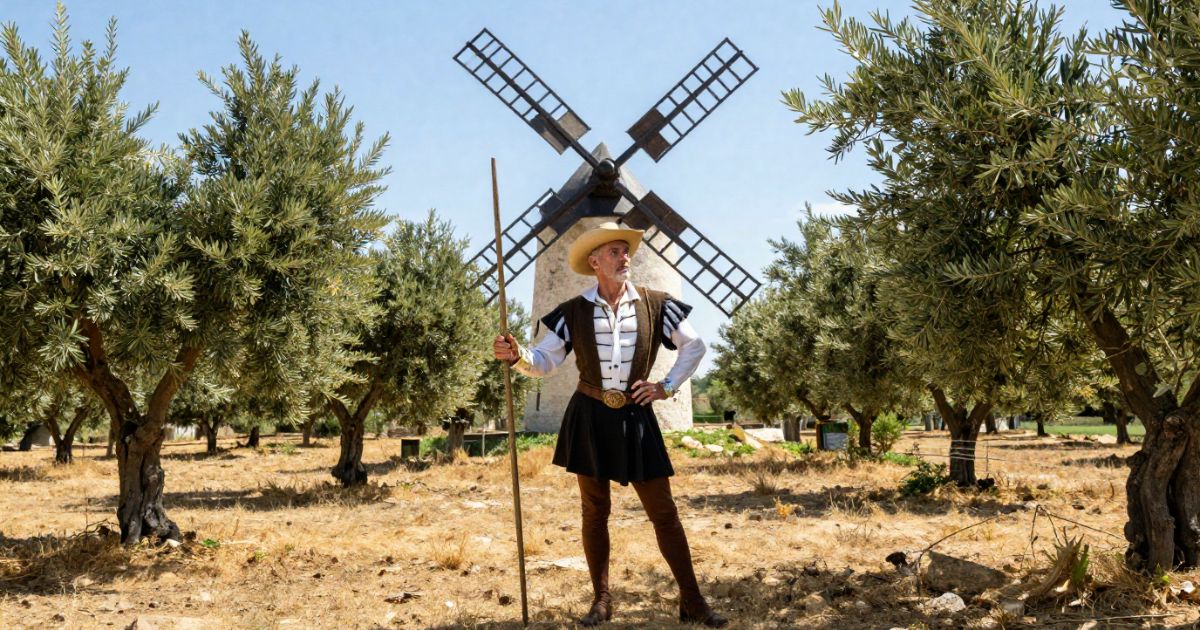
An excerpt from the original text.(complete · 740 words)
: N WHICH IS RELATED THE DISCOURSE SANCHO PANZA HELD WITH HIS MASTER, DON QUIXOTE, AND OTHER ADVENTURES WORTH RELATING
Sancho reached his master so limp and faint he could not urge on his beast. Don Quixote concluded: "This castle or inn is beyond doubt enchanted, because those who so atrociously diverted themselves with thee, what can they be but phantoms or beings of another world? I hold this confirmed by having noticed that when I witnessed thy sad tragedy from the yard wall, it was out of my power to mount upon it nor even dismount from Rocinante because they had me enchanted."
"I would have avenged myself too," said Sancho, "but I could not. Though I am persuaded those who tossed me were not phantoms but men of flesh and bone like ourselves. They had names—I heard them. One was Pedro Martinez, another Tenorio Hernandez, and the innkeeper was Juan Palomeque the Left-handed. So your not being able to leap the wall came of something else besides enchantments. What I make out is that these adventures will lead us into such misadventures we shall not know which is our right foot. The best thing, according to my small wits, would be to return home now that it's harvest-time and attend to our business, and give over wandering from Zeca to Mecca."
"How little thou knowest about chivalry, Sancho," replied Don Quixote. "Hold thy peace and have patience. The day will come when thou shalt see what an honourable thing it is to wander in pursuit of this calling. What greater pleasure can there be than winning a battle and triumphing over one's enemy?"
"Very likely," answered Sancho, "though I do not know it. All I know is that since we have been knights-errant we have never won any battle except with the Biscayan, and even out of that your worship came with half an ear less. From that till now it has been all cudgellings and more cudgellings, cuffs and more cuffs, I getting the blanketing over and above, and falling in with enchanted persons on whom I cannot avenge myself."
"That is what vexes me," replied Don Quixote. "But henceforward I will endeavor to have at hand some sword made by such craft that no kind of enchantments can take effect upon him who carries it."
"Such is my luck," said Sancho, "that even if that happened, it would turn out serviceable for dubbed knights only. As for squires, they might sup sorrow."
Thus talking, they were going along when Don Quixote perceived approaching them a large thick cloud of dust. Seeing it, he turned to Sancho: "This is the day on which shall be displayed the might of my arm and on which I shall do deeds that shall remain written in the book of fame for all ages to come. Seest thou that cloud of dust which rises yonder? All that is churned up by a vast army composed of various and countless nations that comes marching there."
"According to that there must be two," said Sancho, "for on this opposite side also there rises just such another cloud."
Don Quixote turned and found it was true. Rejoicing exceedingly, he concluded they were two armies about to engage in battle. The clouds were actually raised by two great droves of sheep coming from opposite directions. Because of the dust, they were not visible until they drew near. But Don Quixote asserted so positively they were armies that Sancho was led to believe it.
"Well, what are we to do, señor?"
"Give aid to the weak and those who need it. This army is led by the mighty emperor Alifanfaron, lord of the great isle of Trapobana. This other is that of his enemy the king of the Garamantas, Pentapolin of the Bare Arm, for he always goes into battle with his right arm bare."
"But why are these two lords such enemies?"
"Because Alifanfaron is a furious pagan in love with Pentapolin's daughter, who is very beautiful, gracious, and a Christian. Her father is unwilling to bestow her upon the pagan king unless he first abandons his false prophet Mahomet and adopts his own religion."
"By my beard," said Sancho, "but Pentapolin does quite right, and I will help him as much as I can."
Don Quixote then began naming countless knights he saw in both armies, describing their armor and heraldry in elaborate detail.
Master this chapter. Complete your experience
Purchase the complete book to access all chapters and support classic literature
As an Amazon Associate, we earn a small commission from qualifying purchases at no additional cost to you.
Available in paperback, hardcover, and e-book formats
Let's Analyse the Pattern
When elaborate specific fictional narratives override simpler accurate explanations because detail creates false sense of credibility.
Why This Matters
Connect literature to life
This chapter teaches how to recognize when someone's good intentions are causing real damage to real people.
Practice This Today
This week, notice when someone offers help you didn't ask for—watch whether they listen to your response or push harder when you decline.
Now let's explore the literary elements.
Key Quotes & Analysis
"Those who amused themselves with me were not phantoms or enchanted men...they all had their names, for I heard them name them when they were tossing me."
Context: Refuting Quixote's enchantment explanation
Perfect use of evidence—they had names, I heard the names, therefore they were real. Sancho using basic logic to resist magical explanations. Specificity as proof of reality.
In Today's Words:
They weren't ghosts—they were real people with actual names that I heard.
"These adventures we go seeking will in the end lead us into such misadventures that we shall not know which is our right foot."
Context: Arguing they should quit
Sancho predicting accurately where this leads—total disorientation, constant disaster. He's doing risk projection based on pattern: if it's been all beatings so far, more beatings are coming. Rational forecasting Quixote ignores.
In Today's Words:
These adventures are just going to keep getting us hurt until we're completely lost.
"Since we have been knights-errant...we have never won any battle except the one with the Biscayan, and even out of that your worship came with half an ear the less."
Context: Tallying their record
Devastating accounting. One partial win (and Quixote lost half an ear), then pure losses. Sancho doing the math Quixote refuses to do. Evidence-based assessment versus faith-based optimism.
In Today's Words:
We've won exactly one fight, and you still got badly hurt. Everything else has been us getting destroyed.
Thematic Threads
Delusion
In This Chapter
Don Quixote sees armies in sheep flocks and refuses to accept reality even when beaten
Development
Deepening from earlier windmill fantasies—now his delusions actively harm innocent people
In Your Life:
You might recognize this in someone who won't accept feedback about their 'helpful' behavior.
Class
In This Chapter
Working shepherds suffer consequences while the delusional nobleman pursues his fantasy
Development
Continuing theme of how upper-class fantasies impact working people's real lives
In Your Life:
You've probably dealt with managers whose grand visions create extra work for frontline staff.
Loyalty
In This Chapter
Sancho finally reaches his breaking point and confronts Don Quixote with harsh truths
Development
Evolution from blind loyalty to frustrated honesty—relationship hitting crisis point
In Your Life:
You might face this moment when supporting someone becomes enabling their destructive behavior.
Reality
In This Chapter
Physical violence forces Don Quixote to confront the gap between his dreams and consequences
Development
Reality intrudes more violently than before, creating first real crack in his armor
In Your Life:
You might recognize when harsh feedback finally breaks through someone's defensive walls.
Consequences
In This Chapter
Don Quixote loses teeth and dignity while innocent shepherds lose livestock and peace
Development
Introduced here—showing how noble intentions don't prevent real damage
In Your Life:
You might see this when good intentions at work create problems you have to fix.
You now have the context. Time to form your own thoughts.
Discussion Questions
- 1
What actually happened when Don Quixote charged at what he thought were armies?
analysis • surface - 2
Why couldn't Don Quixote see that he was hurting innocent people who were just doing their jobs?
analysis • medium - 3
Think about someone you know who always 'helps' but creates more problems. How do they justify their actions to themselves?
application • medium - 4
When someone is convinced they're helping but clearly causing harm, what's the most effective way to protect yourself and others?
application • deep - 5
What does this chapter reveal about the difference between good intentions and actually doing good?
reflection • deep
Critical Thinking Exercise
Rewrite from the Shepherd's Perspective
Imagine you're one of the shepherds whose sheep got scattered by this madman on a horse. Write a short account of what happened from your point of view. Focus on what you were actually doing, what you saw, and how you felt when your livelihood was suddenly under attack by someone claiming to fight injustice.
Consider:
- •The shepherds had no idea about Don Quixote's noble quest - they just saw destruction
- •These were working people whose income depended on keeping their animals safe
- •Consider how differently the same event looks depending on who's telling the story
Journaling Prompt
Write about a time when someone's 'help' created problems for you. How did you handle it, and what would you do differently now?
Coming Up Next...
Chapter 19: Sheep, Stones, and Vomit
Don Quixote charges into what he believes are battling armies. They're sheep. The shepherds will respond with stones. Another disaster is coming, and once again, Quixote will have an explanation that preserves his delusion.