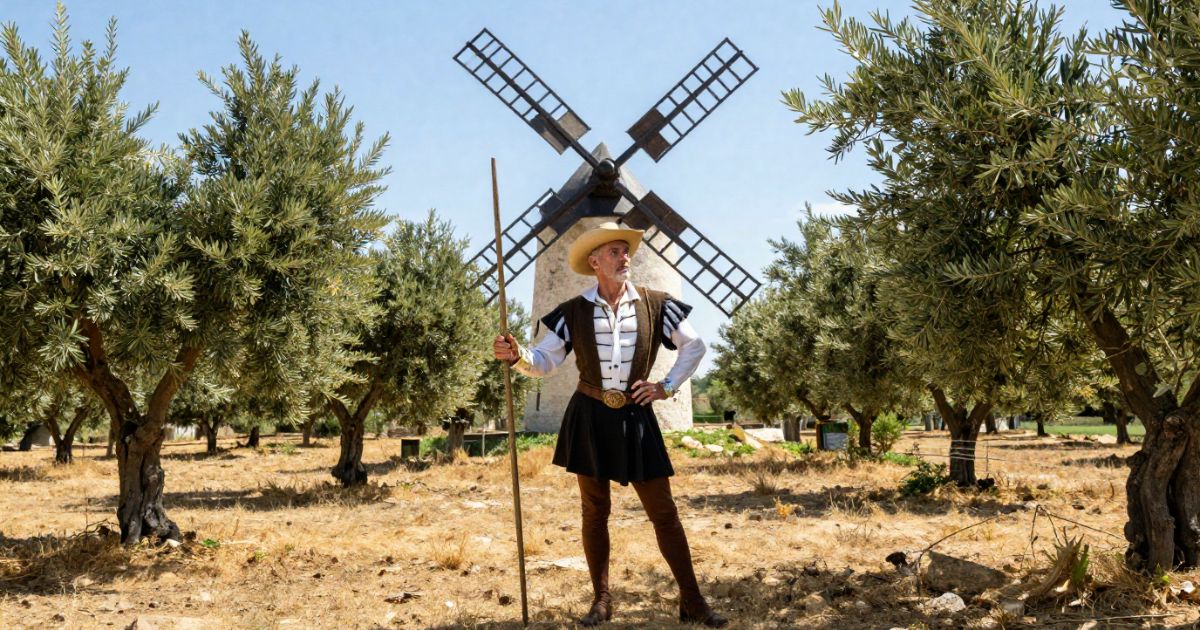
An excerpt from the original text.(complete · 823 words)
: N WHICH ARE CONTINUED THE INNUMERABLE TROUBLES WHICH THE BRAVE DON QUIXOTE AND HIS GOOD SQUIRE SANCHO PANZA ENDURED IN THE INN
Don Quixote recovered from his swoon and called out: "Sancho, my friend, art thou asleep?"
"How can I sleep!" returned Sancho discontentedly, "when it is plain that all the devils have been at me this night?"
"Thou mayest well believe that," answered Don Quixote, "for this castle is enchanted. Thou must swear to keep secret what I tell thee until after my death."
Sancho swore, adding he hated keeping things long and didn't want them to grow rotten from over-keeping.
Don Quixote explained: "This night there befell me one of the strangest adventures. A little while ago the daughter of the lord of this castle came to me—the most elegant and beautiful damsel that could be found in the wide world. But either fate being envious, or this castle being enchanted, at the time when I was engaged in the sweetest discourse with her, there came a hand attached to some arm of some huge giant that planted such a cuff on my jaws that I have them bathed in blood, and pummelled me worse than yesterday. Whence I conjecture there must be some enchanted Moor guarding this damsel's beauty, and it is not for me."
"Not for me either," said Sancho, "for more than four hundred Moors have so thrashed me that the drubbing of the stakes was cakes and fancy-bread to it. But tell me, señor, what do you call this excellent adventure that has left us as we are now? Though your worship had that incomparable beauty in your arms, I, what did I have except the heaviest whacks in all my life? Unlucky me! I am not a knight-errant and never expect to be one, and of all the mishaps, the greater part falls to my share."
"Then thou hast been thrashed too?" said Don Quixote.
"Didn't I say so!" said Sancho.
"Be not distressed, friend," said Don Quixote, "for I will now make the precious balsam with which we shall cure ourselves in the twinkling of an eye."
The cuadrillero lit his lamp and came in to see the man he thought had been killed. Sancho, seeing him in his shirt with a cloth on his head and forbidding countenance, asked: "Señor, can it be that this is the enchanted Moor coming back to give us more castigation?"
"It cannot be the Moor," answered Don Quixote, "for those under enchantment do not let themselves be seen."
"If they don't let themselves be seen, they let themselves be felt," said Sancho. "If not, let my shoulders speak to the point."
The officer found them in peaceful conversation, though Don Quixote still lay on his back unable to move from pummelling and plasters. The officer said: "Well, how goes it, good man?"
"I would speak more politely if I were you," replied Don Quixote. "Is it the way of this country to address knights-errant in that style, you booby?"
The cuadrillero, finding himself so disrespectfully treated by such a sorry-looking individual, lost his temper and raising the lamp full of oil, smote Don Quixote such a blow on the head that he gave him a badly broken pate. Then in darkness he went out.
Sancho said: "That is certainly the enchanted Moor, and he keeps the treasure for others, and for us only the cuffs and lamp-whacks."
"That is the truth," answered Don Quixote, "and there is no use troubling oneself about these matters of enchantment. Rise if thou canst and call the alcaide of this fortress to give me oil, wine, salt, and rosemary to make the salutiferous balsam, for I am losing much blood from the wound that phantom gave me."
Sancho got up with aching bones and found the innkeeper. He asked for the ingredients. The innkeeper provided them. Don Quixote mixed everything together and boiled it a good while until it seemed to him to have come to perfection. He asked for a flask to hold it but there was none, so the innkeeper gave him a tin oil-bottle. Don Quixote blessed it with 80-odd paternosters and as many ave-marias, salves, and credos, making a cross over each word.
Sancho, the innkeeper, and the cuadrillero witnessed this. The carrier was quietly tending his mules' needs.
Don Quixote wanted to try the balsam immediately. He drank a large quantity of what wouldn't fit in the flask—about a quart. Scarcely had he swallowed it when he began to vomit violently until nothing was left in his stomach. With the sickness and spasms he broke into a sweat. He asked to be covered and left alone. They did so.
He slept more than three hours. When he woke he felt greatly relieved and believed he had hit upon the true balsam of Fierabras. With this remedy he could thenceforth face any battle or conflict without fear.
Master this chapter. Complete your experience
Purchase the complete book to access all chapters and support classic literature
As an Amazon Associate, we earn a small commission from qualifying purchases at no additional cost to you.
Available in paperback, hardcover, and e-book formats
Let's Analyse the Pattern
When you credit outcomes to your believed cause regardless of actual mechanism, making the belief unfalsifiable through selective attribution.
Why This Matters
Connect literature to life
This chapter teaches how to recognize when constant urgency prevents strategic thinking and intentional choice-making.
Practice This Today
This week, notice when someone else's poor planning becomes your emergency, and practice asking 'What happens if I wait 24 hours?' before responding to urgent requests.
Now let's explore the literary elements.
Key Quotes & Analysis
"If they don't let themselves be seen, they let themselves be felt. If not, let my shoulders speak to the point."
Context: About the enchanted Moor
Sancho using physical evidence (his beaten shoulders) to confirm Quixote's magical explanation. He's given up contradicting and now just agrees with sarcastic elaboration. His shoulders are proof of enchantment not of getting caught in a brawl.
In Today's Words:
Well, I can't see him but I sure felt him beating me—my shoulders prove it!
"That is certainly the enchanted Moor, and he keeps the treasure for others, and for us only the cuffs and lamp-whacks."
Context: After the officer hits Quixote with the lamp
Peak sarcasm. Sancho describing ordinary violence with magical narrative language, highlighting the absurdity by perfect deadpan delivery. He's mocking the interpretation while pretending to confirm it.
In Today's Words:
Yep, definitely the magical Moor. He guards treasure for others; we just get beaten up.
Thematic Threads
Identity
In This Chapter
Don Quixote's identity as knight-errant forces him to respond to every perceived injustice or challenge without considering if it serves his larger purpose
Development
Evolved from earlier chapters where his identity gave him direction; now it's become a trap that controls him
In Your Life:
Your professional identity might compel you to take on every extra shift or project, even when it's burning you out
Social Expectations
In This Chapter
Court expectations and social protocols demand Don Quixote's participation in situations he'd rather avoid, like Altisidora's advances
Development
Developed from earlier themes about how society shapes our choices, now showing the exhausting side
In Your Life:
Family or workplace expectations might keep you trapped in commitments that drain your energy
Personal Growth
In This Chapter
Constant reaction prevents the reflection necessary for growth; Don Quixote can't learn from experiences because the next one immediately demands attention
Development
Contrast to earlier chapters where adventures taught lessons; now the pace prevents learning
In Your Life:
When you're always busy handling the next crisis, you never get time to process what you've learned or plan better approaches
Human Relationships
In This Chapter
Relationships become another demand to manage rather than sources of connection, as seen with Altisidora's unwanted attention
Development
Evolution from earlier chapters where relationships provided support; now they add to the burden
In Your Life:
When overwhelmed, even good relationships can feel like obligations rather than sources of joy and support
You now have the context. Time to form your own thoughts.
Discussion Questions
- 1
What pattern do you see in how Don Quixote moves from one situation to the next in this chapter?
analysis • surface - 2
Why does Don Quixote struggle to handle situations thoughtfully when they come one after another without breaks?
analysis • medium - 3
Where do you see this same pattern of constant reaction mode in your own life or workplace?
application • medium - 4
How could Don Quixote have created breathing room between these urgent situations, and what would that look like in your life?
application • deep - 5
What does this chapter reveal about the difference between being busy and being intentional with your choices?
reflection • deep
Critical Thinking Exercise
Map Your Reaction Triggers
Think about your last week and identify three moments when you felt like you were just reacting to whatever came next, without time to think. For each situation, write down what made it feel urgent and what would have happened if you had waited 24 hours before responding. This exercise helps you recognize when you're in Don Quixote's reactive pattern.
Consider:
- •Was this truly an emergency, or did it just feel urgent because someone else needed it quickly?
- •What were you sacrificing (sleep, family time, other priorities) to handle this 'urgent' matter?
- •How often do these reactive moments happen in your typical week?
Journaling Prompt
Write about a time when you were stuck in constant reaction mode for days or weeks. How did it affect your energy, relationships, and ability to work toward your bigger goals? What would you do differently now?
Coming Up Next...
Chapter 18: When Reality Crashes Down
Sancho, seeing his master's apparent recovery, will want to try the magical balsam himself. What works for a delusional knight won't work the same way for a pragmatic squire. Meanwhile, the innkeeper will want payment for the chaos they've caused.