An excerpt from the original text.(complete · 5599 words)
ONG I.
BOETHIUS' COMPLAINT.
Who wrought my studious numbers
Smoothly once in happier days,
Now perforce in tears and sadness
Learn a mournful strain to raise.
Lo, the Muses, grief-dishevelled,
Guide my pen and voice my woe;
Down their cheeks unfeigned the tear drops
To my sad complainings flow!
These alone in danger's hour
Faithful found, have dared attend
On the footsteps of the exile
To his lonely journey's end.
These that were the pride and pleasure
Of my youth and high estate
Still remain the only solace
Of the old man's mournful fate.
Old? Ah yes; swift, ere I knew it,
By these sorrows on me pressed
Age hath come; lo, Grief hath bid me
Wear the garb that fits her best.
O'er my head untimely sprinkled
These white hairs my woes proclaim,
And the skin hangs loose and shrivelled
On this sorrow-shrunken frame.
Blest is death that intervenes not
In the sweet, sweet years of peace,
But unto the broken-hearted,
When they call him, brings release!
Yet Death passes by the wretched,
Shuts his ear and slumbers deep;
Will not heed the cry of anguish,
Will not close the eyes that weep.
For, while yet inconstant Fortune
Poured her gifts and all was bright,
Death's dark hour had all but whelmed me
In the gloom of endless night.
Now, because misfortune's shadow
Hath o'erclouded that false face,
Cruel Life still halts and lingers,
Though I loathe his weary race.
Friends, why did ye once so lightly
Vaunt me happy among men?
Surely he who so hath fallen
Was not firmly founded then.
I.
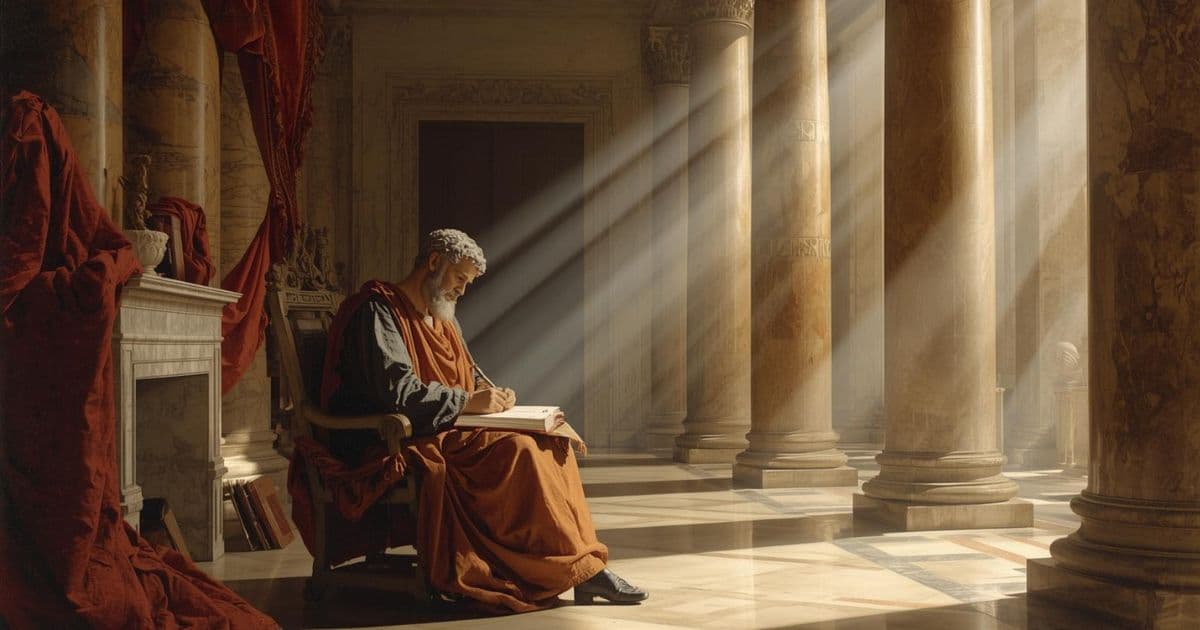
While I was thus mutely pondering within myself, and recording my
sorrowful complainings with my pen, it seemed to me that there appeared
above my head a woman of a countenance exceeding venerable. Her eyes
were bright as fire, and of a more than human keenness; her complexion
was lively, her vigour showed no trace of enfeeblement; and yet her
years were right full, and she plainly seemed not of our age and time.
Her stature was difficult to judge. At one moment it exceeded not the
common height, at another her forehead seemed to strike the sky; and
whenever she raised her head higher, she began to pierce within the very
heavens, and to baffle the eyes of them that looked upon her. Her
garments were of an imperishable fabric, wrought with the finest threads
and of the most delicate workmanship; and these, as her own lips
afterwards assured me, she had herself woven with her own hands. The
beauty of this vesture had been somewhat tarnished by age and neglect,
and wore that dingy look which marble contracts from exposure. On the
lower-most edge was inwoven the Greek letter [Greek: P], on the topmost
the letter [Greek: Th],[A] and between the two were to be seen steps,
like a staircase, from the lower to the upper letter. This robe,
moreover, had been torn by the hands of violent persons, who had each
snatched away what he could clutch.[B] Her right hand held a note-book;
in her left she bore a staff. And when she saw the Muses of Poesie
standing by my bedside, dictating the words of my lamentations, she was
moved awhile to wrath, and her eyes flashed sternly. 'Who,' said she,
'has allowed yon play-acting wantons to approach this sick man--these
who, so far from giving medicine to heal his malady, even feed it with
sweet poison? These it is who kill the rich crop of reason with the
barren thorns of passion, who accustom men's minds to disease, instead
of setting them free. Now, were it some common man whom your allurements
were seducing, as is usually your way, I should be less indignant. On
such a one I should not have spent my pains for naught. But this is one
nurtured in the Eleatic and Academic philosophies. Nay, get ye gone, ye
sirens, whose sweetness lasteth not; leave him for my muses to tend and
heal!' At these words of upbraiding, the whole band, in deepened
sadness, with downcast eyes, and blushes that confessed their shame,
dolefully left the chamber.
But I, because my sight was dimmed with much weeping, and I could not
tell who was this woman of authority so commanding--I was dumfoundered,
and, with my gaze fastened on the earth, continued silently to await
what she might do next. Then she drew near me and sat on the edge of my
couch, and, looking into my face all heavy with grief and fixed in
sadness on the ground, she bewailed in these words the disorder of my
mind:
FOOTNOTES:
[A] [Greek: P] (P) stands for the Political life, the life of action;
[Greek: Th] (Th) for the Theoretical life, the life of thought.
[B] The Stoic, Epicurean, and other philosophical sects, which Boethius
regards as heterodox. See also below, ch. iii., p. 14.
SONG II.
HIS DESPONDENCY.
Alas! in what abyss his mind
Is plunged, how wildly tossed!
Still, still towards the outer night
She sinks, her true light lost,
As oft as, lashed tumultuously
By earth-born blasts, care's waves rise high.
Yet once he ranged the open heavens,
The sun's bright pathway tracked;
Watched how the cold moon waxed and waned;
Nor rested, till there lacked
To his wide ken no star that steers
Amid the maze of circling spheres.
The causes why the blusterous winds
Vex ocean's tranquil face,
Whose hand doth turn the stable globe,
Or why his even race
From out the ruddy east the sun
Unto the western waves doth run:
What is it tempers cunningly
The placid hours of spring,
So that it blossoms with the rose
For earth's engarlanding:
Who loads the year's maturer prime
With clustered grapes in autumn time:
All this he knew--thus ever strove
Deep Nature's lore to guess.
Now, reft of reason's light, he lies,
And bonds his neck oppress;
While by the heavy load constrained,
His eyes to this dull earth are chained.
II.
'But the time,' said she, 'calls rather for healing than for
lamentation.' Then, with her eyes bent full upon me, 'Art thou that
man,' she cries, 'who, erstwhile fed with the milk and reared upon the
nourishment which is mine to give, had grown up to the full vigour of a
manly spirit? And yet I had bestowed such armour on thee as would have
proved an invincible defence, hadst thou not first cast it away. Dost
thou know me? Why art thou silent? Is it shame or amazement that hath
struck thee dumb? Would it were shame; but, as I see, a stupor hath
seized upon thee.' Then, when she saw me not only answering nothing, but
mute and utterly incapable of speech, she gently touched my breast with
her hand, and said: 'There is no danger; these are the symptoms of
lethargy, the usual sickness of deluded minds. For awhile he has
forgotten himself; he will easily recover his memory, if only he first
recognises me. And that he may do so, let me now wipe his eyes that are
clouded with a mist of mortal things.' Thereat, with a fold of her robe,
she dried my eyes all swimming with tears.
SONG III.
THE MISTS DISPELLED.
Then the gloom of night was scattered,
Sight returned unto mine eyes.
So, when haply rainy Caurus
Rolls the storm-clouds through the skies,
Hidden is the sun; all heaven
Is obscured in starless night.
But if, in wild onset sweeping,
Boreas frees day's prisoned light,
All suddenly the radiant god outstreams,
And strikes our dazzled eyesight with his beams.
III.
Even so the clouds of my melancholy were broken up. I saw the clear sky,
and regained the power to recognise the face of my physician.
Accordingly, when I had lifted my eyes and fixed my gaze upon her, I
beheld my nurse, Philosophy, whose halls I had frequented from my youth
up.
'Ah! why,' I cried, 'mistress of all excellence, hast thou come down
from on high, and entered the solitude of this my exile? Is it that
thou, too, even as I, mayst be persecuted with false accusations?'
'Could I desert thee, child,' said she, 'and not lighten the burden
which thou hast taken upon thee through the hatred of my name, by
sharing this trouble? Even forgetting that it were not lawful for
Philosophy to leave companionless the way of the innocent, should I,
thinkest thou, fear to incur reproach, or shrink from it, as though
some strange new thing had befallen? Thinkest thou that now, for the
first time in an evil age, Wisdom hath been assailed by peril? Did I not
often in days of old, before my servant Plato lived, wage stern warfare
with the rashness of folly? In his lifetime, too, Socrates, his master,
won with my aid the victory of an unjust death. And when, one after the
other, the Epicurean herd, the Stoic, and the rest, each of them as far
as in them lay, went about to seize the heritage he left, and were
dragging me off protesting and resisting, as their booty, they tore in
pieces the garment which I had woven with my own hands, and, clutching
the torn pieces, went off, believing that the whole of me had passed
into their possession. And some of them, because some traces of my
vesture were seen upon them, were destroyed through the mistake of the
lewd multitude, who falsely deemed them to be my disciples. It may be
thou knowest not of the banishment of Anaxagoras, of the poison draught
of Socrates, nor of Zeno's torturing, because these things happened in
a distant country; yet mightest thou have learnt the fate of Arrius, of
Seneca, of Soranus, whose stories are neither old nor unknown to fame.
These men were brought to destruction for no other reason than that,
settled as they were in my principles, their lives were a manifest
contrast to the ways of the wicked. So there is nothing thou shouldst
wonder at, if on the seas of this life we are tossed by storm-blasts,
seeing that we have made it our chiefest aim to refuse compliance with
evil-doers. And though, maybe, the host of the wicked is many in number,
yet is it contemptible, since it is under no leadership, but is hurried
hither and thither at the blind driving of mad error. And if at times
and seasons they set in array against us, and fall on in overwhelming
strength, our leader draws off her forces into the citadel while they
are busy plundering the useless baggage. But we from our vantage ground,
safe from all this wild work, laugh to see them making prize of the most
valueless of things, protected by a bulwark which aggressive folly may
not aspire to reach.'
SONG IV.
NOTHING CAN SUBDUE VIRTUE.
Whoso calm, serene, sedate,
Sets his foot on haughty fate;
Firm and steadfast, come what will,
Keeps his mien unconquered still;
Him the rage of furious seas,
Tossing high wild menaces,
Nor the flames from smoky forges
That Vesuvius disgorges,
Nor the bolt that from the sky
Smites the tower, can terrify.
Why, then, shouldst thou feel affright
At the tyrant's weakling might?
Dread him not, nor fear no harm,
And thou shall his rage disarm;
But who to hope or fear gives way--
Lost his bosom's rightful sway--
He hath cast away his shield,
Like a coward fled the field;
He hath forged all unaware
Fetters his own neck must bear!
IV.
'Dost thou understand?' she asks. Do my words sink into thy mind? Or art
thou dull "as the ass to the sound of the lyre"? Why dost thou weep? Why
do tears stream from thy eyes?
'"Speak out, hide it not in thy heart."
If thou lookest for the physician's help, thou must needs disclose thy
wound.'
Then I, gathering together what strength I could, began: 'Is there still
need of telling? Is not the cruelty of fortune against me plain enough?
Doth not the very aspect of this place move thee? Is this the library,
the room which thou hadst chosen as thy constant resort in my home, the
place where we so often sat together and held discourse of all things in
heaven and earth? Was my garb and mien like this when I explored with
thee nature's hid secrets, and thou didst trace for me with thy wand
the courses of the stars, moulding the while my character and the whole
conduct of my life after the pattern of the celestial order? Is this the
recompense of my obedience? Yet thou hast enjoined by Plato's mouth the
maxim, "that states would be happy, either if philosophers ruled them,
or if it should so befall that their rulers would turn philosophers." By
his mouth likewise thou didst point out this imperative reason why
philosophers should enter public life, to wit, lest, if the reins of
government be left to unprincipled and profligate citizens, trouble and
destruction should come upon the good. Following these precepts, I have
tried to apply in the business of public administration the principles
which I learnt from thee in leisured seclusion. Thou art my witness and
that divinity who hath implanted thee in the hearts of the wise, that I
brought to my duties no aim but zeal for the public good. For this cause
I have become involved in bitter and irreconcilable feuds, and, as
happens inevitably, if a man holds fast to the independence of
conscience, I have had to think nothing of giving offence to the
powerful in the cause of justice. How often have I encountered and
balked Conigastus in his assaults on the fortunes of the weak? How often
have I thwarted Trigguilla, steward of the king's household, even when
his villainous schemes were as good as accomplished? How often have I
risked my position and influence to protect poor wretches from the false
charges innumerable with which they were for ever being harassed by the
greed and license of the barbarians? No one has ever drawn me aside from
justice to oppression. When ruin was overtaking the fortunes of the
provincials through the combined pressure of private rapine and public
taxation, I grieved no less than the sufferers. When at a season of
grievous scarcity a forced sale, disastrous as it was unjustifiable, was
proclaimed, and threatened to overwhelm Campania with starvation, I
embarked on a struggle with the prætorian prefect in the public
interest, I fought the case at the king's judgment-seat, and succeeded
in preventing the enforcement of the sale. I rescued the consular
Paulinus from the gaping jaws of the court bloodhounds, who in their
covetous hopes had already made short work of his wealth. To save
Albinus, who was of the same exalted rank, from the penalties of a
prejudged charge, I exposed myself to the hatred of Cyprian, the
informer.
'Thinkest thou I had laid up for myself store of enmities enough? Well,
with the rest of my countrymen, at any rate, my safety should have been
assured, since my love of justice had left me no hope of security at
court. Yet who was it brought the charges by which I have been struck
down? Why, one of my accusers is Basil, who, after being dismissed from
the king's household, was driven by his debts to lodge an information
against my name. There is Opilio, there is Gaudentius, men who for many
and various offences the king's sentence had condemned to banishment;
and when they declined to obey, and sought to save themselves by taking
sanctuary, the king, as soon as he heard of it, decreed that, if they
did not depart from the city of Ravenna within a prescribed time, they
should be branded on the forehead and expelled. What would exceed the
rigour of this severity? And yet on that same day these very men lodged
an information against me, and the information was admitted. Just
Heaven! had I deserved this by my way of life? Did it make them fit
accusers that my condemnation was a foregone conclusion? Has fortune no
shame--if not at the accusation of the innocent, at least for the
vileness of the accusers? Perhaps thou wonderest what is the sum of the
charges laid against me? I wished, they say, to save the senate. But
how? I am accused of hindering an informer from producing evidence to
prove the senate guilty of treason. Tell me, then, what is thy counsel,
O my mistress. Shall I deny the charge, lest I bring shame on thee? But
I did wish it, and I shall never cease to wish it. Shall I admit it?
Then the work of thwarting the informer will come to an end. Shall I
call the wish for the preservation of that illustrious house a crime?
Of a truth the senate, by its decrees concerning me, has made it such!
But blind folly, though it deceive itself with false names, cannot alter
the true merits of things, and, mindful of the precept of Socrates, I do
not think it right either to keep the truth concealed or allow falsehood
to pass. But this, however it may be, I leave to thy judgment and to the
verdict of the discerning. Moreover, lest the course of events and the
true facts should be hidden from posterity, I have myself committed to
writing an account of the transaction.
'What need to speak of the forged letters by which an attempt is made to
prove that I hoped for the freedom of Rome? Their falsity would have
been manifest, if I had been allowed to use the confession of the
informers themselves, evidence which has in all matters the most
convincing force. Why, what hope of freedom is left to us? Would there
were any! I should have answered with the epigram of Canius when
Caligula declared him to have been cognisant of a conspiracy against
him. "If I had known," said he, "thou shouldst never have known." Grief
hath not so blunted my perceptions in this matter that I should complain
because impious wretches contrive their villainies against the virtuous,
but at their achievement of their hopes I do exceedingly marvel. For
evil purposes are, perchance, due to the imperfection of human nature;
that it should be possible for scoundrels to carry out their worst
schemes against the innocent, while God beholdeth, is verily monstrous.
For this cause, not without reason, one of thy disciples asked, "If God
exists, whence comes evil? Yet whence comes good, if He exists not?"
However, it might well be that wretches who seek the blood of all honest
men and of the whole senate should wish to destroy me also, whom they
saw to be a bulwark of the senate and all honest men. But did I deserve
such a fate from the Fathers also? Thou rememberest, methinks--since
thou didst ever stand by my side to direct what I should do or say--thou
rememberest, I say, how at Verona, when the king, eager for the general
destruction, was bent on implicating the whole senatorial order in the
charge of treason brought against Albinus, with what indifference to my
own peril I maintained the innocence of its members, one and all. Thou
knowest that what I say is the truth, and that I have never boasted of
my good deeds in a spirit of self-praise. For whenever a man by
proclaiming his good deeds receives the recompense of fame, he
diminishes in a measure the secret reward of a good conscience. What
issues have overtaken my innocency thou seest. Instead of reaping the
rewards of true virtue, I undergo the penalties of a guilt falsely laid
to my charge--nay, more than this; never did an open confession of guilt
cause such unanimous severity among the assessors, but that some
consideration, either of the mere frailty of human nature, or of
fortune's universal instability, availed to soften the verdict of some
few. Had I been accused of a design to fire the temples, to slaughter
the priests with impious sword, of plotting the massacre of all honest
men, I should yet have been produced in court, and only punished on due
confession or conviction. Now for my too great zeal towards the senate I
have been condemned to outlawry and death, unheard and undefended, at a
distance of near five hundred miles away.[C] Oh, my judges, well do ye
deserve that no one should hereafter be convicted of a fault like mine!
'Yet even my very accusers saw how honourable was the charge they
brought against me, and, in order to overlay it with some shadow of
guilt, they falsely asserted that in the pursuit of my ambition I had
stained my conscience with sacrilegious acts. And yet thy spirit,
indwelling in me, had driven from the chamber of my soul all lust of
earthly success, and with thine eye ever upon me, there could be no
place left for sacrilege. For thou didst daily repeat in my ear and
instil into my mind the Pythagorean maxim, "Follow after God." It was
not likely, then, that I should covet the assistance of the vilest
spirits, when thou wert moulding me to such an excellence as should
conform me to the likeness of God. Again, the innocency of the inner
sanctuary of my home, the company of friends of the highest probity, a
father-in-law revered at once for his pure character and his active
beneficence, shield me from the very suspicion of sacrilege.
Yet--atrocious as it is--they even draw credence for this charge from
thee; I am like to be thought implicated in wickedness on this very
account, that I am imbued with thy teachings and stablished in thy
ways. So it is not enough that my devotion to thee should profit me
nothing, but thou also must be assailed by reason of the odium which I
have incurred. Verily this is the very crown of my misfortunes, that
men's opinions for the most part look not to real merit, but to the
event; and only recognise foresight where Fortune has crowned the issue
with her approval. Whereby it comes to pass that reputation is the first
of all things to abandon the unfortunate. I remember with chagrin how
perverse is popular report, how various and discordant men's judgments.
This only will I say, that the most crushing of misfortune's burdens is,
that as soon as a charge is fastened upon the unhappy, they are believed
to have deserved their sufferings. I, for my part, who have been
banished from all life's blessings, stripped of my honours, stained in
repute, am punished for well-doing.
'And now methinks I see the villainous dens of the wicked surging with
joy and gladness, all the most recklessly unscrupulous threatening a new
crop of lying informations, the good prostrate with terror at my danger,
every ruffian incited by impunity to new daring and to success by the
profits of audacity, the guiltless not only robbed of their peace of
mind, but even of all means of defence. Wherefore I would fain cry out:
FOOTNOTES:
[C] The distance from Rome to Pavia, the place of Boethius'
imprisonment, is 455 Roman miles.
SONG V.
BOETHIUS' PRAYER.
'Builder of yon starry dome,
Thou that whirlest, throned eternal,
Heaven's swift globe, and, as they roam,
Guid'st the stars by laws supernal:
So in full-sphered splendour dight
Cynthia dims the lamps of night,
But unto the orb fraternal
Closer drawn,[D] doth lose her light.
'Who at fall of eventide,
Hesper, his cold radiance showeth,
Lucifer his beams doth hide,
Paling as the sun's light groweth,
Brief, while winter's frost holds sway,
By thy will the space of day;
Swift, when summer's fervour gloweth,
Speed the hours of night away.
'Thou dost rule the changing year:
When rude Boreas oppresses,
Fall the leaves; they reappear,
Wooed by Zephyr's soft caresses.
Fields that Sirius burns deep grown
By Arcturus' watch were sown:
Each the reign of law confesses,
Keeps the place that is his own.
'Sovereign Ruler, Lord of all!
Can it be that Thou disdainest
Only man? 'Gainst him, poor thrall,
Wanton Fortune plays her vainest.
Guilt's deserved punishment
Falleth on the innocent;
High uplifted, the profanest
On the just their malice vent.
'Virtue cowers in dark retreats,
Crime's foul stain the righteous beareth,
Perjury and false deceits
Hurt not him the wrong who dareth;
But whene'er the wicked trust
In ill strength to work their lust,
Kings, whom nations' awe declareth
Mighty, grovel in the dust.
'Look, oh look upon this earth,
Thou who on law's sure foundation
Framedst all! Have we no worth,
We poor men, of all creation?
Sore we toss on fortune's tide;
Master, bid the waves subside!
And earth's ways with consummation
Of Thy heaven's order guide!'
FOOTNOTES:
[D] The moon is regarded as farthest from the sun at the full, and, as
she wanes, approaching gradually nearer.
V.
When I had poured out my griefs in this long and unbroken strain of
lamentation, she, with calm countenance, and in no wise disturbed at my
complainings, thus spake:
'When I saw thee sorrowful, in tears, I straightway knew thee wretched
and an exile. But how far distant that exile I should not know, had not
thine own speech revealed it. Yet how far indeed from thy country hast
thou, not been banished, but rather hast strayed; or, if thou wilt have
it banishment, hast banished thyself! For no one else could ever
lawfully have had this power over thee. Now, if thou wilt call to mind
from what country thou art sprung, it is not ruled, as once was the
Athenian polity, by the sovereignty of the multitude, but "one is its
Ruler, one its King," who takes delight in the number of His citizens,
not in their banishment; to submit to whose governance and to obey
whose ordinances is perfect freedom. Art thou ignorant of that most
ancient law of this thy country, whereby it is decreed that no one
whatsoever, who hath chosen to fix there his dwelling, may be sent into
exile? For truly there is no fear that one who is encompassed by its
ramparts and defences should deserve to be exiled. But he who has ceased
to wish to dwell therein, he likewise ceases to deserve to do so. And so
it is not so much the aspect of this place which moves me, as thy
aspect; not so much the library walls set off with glass and ivory which
I miss, as the chamber of thy mind, wherein I once placed, not books,
but that which gives books their value, the doctrines which my books
contain. Now, what thou hast said of thy services to the commonweal is
true, only too little compared with the greatness of thy deservings. The
things laid to thy charge whereof thou hast spoken, whether such as
redound to thy credit, or mere false accusations, are publicly known. As
for the crimes and deceits of the informers, thou hast rightly deemed
it fitting to pass them over lightly, because the popular voice hath
better and more fully pronounced upon them. Thou hast bitterly
complained of the injustice of the senate. Thou hast grieved over my
calumniation, and likewise hast lamented the damage to my good name.
Finally, thine indignation blazed forth against fortune; thou hast
complained of the unfairness with which thy merits have been
recompensed. Last of all thy frantic muse framed a prayer that the peace
which reigns in heaven might rule earth also. But since a throng of
tumultuous passions hath assailed thy soul, since thou art distraught
with anger, pain, and grief, strong remedies are not proper for thee in
this thy present mood. And so for a time I will use milder methods, that
the tumours which have grown hard through the influx of disturbing
passion may be softened by gentle treatment, till they can bear the
force of sharper remedies.'
SONG VI.
ALL THINGS HAVE THEIR NEEDFUL ORDER
He who to th' unwilling furrows
Gives the generous grain,
When the Crab with baleful fervours
Scorches all the plain;
He shall find his garner bare,
Acorns for his scanty fare.
Go not forth to cull sweet violets
From the purpled steep,
While the furious blasts of winter
Through the valleys sweep;
Nor the grape o'erhasty bring
To the press in days of spring.
For to each thing God hath given
Its appointed time;
No perplexing change permits He
In His plan sublime.
So who quits the order due
Shall a luckless issue rue.
VI.
'First, then, wilt thou suffer me by a few questions to make some
attempt to test the state of thy mind, that I may learn in what way to
set about thy cure?'
'Ask what thou wilt,' said I, 'for I will answer whatever questions thou
choosest to put.'
Then said she: 'This world of ours--thinkest thou it is governed
haphazard and fortuitously, or believest thou that there is in it any
rational guidance?'
'Nay,' said I, 'in no wise may I deem that such fixed motions can be
determined by random hazard, but I know that God, the Creator, presideth
over His work, nor will the day ever come that shall drive me from
holding fast the truth of this belief.'
'Yes,' said she; 'thou didst even but now affirm it in song, lamenting
that men alone had no portion in the divine care. As to the rest, thou
wert unshaken in the belief that they were ruled by reason. Yet I
marvel exceedingly how, in spite of thy firm hold on this opinion, thou
art fallen into sickness. But let us probe more deeply: something or
other is missing, I think. Now, tell me, since thou doubtest not that
God governs the world, dost thou perceive by what means He rules it?'
'I scarcely understand what thou meanest,' I said, 'much less can I
answer thy question.'
'Did I not say truly that something is missing, whereby, as through a
breach in the ramparts, disease hath crept in to disturb thy mind? But,
tell me, dost thou remember the universal end towards which the aim of
all nature is directed?'
'I once heard,' said I, 'but sorrow hath dulled my recollection.'
'And yet thou knowest whence all things have proceeded.'
'Yes, that I know,' said I, 'and have answered that it is from God.'
'Yet how is it possible that thou knowest not what is the end of
existence, when thou dost understand its source and origin? However,
these disturbances of mind have force to shake a man's position, but
cannot pluck him up and root him altogether out of himself. But answer
this also, I pray thee: rememberest thou that thou art a man?'
'How should I not?' said I.
'Then, canst thou say what man is?'
'Is this thy question: Whether I know myself for a being endowed with
reason and subject to death? Surely I do acknowledge myself such.'
Then she: 'Dost know nothing else that thou art?'
'Nothing.'
'Now,' said she, 'I know another cause of thy disease, one, too, of
grave moment. Thou hast ceased to know thy own nature. So, then, I have
made full discovery both of the causes of thy sickness and the means of
restoring thy health. It is because forgetfulness of thyself hath
bewildered thy mind that thou hast bewailed thee as an exile, as one
stripped of the blessings that were his; it is because thou knowest not
the end of existence that thou deemest abominable and wicked men to be
happy and powerful; while, because thou hast forgotten by what means the
earth is governed, thou deemest that fortune's changes ebb and flow
without the restraint of a guiding hand. These are serious enough to
cause not sickness only, but even death; but, thanks be to the Author of
our health, the light of nature hath not yet left thee utterly. In thy
true judgment concerning the world's government, in that thou believest
it subject, not to the random drift of chance, but to divine reason, we
have the divine spark from which thy recovery may be hoped. Have, then,
no fear; from these weak embers the vital heat shall once more be
kindled within thee. But seeing that it is not yet time for strong
remedies, and that the mind is manifestly so constituted that when it
casts off true opinions it straightway puts on false, wherefrom arises a
cloud of confusion that disturbs its true vision, I will now try and
disperse these mists by mild and soothing application, that so the
darkness of misleading passion may be scattered, and thou mayst come to
discern the splendour of the true light.'
SONG VII.
THE PERTURBATIONS OF PASSION.
Stars shed no light
Through the black night,
When the clouds hide;
And the lashed wave,
If the winds rave
O'er ocean's tide,--
Though once serene
As day's fair sheen,--
Soon fouled and spoiled
By the storm's spite,
Shows to the sight
Turbid and soiled.
Oft the fair rill,
Down the steep hill
Seaward that strays,
Some tumbled block
Of fallen rock
Hinders and stays.
Then art thou fain
Clear and most plain
Truth to discern,
In the right way
Firmly to stay,
Nor from it turn?
Joy, hope and fear
Suffer not near,
Drive grief away:
Shackled and blind
And lost is the mind
Where these have sway.
Master this chapter. Complete your experience
Purchase the complete book to access all chapters and support classic literature
As an Amazon Associate, we earn a small commission from qualifying purchases at no additional cost to you.
Available in paperback, hardcover, and e-book formats
Let's Analyse the Pattern
When intense emotions take control of our thinking, making us unreliable narrators of our own lives and blocking access to our better judgment.
Why This Matters
Connect literature to life
This chapter teaches how intense emotions can make us unreliable narrators of our own lives, trapping us in victim stories that feel satisfying but prevent forward movement.
Practice This Today
This week, notice when you're rehearsing grievances—catch yourself mid-story and ask: 'Is this helping me move forward or keeping me stuck?'
Now let's explore the literary elements.
Key Quotes & Analysis
"These wounds require not gentle but harsh remedies."
Context: Philosophy explains why she must be tough with Boethius rather than sympathetic
This establishes that real healing requires facing hard truths, not getting comfort. Philosophy won't coddle him or validate his victim mentality. The cure will be uncomfortable but necessary.
In Today's Words:
Sometimes you need tough love, not a shoulder to cry on.
"You have forgotten who you are."
Context: Philosophy's diagnosis of Boethius's real problem
This cuts to the heart of the issue - his suffering comes from losing sight of his true identity and values. External circumstances didn't change who he really is, but he's forgotten this fundamental truth.
In Today's Words:
You've lost yourself and forgotten what you're really made of.
"Will you be led by every random impulse?"
Context: Philosophy challenging Boethius's emotional reactions
She's pointing out that he's letting his emotions control him instead of using his reason. This sets up the central theme that we can choose our responses even when we can't choose our circumstances.
In Today's Words:
Are you going to let every feeling control you?
"You are not in exile from your country, but from yourself."
Context: Philosophy reframing his understanding of his situation
This powerful reframe shows that the real problem isn't external punishment but internal confusion. True home is knowing who you are and what you stand for, not a physical location.
In Today's Words:
You're not homeless - you're just lost.
Thematic Threads
Identity
In This Chapter
Boethius has forgotten who he truly is beneath his circumstances—Philosophy says he's 'in exile from himself'
Development
Introduced here
In Your Life:
When crisis hits, you might lose sight of your core values and strengths, defining yourself only by what's happening to you.
Class
In This Chapter
His fall from political power and social status drives much of his anguish—he's lost his place in the hierarchy
Development
Introduced here
In Your Life:
Job loss, demotion, or social rejection can make you feel like your worth disappeared with your position.
Personal Growth
In This Chapter
Philosophy arrives not to validate his complaints but to challenge his perspective and begin his education
Development
Introduced here
In Your Life:
Real growth often starts when someone refuses to enable your victim story and pushes you toward harder truths.
Social Expectations
In This Chapter
Boethius expected that serving justice and fighting corruption would protect him from injustice
Development
Introduced here
In Your Life:
You might believe that doing the right thing guarantees fair treatment, then feel betrayed when the world doesn't work that way.
You now have the context. Time to form your own thoughts.
Discussion Questions
- 1
What does Philosophy criticize about the poetry and self-pity that Boethius is indulging in?
analysis • surface - 2
Why does Philosophy say Boethius is 'in exile from himself' rather than just from his country?
analysis • medium - 3
Think about someone you know who got stuck replaying their grievances over and over. How did that affect their ability to move forward?
application • medium - 4
When you're emotionally hijacked by anger or hurt, what strategies help you step back and see the bigger picture?
application • deep - 5
What does this chapter suggest about the difference between being a victim of circumstances and being trapped by your response to those circumstances?
reflection • deep
Critical Thinking Exercise
Rewrite Your Grievance Story
Think of a recent situation where you felt wronged or treated unfairly. Write a one-paragraph 'victim version' of what happened, focusing on everything others did wrong. Then rewrite the same situation focusing only on your choices, responses, and what you learned. Notice how the same facts create completely different stories depending on where you place your attention.
Consider:
- •Both versions can contain true facts while leading to different outcomes
- •The victim version often feels more satisfying in the moment
- •The choice-focused version usually reveals more options for moving forward
Journaling Prompt
Write about a time when you got stuck in a victim story for weeks or months. What finally helped you shift perspective? What would you tell someone else who's stuck in that same pattern?
Coming Up Next...
Chapter 3: Why Fortune Always Disappoints
Philosophy begins her cure by examining what Boethius thinks he's lost. But her questions about happiness and success will reveal that everything he's mourning might not have been worth having in the first place.