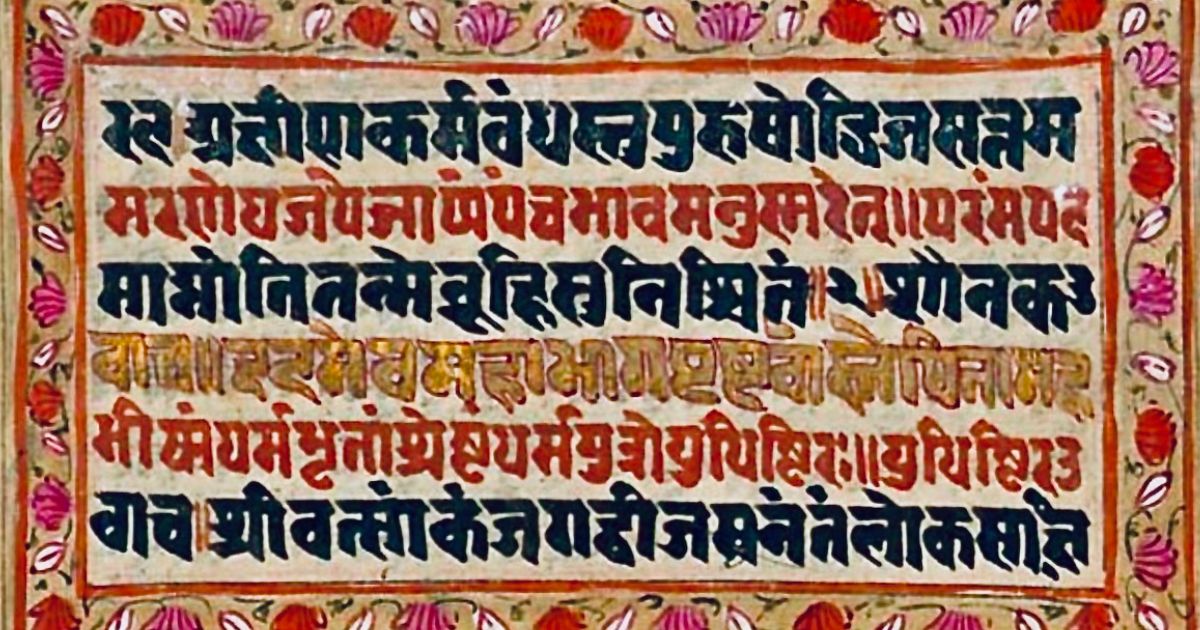
An excerpt from the original text.(complete · 5327 words)
rjuna.
Fain would I better know, Thou Glorious One!
The very truth--Heart's Lord!--of Sannyas,
Abstention; and enunciation, Lord!
Tyaga; and what separates these twain!
Krishna.
The poets rightly teach that Sannyas
Is the foregoing of all acts which spring
Out of desire; and their wisest say
Tyaga is renouncing fruit of acts.
There be among the saints some who have held
All action sinful, and to be renounced;
And some who answer, "Nay! the goodly acts--
As worship, penance, alms--must be performed!"
Hear now My sentence, Best of Bharatas!
'Tis well set forth, O Chaser of thy Foes!
Renunciation is of threefold form,
And Worship, Penance, Alms, not to be stayed;
Nay, to be gladly done; for all those three
Are purifying waters for true souls!
Yet must be practised even those high works
In yielding up attachment, and all fruit
Produced by works. This is My judgment, Prince!
This My insuperable and fixed decree!
Abstaining from a work by right prescribed
Never is meet! So to abstain doth spring
From "Darkness," and Delusion teacheth it.
Abstaining from a work grievous to flesh,
When one saith "'Tis unpleasing!" this is null!
Such an one acts from "passion;" nought of gain
Wins his Renunciation! But, Arjun!
Abstaining from attachment to the work,
Abstaining from rewardment in the work,
While yet one doeth it full faithfully,
Saying, "Tis right to do!" that is "true " act
And abstinence! Who doeth duties so,
Unvexed if his work fail, if it succeed
Unflattered, in his own heart justified,
Quit of debates and doubts, his is "true" act:
For, being in the body, none may stand
Wholly aloof from act; yet, who abstains
From profit of his acts is abstinent.
The fruit of labours, in the lives to come,
Is threefold for all men,--Desirable,
And Undesirable, and mixed of both;
But no fruit is at all where no work was.
Hear from me, Long-armed Lord! the makings five
Which go to every act, in Sankhya taught
As necessary. First the force; and then
The agent; next, the various instruments;
Fourth, the especial effort; fifth, the God.
What work soever any mortal doth
Of body, mind, or speech, evil or good,
By these five doth he that. Which being thus,
Whoso, for lack of knowledge, seeth himself
As the sole actor, knoweth nought at all
And seeth nought. Therefore, I say, if one--
Holding aloof from self--with unstained mind
Should slay all yonder host, being bid to slay,
He doth not slay; he is not bound thereby!
Knowledge, the thing known, and the mind which knows,
These make the threefold starting-ground of act.
The act, the actor, and the instrument,
These make the threefold total of the deed.
But knowledge, agent, act, are differenced
By three dividing qualities. Hear now
Which be the qualities dividing them.
There is "true" Knowledge. Learn thou it is this:
To see one changeless Life in all the Lives,
And in the Separate, One Inseparable.
There is imperfect Knowledge: that which sees
The separate existences apart,
And, being separated, holds them real.
There is false Knowledge: that which blindly clings
To one as if 'twere all, seeking no Cause,
Deprived of light, narrow, and dull, and "dark."
There is "right" Action: that which being enjoined--
Is wrought without attachment, passionlessly,
For duty, not for love, nor hate, nor gain.
There is "vain" Action: that which men pursue
Aching to satisfy desires, impelled
By sense of self, with all-absorbing stress:
This is of Rajas--passionate and vain.
There is "dark" Action: when one doth a thing
Heedless of issues, heedless of the hurt
Or wrong for others, heedless if he harm
His own soul--'tis of Tamas, black and bad!
There is the "rightful"doer. He who acts
Free from self-seeking, humble, resolute,
Steadfast, in good or evil hap the same,
Content to do aright-he "truly" acts.
There is th' "impassioned" doer. He that works
From impulse, seeking profit, rude and bold
To overcome, unchastened; slave by turns
Of sorrow and of joy: of Rajas he!
And there be evil doers; loose of heart,
Low-minded, stubborn, fraudulent, remiss,
Dull, slow, despondent--children of the "dark."
Hear, too, of Intellect and Steadfastness
The threefold separation, Conqueror-Prince!
How these are set apart by Qualities.
Good is the Intellect which comprehends
The coming forth and going back of life,
What must be done, and what must not be done,
What should be feared, and what should not be feared,
What binds and what emancipates the soul:
That is of Sattwan, Prince! of "soothfastness."
Marred is the Intellect which, knowing right
And knowing wrong, and what is well to do
And what must not be done, yet understands
Nought with firm mind, nor as the calm truth is:
This is of Rajas, Prince! and "passionate!"
Evil is Intellect which, wrapped in gloom,
Looks upon wrong as right, and sees all things
Contrariwise of Truth. O Pritha's Son!
That is of Tamas, "dark" and desperate!
Good is the steadfastness whereby a man
Masters his beats of heart, his very breath
Of life, the action of his senses; fixed
In never-shaken faith and piety:
That is of Sattwan, Prince! "soothfast" and fair!
Stained is the steadfastness whereby a man
Holds to his duty, purpose, effort, end,
For life's sake, and the love of goods to gain,
Arjuna! 'tis of Rajas, passion-stamped!
Sad is the steadfastness wherewith the fool
Cleaves to his sloth, his sorrow, and his fears,
His folly and despair. This--Pritha's Son!--
Is born of Tamas, "dark" and miserable!
Hear further, Chief of Bharatas! from Me
The threefold kinds of Pleasure which there be.
Good Pleasure is the pleasure that endures,
Banishing pain for aye; bitter at first
As poison to the soul, but afterward
Sweet as the taste of Amrit. Drink of that!
It springeth in the Spirit's deep content.
And painful Pleasure springeth from the bond
Between the senses and the sense-world. Sweet
As Amrit is its first taste, but its last
Bitter as poison. 'Tis of Rajas, Prince!
And foul and "dark" the Pleasure is which springs
From sloth and sin and foolishness; at first
And at the last, and all the way of life
The soul bewildering. 'Tis of Tamas, Prince!
For nothing lives on earth, nor 'midst the gods
In utmost heaven, but hath its being bound
With these three Qualities, by Nature framed.
The work of Brahmans, Kshatriyas, Vaisyas,
And Sudras, O thou Slayer of thy Foes!
Is fixed by reason of the Qualities
Planted in each:
A Brahman's virtues, Prince!
Born of his nature, are serenity,
Self-mastery, religion, purity,
Patience, uprightness, learning, and to know
The truth of things which be. A Kshatriya's pride,
Born of his nature, lives in valour, fire,
Constancy, skilfulness, spirit in fight,
And open-handedness and noble mien,
As of a lord of men. A Vaisya's task,
Born with his nature, is to till the ground,
Tend cattle, venture trade. A Sudra's state,
Suiting his nature, is to minister.
Whoso performeth--diligent, content--
The work allotted him, whate'er it be,
Lays hold of perfectness! Hear how a man
Findeth perfection, being so content:
He findeth it through worship--wrought by work--
Of Him that is the Source of all which lives,
Of HIM by Whom the universe was stretched.
Better thine own work is, though done with fault,
Than doing others' work, ev'n excellently.
He shall not fall in sin who fronts the task
Set him by Nature's hand! Let no man leave
His natural duty, Prince! though it bear blame!
For every work hath blame, as every flame
Is wrapped in smoke! Only that man attains
Perfect surcease of work whose work was wrought
With mind unfettered, soul wholly subdued,
Desires for ever dead, results renounced.
Learn from me, Son of Kunti! also this,
How one, attaining perfect peace, attains
BRAHM, the supreme, the highest height of all!
Devoted--with a heart grown pure, restrained
In lordly self-control, forgoing wiles
Of song and senses, freed from love and hate,
Dwelling 'mid solitudes, in diet spare,
With body, speech, and will tamed to obey,
Ever to holy meditation vowed,
From passions liberate, quit of the Self,
Of arrogance, impatience, anger, pride;
Freed from surroundings, quiet, lacking nought--
Such an one grows to oneness with the BRAHM;
Such an one, growing one with BRAHM, serene,
Sorrows no more, desires no more; his soul,
Equally loving all that lives, loves well
Me, Who have made them, and attains to Me.
By this same love and worship doth he know
Me as I am, how high and wonderful,
And knowing, straightway enters into Me.
And whatsoever deeds he doeth--fixed
In Me, as in his refuge--he hath won
For ever and for ever by My grace
Th' Eternal Rest! So win thou! In thy thoughts
Do all thou dost for Me! Renounce for Me!
Sacrifice heart and mind and will to Me!
Live in the faith of Me! In faith of Me
All dangers thou shalt vanquish, by My grace;
But, trusting to thyself and heeding not,
Thou can'st but perish! If this day thou say'st,
Relying on thyself, "I will not fight!"
Vain will the purpose prove! thy qualities
Would spur thee to the war. What thou dost shun,
Misled by fair illusions, thou wouldst seek
Against thy will, when the task comes to thee
Waking the promptings in thy nature set.
There lives a Master in the hearts of men
Maketh their deeds, by subtle pulling--strings,
Dance to what tune HE will. With all thy soul
Trust Him, and take Him for thy succour, Prince!
So--only so, Arjuna!--shalt thou gain--
By grace of Him--the uttermost repose,
The Eternal Place!
Thus hath been opened thee
This Truth of Truths, the Mystery more hid
Than any secret mystery. Meditate!
And--as thou wilt--then act!
Nay! but once more
Take My last word, My utmost meaning have!
Precious thou art to Me; right well-beloved!
Listen! I tell thee for thy comfort this.
Give Me thy heart! adore Me! serve Me! cling
In faith and love and reverence to Me!
So shalt thou come to Me! I promise true,
For thou art sweet to Me!
And let go those--
Rites and writ duties! Fly to Me alone!
Make Me thy single refuge! I will free
Thy soul from all its sins! Be of good cheer!
[Hide, the holy Krishna saith,
This from him that hath no faith,
Him that worships not, nor seeks
Wisdom's teaching when she speaks:
Hide it from all men who mock;
But, wherever, 'mid the flock
Of My lovers, one shall teach
This divinest, wisest, speech--
Teaching in the faith to bring
Truth to them, and offering
Of all honour unto Me--
Unto Brahma cometh he!
Nay, and nowhere shall ye find
Any man of all mankind
Doing dearer deed for Me;
Nor shall any dearer be
In My earth. Yea, furthermore,
Whoso reads this converse o'er,
Held by Us upon the plain,
Pondering piously and fain,
He hath paid Me sacrifice!
(Krishna speaketh in this wise!)
Yea, and whoso, full of faith,
Heareth wisely what it saith,
Heareth meekly,--when he dies,
Surely shall his spirit rise
To those regions where the Blest,
Free of flesh, in joyance rest.]
Hath this been heard by thee, O Indian Prince!
With mind intent? hath all the ignorance--
Which bred thy trouble--vanished, My Arjun?
Arjuna.
Trouble and ignorance are gone! the Light
Hath come unto me, by Thy favour, Lord!
Now am I fixed! my doubt is fled away!
According to Thy word, so will I do!
Sanjaya.
Thus gathered I the gracious speech of Krishna, O my King!
Thus have I told, with heart a-thrill, this wise and wondrous thing
By great Vyasa's learning writ, how Krishna's self made known
The Yoga, being Yoga's Lord. So is the high truth shown!
And aye, when I remember, O Lord my King, again
Arjuna and the God in talk, and all this holy strain,
Great is my gladness: when I muse that splendour, passing speech,
Of Hari, visible and plain, there is no tongue to reach
My marvel and my love and bliss. O Archer-Prince! all hail!
O Krishna, Lord of Yoga! surely there shall not fail
Blessing, and victory, and power, for Thy most mighty sake,
Where this song comes of Arjun, and how with God he spake.
HERE ENDS, WITH CHAPTER XVIII.,
Entitled "Mokshasanyasayog,"
Or "The Book of Religion by Deliverance and Renunciation,"
THE BHAGAVAD-GITA.
[FN#1] Some repetitionary lines are here omitted.
[FN#2] Technical phrases of Vedic religion.
[FN#3] The whole of this passage is highly involved and difficult to
render.
[FN#4] I feel convinced sankhyanan and yoginan must be transposed
here in sense.
[FN#5] I am doubtful of accuracy here.
[FN#6] A name of the sun.
[FN#7] Without desire of fruit.
[FN#8] That is,"joy and sorrow, success and failure, heat and cold,"&c.
[FN#9] i.e., the body.
[FN#10] The Sanskrit has this play on the double meaning of Atman.
[FN#11] So in original.
[FN#12] Beings of low and devilish nature.
[FN#13] Krishna.
[FN#14] I read here janma, "birth;" not jara,"age"
[FN#15] I have discarded ten lines of Sanskrit text here as an
undoubted interpolation by some Vedantist
[FN#16] The Sanskrit poem here rises to an elevation of style and
manner which I have endeavoured to mark by change of metre.
[FN#17] Ahinsa.
[FN#18] The nectar of immortality.
[FN#19] Called "The Jap."
[FN#20] The compound form of Sanskrit words.
[FN#21] "Kamalapatraksha"
[FN#22] These are all divine or deified orders of the Hindoo Pantheon.
[FN#23] "Hail to Thee, God of Gods! Be favourable!"
[FN#24] The wind.
[FN#25] "Not peering about,"anapeksha.
[FN#26] The Calcutta edition of the Mahabharata has these three
opening lines.
[FN#27] This is the nearest possible version of
Kshetrakshetrajnayojnanan yat tajnan matan mama.
[FN#28] I omit two lines of the Sanskrit here, evidently interpolated by
some Vedantist.
[FN#29] Wombs.
[FN#30] I do not consider the Sanskrit verses here-which are somewhat
freely rendered--"an attack on the authority of the Vedas," with Mr
Davies, but a beautiful lyrical episode, a new "Parable of the fig-tree."
[FN#31] I omit a verse here, evidently interpolated.
[FN#32] "Of the Asuras," lit.
[FN#33] I omit the ten concluding shlokas, with Mr Davis.
[FN#34] Rakshasas and Yakshas are unembodied but capricious beings
of great power, gifts, and beauty, same times also of benignity.
[FN#35] These are spirits of evil wandering ghosts.
[FN#36] Yatayaman, food which has remained after the watches of the
night. In India this would probably "go bad."
[FN#37] I omit the concluding shlokas, as of very doubtful authenticity.
*** END OF THE PROJECT GUTENBERG EBOOK THE SONG CELESTIAL; OR, BHAGAVAD-GÎTÂ (FROM THE MAHÂBHÂRATA) ***
Updated editions will replace the previous one—the old editions will
be renamed.
Creating the works from print editions not protected by U.S. copyright
law means that no one owns a United States copyright in these works,
so the Foundation (and you!) can copy and distribute it in the United
States without permission and without paying copyright
royalties. Special rules, set forth in the General Terms of Use part
of this license, apply to copying and distributing Project
Gutenberg™ electronic works to protect the PROJECT GUTENBERG™
concept and trademark. Project Gutenberg is a registered trademark,
and may not be used if you charge for an eBook, except by following
the terms of the trademark license, including paying royalties for use
of the Project Gutenberg trademark. If you do not charge anything for
copies of this eBook, complying with the trademark license is very
easy. You may use this eBook for nearly any purpose such as creation
of derivative works, reports, performances and research. Project
Gutenberg eBooks may be modified and printed and given away—you may
do practically ANYTHING in the United States with eBooks not protected
by U.S. copyright law. Redistribution is subject to the trademark
license, especially commercial redistribution.
START: FULL LICENSE
THE FULL PROJECT GUTENBERG LICENSE
PLEASE READ THIS BEFORE YOU DISTRIBUTE OR USE THIS WORK
To protect the Project Gutenberg™ mission of promoting the free
distribution of electronic works, by using or distributing this work
(or any other work associated in any way with the phrase “Project
Gutenberg”), you agree to comply with all the terms of the Full
Project Gutenberg™ License available with this file or online at
www.gutenberg.org/license.
Section 1. General Terms of Use and Redistributing Project Gutenberg™
electronic works
1.A. By reading or using any part of this Project Gutenberg™
electronic work, you indicate that you have read, understand, agree to
and accept all the terms of this license and intellectual property
(trademark/copyright) agreement. If you do not agree to abide by all
the terms of this agreement, you must cease using and return or
destroy all copies of Project Gutenberg™ electronic works in your
possession. If you paid a fee for obtaining a copy of or access to a
Project Gutenberg™ electronic work and you do not agree to be bound
by the terms of this agreement, you may obtain a refund from the person
or entity to whom you paid the fee as set forth in paragraph 1.E.8.
1.B. “Project Gutenberg” is a registered trademark. It may only be
used on or associated in any way with an electronic work by people who
agree to be bound by the terms of this agreement. There are a few
things that you can do with most Project Gutenberg™ electronic works
even without complying with the full terms of this agreement. See
paragraph 1.C below. There are a lot of things you can do with Project
Gutenberg™ electronic works if you follow the terms of this
agreement and help preserve free future access to Project Gutenberg™
electronic works. See paragraph 1.E below.
1.C. The Project Gutenberg Literary Archive Foundation (“the
Foundation” or PGLAF), owns a compilation copyright in the collection
of Project Gutenberg™ electronic works. Nearly all the individual
works in the collection are in the public domain in the United
States. If an individual work is unprotected by copyright law in the
United States and you are located in the United States, we do not
claim a right to prevent you from copying, distributing, performing,
displaying or creating derivative works based on the work as long as
all references to Project Gutenberg are removed. Of course, we hope
that you will support the Project Gutenberg™ mission of promoting
free access to electronic works by freely sharing Project Gutenberg™
works in compliance with the terms of this agreement for keeping the
Project Gutenberg™ name associated with the work. You can easily
comply with the terms of this agreement by keeping this work in the
same format with its attached full Project Gutenberg™ License when
you share it without charge with others.
1.D. The copyright laws of the place where you are located also govern
what you can do with this work. Copyright laws in most countries are
in a constant state of change. If you are outside the United States,
check the laws of your country in addition to the terms of this
agreement before downloading, copying, displaying, performing,
distributing or creating derivative works based on this work or any
other Project Gutenberg™ work. The Foundation makes no
representations concerning the copyright status of any work in any
country other than the United States.
1.E. Unless you have removed all references to Project Gutenberg:
1.E.1. The following sentence, with active links to, or other
immediate access to, the full Project Gutenberg™ License must appear
prominently whenever any copy of a Project Gutenberg™ work (any work
on which the phrase “Project Gutenberg” appears, or with which the
phrase “Project Gutenberg” is associated) is accessed, displayed,
performed, viewed, copied or distributed:
This eBook is for the use of anyone anywhere in the United States and most
other parts of the world at no cost and with almost no restrictions
whatsoever. You may copy it, give it away or re-use it under the terms
of the Project Gutenberg License included with this eBook or online
at www.gutenberg.org. If you
are not located in the United States, you will have to check the laws
of the country where you are located before using this eBook.
1.E.2. If an individual Project Gutenberg™ electronic work is
derived from texts not protected by U.S. copyright law (does not
contain a notice indicating that it is posted with permission of the
copyright holder), the work can be copied and distributed to anyone in
the United States without paying any fees or charges. If you are
redistributing or providing access to a work with the phrase “Project
Gutenberg” associated with or appearing on the work, you must comply
either with the requirements of paragraphs 1.E.1 through 1.E.7 or
obtain permission for the use of the work and the Project Gutenberg™
trademark as set forth in paragraphs 1.E.8 or 1.E.9.
1.E.3. If an individual Project Gutenberg™ electronic work is posted
with the permission of the copyright holder, your use and distribution
must comply with both paragraphs 1.E.1 through 1.E.7 and any
additional terms imposed by the copyright holder. Additional terms
will be linked to the Project Gutenberg™ License for all works
posted with the permission of the copyright holder found at the
beginning of this work.
1.E.4. Do not unlink or detach or remove the full Project Gutenberg™
License terms from this work, or any files containing a part of this
work or any other work associated with Project Gutenberg™.
1.E.5. Do not copy, display, perform, distribute or redistribute this
electronic work, or any part of this electronic work, without
prominently displaying the sentence set forth in paragraph 1.E.1 with
active links or immediate access to the full terms of the Project
Gutenberg™ License.
1.E.6. You may convert to and distribute this work in any binary,
compressed, marked up, nonproprietary or proprietary form, including
any word processing or hypertext form. However, if you provide access
to or distribute copies of a Project Gutenberg™ work in a format
other than “Plain Vanilla ASCII” or other format used in the official
version posted on the official Project Gutenberg™ website
(www.gutenberg.org), you must, at no additional cost, fee or expense
to the user, provide a copy, a means of exporting a copy, or a means
of obtaining a copy upon request, of the work in its original “Plain
Vanilla ASCII” or other form. Any alternate format must include the
full Project Gutenberg™ License as specified in paragraph 1.E.1.
1.E.7. Do not charge a fee for access to, viewing, displaying,
performing, copying or distributing any Project Gutenberg™ works
unless you comply with paragraph 1.E.8 or 1.E.9.
1.E.8. You may charge a reasonable fee for copies of or providing
access to or distributing Project Gutenberg™ electronic works
provided that:
• You pay a royalty fee of 20% of the gross profits you derive from
the use of Project Gutenberg™ works calculated using the method
you already use to calculate your applicable taxes. The fee is owed
to the owner of the Project Gutenberg™ trademark, but he has
agreed to donate royalties under this paragraph to the Project
Gutenberg Literary Archive Foundation. Royalty payments must be paid
within 60 days following each date on which you prepare (or are
legally required to prepare) your periodic tax returns. Royalty
payments should be clearly marked as such and sent to the Project
Gutenberg Literary Archive Foundation at the address specified in
Section 4, “Information about donations to the Project Gutenberg
Literary Archive Foundation.”
• You provide a full refund of any money paid by a user who notifies
you in writing (or by e-mail) within 30 days of receipt that s/he
does not agree to the terms of the full Project Gutenberg™
License. You must require such a user to return or destroy all
copies of the works possessed in a physical medium and discontinue
all use of and all access to other copies of Project Gutenberg™
works.
• You provide, in accordance with paragraph 1.F.3, a full refund of
any money paid for a work or a replacement copy, if a defect in the
electronic work is discovered and reported to you within 90 days of
receipt of the work.
• You comply with all other terms of this agreement for free
distribution of Project Gutenberg™ works.
1.E.9. If you wish to charge a fee or distribute a Project
Gutenberg™ electronic work or group of works on different terms than
are set forth in this agreement, you must obtain permission in writing
from the Project Gutenberg Literary Archive Foundation, the manager of
the Project Gutenberg™ trademark. Contact the Foundation as set
forth in Section 3 below.
1.F.
1.F.1. Project Gutenberg volunteers and employees expend considerable
effort to identify, do copyright research on, transcribe and proofread
works not protected by U.S. copyright law in creating the Project
Gutenberg™ collection. Despite these efforts, Project Gutenberg™
electronic works, and the medium on which they may be stored, may
contain “Defects,” such as, but not limited to, incomplete, inaccurate
or corrupt data, transcription errors, a copyright or other
intellectual property infringement, a defective or damaged disk or
other medium, a computer virus, or computer codes that damage or
cannot be read by your equipment.
1.F.2. LIMITED WARRANTY, DISCLAIMER OF DAMAGES - Except for the “Right
of Replacement or Refund” described in paragraph 1.F.3, the Project
Gutenberg Literary Archive Foundation, the owner of the Project
Gutenberg™ trademark, and any other party distributing a Project
Gutenberg™ electronic work under this agreement, disclaim all
liability to you for damages, costs and expenses, including legal
fees. YOU AGREE THAT YOU HAVE NO REMEDIES FOR NEGLIGENCE, STRICT
LIABILITY, BREACH OF WARRANTY OR BREACH OF CONTRACT EXCEPT THOSE
PROVIDED IN PARAGRAPH 1.F.3. YOU AGREE THAT THE FOUNDATION, THE
TRADEMARK OWNER, AND ANY DISTRIBUTOR UNDER THIS AGREEMENT WILL NOT BE
LIABLE TO YOU FOR ACTUAL, DIRECT, INDIRECT, CONSEQUENTIAL, PUNITIVE OR
INCIDENTAL DAMAGES EVEN IF YOU GIVE NOTICE OF THE POSSIBILITY OF SUCH
DAMAGE.
1.F.3. LIMITED RIGHT OF REPLACEMENT OR REFUND - If you discover a
defect in this electronic work within 90 days of receiving it, you can
receive a refund of the money (if any) you paid for it by sending a
written explanation to the person you received the work from. If you
received the work on a physical medium, you must return the medium
with your written explanation. The person or entity that provided you
with the defective work may elect to provide a replacement copy in
lieu of a refund. If you received the work electronically, the person
or entity providing it to you may choose to give you a second
opportunity to receive the work electronically in lieu of a refund. If
the second copy is also defective, you may demand a refund in writing
without further opportunities to fix the problem.
1.F.4. Except for the limited right of replacement or refund set forth
in paragraph 1.F.3, this work is provided to you ‘AS-IS’, WITH NO
OTHER WARRANTIES OF ANY KIND, EXPRESS OR IMPLIED, INCLUDING BUT NOT
LIMITED TO WARRANTIES OF MERCHANTABILITY OR FITNESS FOR ANY PURPOSE.
1.F.5. Some states do not allow disclaimers of certain implied
warranties or the exclusion or limitation of certain types of
damages. If any disclaimer or limitation set forth in this agreement
violates the law of the state applicable to this agreement, the
agreement shall be interpreted to make the maximum disclaimer or
limitation permitted by the applicable state law. The invalidity or
unenforceability of any provision of this agreement shall not void the
remaining provisions.
1.F.6. INDEMNITY - You agree to indemnify and hold the Foundation, the
trademark owner, any agent or employee of the Foundation, anyone
providing copies of Project Gutenberg™ electronic works in
accordance with this agreement, and any volunteers associated with the
production, promotion and distribution of Project Gutenberg™
electronic works, harmless from all liability, costs and expenses,
including legal fees, that arise directly or indirectly from any of
the following which you do or cause to occur: (a) distribution of this
or any Project Gutenberg™ work, (b) alteration, modification, or
additions or deletions to any Project Gutenberg™ work, and (c) any
Defect you cause.
Section 2. Information about the Mission of Project Gutenberg™
Project Gutenberg™ is synonymous with the free distribution of
electronic works in formats readable by the widest variety of
computers including obsolete, old, middle-aged and new computers. It
exists because of the efforts of hundreds of volunteers and donations
from people in all walks of life.
Volunteers and financial support to provide volunteers with the
assistance they need are critical to reaching Project Gutenberg™’s
goals and ensuring that the Project Gutenberg™ collection will
remain freely available for generations to come. In 2001, the Project
Gutenberg Literary Archive Foundation was created to provide a secure
and permanent future for Project Gutenberg™ and future
generations. To learn more about the Project Gutenberg Literary
Archive Foundation and how your efforts and donations can help, see
Sections 3 and 4 and the Foundation information page at www.gutenberg.org.
Section 3. Information about the Project Gutenberg Literary Archive Foundation
The Project Gutenberg Literary Archive Foundation is a non-profit
501(c)(3) educational corporation organized under the laws of the
state of Mississippi and granted tax exempt status by the Internal
Revenue Service. The Foundation’s EIN or federal tax identification
number is 64-6221541. Contributions to the Project Gutenberg Literary
Archive Foundation are tax deductible to the full extent permitted by
U.S. federal laws and your state’s laws.
The Foundation’s business office is located at 809 North 1500 West,
Salt Lake City, UT 84116, (801) 596-1887. Email contact links and up
to date contact information can be found at the Foundation’s website
and official page at www.gutenberg.org/contact
Section 4. Information about Donations to the Project Gutenberg
Literary Archive Foundation
Project Gutenberg™ depends upon and cannot survive without widespread
public support and donations to carry out its mission of
increasing the number of public domain and licensed works that can be
freely distributed in machine-readable form accessible by the widest
array of equipment including outdated equipment. Many small donations
($1 to $5,000) are particularly important to maintaining tax exempt
status with the IRS.
The Foundation is committed to complying with the laws regulating
charities and charitable donations in all 50 states of the United
States. Compliance requirements are not uniform and it takes a
considerable effort, much paperwork and many fees to meet and keep up
with these requirements. We do not solicit donations in locations
where we have not received written confirmation of compliance. To SEND
DONATIONS or determine the status of compliance for any particular state
visit www.gutenberg.org/donate.
While we cannot and do not solicit contributions from states where we
have not met the solicitation requirements, we know of no prohibition
against accepting unsolicited donations from donors in such states who
approach us with offers to donate.
International donations are gratefully accepted, but we cannot make
any statements concerning tax treatment of donations received from
outside the United States. U.S. laws alone swamp our small staff.
Please check the Project Gutenberg web pages for current donation
methods and addresses. Donations are accepted in a number of other
ways including checks, online payments and credit card donations. To
donate, please visit: www.gutenberg.org/donate.
Section 5. General Information About Project Gutenberg™ electronic works
Professor Michael S. Hart was the originator of the Project
Gutenberg™ concept of a library of electronic works that could be
freely shared with anyone. For forty years, he produced and
distributed Project Gutenberg™ eBooks with only a loose network of
volunteer support.
Project Gutenberg™ eBooks are often created from several printed
editions, all of which are confirmed as not protected by copyright in
the U.S. unless a copyright notice is included. Thus, we do not
necessarily keep eBooks in compliance with any particular paper
edition.
Most people start at our website which has the main PG search
facility: www.gutenberg.org.
This website includes information about Project Gutenberg™,
including how to make donations to the Project Gutenberg Literary
Archive Foundation, how to help produce our new eBooks, and how to
subscribe to our email newsletter to hear about new eBooks.
Master this chapter. Complete your experience
Purchase the complete book to access all chapters and support classic literature
As an Amazon Associate, we earn a small commission from qualifying purchases at no additional cost to you.
Available in paperback, hardcover, and e-book formats
Let's Analyse the Pattern
Suffering occurs when we pursue work that contradicts our natural temperament and abilities rather than honoring our authentic strengths.
Why This Matters
Connect literature to life
This chapter teaches how to distinguish between work that energizes you and work that drains you, regardless of external rewards.
Practice This Today
This week, notice when tasks feel effortless versus when you have to force yourself through them—that's data about your natural grain.
Now let's explore the literary elements.
Key Quotes & Analysis
"Better is one's own dharma, though imperfectly performed, than the dharma of another well performed."
Context: Krishna explains why it's crucial to follow your own natural path rather than trying to be someone else.
This is revolutionary advice that challenges our tendency to compare ourselves to others or chase what looks successful from the outside. Krishna teaches that authenticity trumps perfection every time.
In Today's Words:
It's better to be yourself badly than to be really good at being someone else.
"Abandon all varieties of dharma and just surrender unto Me. I shall deliver you from all sinful reactions. Do not fear."
Context: Krishna's ultimate teaching - his final promise to those who completely surrender their ego-driven agenda.
This isn't about passive submission but active trust in a larger intelligence. Krishna promises that when we stop trying to control everything from our limited perspective, we find perfect protection and peace.
In Today's Words:
Stop trying to figure it all out yourself and trust that life has your back - everything will work out.
"My delusion is destroyed, and I have regained my memory through Your grace. I am now firm and free from doubt and am prepared to act according to Your instructions."
Context: Arjuna's final declaration after receiving Krishna's complete teaching.
This represents the transformation from confusion to clarity, from paralysis to confident action. Arjuna has moved from overwhelming doubt to complete certainty about his path.
In Today's Words:
I get it now - my head is clear and I know exactly what I need to do.
"Wherever there is Krishna and Arjuna, there will certainly be opulence, victory, extraordinary power, and morality."
Context: Sanjaya's final reflection on the divine dialogue he has witnessed.
This suggests that when divine wisdom meets human willingness to learn and act, success is inevitable. It's about the combination of higher guidance and human effort.
In Today's Words:
When you combine real wisdom with someone ready to use it, amazing things happen.
Thematic Threads
Identity
In This Chapter
Krishna teaches that identity comes from understanding your natural qualities and role, not from external achievements or social position
Development
Evolved from early questions of duty to this final understanding of authentic self-knowledge
In Your Life:
You might struggle with identity when chasing roles that look good but feel wrong for your temperament.
Class
In This Chapter
The text describes natural roles based on qualities rather than birth, suggesting everyone has valuable work suited to their nature
Development
Transformed from rigid social duty to flexible understanding of natural capacity and contribution
In Your Life:
You might feel class pressure to pursue prestigious work that doesn't match your actual strengths and interests.
Social Expectations
In This Chapter
Krishna explicitly rejects the pressure to excel at work that isn't yours, even if society values it more
Development
Culminated from earlier themes about duty versus desire into clear guidance about authentic versus imposed expectations
In Your Life:
You might exhaust yourself trying to meet others' expectations instead of honoring what actually energizes you.
Personal Growth
In This Chapter
Growth comes through surrender of ego-driven agendas and trust in larger intelligence guiding your authentic path
Development
Reached final form as complete integration of spiritual insight with practical action
In Your Life:
You might find growth happens faster when you stop forcing outcomes and start trusting your natural development process.
Human Relationships
In This Chapter
Relationships improve when each person operates from their authentic nature rather than trying to be what others want
Development
Evolved from conflict resolution to this understanding of how authenticity creates harmony
In Your Life:
You might struggle in relationships when you're performing a role instead of being genuinely yourself.
You now have the context. Time to form your own thoughts.
Discussion Questions
- 1
What's the difference between renunciation and surrender according to Krishna, and why does he say it's better to do your own work imperfectly than excel at work that isn't yours?
analysis • surface - 2
Why do people often end up in careers or roles that don't match their natural abilities, and what are the warning signs that you're fighting against your own grain?
analysis • medium - 3
Think about someone you know who seems naturally suited to their work versus someone who always seems to be struggling. What differences do you notice in their energy, stress levels, or job satisfaction?
application • medium - 4
If you discovered you were in the wrong type of work for your natural abilities, how would you transition toward better alignment without destroying your financial stability?
application • deep - 5
What does Krishna's teaching about surrender reveal about the relationship between accepting our authentic nature and finding peace in our choices?
reflection • deep
Critical Thinking Exercise
Map Your Natural Work Style
Create two columns: 'What Energizes Me' and 'What Drains Me' at work or in daily tasks. Be brutally honest about which activities feel natural versus forced. Then look for patterns—are you naturally collaborative or independent? Detail-focused or big-picture? Do you thrive on routine or variety? Finally, compare this authentic profile to your current role or career path.
Consider:
- •Notice the difference between what you're good at because you've practiced and what feels naturally easy
- •Pay attention to which tasks you procrastinate on versus which ones you naturally gravitate toward
- •Consider how much energy different types of work require from you—some drain you, others actually restore you
Journaling Prompt
Write about a time when you were doing work that felt completely natural to you. What was different about that experience? How did it affect your stress levels, relationships, and overall satisfaction? What would need to change for more of your work to feel that way?