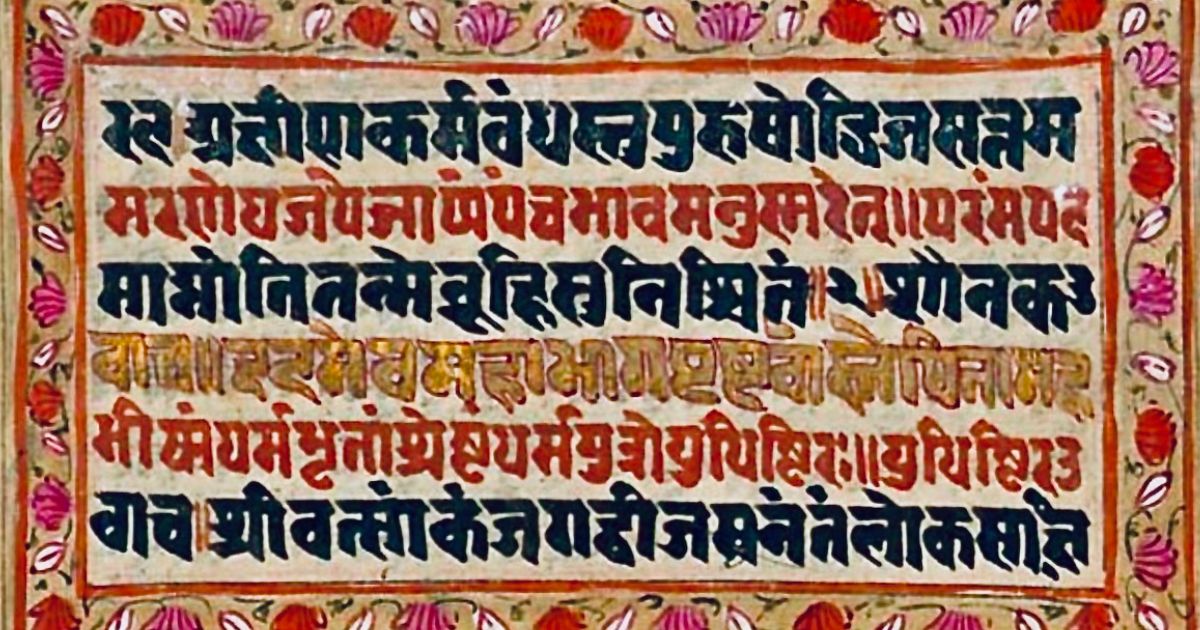
An excerpt from the original text.(complete · 618 words)
rjuna.
If men forsake the holy ordinance,
Heedless of Shastras, yet keep faith at heart
And worship, what shall be the state of those,
Great Krishna! Sattwan, Rajas, Tamas? Say!
Krishna.
Threefold the faith is of mankind and springs
From those three qualities,--becoming "true,"
Or "passion-stained," or "dark," as thou shalt hear!
The faith of each believer, Indian Prince!
Conforms itself to what he truly is.
Where thou shalt see a worshipper, that one
To what he worships lives assimilate,
[Such as the shrine, so is the votary,]
The "soothfast" souls adore true gods; the souls
Obeying Rajas worship Rakshasas[FN#34]
Or Yakshas; and the men of Darkness pray
To Pretas and to Bhutas.[FN#35] Yea, and those
Who practise bitter penance, not enjoined
By rightful rule--penance which hath its root
In self-sufficient, proud hypocrisies--
Those men, passion-beset, violent, wild,
Torturing--the witless ones--My elements
Shut in fair company within their flesh,
(Nay, Me myself, present within the flesh!)
Know them to devils devoted, not to Heaven!
For like as foods are threefold for mankind
In nourishing, so is there threefold way
Of worship, abstinence, and almsgiving!
Hear this of Me! there is a food which brings
Force, substance, strength, and health, and joy to live,
Being well-seasoned, cordial, comforting,
The "Soothfast" meat. And there be foods which bring
Aches and unrests, and burning blood, and grief,
Being too biting, heating, salt, and sharp,
And therefore craved by too strong appetite.
And there is foul food--kept from over-night,[FN#36]
Savourless, filthy, which the foul will eat,
A feast of rottenness, meet for the lips
Of such as love the "Darkness."
Thus with rites;--
A sacrifice not for rewardment made,
Offered in rightful wise, when he who vows
Sayeth, with heart devout, "This I should do!"
Is "Soothfast" rite. But sacrifice for gain,
Offered for good repute, be sure that this,
O Best of Bharatas! is Rajas-rite,
With stamp of "passion." And a sacrifice
Offered against the laws, with no due dole
Of food-giving, with no accompaniment
Of hallowed hymn, nor largesse to the priests,
In faithless celebration, call it vile,
The deed of "Darkness!"--lost!
Worship of gods
Meriting worship; lowly reverence
Of Twice-borns, Teachers, Elders; Purity,
Rectitude, and the Brahmacharya's vow,
And not to injure any helpless thing,--
These make a true religiousness of Act.
Words causing no man woe, words ever true,
Gentle and pleasing words, and those ye say
In murmured reading of a Sacred Writ,--
These make the true religiousness of Speech.
Serenity of soul, benignity,
Sway of the silent Spirit, constant stress
To sanctify the Nature,--these things make
Good rite, and true religiousness of Mind.
Such threefold faith, in highest piety
Kept, with no hope of gain, by hearts devote,
Is perfect work of Sattwan, true belief.
Religion shown in act of proud display
To win good entertainment, worship, fame,
Such--say I--is of Rajas, rash and vain.
Religion followed by a witless will
To torture self, or come at power to hurt
Another,--'tis of Tamas, dark and ill.
The gift lovingly given, when one shall say
"Now must I gladly give!" when he who takes
Can render nothing back; made in due place,
Due time, and to a meet recipient,
Is gift of Sattwan, fair and profitable.
The gift selfishly given, where to receive
Is hoped again, or when some end is sought,
Or where the gift is proffered with a grudge,
This is of Rajas, stained with impulse, ill.
The gift churlishly flung, at evil time,
In wrongful place, to base recipient,
Made in disdain or harsh unkindliness,
Is gift of Tamas, dark; it doth not bless![FN#37]
HERE ENDETH CHAPTER XVII. OF THE BHAGAVAD-GITA,
Entitled "Sraddhatrayavibhagayog,"
Or "The Book of Religion by the Threefold Kinds of Faith."
Master this chapter. Complete your experience
Purchase the complete book to access all chapters and support classic literature
As an Amazon Associate, we earn a small commission from qualifying purchases at no additional cost to you.
Available in paperback, hardcover, and e-book formats
Let's Analyse the Pattern
The same action produces different results depending on the true motivation behind it, even when the surface behavior appears identical.
Why This Matters
Connect literature to life
This chapter teaches how to look beneath surface actions and recognize the true driving forces behind people's behavior.
Practice This Today
This week, notice when someone does something helpful or generous—then quietly ask yourself what might really be motivating them, including yourself when you help others.
Now let's explore the literary elements.
Key Quotes & Analysis
"The faith of each believer conforms itself to what he truly is"
Context: Explaining why people are drawn to different types of spiritual practices
This reveals that our spiritual choices aren't random - they reflect our inner character. It's both liberating and challenging because it means we can't fake our way to enlightenment, but we can grow by examining what we're actually drawn to.
In Today's Words:
You worship what you are inside
"There is a food which brings force, substance, strength, and health, and joy to live"
Context: Describing pure food that nourishes both body and spirit
Krishna uses food as a concrete example of how the same basic need can be met in ways that either elevate or degrade us. This makes spiritual principles practical and applicable to daily choices.
In Today's Words:
Some food actually makes you feel good and gives you energy
"Those men, passion-beset, violent, wild, torturing the witless ones"
Context: Warning about people who create extreme spiritual practices to feed their ego
This warns against spiritual practices that become about proving how tough or dedicated you are rather than genuine growth. It's a caution about spiritual ego disguised as devotion.
In Today's Words:
Some people turn spirituality into a competition to show off how hardcore they are
Thematic Threads
Self-Examination
In This Chapter
Krishna teaches Arjuna to look beyond surface actions and examine the true motivations driving choices
Development
Builds on earlier chapters about duty and action by adding the crucial element of inner motivation
In Your Life:
You might catch yourself doing the 'right thing' for the wrong reasons and need to get honest about your real motives.
Faith
In This Chapter
Faith itself comes in three types—pure, passionate, and dark—each reflecting different inner natures
Development
Introduced here as a new framework for understanding spiritual and moral development
In Your Life:
You might notice that what you put your faith in (money, status, relationships) reveals your current level of spiritual maturity.
Class
In This Chapter
The three types of faith and action transcend traditional religious rules and social boundaries
Development
Continues the theme that spiritual worth isn't determined by birth or social position
In Your Life:
You might realize that your values and motivations matter more than following all the 'right' social expectations.
Personal Growth
In This Chapter
Gradual alignment of actions with highest values through honest self-assessment
Development
Builds on earlier teachings about disciplined action by adding the element of motivation awareness
In Your Life:
You might start catching yourself before acting from ego or ignorance and choose to wait for better motivations.
Human Relationships
In This Chapter
How the quality of our giving, helping, and interacting depends entirely on our inner state
Development
Expands earlier teachings about duty to others by examining the spirit behind our actions
In Your Life:
You might notice how your relationships improve when you act from genuine care rather than trying to get something back.
You now have the context. Time to form your own thoughts.
Discussion Questions
- 1
Krishna describes three types of faith that drive people's actions. What are these three types, and how does each one show up in daily behavior?
analysis • surface - 2
Why does Krishna say the same action—like giving a gift or helping someone—can be pure, passionate, or dark depending on motivation? What makes the difference?
analysis • medium - 3
Think about your workplace or family. Where do you see people doing the 'right' thing but for ego-driven or self-serving reasons? How can you tell the difference?
application • medium - 4
Krishna suggests examining your true motivations before acting. How would you apply this to a situation where you're considering helping a coworker or family member?
application • deep - 5
What does this chapter reveal about the gap between how we see ourselves and our actual motivations? Why is self-honesty so difficult but crucial?
reflection • deep
Critical Thinking Exercise
Motivation Detective Work
Think of three recent actions you took that seemed helpful or generous—volunteering for something, giving advice, offering help, making a donation, or posting something positive online. For each action, honestly examine what was really driving you underneath. Write down the surface reason you told yourself, then dig deeper for any hidden motivations.
Consider:
- •Be brutally honest—this is for your eyes only, so you can afford to tell the truth
- •Look for patterns in what motivates you: approval, control, avoiding conflict, genuine care
- •Notice that mixed motivations are normal—most actions have multiple drivers
Journaling Prompt
Write about a time when you discovered your real motivation was different from what you initially thought. How did that awareness change how you approached similar situations?
Coming Up Next...
Chapter 18: The Ultimate Teaching: Surrender and Liberation
In the final chapter, Arjuna asks Krishna to clarify the difference between renunciation and surrender - two concepts that sound similar but lead to very different ways of living. Krishna's answer will tie together all the teachings of the Gita into a final, practical wisdom for navigating life's challenges.