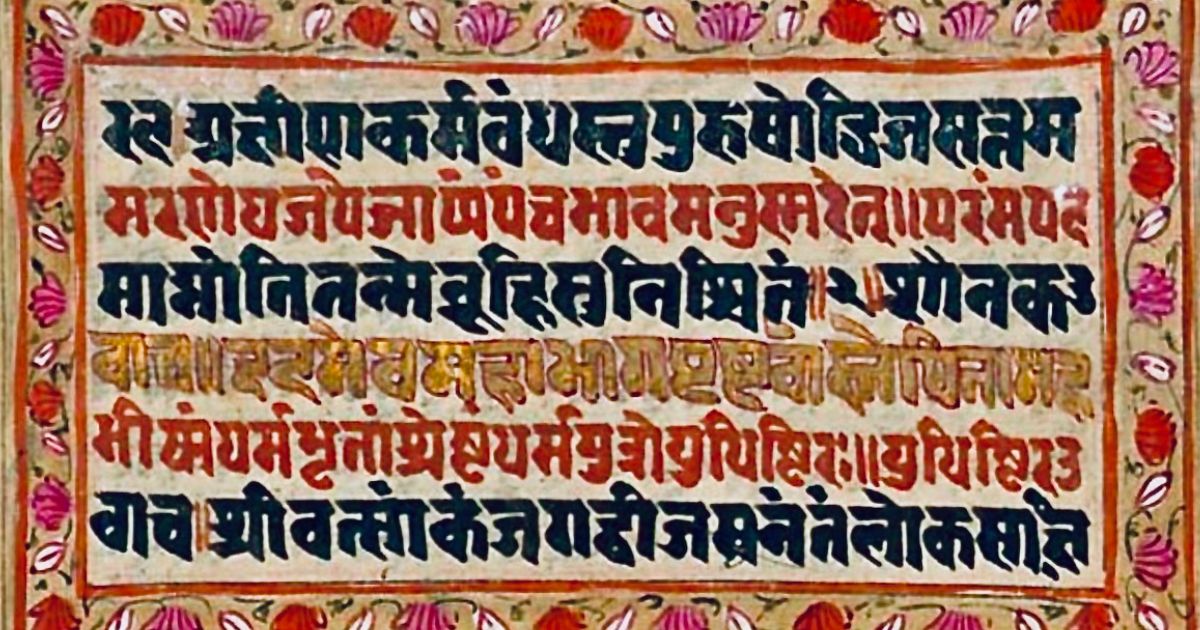
An excerpt from the original text.(complete · 671 words)
rishna.
Fearlessness, singleness of soul, the will
Always to strive for wisdom; opened hand
And governed appetites; and piety,
And love of lonely study; humbleness,
Uprightness, heed to injure nought which lives,
Truthfulness, slowness unto wrath, a mind
That lightly letteth go what others prize;
And equanimity, and charity
Which spieth no man's faults; and tenderness
Towards all that suffer; a contented heart,
Fluttered by no desires; a bearing mild,
Modest, and grave, with manhood nobly mixed,
With patience, fortitude, and purity;
An unrevengeful spirit, never given
To rate itself too high;--such be the signs,
O Indian Prince! of him whose feet are set
On that fair path which leads to heavenly birth!
Deceitfulness, and arrogance, and pride,
Quickness to anger, harsh and evil speech,
And ignorance, to its own darkness blind,--
These be the signs, My Prince! of him whose birth
Is fated for the regions of the vile.[FN#32]
The Heavenly Birth brings to deliverance,
So should'st thou know! The birth with Asuras
Brings into bondage. Be thou joyous, Prince!
Whose lot is set apart for heavenly Birth.
Two stamps there are marked on all living men,
Divine and Undivine; I spake to thee
By what marks thou shouldst know the Heavenly Man,
Hear from me now of the Unheavenly!
They comprehend not, the Unheavenly,
How Souls go forth from Me; nor how they come
Back unto Me: nor is there Truth in these,
Nor purity, nor rule of Life. "This world
Hath not a Law, nor Order, nor a Lord,"
So say they: "nor hath risen up by Cause
Following on Cause, in perfect purposing,
But is none other than a House of Lust."
And, this thing thinking, all those ruined ones--
Of little wit, dark-minded--give themselves
To evil deeds, the curses of their kind.
Surrendered to desires insatiable,
Full of deceitfulness, folly, and pride,
In blindness cleaving to their errors, caught
Into the sinful course, they trust this lie
As it were true--this lie which leads to death--
Finding in Pleasure all the good which is,
And crying "Here it finisheth!"
Ensnared
In nooses of a hundred idle hopes,
Slaves to their passion and their wrath, they buy
Wealth with base deeds, to glut hot appetites;
"Thus much, to-day," they say, "we gained! thereby
Such and such wish of heart shall have its fill;
And this is ours! and th' other shall be ours!
To-day we slew a foe, and we will slay
Our other enemy to-morrow! Look!
Are we not lords? Make we not goodly cheer?
Is not our fortune famous, brave, and great?
Rich are we, proudly born! What other men
Live like to us? Kill, then, for sacrifice!
Cast largesse, and be merry!" So they speak
Darkened by ignorance; and so they fall--
Tossed to and fro with projects, tricked, and bound
In net of black delusion, lost in lusts--
Down to foul Naraka. Conceited, fond,
Stubborn and proud, dead-drunken with the wine
Of wealth, and reckless, all their offerings
Have but a show of reverence, being not made
In piety of ancient faith. Thus vowed
To self-hood, force, insolence, feasting, wrath,
These My blasphemers, in the forms they wear
And in the forms they breed, my foemen are,
Hateful and hating; cruel, evil, vile,
Lowest and least of men, whom I cast down
Again, and yet again, at end of lives,
Into some devilish womb, whence--birth by birth--
The devilish wombs re-spawn them, all beguiled;
And, till they find and worship Me, sweet Prince!
Tread they that Nether Road.
The Doors of Hell
Are threefold, whereby men to ruin pass,--
The door of Lust, the door of Wrath, the door
Of Avarice. Let a man shun those three!
He who shall turn aside from entering
All those three gates of Narak, wendeth straight
To find his peace, and comes to Swarga's gate.
. . . . . . . . . . . .[FN#33]
HERE ENDETH CHAPTER XVI. OF THE BHAGAVAD-GITA,
Entitled "Daivasarasaupadwibhagayog,"
Or "The Book of the Separateness of the Divine and Undivine."
Master this chapter. Complete your experience
Purchase the complete book to access all chapters and support classic literature
As an Amazon Associate, we earn a small commission from qualifying purchases at no additional cost to you.
Available in paperback, hardcover, and e-book formats
Let's Analyse the Pattern
Every person operates from either a divine nature (self-aware, internally regulated) or demonic nature (externally dependent, impulse-driven), and this choice determines their entire life trajectory.
Why This Matters
Connect literature to life
This chapter teaches how to identify whether someone operates from internal strength or external dependency when things go wrong.
Practice This Today
This week, notice when someone faces a setback—watch whether they blame others and demand external fixes, or focus on what they can control and maintain their dignity.
Now let's explore the literary elements.
Key Quotes & Analysis
"Fearlessness, singleness of soul, the will always to strive for wisdom; opened hand and governed appetites"
Context: Beginning his description of divine qualities
Krishna starts with fearlessness because fear drives most bad decisions. 'Singleness of soul' means inner consistency - not being one way at work and another way at home. The 'opened hand' represents generosity without expecting payback.
In Today's Words:
Don't let fear run your life, be the same person everywhere, keep learning, share what you have, and don't let your cravings control you.
"This world hath not a Law, nor Order, nor a Truth"
Context: Describing how people with demonic qualities view life
This is the mindset that creates chaos - believing nothing matters except getting what you want. When people think there's no deeper meaning or consequences, they justify any behavior.
In Today's Words:
Life's meaningless, there are no real rules, so I might as well do whatever I want.
"Three gateways lead to hell: lust, anger, and greed"
Context: Warning about the main patterns that destroy peace
These three work together to trap people in cycles of suffering. Uncontrolled desire leads to anger when you don't get what you want, which leads to greed for more power to control outcomes.
In Today's Words:
Three things will mess up your life: letting your sexual desires run wild, flying into rages, and never having enough money or stuff.
Thematic Threads
Self-Control
In This Chapter
Krishna contrasts people who master their impulses versus those enslaved by lust, anger, and greed
Development
Builds on earlier teachings about disciplining the mind and senses
In Your Life:
You might notice this when deciding whether to respond or react during conflicts at work or home.
Internal vs External Validation
In This Chapter
Divine nature finds contentment within while demonic nature chases wealth, power, and status for happiness
Development
Expands the concept of detachment from outcomes introduced earlier
In Your Life:
You see this in how you measure success—by inner peace or by what others think of your achievements.
Destructive Patterns
In This Chapter
Krishna identifies three specific doorways to suffering: uncontrolled lust, explosive anger, and greed
Development
Provides concrete examples of the mental bondage discussed in previous chapters
In Your Life:
You might recognize these as the moments when you make decisions you later regret—wanting what you can't have, exploding at loved ones, or believing more stuff will fix your problems.
Choice and Consequence
In This Chapter
Daily choices about how to treat others and handle desires determine which type of person you become
Development
Reinforces the karma principle while making it practical and immediate
In Your Life:
You see this in how your small daily choices—being patient with difficult people or gossiping about them—shape who you're becoming.
Freedom vs Bondage
In This Chapter
Divine qualities lead to liberation while destructive patterns create endless suffering and delusion
Development
Culminates the book's central theme about achieving true freedom
In Your Life:
You experience this as the difference between feeling genuinely peaceful versus constantly stressed and wanting things to be different.
You now have the context. Time to form your own thoughts.
Discussion Questions
- 1
What are the three 'doorways to hell' Krishna warns about, and how do they show up in everyday situations?
analysis • surface - 2
Why does Krishna say the divine nature leads to freedom while the demonic nature leads to slavery, even when the demonic path seems more powerful?
analysis • medium - 3
Think about your workplace or family dynamics—can you identify someone operating from each nature? How does their behavior affect everyone around them?
application • medium - 4
When you catch yourself in lust, anger, or greed mode, what practical strategies could help you shift back to your divine nature?
application • deep - 5
Krishna suggests we're always feeding one nature or the other through our daily choices. What does this reveal about how personality and character actually develop?
reflection • deep
Critical Thinking Exercise
Map Your Personal Triggers
Create two columns on paper: 'Divine Nature Moments' and 'Demonic Nature Moments.' For each column, write down specific situations that tend to bring out that side of you. Then identify which of the three doorways (lust, anger, greed) most often pulls you toward your demonic nature. Finally, brainstorm one concrete strategy for catching yourself before you walk through that doorway next time.
Consider:
- •Be honest about your patterns without judging yourself harshly
- •Look for specific triggers rather than general personality traits
- •Focus on situations you can actually control or influence
Journaling Prompt
Write about a recent time when you operated from your demonic nature. What were you really wanting in that moment, and how could you have met that need through your divine nature instead?
Coming Up Next...
Chapter 17: The Three Types of Faith
Arjuna asks a crucial question about people who ignore religious rules but still have faith in their hearts. Krishna's answer will reveal how genuine spiritual practice differs from empty ritual, and what really matters when it comes to finding the divine.