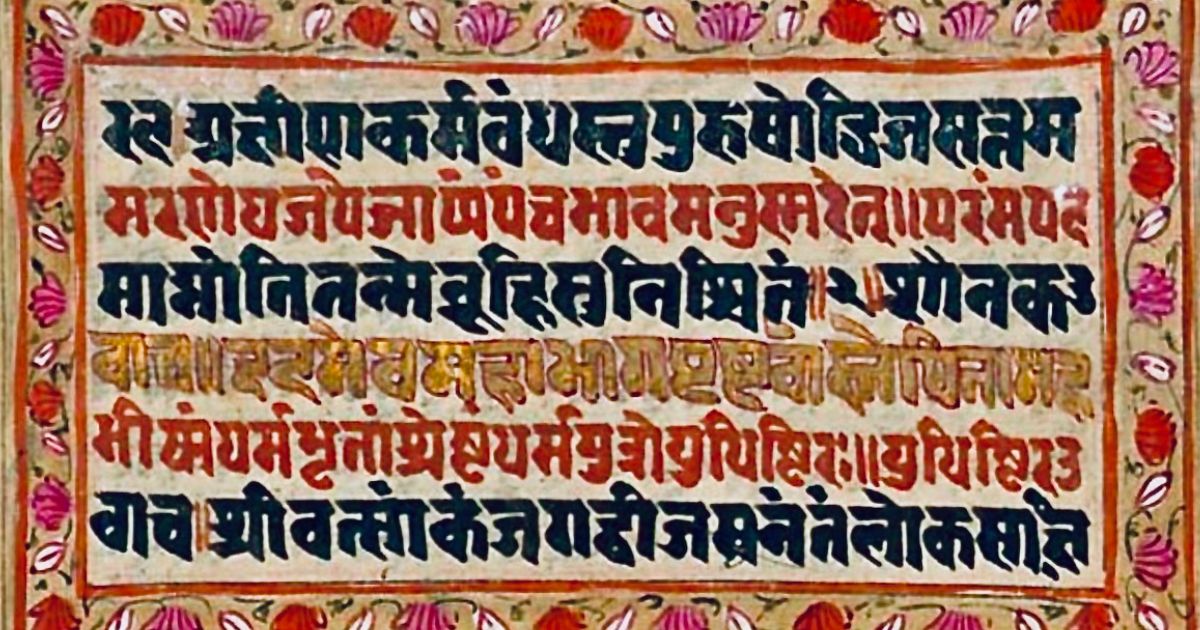
An excerpt from the original text.(complete · 910 words)
rjuna.
Now would I hear, O gracious Kesava![FN#26]
Of Life which seems, and Soul beyond, which sees,
And what it is we know-or think to know.
Krishna.
Yea! Son of Kunti! for this flesh ye see
Is Kshetra, is the field where Life disports;
And that which views and knows it is the Soul,
Kshetrajna. In all "fields," thou Indian prince!
I am Kshetrajna. I am what surveys!
Only that knowledge knows which knows the known
By the knower![FN#27] What it is, that "field" of life,
What qualities it hath, and whence it is,
And why it changeth, and the faculty
That wotteth it, the mightiness of this,
And how it wotteth-hear these things from Me!
. . . . . . . . . . . .[FN#28]
The elements, the conscious life, the mind,
The unseen vital force, the nine strange gates
Of the body, and the five domains of sense;
Desire, dislike, pleasure and pain, and thought
Deep-woven, and persistency of being;
These all are wrought on Matter by the Soul!
Humbleness, truthfulness, and harmlessness,
Patience and honour, reverence for the wise.
Purity, constancy, control of self,
Contempt of sense-delights, self-sacrifice,
Perception of the certitude of ill
In birth, death, age, disease, suffering, and sin;
Detachment, lightly holding unto home,
Children, and wife, and all that bindeth men;
An ever-tranquil heart in fortunes good
And fortunes evil, with a will set firm
To worship Me--Me only! ceasing not;
Loving all solitudes, and shunning noise
Of foolish crowds; endeavours resolute
To reach perception of the Utmost Soul,
And grace to understand what gain it were
So to attain,--this is true Wisdom, Prince!
And what is otherwise is ignorance!
Now will I speak of knowledge best to know-
That Truth which giveth man Amrit to drink,
The Truth of HIM, the Para-Brahm, the All,
The Uncreated;; not Asat, not Sat,
Not Form, nor the Unformed; yet both, and more;--
Whose hands are everywhere, and everywhere
Planted His feet, and everywhere His eyes
Beholding, and His ears in every place
Hearing, and all His faces everywhere
Enlightening and encompassing His worlds.
Glorified in the senses He hath given,
Yet beyond sense He is; sustaining all,
Yet dwells He unattached: of forms and modes
Master, yet neither form nor mode hath He;
He is within all beings--and without--
Motionless, yet still moving; not discerned
For subtlety of instant presence; close
To all, to each; yet measurelessly far!
Not manifold, and yet subsisting still
In all which lives; for ever to be known
As the Sustainer, yet, at the End of Times,
He maketh all to end--and re-creates.
The Light of Lights He is, in the heart of the Dark
Shining eternally. Wisdom He is
And Wisdom's way, and Guide of all the wise,
Planted in every heart.
So have I told
Of Life's stuff, and the moulding, and the lore
To comprehend. Whoso, adoring Me,
Perceiveth this, shall surely come to Me!
Know thou that Nature and the Spirit both
Have no beginning! Know that qualities
And changes of them are by Nature wrought;
That Nature puts to work the acting frame,
But Spirit doth inform it, and so cause
Feeling of pain and pleasure. Spirit, linked
To moulded matter, entereth into bond
With qualities by Nature framed, and, thus
Married to matter, breeds the birth again
In good or evil yonis.[FN#29]
Yet is this
Yea! in its bodily prison!--Spirit pure,
Spirit supreme; surveying, governing,
Guarding, possessing; Lord and Master still
PURUSHA, Ultimate, One Soul with Me.
Whoso thus knows himself, and knows his soul
PURUSHA, working through the qualities
With Nature's modes, the light hath come for him!
Whatever flesh he bears, never again
Shall he take on its load. Some few there be
By meditation find the Soul in Self
Self-schooled; and some by long philosophy
And holy life reach thither; some by works:
Some, never so attaining, hear of light
From other lips, and seize, and cleave to it
Worshipping; yea! and those--to teaching true--
Overpass Death!
Wherever, Indian Prince!
Life is--of moving things, or things unmoved,
Plant or still seed--know, what is there hath grown
By bond of Matter and of Spirit: Know
He sees indeed who sees in all alike
The living, lordly Soul; the Soul Supreme,
Imperishable amid the Perishing:
For, whoso thus beholds, in every place,
In every form, the same, one, Living Life,
Doth no more wrongfulness unto himself,
But goes the highest road which brings to bliss.
Seeing, he sees, indeed, who sees that works
Are Nature's wont, for Soul to practise by
Acting, yet not the agent; sees the mass
Of separate living things--each of its kind--
Issue from One, and blend again to One:
Then hath he BRAHMA, he attains!
O Prince!
That Ultimate, High Spirit, Uncreate,
Unqualified, even when it entereth flesh
Taketh no stain of acts, worketh in nought!
Like to the ethereal air, pervading all,
Which, for sheer subtlety, avoideth taint,
The subtle Soul sits everywhere, unstained:
Like to the light of the all-piercing sun
[Which is not changed by aught it shines upon,]
The Soul's light shineth pure in every place;
And they who, by such eye of wisdom, see
How Matter, and what deals with it, divide;
And how the Spirit and the flesh have strife,
Those wise ones go the way which leads to Life!
HERE ENDS CHAPTER XIII. OF THE BHAGAVAD-GITA,
Entitled "Kshetrakshetrajnavibhagayog,"
Or "The Book of Religion by Separation of Matter and Spirit."
Master this chapter. Complete your experience
Purchase the complete book to access all chapters and support classic literature
As an Amazon Associate, we earn a small commission from qualifying purchases at no additional cost to you.
Available in paperback, hardcover, and e-book formats
Let's Analyse the Pattern
Confusing your identity with your temporary circumstances and emotions instead of recognizing the unchanging awareness that observes them all.
Why This Matters
Connect literature to life
This chapter teaches how to separate your identity from your circumstances to maintain perspective during setbacks.
Practice This Today
This week, notice when disappointments make you feel like a failure as a person rather than someone who experienced a setback - practice asking 'What part of me is watching this unfold?'
Now let's explore the literary elements.
Key Quotes & Analysis
"Only that knowledge knows which knows the known by the knower!"
Context: Explaining the relationship between awareness and what we're aware of
Krishna is pointing out that true understanding comes from recognizing the difference between your experiences and the part of you that experiences them. Most people get lost in their problems instead of stepping back to observe them clearly.
In Today's Words:
Real wisdom is knowing the difference between what's happening to you and who you really are.
"An ever-tranquil heart in fortunes good and fortunes evil, with a will set firm"
Context: Describing the qualities of someone who lives from deeper awareness
This describes emotional stability that doesn't depend on external circumstances. It's not about being emotionless, but about having an inner anchor that keeps you steady whether you're winning or losing.
In Today's Words:
Stay calm and focused whether you're having a great day or everything's falling apart.
"Loving all solitudes, and shunning noise of foolish crowds"
Context: Listing qualities that help maintain inner clarity
Krishna emphasizes the importance of quiet reflection and avoiding environments that pull you into drama or superficial thinking. This isn't about being antisocial, but about protecting your mental space.
In Today's Words:
Make time for quiet thinking and don't get caught up in gossip or meaningless drama.
Thematic Threads
Identity
In This Chapter
Krishna distinguishes between false identity (body, emotions, circumstances) and true identity (the witnessing consciousness)
Development
Deepens from earlier discussions of duty and action - now examining who performs the action
In Your Life:
Notice when you say 'I am stressed' versus 'I am experiencing stress' - the difference reveals your level of identification
Personal Growth
In This Chapter
Growth comes from developing qualities like humility, patience, and detachment while maintaining the observer perspective
Development
Builds on previous chapters about selfless action - now showing the consciousness that enables it
In Your Life:
Real growth happens when you can watch your own reactions and patterns without being completely controlled by them
Class
In This Chapter
True nobility comes from wisdom and self-awareness, not external circumstances or social position
Development
Continues theme that worth isn't determined by birth or status but by understanding
In Your Life:
Your value doesn't depend on your job title, income level, or what others think of your circumstances
Social Expectations
In This Chapter
Freedom from being defined by others' opinions or social roles through maintaining observer consciousness
Development
Expands on duty theme - you can fulfill roles without losing yourself in them
In Your Life:
You can play your various roles (worker, parent, friend) without becoming trapped by others' expectations of those roles
Human Relationships
In This Chapter
Relating from the observer self creates more authentic connections than ego-driven interactions
Development
Builds foundation for deeper relationship wisdom in later chapters
In Your Life:
When you stop taking everything personally, your relationships become less reactive and more genuine
You now have the context. Time to form your own thoughts.
Discussion Questions
- 1
What's the difference between the 'field' and the 'knower' that Krishna describes, and why does he say most suffering comes from confusing the two?
analysis • surface - 2
Why do people become so identified with their circumstances that they lose perspective, and what happens when your entire identity depends on external things?
analysis • medium - 3
Where do you see people today getting trapped by defining themselves through their problems, achievements, or roles instead of recognizing the part of them that observes it all?
application • medium - 4
How would you practice 'observer consciousness' during a stressful situation - what would it look like to be the sky that holds the storm rather than the storm itself?
application • deep - 5
What does this chapter reveal about why some people stay stuck in drama while others navigate challenges with more stability and clarity?
reflection • deep
Critical Thinking Exercise
Practice the Observer Self
Think of a current situation that's causing you stress or strong emotions. Write it down, then practice separating the 'field' from the 'knower.' Describe what's happening in your circumstances, your emotional reactions, and your thoughts about it. Then identify what part of you is watching all of this unfold - the awareness that notices your stress without being consumed by it.
Consider:
- •Notice the difference between experiencing emotions and being aware that you're experiencing them
- •Pay attention to how much mental energy you spend being the drama versus observing it
- •Consider how your decision-making changes when you operate from observer consciousness versus total identification
Journaling Prompt
Write about a time when you were so caught up in a situation that you lost perspective. How might things have been different if you had been able to step back and observe what was happening rather than being completely swept up in it?
Coming Up Next...
Chapter 14: The Three Forces That Shape Us
Krishna is about to reveal the 'wisdom of all wisdoms' - the ultimate understanding that has allowed the greatest saints to transcend the cycle of birth and death entirely. This isn't just philosophy anymore; it's the master key to permanent liberation.