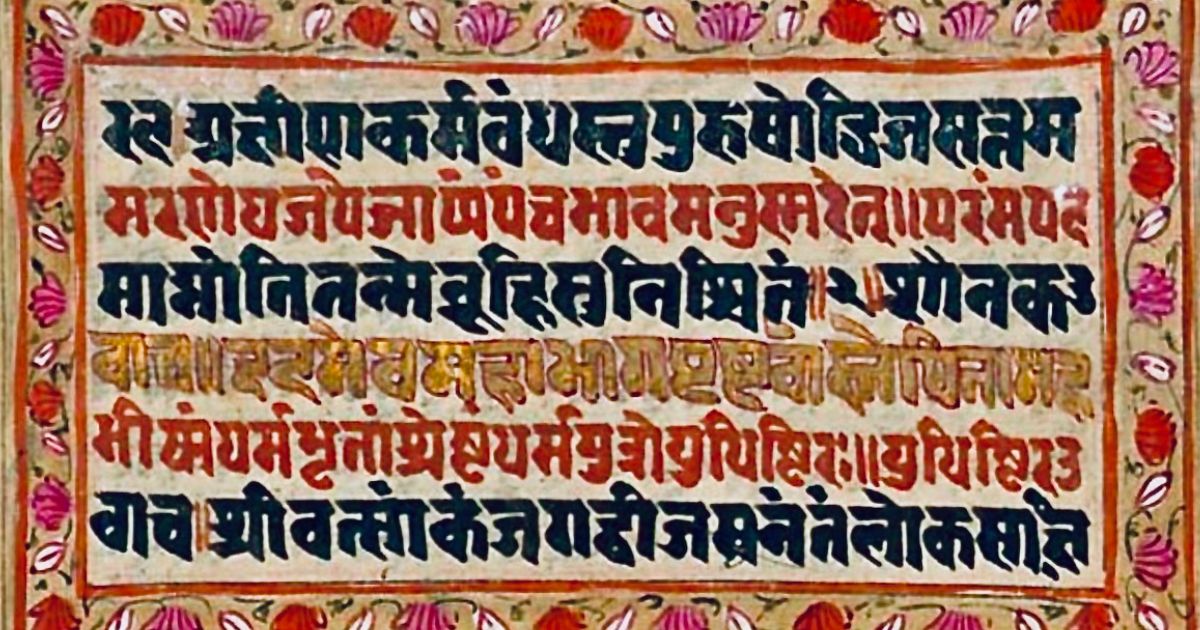
An excerpt from the original text.(complete · 657 words)
rishna.
Yet farther will I open unto thee
This wisdom of all wisdoms, uttermost,
The which possessing, all My saints have passed
To perfectness. On such high verities
Reliant, rising into fellowship
With Me, they are not born again at birth
Of Kalpas, nor at Pralyas suffer change!
This Universe the womb is where I plant
Seed of all lives! Thence, Prince of India, comes
Birth to all beings! Whoso, Kunti's Son!
Mothers each mortal form, Brahma conceives,
And I am He that fathers, sending seed!
Sattwan, Rajas, and Tamas, so are named
The qualities of Nature, "Soothfastness,"
"Passion," and "Ignorance." These three bind down
The changeless Spirit in the changeful flesh.
Whereof sweet "Soothfastness," by purity
Living unsullied and enlightened, binds
The sinless Soul to happiness and truth;
And Passion, being kin to appetite,
And breeding impulse and propensity,
Binds the embodied Soul, O Kunti's Son!
By tie of works. But Ignorance, begot
Of Darkness, blinding mortal men, binds down
Their souls to stupor, sloth, and drowsiness.
Yea, Prince of India! Soothfastness binds souls
In pleasant wise to flesh; and Passion binds
By toilsome strain; but Ignorance, which blots
The beams of wisdom, binds the soul to sloth.
Passion and Ignorance, once overcome,
Leave Soothfastness, O Bharata! Where this
With Ignorance are absent, Passion rules;
And Ignorance in hearts not good nor quick.
When at all gateways of the Body shines
The Lamp of Knowledge, then may one see well
Soothfastness settled in that city reigns;
Where longing is, and ardour, and unrest,
Impulse to strive and gain, and avarice,
Those spring from Passion--Prince!--engrained; and where
Darkness and dulness, sloth and stupor are,
'Tis Ignorance hath caused them, Kuru Chief!
Moreover, when a soul departeth, fixed
In Soothfastness, it goeth to the place--
Perfect and pure--of those that know all Truth.
If it departeth in set habitude
Of Impulse, it shall pass into the world
Of spirits tied to works; and, if it dies
In hardened Ignorance, that blinded soul
Is born anew in some unlighted womb.
The fruit of Soothfastness is true and sweet;
The fruit of lusts is pain and toil; the fruit
Of Ignorance is deeper darkness. Yea!
For Light brings light, and Passion ache to have;
And gloom, bewilderments, and ignorance
Grow forth from Ignorance. Those of the first
Rise ever higher; those of the second mode
Take a mid place; the darkened souls sink back
To lower deeps, loaded with witlessness!
When, watching life, the living man perceives
The only actors are the Qualities,
And knows what rules beyond the Qualities,
Then is he come nigh unto Me!
The Soul,
Thus passing forth from the Three Qualities--
Whereby arise all bodies--overcomes
Birth, Death, Sorrow, and Age; and drinketh deep
The undying wine of Amrit.
Arjuna.
Oh, my Lord!
Which be the signs to know him that hath gone
Past the Three Modes? How liveth he? What way
Leadeth him safe beyond the threefold Modes?
Krishna.
He who with equanimity surveys
Lustre of goodness, strife of passion, sloth
Of ignorance, not angry if they are,
Not wishful when they are not: he who sits
A sojourner and stranger in their midst
Unruffled, standing off, saying--serene--
When troubles break, "These be the Qualities!"
He unto whom--self-centred--grief and joy
Sound as one word; to whose deep-seeing eyes
The clod, the marble, and the gold are one;
Whose equal heart holds the same gentleness
For lovely and unlovely things, firm-set,
Well-pleased in praise and dispraise; satisfied
With honour or dishonour; unto friends
And unto foes alike in tolerance;
Detached from undertakings,--he is named
Surmounter of the Qualities!
And such--
With single, fervent faith adoring Me,
Passing beyond the Qualities, conforms
To Brahma, and attains Me!
For I am
That whereof Brahma is the likeness! Mine
The Amrit is; and Immortality
Is mine; and mine perfect Felicity!
HERE ENDS CHAPTER XIV. OF THE BHAGAVAD-GITA
Entitled "Gunatrayavibhagayog,"
Or "The Book of Religion by Separation from the Qualities."
Master this chapter. Complete your experience
Purchase the complete book to access all chapters and support classic literature
As an Amazon Associate, we earn a small commission from qualifying purchases at no additional cost to you.
Available in paperback, hardcover, and e-book formats
Let's Analyse the Pattern
People get controlled by their current mental state instead of observing it and choosing their response.
Why This Matters
Connect literature to life
This chapter teaches you to identify which of three core mental states is driving your decisions and behavior in any given moment.
Practice This Today
This week, notice when you're operating from stress (drive mode), avoidance (stuck mode), or clear thinking (clarity mode) - and catch yourself before making important decisions from the wrong headspace.
Now let's explore the literary elements.
Key Quotes & Analysis
"Sattwan, Rajas, and Tamas, so are named The qualities of Nature, 'Soothfastness,' 'Passion,' and 'Ignorance.' These three bind down The changeless Spirit in the changeful flesh."
Context: Krishna explains the fundamental forces that control human behavior
This reveals that what we think is 'our personality' is actually just temporary states we cycle through. The real you exists beyond these moods and mental patterns.
In Today's Words:
There are three basic modes your mind operates in - clear thinking, driven/stressed, and checked out. Don't mistake these temporary states for who you really are.
"When at all gateways of the Body shines The Lamp of Knowledge, then may one see well Soothfastness settled in that city reigns"
Context: Describing how to recognize when someone is in a state of clarity and balance
This gives practical signs for recognizing when you're thinking clearly versus being clouded by stress or laziness. It's about developing self-awareness.
In Today's Words:
When your mind is clear and your senses are sharp, you know you're in a good headspace to make decisions.
"Passion, being kin to appetite, And breeding impulse and propensity, Binds the embodied Soul, O Kunti's Son! By tie of works."
Context: Explaining how the driven, passionate state creates its own form of bondage
Shows that even positive qualities like ambition and drive can become traps if they control you completely. Being constantly driven is still being controlled by external forces.
In Today's Words:
When you're always wanting more and can't sit still, that restless energy is running your life instead of you running it.
Thematic Threads
Personal Growth
In This Chapter
Krishna teaches the framework of three mental states and how to master them through observation
Development
Builds on earlier teachings about duty and devotion by showing how mental mastery enables right action
In Your Life:
You might notice how your mood determines your choices more than you realize
Identity
In This Chapter
The text distinguishes between your temporary mental state and your deeper self that can observe those states
Development
Deepens the exploration of who you really are beyond surface-level emotions and reactions
In Your Life:
You might catch yourself saying 'I'm stressed' instead of 'I'm experiencing stress right now'
Class
In This Chapter
Different mental states create different life outcomes and social positions over time
Development
Shows how internal patterns affect external circumstances and social mobility
In Your Life:
You might see how stuck-mode thinking keeps people trapped in cycles of poverty or bad decisions
Human Relationships
In This Chapter
The three states affect how we interact with others - from clarity and compassion to drive-based conflict to stuck-mode withdrawal
Development
Expands understanding of relationship dynamics beyond surface behaviors to underlying mental patterns
In Your Life:
You might notice how your mental state affects whether you're patient or reactive with family members
You now have the context. Time to form your own thoughts.
Discussion Questions
- 1
Krishna describes three mental states that drive all human behavior: clarity mode, drive mode, and stuck mode. Can you think of a recent day when you experienced all three? What was different about how you made decisions in each state?
analysis • surface - 2
Why do people get trapped cycling between these states without realizing it? What keeps someone from stepping back and observing which mode they're operating from?
analysis • medium - 3
Think about your workplace or family dynamics. How do you see these three states playing out? Who operates mainly from drive mode? Who gets stuck? Who stays clear-headed under pressure?
application • medium - 4
Krishna suggests developing an 'inner observer' - the part of you that can step back and recognize which state you're in without being controlled by it. How would you practically develop this skill in your daily life?
application • deep - 5
What does this chapter reveal about the relationship between self-awareness and personal power? Why might recognizing your mental state be more valuable than trying to control it?
reflection • deep
Critical Thinking Exercise
Track Your Mental State Patterns
For the next three days, set three random phone alarms. When they go off, quickly note which of the three states you're in: clarity (balanced, making good choices), drive (stressed but productive, wanting more), or stuck (avoiding problems, feeling foggy). Don't judge or try to change anything - just observe and record. After three days, look for patterns: What triggers each state? Which decisions do you make in each mode?
Consider:
- •Notice how your state affects not just big decisions, but small ones like what you eat or how you respond to texts
- •Pay attention to how long you stay in each state - some people cycle quickly, others get stuck for days
- •Observe how other people's energy affects your state - does being around stressed people pull you into drive mode?
Journaling Prompt
Write about a time when you made a major life decision while in drive mode (stressed, wanting more) versus clarity mode (calm, thinking clearly). How did the process and outcome differ? What would you do differently now?
Coming Up Next...
Chapter 15: The Upside-Down Tree of Life
Krishna shifts to a powerful metaphor - life as an ancient tree with roots above and branches below, its leaves whispering sacred truths. He's about to reveal how to cut through the illusions that keep us trapped in cycles of suffering.