
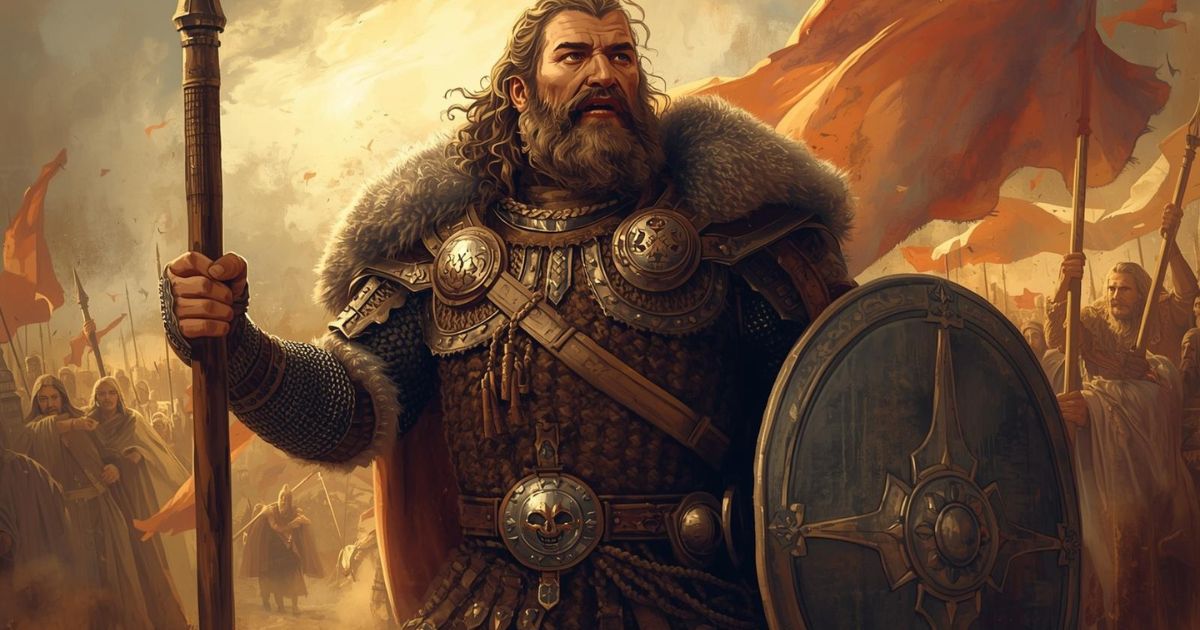
An excerpt from the original text.(complete · 858 words)
BEOWULF BRINGS HIS TROPHIES.--HROTHGAR'S GRATITUDE.


{Beowulf relates his last exploit.}

          Beowulf spake, offspring of Ecgtheow:
          "Lo! we blithely have brought thee, bairn of Healfdene,
          Prince of the Scyldings, these presents from ocean
          Which thine eye looketh on, for an emblem of glory.
        5 I came off alive from this, narrowly 'scaping:
          In war 'neath the water the work with great pains I
          Performed, and the fight had been finished quite nearly,
          Had God not defended me. I failed in the battle
          Aught to accomplish, aided by Hrunting,
       10 Though that weapon was worthy, but the Wielder of earth-folk

{God was fighting with me.}

          Gave me willingly to see on the wall a
          Heavy old hand-sword hanging in splendor
          (He guided most often the lorn and the friendless),
          That I swung as a weapon. The wards of the house then
       15 I killed in the conflict (when occasion was given me).
          Then the battle-sword burned, the brand that was lifted,[1]
          As the blood-current sprang, hottest of war-sweats;
          Seizing the hilt, from my foes I offbore it;
          I avenged as I ought to their acts of malignity,
       20 The murder of Danemen. I then make thee this promise,

{Heorot is freed from monsters.}

          Thou'lt be able in Heorot careless to slumber
          With thy throng of heroes and the thanes of thy people
          Every and each, of greater and lesser,
          And thou needest not fear for them from the selfsame direction
       25 As thou formerly fearedst, oh, folk-lord of Scyldings,
[58]     End-day for earlmen." To the age-hoary man then,

{The famous sword is presented to Hrothgar.}

          The gray-haired chieftain, the gold-fashioned sword-hilt,
          Old-work of giants, was thereupon given;
          Since the fall of the fiends, it fell to the keeping
       30 Of the wielder of Danemen, the wonder-smith's labor,
          And the bad-mooded being abandoned this world then,
          Opponent of God, victim of murder,
          And also his mother; it went to the keeping
          Of the best of the world-kings, where waters encircle,
       35 Who the scot divided in Scylding dominion.

{Hrothgar looks closely at the old sword.}

          Hrothgar discoursed, the hilt he regarded,
          The ancient heirloom where an old-time contention's
          Beginning was graven: the gurgling currents,
          The flood slew thereafter the race of the giants,
       40 They had proved themselves daring: that people was loth to

{It had belonged to a race hateful to God.}

          The Lord everlasting, through lash of the billows
          The Father gave them final requital.
          So in letters of rune on the clasp of the handle
          Gleaming and golden, 'twas graven exactly,
       45 Set forth and said, whom that sword had been made for,
          Finest of irons, who first it was wrought for,
          Wreathed at its handle and gleaming with serpents.
          The wise one then said (silent they all were)

{Hrothgar praises Beowulf.}

          Son of old Healfdene: "He may say unrefuted
       50 Who performs 'mid the folk-men fairness and truth
          (The hoary old ruler remembers the past),
          That better by birth is this bairn of the nobles!
          Thy fame is extended through far-away countries,
          Good friend Beowulf, o'er all of the races,
       55 Thou holdest all firmly, hero-like strength with
          Prudence of spirit. I'll prove myself grateful
          As before we agreed on; thou granted for long shalt
          Become a great comfort to kinsmen and comrades,

{Heremod's career is again contrasted with Beowulf's.}

          A help unto heroes. Heremod became not
       60 Such to the Scyldings, successors of Ecgwela;
          He grew not to please them, but grievous destruction,
[59]      And diresome death-woes to Danemen attracted;
          He slew in anger his table-companions,
          Trustworthy counsellors, till he turned off lonely
       65 From world-joys away, wide-famous ruler:
          Though high-ruling heaven in hero-strength raised him,
          In might exalted him, o'er men of all nations
          Made him supreme, yet a murderous spirit
          Grew in his bosom: he gave then no ring-gems

{A wretched failure of a king, to give no jewels to his retainers.}

       70 To the Danes after custom; endured he unjoyful
          Standing the straits from strife that was raging,
          Longsome folk-sorrow. Learn then from this,
          Lay hold of virtue! Though laden with winters,
          I have sung thee these measures. 'Tis a marvel to tell it,

{Hrothgar moralizes.}

       75 How all-ruling God from greatness of spirit
          Giveth wisdom to children of men,
          Manor and earlship: all things He ruleth.
          He often permitteth the mood-thought of man of
          The illustrious lineage to lean to possessions,
       80 Allows him earthly delights at his manor,
          A high-burg of heroes to hold in his keeping,
          Maketh portions of earth-folk hear him,
          And a wide-reaching kingdom so that, wisdom failing him,
          He himself is unable to reckon its boundaries;
       85 He liveth in luxury, little debars him,
          Nor sickness nor age, no treachery-sorrow
          Becloudeth his spirit, conflict nowhere,
          No sword-hate, appeareth, but all of the world doth
          Wend as he wisheth; the worse he knoweth not,
       90 Till arrant arrogance inward pervading,
          Waxeth and springeth, when the warder is sleeping,
          The guard of the soul: with sorrows encompassed,
          Too sound is his slumber, the slayer is near him,
          Who with bow and arrow aimeth in malice.

[60]

    [1] Or rather, perhaps, '_the inlaid, or damaskeened weapon_.' Cf.
    24_57 and note.
Master this chapter. Complete your experience
Purchase the complete book to access all chapters and support classic literature
As an Amazon Associate, we earn a small commission from qualifying purchases at no additional cost to you.
Available in paperback, hardcover, and e-book formats
Let's Analyse the Pattern
Secure people can share credit because their results speak for themselves; insecure people hoard credit because they doubt their actual contribution.
Why This Matters
Connect literature to life
This chapter teaches how to distinguish between confident humility and desperate self-promotion by watching how people handle success and credit.
Practice This Today
This week, notice when someone at work gets recognition—do they share credit or hoard it, and watch how their team responds to predict their long-term trajectory.
Now let's explore the literary elements.
Key Quotes & Analysis
"I failed in the battle aught to accomplish, aided by Hrunting, though that weapon was worthy, but the Wielder of earth-folk gave me willingly to see on the wall a heavy old hand-sword hanging in splendor"
Context: Beowulf explains how his original sword failed but God provided him with an ancient weapon
This shows Beowulf's strategic humility—he admits his limitations and credits divine help, which actually makes his achievement more impressive. He's not diminishing himself; he's showing wisdom about how success really works.
In Today's Words:
My original plan didn't work, but I stayed open to new opportunities and found exactly what I needed to get the job done.
"Thou'lt be able in Heorot careless to slumber with thy throng of heroes and the thanes of thy people, every and each, of greater and lesser"
Context: Beowulf promises Hrothgar that the hall is now safe from monsters
This isn't just about killing monsters—it's about restoring peace and security to an entire community. Beowulf understands that true heroism means creating safety for everyone, not just proving your strength.
In Today's Words:
You and your people can finally sleep peacefully—the threat is completely eliminated.
"Choose, dear Beowulf, the better part, eternal rewards. Do not give way to pride"
Context: Hrothgar's warning about how success can corrupt even good people
This is the heart of Hrothgar's wisdom—success is a test, not a destination. He's warning that pride is the enemy of sustained greatness, and that staying grounded is a choice you have to make every day.
In Today's Words:
Don't let success go to your head—stay humble and keep doing right, because that's what lasts.
Thematic Threads
Class
In This Chapter
Beowulf demonstrates noble behavior by sharing credit while maintaining dignity, contrasting with Heremod who abandoned his class obligations
Development
Evolved from earlier physical displays of nobility to sophisticated understanding of leadership responsibility
In Your Life:
You see this when managers either lift up their teams or throw them under the bus—it reveals their true character.
Identity
In This Chapter
Beowulf's identity is secure enough to acknowledge help; Heremod's identity required constant validation and sole credit
Development
Building on earlier themes of proving worth, now showing how secure identity handles success
In Your Life:
When you're confident in who you are, you don't need to take credit for everything—your work speaks for itself.
Social Expectations
In This Chapter
Society expects leaders to reward followers and share prosperity; Heremod violated this contract and lost legitimacy
Development
Deepening from individual heroic expectations to complex leadership obligations
In Your Life:
Whether you're training new staff or raising kids, people expect you to lift others up as you succeed.
Personal Growth
In This Chapter
Hrothgar uses Heremod's cautionary tale to teach Beowulf how success can corrupt if you're not careful
Development
Moving beyond individual achievement to wisdom about maintaining character through success
In Your Life:
The more you achieve, the more important it becomes to remember what got you there and who helped along the way.
You now have the context. Time to form your own thoughts.
Discussion Questions
- 1
How does Beowulf handle telling the story of his victory, and what does this reveal about his character?
analysis • surface - 2
Why does Hrothgar use Heremod as an example, and what specific behaviors led to Heremod's downfall?
analysis • medium - 3
Where do you see the difference between Beowulf's 'strategic humility' and Heremod's need for all the credit in your workplace or community?
application • medium - 4
When someone you know achieves success, how can you tell whether they'll handle it like Beowulf or like Heremod?
application • deep - 5
What does this chapter suggest about the relationship between gratitude, power, and long-term success?
reflection • deep
Critical Thinking Exercise
Map Your Credit-Sharing Strategy
Think of a recent success or accomplishment in your life—at work, home, or in your community. Write down everyone who contributed to that success, including people who taught you, supported you, or gave you opportunities. Then practice how you would tell that success story using Beowulf's approach: owning your courage and effort while crediting the help you received.
Consider:
- •Notice how acknowledging help actually makes your achievement sound more impressive, not less
- •Consider which people in your life practice strategic humility versus those who hoard credit
- •Think about how you want to be remembered when you're in positions of success or leadership
Journaling Prompt
Write about a time when someone shared credit with you for a success, or when someone took all the credit for something you helped with. How did each situation make you feel, and what did it teach you about handling your own future successes?
Coming Up Next...
Chapter 26: Hrothgar's Warning About Power and Pride
Hrothgar isn't finished with his wisdom yet. He has more crucial advice about handling success and the responsibilities that come with great achievement.



