
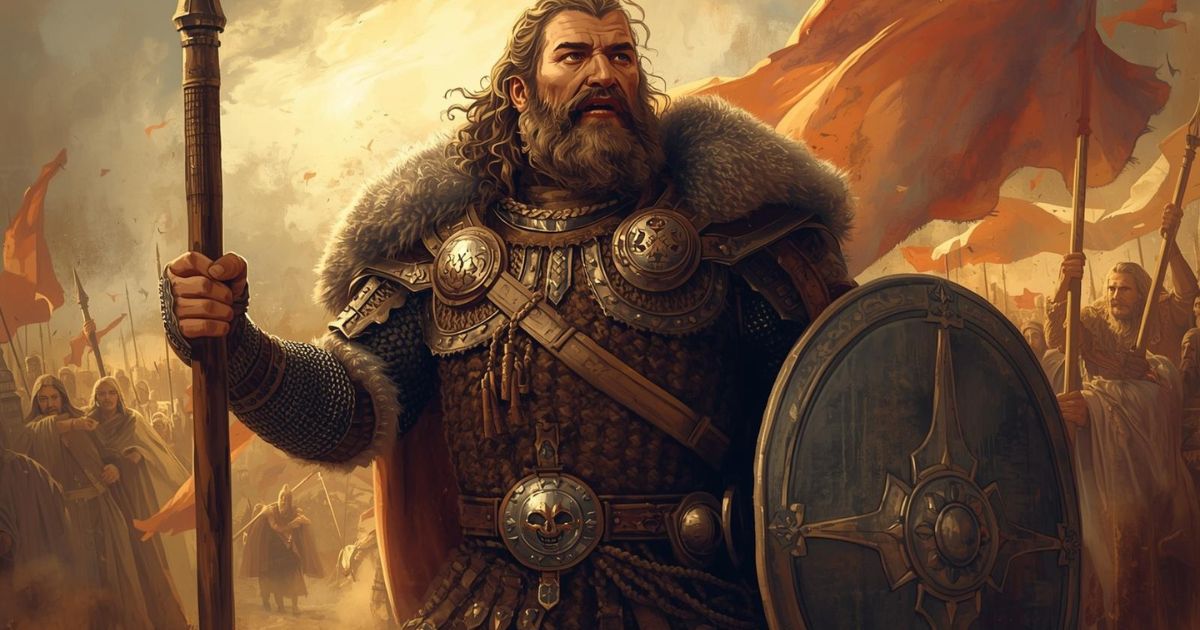
An excerpt from the original text.(complete · 1098 words)
BEOWULF IS DOUBLE-CONQUEROR.


{Beowulf grasps a giant-sword,}

          Then he saw mid the war-gems a weapon of victory,
          An ancient giant-sword, of edges a-doughty,
          Glory of warriors: of weapons 'twas choicest,
          Only 'twas larger than any man else was
[54]    5 Able to bear to the battle-encounter,
          The good and splendid work of the giants.
          He grasped then the sword-hilt, knight of the Scyldings,
          Bold and battle-grim, brandished his ring-sword,
          Hopeless of living, hotly he smote her,
       10 That the fiend-woman's neck firmly it grappled,

{and fells the female monster.}

          Broke through her bone-joints, the bill fully pierced her
          Fate-cursèd body, she fell to the ground then:
          The hand-sword was bloody, the hero exulted.
          The brand was brilliant, brightly it glimmered,
       15 Just as from heaven gemlike shineth
          The torch of the firmament. He glanced 'long the building,
          And turned by the wall then, Higelac's vassal
          Raging and wrathful raised his battle-sword
          Strong by the handle. The edge was not useless
       20 To the hero-in-battle, but he speedily wished to
          Give Grendel requital for the many assaults he
          Had worked on the West-Danes not once, but often,
          When he slew in slumber the subjects of Hrothgar,
          Swallowed down fifteen sleeping retainers
       25 Of the folk of the Danemen, and fully as many
          Carried away, a horrible prey.
          He gave him requital, grim-raging champion,

{Beowulf sees the body of Grendel, and cuts off his head.}

          When he saw on his rest-place weary of conflict
          Grendel lying, of life-joys bereavèd,
       30 As the battle at Heorot erstwhile had scathed him;
          His body far bounded, a blow when he suffered,
          Death having seized him, sword-smiting heavy,
          And he cut off his head then. Early this noticed
          The clever carles who as comrades of Hrothgar

{The waters are gory.}

       35 Gazed on the sea-deeps, that the surging wave-currents
          Were mightily mingled, the mere-flood was gory:
          Of the good one the gray-haired together held converse,

{Beowulf is given up for dead.}

          The hoary of head, that they hoped not to see again
          The atheling ever, that exulting in victory
       40 He'd return there to visit the distinguished folk-ruler:
[55]      Then many concluded the mere-wolf had killed him.[1]
          The ninth hour came then. From the ness-edge departed
          The bold-mooded Scyldings; the gold-friend of heroes
          Homeward betook him. The strangers sat down then
       45 Soul-sick, sorrowful, the sea-waves regarding:
          They wished and yet weened not their well-loved friend-lord

{The giant-sword melts.}

          To see any more. The sword-blade began then,
          The blood having touched it, contracting and shriveling
          With battle-icicles; 'twas a wonderful marvel
       50 That it melted entirely, likest to ice when
          The Father unbindeth the bond of the frost and
          Unwindeth the wave-bands, He who wieldeth dominion
          Of times and of tides: a truth-firm Creator.
          Nor took he of jewels more in the dwelling,
       55 Lord of the Weders, though they lay all around him,
          Than the head and the handle handsome with jewels;
[56]      The brand early melted, burnt was the weapon:[2]
          So hot was the blood, the strange-spirit poisonous

{The hero swims back to the realms of day.}

          That in it did perish. He early swam off then
       60 Who had bided in combat the carnage of haters,
          Went up through the ocean; the eddies were cleansèd,
          The spacious expanses, when the spirit from farland
          His life put aside and this short-lived existence.
          The seamen's defender came swimming to land then
       65 Doughty of spirit, rejoiced in his sea-gift,
          The bulky burden which he bore in his keeping.
          The excellent vassals advanced then to meet him,
          To God they were grateful, were glad in their chieftain,
          That to see him safe and sound was granted them.
       70 From the high-minded hero, then, helmet and burnie
          Were speedily loosened: the ocean was putrid,
          The water 'neath welkin weltered with gore.
          Forth did they fare, then, their footsteps retracing,
          Merry and mirthful, measured the earth-way,
       75 The highway familiar: men very daring[3]
          Bare then the head from the sea-cliff, burdening
          Each of the earlmen, excellent-valiant.

{It takes four men to carry Grendel's head on a spear.}

          Four of them had to carry with labor
          The head of Grendel to the high towering gold-hall
       80 Upstuck on the spear, till fourteen most-valiant
          And battle-brave Geatmen came there going
          Straight to the palace: the prince of the people
          Measured the mead-ways, their mood-brave companion.
          The atheling of earlmen entered the building,
       85 Deed-valiant man, adorned with distinction,
          Doughty shield-warrior, to address King Hrothgar:
[57]      Then hung by the hair, the head of Grendel
          Was borne to the building, where beer-thanes were drinking,
          Loth before earlmen and eke 'fore the lady:
       90 The warriors beheld then a wonderful sight.

    [1] 'Þæs monige gewearð' (1599) and 'hafað þæs geworden' (2027).--In a
    paper published some years ago in one of the Johns Hopkins University
    circulars, I tried to throw upon these two long-doubtful passages some
    light derived from a study of like passages in Alfred's prose.--The
    impersonal verb 'geweorðan,' with an accus. of the person, and a
    þæt-clause is used several times with the meaning 'agree.' See Orosius
    (Sweet's ed.) 178_7; 204_34; 208_28; 210_15; 280_20. In the two
    Beowulf passages, the þæt-clause is anticipated by 'þæs,' which is
    clearly a gen. of the thing agreed on.

    The first passage (v. 1599 (b)-1600) I translate literally: _Then many
    agreed upon this (namely), that the sea-wolf had killed him_.

    The second passage (v. 2025 (b)-2027): _She is promised ...; to this
    the friend of the Scyldings has agreed, etc_. By emending 'is' instead
    of 'wæs' (2025), the tenses will be brought into perfect harmony.

    In v. 1997 ff. this same idiom occurs, and was noticed in B.'s great
    article on Beowulf, which appeared about the time I published my
    reading of 1599 and 2027. Translate 1997 then: _Wouldst let the
    South-Danes themselves decide about their struggle with Grendel_. Here
    'Súð-Dene' is accus. of person, and 'gúðe' is gen. of thing agreed on.

    With such collateral support as that afforded by B. (P. and B. XII.
    97), I have no hesitation in departing from H.-So., my usual guide.

    The idiom above treated runs through A.-S., Old Saxon, and other
    Teutonic languages, and should be noticed in the lexicons.

    [2] 'Bróden-mæl' is regarded by most scholars as meaning a damaskeened
    sword. Translate: _The damaskeened sword burned up_. Cf. 25_16 and
    note.

    [3] 'Cyning-balde' (1635) is the much-disputed reading of K. and Th.
    To render this, "_nobly bold_," "_excellently bold_," have been
    suggested. B. would read 'cyning-holde' (cf. 290), and render: _Men
    well-disposed towards the king carried the head, etc._ 'Cynebealde,'
    says t.B., endorsing Gr.
Master this chapter. Complete your experience
Purchase the complete book to access all chapters and support classic literature
As an Amazon Associate, we earn a small commission from qualifying purchases at no additional cost to you.
Available in paperback, hardcover, and e-book formats
Let's Analyse the Pattern
The phenomenon where our most effective solutions become visible only when we're under maximum pressure and forced to see beyond our usual limitations.
Why This Matters
Connect literature to life
This chapter teaches how to distinguish between people who abandon you when things look bad versus those who stick around when the outcome is uncertain.
Practice This Today
This week, notice who shows up when you're struggling with something difficult—those are your real allies worth investing in.
Now let's explore the literary elements.
Key Quotes & Analysis
"Only 'twas larger than any man else was able to bear to the battle-encounter"
Context: Describing the giant-sword that Beowulf discovers in the lair
This emphasizes that some challenges require tools beyond normal human capability. The sword represents divine intervention or fate providing exactly what's needed when human strength alone isn't enough.
In Today's Words:
This thing was way too big for any regular person to even lift, let alone fight with
"Hopeless of living, hotly he smote her"
Context: Beowulf attacking Grendel's mother with the giant-sword
Beowulf acts with desperate courage, not confidence of victory. This shows true heroism - doing what's right even when you think you might die trying.
In Today's Words:
He figured he was probably going to die, but he went at her anyway with everything he had
"He gave him requital, grim-raging champion"
Context: Beowulf cutting off Grendel's head after killing the mother
This isn't random violence but deliberate justice for all of Grendel's victims. Beowulf ensures the monster can never hurt anyone again and gives the community the closure they need.
In Today's Words:
He made sure that monster finally paid for what he'd done
Thematic Threads
Loyalty
In This Chapter
Hrothgar's men give up and leave when they see blood, but Beowulf's warriors stay and hope against hope
Development
Deepened from earlier chapters where loyalty was about following orders—now it's about faith during apparent failure
In Your Life:
You discover who really has your back when things look hopeless, not when you're winning.
Resourcefulness
In This Chapter
Beowulf finds the giant-sword in the underwater lair exactly when he needs it most
Development
Built from his earlier adaptability with Grendel—now shows how crisis reveals hidden resources
In Your Life:
Your biggest breakthrough tools often become visible only when you're desperate enough to look everywhere.
Completion
In This Chapter
Beowulf doesn't just kill the mother—he takes Grendel's head to finish what he started
Development
Evolved from simple monster-slaying to understanding that communities need closure, not just victory
In Your Life:
Solving the immediate problem isn't enough—people need proof that the threat is truly over.
Impermanence
In This Chapter
The mighty giant-sword melts away from poisonous blood, leaving only the jeweled hilt
Development
Introduced here as counterpoint to lasting heroic deeds—tools fade but results endure
In Your Life:
Even your best skills and resources are temporary, but what you accomplish with them can last forever.
Assumptions
In This Chapter
Everyone assumes Beowulf is dead when blood surfaces, but they're completely wrong
Development
Expanded from earlier themes about appearances—now shows how assumptions make people quit too early
In Your Life:
When others assume you've failed and walk away, that might be exactly when you're about to succeed.
You now have the context. Time to form your own thoughts.
Discussion Questions
- 1
What allowed Beowulf to find the giant-sword when he needed it most, and why didn't he see it earlier?
analysis • surface - 2
Why did Hrothgar's men give up and leave when they saw blood in the water, while Beowulf's warriors stayed?
analysis • medium - 3
Think about a time when you found a solution only after things got really desperate. What made you finally see what you'd been missing?
application • medium - 4
If you were facing your biggest problem right now, what resources might you be overlooking because you're not desperate enough yet?
application • deep - 5
What does the melting sword teach us about the difference between temporary tools and lasting results?
reflection • deep
Critical Thinking Exercise
Crisis Resource Mapping
Think of a current challenge you're facing. Write it at the top of a page. Now imagine this problem got twice as bad tomorrow - what would you be forced to try that you're avoiding now? List three resources, people, or options you might notice only under extreme pressure. Sometimes we need to simulate desperation to see clearly.
Consider:
- •What assumptions about your situation might be limiting your vision?
- •Which people in your life would stick around versus walk away if things got worse?
- •What tools or skills do you already have that you're not fully using?
Journaling Prompt
Write about a time when your worst day led to your biggest breakthrough. What did crisis force you to see that comfort had hidden from you?
Coming Up Next...
Chapter 25: The Sword's Story and a King's Warning
Beowulf returns to the great hall carrying proof of his impossible victory, but will the sight of Grendel's severed head finally convince everyone that their nightmare is truly over?



