
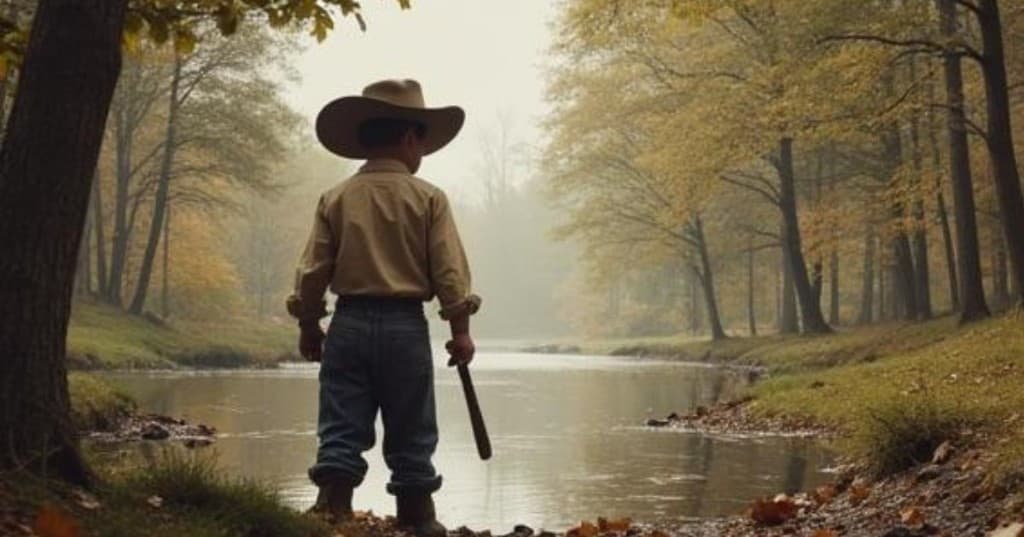
What Courage Actually Looks Like
Tom Sawyer performs bravery constantly — before an audience, in games, in adventures where the danger is managed and the outcome is under control. The courage the book is interested in is different: it is the courage that happens when the cost is real, the audience is unhelpful, and there is no guarantee the right act will produce a good outcome.
Twain structures the courage arc across eight chapters that escalate from failure (Chapter 9 — running from the graveyard) to delayed action (Chapter 23 — testifying at the last possible moment) to immediate instinctive action (Chapter 20 — taking Becky's punishment before thinking) to sustained invisible courage (Chapters 31-32 — the cave). The arc is complete and honest: it shows Tom failing at courage, managing the guilt of failure, finally acting, paying the cost of acting, and ultimately developing something more durable than bravery — the habit of continuing to move while afraid.
The final scene — Tom looking at Injun Joe's body with pity — is the measure of how far the arc has traveled. Tom has been terrified of this man for chapters. Now he feels sorry for him. That shift — from fear of the threat to compassion for the person inside it — is what genuine courage, fully developed, eventually produces.
Chapter-by-Chapter Analysis
Witnessing Something You Can't Unsee
Tom and Huck watch Injun Joe murder Dr. Robinson and frame Muff Potter. They run. The courage the moment demanded — staying, speaking, testifying immediately — they do not have. Tom knows, in the seconds after the murder, that he has just witnessed something that will cost him no matter what he does. He chooses the cheaper cost. For now.
“The two boys flew on and on, toward the village, speechless with horror.”
Key Insight
The graveyard chapter establishes the central distinction the book will develop across 15 chapters: the difference between the courage that acts immediately, when the cost is still manageable, and the courage that waits until action becomes unavoidable. Tom's failure in Chapter 9 is not a moral catastrophe — it is a recognizable human response. Fear produces inaction; inaction compounds the eventual cost. Understanding this sequence is more useful than judging Tom for it.
The Cheaper Substitute: Visiting Muff Potter
Tom visits Muff Potter in jail, bringing tobacco and spending time with him. These visits are acts of genuine conscience — Tom cares about Muff — but they are also substitutes for the only act that would actually help. Tom is paying the affordable cost of guilt while refusing to pay the unaffordable cost of testimony.
Key Insight
The jail visits reveal the psychology of deferred courage: we take actions that feel like moral progress because they are directed at the right person, while carefully avoiding the specific action that would actually solve the problem. Tom is not callous — he genuinely cares. But caring is not the same as acting, and the jail visits are a precise portrait of the way conscience expresses itself through safe substitutes when the real action feels too dangerous.
Taking Becky's Punishment: Courage With No Calculation
Mr. Dobbins is about to punish Becky for tearing his anatomy book. Tom stands up and claims he did it. He has not calculated the social or romantic benefits. He acts before he thinks. He takes the beating. It is the only genuinely uncalculated act of courage in the book — and the one that costs him most directly.
“Tom took upon himself the whole blame of the mischief. He got the most merciless flogging that even Mr. Dobbins had ever administered.”
Key Insight
Tom's decision to take Becky's punishment is the model act of courage in the novel because it is the only one that happens without deliberation. Every other courageous act Tom performs involves calculation, fear, weighing of costs. This one happens in the moment before calculation is possible. Twain is suggesting that this — the instinctive act before the rationalizing mind engages — may be the purest form of courage available. It is also the most painful, because it happens without the preparation that calculation would have provided.
The Decision to Testify
On the last day of Muff Potter's trial, with conviction appearing inevitable, Tom tells the defense attorney he will testify. He takes the stand and tells the truth — everything, in sequence, including Injun Joe's role. Injun Joe escapes through the window. Tom is celebrated. Tom is also in danger for the first time that is entirely his own doing.
“I saw Injun Joe with the knife!”
Key Insight
Tom's testimony is the climax of the courage arc — the moment when the deferred action finally happens, at the highest possible cost and the most public possible moment. What Twain shows is that Tom doesn't decide to testify out of moral clarity or sudden virtue. He decides because the cost of continued silence has exceeded what he can bear. This is how most consequential acts of courage actually happen: not when we are ready, not when we feel brave, but when the alternative has finally become worse than the risk.
Being Right Does Not Make You Safe
Tom is a hero. The town celebrates him. He also cannot sleep. Injun Joe is free and somewhere in St. Petersburg, and Tom's testimony put him there. Doing the right thing has not made Tom safe — it has introduced a new and very real danger. The nightmares are not metaphors. They are appropriate responses to an actual threat.
Key Insight
Chapter 24 is where Twain refuses to let the novel lie about what courage costs. Tom did the right thing and is now genuinely afraid, genuinely at risk, and genuinely unable to enjoy the celebration surrounding him. Most stories about courage end at the heroic act. Twain follows the hero home from the courthouse and shows what happens in the bedroom afterward. The lesson: moral courage does not come with a safety guarantee. It comes with the knowledge that you did right. That is all it comes with.
Keeping Another Person Together in the Dark
Lost in the cave with Becky, Tom performs a kind of courage that is less visible than testimony but equally demanding: he keeps Becky calm for days. He explores when she cannot. He performs optimism he does not feel. He manages his own terror for long enough to manage hers. The courage is interior and invisible.
“Tom said they must go on, and they did. Tom had the presence of mind to mark the way to avoid further mistakes.”
Key Insight
The cave chapters introduce a form of courage that Tom's adventures have not previously demanded: the sustained performance of composure for someone else's benefit, maintained over days, without any guarantee of rescue. This is harder than a single dramatic act of bravery because it must be renewed constantly, cannot draw on adrenaline, and produces no immediate payoff. Tom does it without ceremony. It may be the most genuinely courageous thing he does in the entire book.
Finding the Exit
Tom finds the way out of the cave — a small hole high in a rock face, a glimmer of blue sky. He squeezes through to confirm it is real before bringing Becky. When he helps her out, they are standing on the banks of the Mississippi five miles below St. Petersburg. He has led them out entirely on his own.
Key Insight
Tom's cave exit is the payoff of all the preceding courage: the testimony, the jail visits, the sustained composure in the dark. He finds the way out because he kept looking when Becky could not, because the imagination games taught him to scan systematically, and because the fear never stopped him moving. Courage, Twain shows, is not the absence of fear — it is the specific habit of continuing to move while afraid. Tom has been building that habit since Chapter 1.
The Reckoning: Injun Joe's End
Injun Joe is found dead inside the cave, having starved after the door was sealed with Tom still inside. He had fashioned a crude cup and a crude candle-stub from a stalactite drip — trying desperately to survive. Tom, who feared him for weeks, sees the body and experiences something closer to pity than triumph.
“Tom was touched, for he knew by his own experience how this wretch had suffered.”
Key Insight
Twain ends the courage arc not with a confrontation but with a discovery — and Tom's response to it is the final measure of the courage he has developed. He does not celebrate. He looks at the body of the man who terrorized him for weeks and feels sorrow for the desperate survival attempts recorded in the cave's evidence. Genuine courage, at its maturity, is not contemptuous of the threat. It sees the threat clearly, acts anyway, and when the threat is removed, can afford to feel compassion for what was inside it.
Applying This to Your Life
The Earlier You Act, the Lower the Total Cost
Tom could have testified in Week 1. He testifies in Week 6, in a public courtroom, under oath, with Injun Joe in the room. The cost of waiting is not zero — it is time, guilt, Muff Potter's suffering, and the maximally dramatic circumstances of the eventual disclosure. This pattern is consistent in every domain: the difficult conversation not had, the professional failure not admitted, the wrong not corrected. The cost of delay is almost always higher than the cost of acting when the action first became necessary.
Courage Is Not the Absence of Fear — It Is Motion Under Fear
Tom is afraid in the cave for days. He does not stop exploring. He is afraid after testifying. He does not recant. The pattern across every courage chapter in Tom Sawyer is the same: the fear is real and acknowledged, and Tom moves anyway. This is the functional definition of courage that Twain is building chapter by chapter: not the state of not being afraid, but the habit of continuing to act toward the necessary thing while the fear is fully present.
The Invisible Courage Is Often the Hardest
Tom's testimony happens in public and is celebrated immediately. His three days of composure management in the cave happens in private, is witnessed only by Becky, and is never specifically recognized by anyone in St. Petersburg. The invisible courage — maintaining calm for another person's sake, over days, with no audience and no payoff — is arguably harder than the public act. The book argues for taking it as seriously.
The Central Lesson
Tom Sawyer begins as a book about a boy who performs bravery for audiences and ends as a book about a boy who has developed genuine courage. The distance between Chapter 1 Tom (distracting Aunt Polly and running) and Chapter 33 Tom (looking at Injun Joe's body with pity) is the whole arc of the novel. Twain doesn't moralize the journey — he just shows it, chapter by chapter, cost by cost. The measure of that development is not that Tom becomes fearless. It is that he becomes the kind of person who keeps moving when he is most afraid, and who can feel compassion for the thing that frightened him most when it is no longer dangerous. That is what mature courage looks like.
Related Themes in Tom Sawyer
The Weight of Secrets
The Muff Potter arc and what happens when you know the truth and stay silent
Imagination as a Survival Tool
How Tom's fantasy life helps him navigate boredom, heartbreak, and fear
Mastering Persuasion
Tom's social genius — from the fence con to his most calculated charms
Lessons Hidden in Play
What Tom's adventures actually teach about risk, consequence, and growing up