
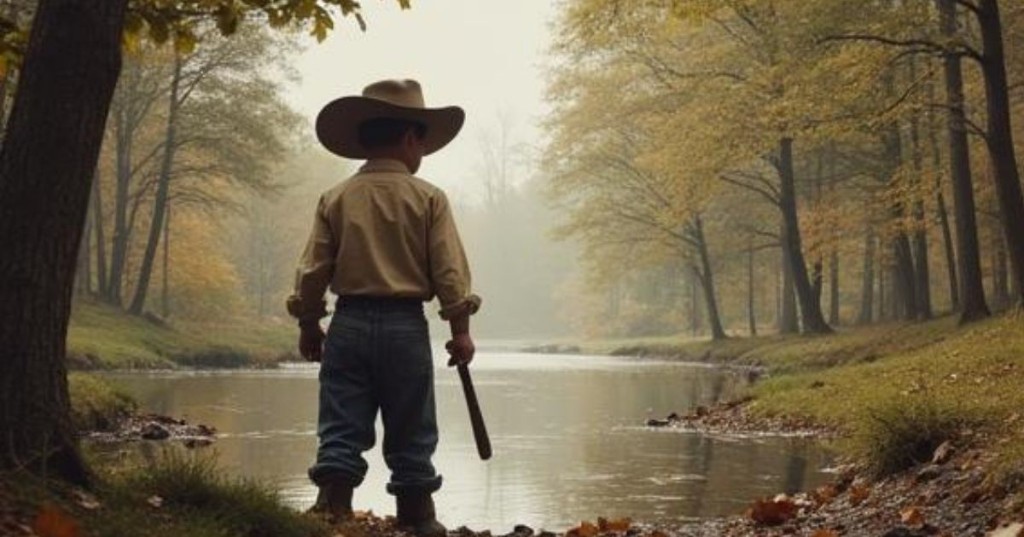
An excerpt from the original text.(complete · 2998 words)
s the earliest suspicion of dawn appeared on Sunday morning, Huck came
groping up the hill and rapped gently at the old Welshman’s door. The
inmates were asleep, but it was a sleep that was set on a hair-trigger,
on account of the exciting episode of the night. A call came from a
window:
“Who’s there!”
Huck’s scared voice answered in a low tone:
“Please let me in! It’s only Huck Finn!”
“It’s a name that can open this door night or day, lad!—and welcome!”
These were strange words to the vagabond boy’s ears, and the pleasantest
he had ever heard. He could not recollect that the closing word had ever
been applied in his case before. The door was quickly unlocked, and he
entered. Huck was given a seat and the old man and his brace of tall
sons speedily dressed themselves.
“Now, my boy, I hope you’re good and hungry, because breakfast will be
ready as soon as the sun’s up, and we’ll have a piping hot one, too—make
yourself easy about that! I and the boys hoped you’d turn up and stop
here last night.”
“I was awful scared,” said Huck, “and I run. I took out when the pistols
went off, and I didn’t stop for three mile. I’ve come now becuz I wanted
to know about it, you know; and I come before daylight becuz I didn’t
want to run across them devils, even if they was dead.”
“Well, poor chap, you do look as if you’d had a hard night of it—but
there’s a bed here for you when you’ve had your breakfast. No, they
ain’t dead, lad—we are sorry enough for that. You see we knew right
where to put our hands on them, by your description; so we crept along
on tiptoe till we got within fifteen feet of them—dark as a cellar that
sumach path was—and just then I found I was going to sneeze. It was the
meanest kind of luck! I tried to keep it back, but no use—’twas bound to
come, and it did come! I was in the lead with my pistol raised, and when
the sneeze started those scoundrels a-rustling to get out of the path,
I sung out, ‘Fire boys!’ and blazed away at the place where the rustling
was. So did the boys. But they were off in a jiffy, those villains, and
we after them, down through the woods. I judge we never touched them.
They fired a shot apiece as they started, but their bullets whizzed by
and didn’t do us any harm. As soon as we lost the sound of their feet
we quit chasing, and went down and stirred up the constables. They got a
posse together, and went off to guard the river bank, and as soon as it
is light the sheriff and a gang are going to beat up the woods. My boys
will be with them presently. I wish we had some sort of description of
those rascals—’twould help a good deal. But you couldn’t see what they
were like, in the dark, lad, I suppose?”
“Oh yes; I saw them downtown and follered them.”
“Splendid! Describe them—describe them, my boy!”
“One’s the old deaf and dumb Spaniard that’s ben around here once or
twice, and t’other’s a mean-looking, ragged—”
“That’s enough, lad, we know the men! Happened on them in the woods back
of the widow’s one day, and they slunk away. Off with you, boys, and
tell the sheriff—get your breakfast tomorrow morning!”
The Welshman’s sons departed at once. As they were leaving the room Huck
sprang up and exclaimed:
“Oh, please don’t tell anybody it was me that blowed on them! Oh,
please!”
“All right if you say it, Huck, but you ought to have the credit of what
you did.”
“Oh no, no! Please don’t tell!”
When the young men were gone, the old Welshman said:
“They won’t tell—and I won’t. But why don’t you want it known?”
Huck would not explain, further than to say that he already knew too
much about one of those men and would not have the man know that he knew
anything against him for the whole world—he would be killed for knowing
it, sure.
The old man promised secrecy once more, and said:
“How did you come to follow these fellows, lad? Were they looking
suspicious?”
Huck was silent while he framed a duly cautious reply. Then he said:
“Well, you see, I’m a kind of a hard lot,—least everybody says so, and
I don’t see nothing agin it—and sometimes I can’t sleep much, on account
of thinking about it and sort of trying to strike out a new way of
doing. That was the way of it last night. I couldn’t sleep, and so I
come along upstreet ’bout midnight, a-turning it all over, and when I
got to that old shackly brick store by the Temperance Tavern, I backed
up agin the wall to have another think. Well, just then along comes
these two chaps slipping along close by me, with something under their
arm, and I reckoned they’d stole it. One was a-smoking, and t’other one
wanted a light; so they stopped right before me and the cigars lit up
their faces and I see that the big one was the deaf and dumb Spaniard,
by his white whiskers and the patch on his eye, and t’other one was a
rusty, ragged-looking devil.”
“Could you see the rags by the light of the cigars?”
This staggered Huck for a moment. Then he said:
“Well, I don’t know—but somehow it seems as if I did.”
“Then they went on, and you—”
“Follered ’em—yes. That was it. I wanted to see what was up—they sneaked
along so. I dogged ’em to the widder’s stile, and stood in the dark and
heard the ragged one beg for the widder, and the Spaniard swear he’d
spile her looks just as I told you and your two—”
“What! The deaf and dumb man said all that!”
Huck had made another terrible mistake! He was trying his best to keep
the old man from getting the faintest hint of who the Spaniard might be,
and yet his tongue seemed determined to get him into trouble in spite of
all he could do. He made several efforts to creep out of his scrape,
but the old man’s eye was upon him and he made blunder after blunder.
Presently the Welshman said:
“My boy, don’t be afraid of me. I wouldn’t hurt a hair of your head for
all the world. No—I’d protect you—I’d protect you. This Spaniard is
not deaf and dumb; you’ve let that slip without intending it; you can’t
cover that up now. You know something about that Spaniard that you want
to keep dark. Now trust me—tell me what it is, and trust me—I won’t
betray you.”
Huck looked into the old man’s honest eyes a moment, then bent over and
whispered in his ear:
“’Tain’t a Spaniard—it’s Injun Joe!”
The Welshman almost jumped out of his chair. In a moment he said:
“It’s all plain enough, now. When you talked about notching ears and
slitting noses I judged that that was your own embellishment, because
white men don’t take that sort of revenge. But an Injun! That’s a
different matter altogether.”
During breakfast the talk went on, and in the course of it the old man
said that the last thing which he and his sons had done, before going
to bed, was to get a lantern and examine the stile and its vicinity for
marks of blood. They found none, but captured a bulky bundle of—
“Of what?”
If the words had been lightning they could not have leaped with a more
stunning suddenness from Huck’s blanched lips. His eyes were staring
wide, now, and his breath suspended—waiting for the answer. The Welshman
started—stared in return—three seconds—five seconds—ten—then replied:
“Of burglar’s tools. Why, what’s the matter with you?”
Huck sank back, panting gently, but deeply, unutterably grateful. The
Welshman eyed him gravely, curiously—and presently said:
“Yes, burglar’s tools. That appears to relieve you a good deal. But what
did give you that turn? What were you expecting we’d found?”
Huck was in a close place—the inquiring eye was upon him—he would have
given anything for material for a plausible answer—nothing suggested
itself—the inquiring eye was boring deeper and deeper—a senseless
reply offered—there was no time to weigh it, so at a venture he uttered
it—feebly:
“Sunday-school books, maybe.”
Poor Huck was too distressed to smile, but the old man laughed loud and
joyously, shook up the details of his anatomy from head to foot, and
ended by saying that such a laugh was money in a man’s pocket, because
it cut down the doctor’s bill like everything. Then he added:
“Poor old chap, you’re white and jaded—you ain’t well a bit—no wonder
you’re a little flighty and off your balance. But you’ll come out of it.
Rest and sleep will fetch you out all right, I hope.”
Huck was irritated to think he had been such a goose and betrayed such
a suspicious excitement, for he had dropped the idea that the parcel
brought from the tavern was the treasure, as soon as he had heard the
talk at the widow’s stile. He had only thought it was not the treasure,
however—he had not known that it wasn’t—and so the suggestion of a
captured bundle was too much for his self-possession. But on the whole
he felt glad the little episode had happened, for now he knew beyond all
question that that bundle was not the bundle, and so his mind was
at rest and exceedingly comfortable. In fact, everything seemed to be
drifting just in the right direction, now; the treasure must be still
in No. 2, the men would be captured and jailed that day, and he and
Tom could seize the gold that night without any trouble or any fear of
interruption.
Just as breakfast was completed there was a knock at the door. Huck
jumped for a hiding-place, for he had no mind to be connected even
remotely with the late event. The Welshman admitted several ladies and
gentlemen, among them the Widow Douglas, and noticed that groups of
citizens were climbing up the hill—to stare at the stile. So the news
had spread. The Welshman had to tell the story of the night to the
visitors. The widow’s gratitude for her preservation was outspoken.
“Don’t say a word about it, madam. There’s another that you’re more
beholden to than you are to me and my boys, maybe, but he don’t allow me
to tell his name. We wouldn’t have been there but for him.”
Of course this excited a curiosity so vast that it almost belittled the
main matter—but the Welshman allowed it to eat into the vitals of his
visitors, and through them be transmitted to the whole town, for he
refused to part with his secret. When all else had been learned, the
widow said:
“I went to sleep reading in bed and slept straight through all that
noise. Why didn’t you come and wake me?”
“We judged it warn’t worth while. Those fellows warn’t likely to come
again—they hadn’t any tools left to work with, and what was the use of
waking you up and scaring you to death? My three negro men stood guard
at your house all the rest of the night. They’ve just come back.”
More visitors came, and the story had to be told and retold for a couple
of hours more.
There was no Sabbath-school during day-school vacation, but everybody
was early at church. The stirring event was well canvassed. News came
that not a sign of the two villains had been yet discovered. When the
sermon was finished, Judge Thatcher’s wife dropped alongside of Mrs.
Harper as she moved down the aisle with the crowd and said:
“Is my Becky going to sleep all day? I just expected she would be tired
to death.”
“Your Becky?”
“Yes,” with a startled look—“didn’t she stay with you last night?”
“Why, no.”
Mrs. Thatcher turned pale, and sank into a pew, just as Aunt Polly,
talking briskly with a friend, passed by. Aunt Polly said:
“Goodmorning, Mrs. Thatcher. Goodmorning, Mrs. Harper. I’ve got a boy
that’s turned up missing. I reckon my Tom stayed at your house last
night—one of you. And now he’s afraid to come to church. I’ve got to
settle with him.”
Mrs. Thatcher shook her head feebly and turned paler than ever.
“He didn’t stay with us,” said Mrs. Harper, beginning to look uneasy. A
marked anxiety came into Aunt Polly’s face.
“Joe Harper, have you seen my Tom this morning?”
“No’m.”
“When did you see him last?”
Joe tried to remember, but was not sure he could say. The people had
stopped moving out of church. Whispers passed along, and a boding
uneasiness took possession of every countenance. Children were anxiously
questioned, and young teachers. They all said they had not noticed
whether Tom and Becky were on board the ferryboat on the homeward trip;
it was dark; no one thought of inquiring if any one was missing. One
young man finally blurted out his fear that they were still in the cave!
Mrs. Thatcher swooned away. Aunt Polly fell to crying and wringing her
hands.
The alarm swept from lip to lip, from group to group, from street to
street, and within five minutes the bells were wildly clanging and
the whole town was up! The Cardiff Hill episode sank into instant
insignificance, the burglars were forgotten, horses were saddled, skiffs
were manned, the ferryboat ordered out, and before the horror was half
an hour old, two hundred men were pouring down highroad and river toward
the cave.
All the long afternoon the village seemed empty and dead. Many women
visited Aunt Polly and Mrs. Thatcher and tried to comfort them. They
cried with them, too, and that was still better than words. All the
tedious night the town waited for news; but when the morning dawned at
last, all the word that came was, “Send more candles—and send food.”
Mrs. Thatcher was almost crazed; and Aunt Polly, also. Judge Thatcher
sent messages of hope and encouragement from the cave, but they conveyed
no real cheer.
The old Welshman came home toward daylight, spattered with
candle-grease, smeared with clay, and almost worn out. He found Huck
still in the bed that had been provided for him, and delirious with
fever. The physicians were all at the cave, so the Widow Douglas came
and took charge of the patient. She said she would do her best by him,
because, whether he was good, bad, or indifferent, he was the Lord’s,
and nothing that was the Lord’s was a thing to be neglected. The
Welshman said Huck had good spots in him, and the widow said:
“You can depend on it. That’s the Lord’s mark. He don’t leave it off.
He never does. Puts it somewhere on every creature that comes from his
hands.”
Early in the forenoon parties of jaded men began to straggle into the
village, but the strongest of the citizens continued searching. All the
news that could be gained was that remotenesses of the cavern were being
ransacked that had never been visited before; that every corner and
crevice was going to be thoroughly searched; that wherever one wandered
through the maze of passages, lights were to be seen flitting hither
and thither in the distance, and shoutings and pistol-shots sent their
hollow reverberations to the ear down the sombre aisles. In one place,
far from the section usually traversed by tourists, the names “BECKY &
TOM” had been found traced upon the rocky wall with candle-smoke, and
near at hand a grease-soiled bit of ribbon. Mrs. Thatcher recognized the
ribbon and cried over it. She said it was the last relic she should ever
have of her child; and that no other memorial of her could ever be so
precious, because this one parted latest from the living body before the
awful death came. Some said that now and then, in the cave, a far-away
speck of light would glimmer, and then a glorious shout would burst
forth and a score of men go trooping down the echoing aisle—and then a
sickening disappointment always followed; the children were not there;
it was only a searcher’s light.
Three dreadful days and nights dragged their tedious hours along, and
the village sank into a hopeless stupor. No one had heart for anything.
The accidental discovery, just made, that the proprietor of the
Temperance Tavern kept liquor on his premises, scarcely fluttered the
public pulse, tremendous as the fact was. In a lucid interval, Huck
feebly led up to the subject of taverns, and finally asked—dimly
dreading the worst—if anything had been discovered at the Temperance
Tavern since he had been ill.
“Yes,” said the widow.
Huck started up in bed, wild-eyed:
“What? What was it?”
“Liquor!—and the place has been shut up. Lie down, child—what a turn you
did give me!”
“Only tell me just one thing—only just one—please! Was it Tom Sawyer
that found it?”
The widow burst into tears. “Hush, hush, child, hush! I’ve told you
before, you must not talk. You are very, very sick!”
Then nothing but liquor had been found; there would have been a great
powwow if it had been the gold. So the treasure was gone forever—gone
forever! But what could she be crying about? Curious that she should
cry.
These thoughts worked their dim way through Huck’s mind, and under the
weariness they gave him he fell asleep. The widow said to herself:
“There—he’s asleep, poor wreck. Tom Sawyer find it! Pity but somebody
could find Tom Sawyer! Ah, there ain’t many left, now, that’s got hope
enough, or strength enough, either, to go on searching.”
Master this chapter. Complete your experience
Purchase the complete book to access all chapters and support classic literature
As an Amazon Associate, we earn a small commission from qualifying purchases at no additional cost to you.
Available in paperback, hardcover, and e-book formats
Let's Analyse the Pattern
When receiving genuine care creates pressure to 'earn' it through impossible performance, leading to the very failures you're trying to prevent.
Why This Matters
Connect literature to life
This chapter teaches how genuine kindness can create crushing internal pressure in people who've never experienced unconditional care.
Practice This Today
This week, notice when someone's help makes you feel like you owe them impossible performance - then practice saying 'thank you' without adding 'I'll make it up to you.'
Now let's explore the literary elements.
Key Quotes & Analysis
"It's a name that can open this door night or day, lad!—and welcome!"
Context: When Huck identifies himself at the door, expecting rejection
This is the first time in Huck's life that his name has opened doors instead of closing them. The Welshman's immediate welcome shows unconditional acceptance. It's a moment of pure grace for a boy used to being unwanted.
In Today's Words:
You're always welcome here, kid - no questions asked.
"These were strange words to the vagabond boy's ears, and the pleasantest he had ever heard."
Context: Describing Huck's reaction to being welcomed
Shows how starved Huck is for basic human kindness. What should be normal - being welcomed somewhere - is revolutionary for him. It highlights how society has failed this child.
In Today's Words:
Nobody had ever been happy to see him before.
"I was awful scared, and I run. I took out when the pistols went off, and I didn't stop for three mile."
Context: Explaining why he fled the night before
Huck's honest admission of fear shows his vulnerability. He's not trying to be brave or heroic - he's just a scared kid who ran when things got dangerous. His honesty makes him more relatable and human.
In Today's Words:
I got terrified and ran as fast as I could when the shooting started.
"Oh, you can't mean it! Nobody could mean it!"
Context: When he realizes Tom and Becky are missing in the cave
Shows how quickly adult priorities shift when children are in real danger. All the drama about burglary and Injun Joe becomes secondary to this new crisis. It reveals what truly matters to the community.
In Today's Words:
This can't be happening - please tell me this isn't real!
Thematic Threads
Class
In This Chapter
Huck's shock at being treated with dignity reveals how class shapes expectations of care and belonging
Development
Evolved from earlier class tensions to show how internalized class shame affects ability to receive kindness
In Your Life:
You might recognize this in how you react when someone 'above' your station treats you with unexpected respect.
Truth
In This Chapter
Huck's lies collapse under pressure, showing how deception becomes impossible to maintain under stress
Development
Continued from Tom's earlier lies, now showing how good intentions don't make lies sustainable
In Your Life:
You see this when you're keeping secrets to protect someone and the mental juggling becomes overwhelming.
Community
In This Chapter
The town's instant mobilization for Tom and Becky shows how real crisis unites people across differences
Development
Builds on earlier community judgment themes to show the positive side of collective action
In Your Life:
You witness this during natural disasters or medical emergencies when neighborhoods suddenly become families.
Identity
In This Chapter
Huck struggles with who he is when treated as worthy—the kindness challenges his self-concept
Development
Advanced from earlier identity questions to show how others' treatment can reshape self-image
In Your Life:
You experience this when someone sees potential in you that you don't see in yourself.
Overwhelm
In This Chapter
Multiple crises—secrets, lies, missing friends—create impossible mental load that leads to physical illness
Development
Introduced here as consequence of accumulated pressures throughout the story
In Your Life:
You feel this when trying to manage too many people's problems while hiding your own struggles.
You now have the context. Time to form your own thoughts.
Discussion Questions
- 1
Why does Huck accidentally reveal Injun Joe's identity after trying so hard to keep it secret?
analysis • surface - 2
What makes the Welshman's kindness different from how other adults have treated Huck, and why does this create pressure for Huck?
analysis • medium - 3
Where do you see people today taking on impossible burdens because they feel they need to 'earn' kindness or help they've received?
application • medium - 4
How could Huck have handled the Welshman's questions differently to avoid the pressure that led to his slip-up?
application • deep - 5
What does Huck's reaction to genuine care reveal about how past experiences shape our ability to accept help?
reflection • deep
Critical Thinking Exercise
Map Your Kindness Debt
Think of a time when someone showed you unexpected kindness or help. Write down what happened, then trace how you responded. Did you feel pressure to 'pay them back' or prove you deserved it? What burdens did you take on? How might you have handled it differently if you viewed their kindness as a gift rather than a debt?
Consider:
- •Notice the difference between gratitude and feeling indebted
- •Consider how trying to 'earn' kindness can backfire
- •Think about what boundaries you could have set to protect both yourself and the relationship
Journaling Prompt
Write about a current situation where you're putting pressure on yourself to earn someone's care or approval. What would it look like to accept their kindness without the performance pressure?
Coming Up Next...
Chapter 31: Lost in the Dark
The story shifts to Tom and Becky's terrifying experience in the cave, where what started as innocent exploration becomes a fight for survival in the dark, twisting passages underground.



