
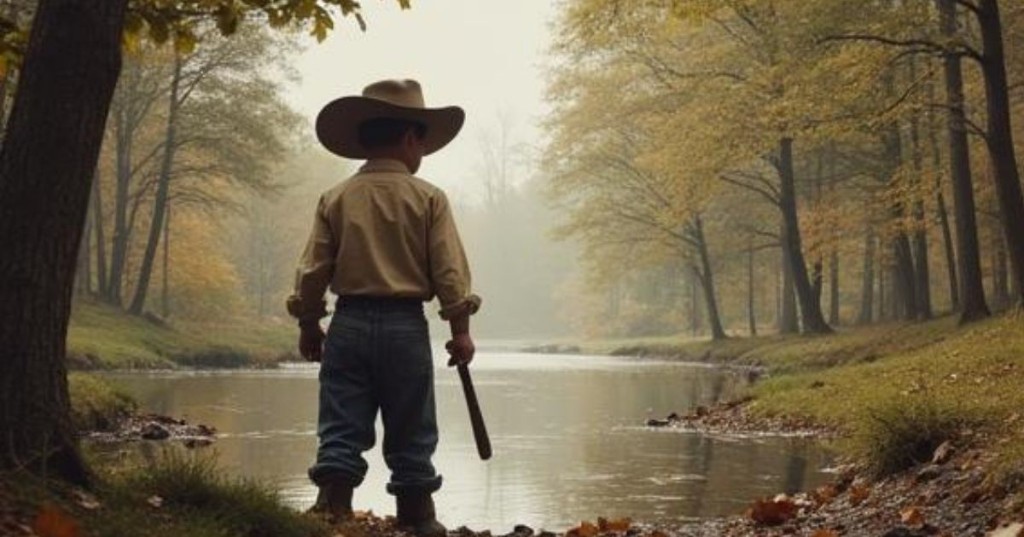
An excerpt from the original text.(complete · 2049 words)
here comes a time in every rightly-constructed boy’s life when he has
a raging desire to go somewhere and dig for hidden treasure. This desire
suddenly came upon Tom one day. He sallied out to find Joe Harper,
but failed of success. Next he sought Ben Rogers; he had gone fishing.
Presently he stumbled upon Huck Finn the Red-Handed. Huck would
answer. Tom took him to a private place and opened the matter to him
confidentially. Huck was willing. Huck was always willing to take a hand
in any enterprise that offered entertainment and required no capital,
for he had a troublesome superabundance of that sort of time which is
not money. “Where’ll we dig?” said Huck.
“Oh, most anywhere.”
“Why, is it hid all around?”
“No, indeed it ain’t. It’s hid in mighty particular places,
Huck—sometimes on islands, sometimes in rotten chests under the end of
a limb of an old dead tree, just where the shadow falls at midnight; but
mostly under the floor in ha’nted houses.”
“Who hides it?”
“Why, robbers, of course—who’d you reckon? Sunday-school
sup’rintendents?”
“I don’t know. If ’twas mine I wouldn’t hide it; I’d spend it and have a
good time.”
“So would I. But robbers don’t do that way. They always hide it and
leave it there.”
“Don’t they come after it any more?”
“No, they think they will, but they generally forget the marks, or else
they die. Anyway, it lays there a long time and gets rusty; and by and
by somebody finds an old yellow paper that tells how to find the marks—a
paper that’s got to be ciphered over about a week because it’s mostly
signs and hy’roglyphics.”
“Hyro—which?”
“Hy’roglyphics—pictures and things, you know, that don’t seem to mean
anything.”
“Have you got one of them papers, Tom?”
“No.”
“Well then, how you going to find the marks?”
“I don’t want any marks. They always bury it under a ha’nted house or on
an island, or under a dead tree that’s got one limb sticking out. Well,
we’ve tried Jackson’s Island a little, and we can try it again some
time; and there’s the old ha’nted house up the Still-House branch, and
there’s lots of dead-limb trees—dead loads of ’em.”
“Is it under all of them?”
“How you talk! No!”
“Then how you going to know which one to go for?”
“Go for all of ’em!”
“Why, Tom, it’ll take all summer.”
“Well, what of that? Suppose you find a brass pot with a hundred dollars
in it, all rusty and gray, or rotten chest full of di’monds. How’s
that?”
Huck’s eyes glowed.
“That’s bully. Plenty bully enough for me. Just you gimme the hundred
dollars and I don’t want no di’monds.”
“All right. But I bet you I ain’t going to throw off on di’monds. Some
of ’em’s worth twenty dollars apiece—there ain’t any, hardly, but’s
worth six bits or a dollar.”
“No! Is that so?”
“Cert’nly—anybody’ll tell you so. Hain’t you ever seen one, Huck?”
“Not as I remember.”
“Oh, kings have slathers of them.”
“Well, I don’ know no kings, Tom.”
“I reckon you don’t. But if you was to go to Europe you’d see a raft of
’em hopping around.”
“Do they hop?”
“Hop?—your granny! No!”
“Well, what did you say they did, for?”
“Shucks, I only meant you’d see ’em—not hopping, of course—what do
they want to hop for?—but I mean you’d just see ’em—scattered around,
you know, in a kind of a general way. Like that old humpbacked Richard.”
“Richard? What’s his other name?”
“He didn’t have any other name. Kings don’t have any but a given name.”
“No?”
“But they don’t.”
“Well, if they like it, Tom, all right; but I don’t want to be a king
and have only just a given name, like a nigger. But say—where you going
to dig first?”
“Well, I don’t know. S’pose we tackle that old dead-limb tree on the
hill t’other side of Still-House branch?”
“I’m agreed.”
So they got a crippled pick and a shovel, and set out on their
three-mile tramp. They arrived hot and panting, and threw themselves
down in the shade of a neighboring elm to rest and have a smoke.
“I like this,” said Tom.
“So do I.”
“Say, Huck, if we find a treasure here, what you going to do with your
share?”
“Well, I’ll have pie and a glass of soda every day, and I’ll go to every
circus that comes along. I bet I’ll have a gay time.”
“Well, ain’t you going to save any of it?”
“Save it? What for?”
“Why, so as to have something to live on, by and by.”
“Oh, that ain’t any use. Pap would come back to thish-yer town some day
and get his claws on it if I didn’t hurry up, and I tell you he’d clean
it out pretty quick. What you going to do with yourn, Tom?”
“I’m going to buy a new drum, and a sure’nough sword, and a red necktie
and a bull pup, and get married.”
“Married!”
“That’s it.”
“Tom, you—why, you ain’t in your right mind.”
“Wait—you’ll see.”
“Well, that’s the foolishest thing you could do. Look at pap and my
mother. Fight! Why, they used to fight all the time. I remember, mighty
well.”
“That ain’t anything. The girl I’m going to marry won’t fight.”
“Tom, I reckon they’re all alike. They’ll all comb a body. Now you
better think ’bout this awhile. I tell you you better. What’s the name
of the gal?”
“It ain’t a gal at all—it’s a girl.”
“It’s all the same, I reckon; some says gal, some says girl—both’s
right, like enough. Anyway, what’s her name, Tom?”
“I’ll tell you some time—not now.”
“All right—that’ll do. Only if you get married I’ll be more lonesomer
than ever.”
“No you won’t. You’ll come and live with me. Now stir out of this and
we’ll go to digging.”
They worked and sweated for half an hour. No result. They toiled another
halfhour. Still no result. Huck said:
“Do they always bury it as deep as this?”
“Sometimes—not always. Not generally. I reckon we haven’t got the right
place.”
So they chose a new spot and began again. The labor dragged a little,
but still they made progress. They pegged away in silence for some time.
Finally Huck leaned on his shovel, swabbed the beaded drops from his
brow with his sleeve, and said:
“Where you going to dig next, after we get this one?”
“I reckon maybe we’ll tackle the old tree that’s over yonder on Cardiff
Hill back of the widow’s.”
“I reckon that’ll be a good one. But won’t the widow take it away from
us, Tom? It’s on her land.”
“She take it away! Maybe she’d like to try it once. Whoever finds one
of these hid treasures, it belongs to him. It don’t make any difference
whose land it’s on.”
That was satisfactory. The work went on. By and by Huck said:
“Blame it, we must be in the wrong place again. What do you think?”
“It is mighty curious, Huck. I don’t understand it. Sometimes witches
interfere. I reckon maybe that’s what’s the trouble now.”
“Shucks! Witches ain’t got no power in the daytime.”
“Well, that’s so. I didn’t think of that. Oh, I know what the matter is!
What a blamed lot of fools we are! You got to find out where the shadow
of the limb falls at midnight, and that’s where you dig!”
“Then consound it, we’ve fooled away all this work for nothing. Now hang
it all, we got to come back in the night. It’s an awful long way. Can
you get out?”
“I bet I will. We’ve got to do it tonight, too, because if somebody sees
these holes they’ll know in a minute what’s here and they’ll go for it.”
“Well, I’ll come around and maow tonight.”
“All right. Let’s hide the tools in the bushes.”
The boys were there that night, about the appointed time. They sat in
the shadow waiting. It was a lonely place, and an hour made solemn by
old traditions. Spirits whispered in the rustling leaves, ghosts lurked
in the murky nooks, the deep baying of a hound floated up out of the
distance, an owl answered with his sepulchral note. The boys were
subdued by these solemnities, and talked little. By and by they judged
that twelve had come; they marked where the shadow fell, and began to
dig. Their hopes commenced to rise. Their interest grew stronger, and
their industry kept pace with it. The hole deepened and still deepened,
but every time their hearts jumped to hear the pick strike upon
something, they only suffered a new disappointment. It was only a stone
or a chunk. At last Tom said:
“It ain’t any use, Huck, we’re wrong again.”
“Well, but we can’t be wrong. We spotted the shadder to a dot.”
“I know it, but then there’s another thing.”
“What’s that?”
“Why, we only guessed at the time. Like enough it was too late or too
early.”
Huck dropped his shovel.
“That’s it,” said he. “That’s the very trouble. We got to give this one
up. We can’t ever tell the right time, and besides this kind of thing’s
too awful, here this time of night with witches and ghosts a-fluttering
around so. I feel as if something’s behind me all the time; and I’m
afeard to turn around, becuz maybe there’s others in front a-waiting for
a chance. I been creeping all over, ever since I got here.”
“Well, I’ve been pretty much so, too, Huck. They most always put in a
dead man when they bury a treasure under a tree, to look out for it.”
“Lordy!”
“Yes, they do. I’ve always heard that.”
“Tom, I don’t like to fool around much where there’s dead people. A
body’s bound to get into trouble with ’em, sure.”
“I don’t like to stir ’em up, either. S’pose this one here was to stick
his skull out and say something!”
“Don’t Tom! It’s awful.”
“Well, it just is. Huck, I don’t feel comfortable a bit.”
“Say, Tom, let’s give this place up, and try somewheres else.”
“All right, I reckon we better.”
“What’ll it be?”
Tom considered awhile; and then said:
“The ha’nted house. That’s it!”
“Blame it, I don’t like ha’nted houses, Tom. Why, they’re a dern sight
worse’n dead people. Dead people might talk, maybe, but they don’t come
sliding around in a shroud, when you ain’t noticing, and peep over your
shoulder all of a sudden and grit their teeth, the way a ghost does. I
couldn’t stand such a thing as that, Tom—nobody could.”
“Yes, but, Huck, ghosts don’t travel around only at night. They won’t
hender us from digging there in the daytime.”
“Well, that’s so. But you know mighty well people don’t go about that
ha’nted house in the day nor the night.”
“Well, that’s mostly because they don’t like to go where a man’s been
murdered, anyway—but nothing’s ever been seen around that house except
in the night—just some blue lights slipping by the windows—no regular
ghosts.”
“Well, where you see one of them blue lights flickering around, Tom,
you can bet there’s a ghost mighty close behind it. It stands to reason.
Becuz you know that they don’t anybody but ghosts use ’em.”
“Yes, that’s so. But anyway they don’t come around in the daytime, so
what’s the use of our being afeard?”
“Well, all right. We’ll tackle the ha’nted house if you say so—but I
reckon it’s taking chances.”
They had started down the hill by this time. There in the middle of the
moonlit valley below them stood the “ha’nted” house, utterly isolated,
its fences gone long ago, rank weeds smothering the very doorsteps, the
chimney crumbled to ruin, the window-sashes vacant, a corner of the roof
caved in. The boys gazed awhile, half expecting to see a blue light flit
past a window; then talking in a low tone, as befitted the time and the
circumstances, they struck far off to the right, to give the haunted
house a wide berth, and took their way homeward through the woods that
adorned the rearward side of Cardiff Hill.
Master this chapter. Complete your experience
Purchase the complete book to access all chapters and support classic literature
As an Amazon Associate, we earn a small commission from qualifying purchases at no additional cost to you.
Available in paperback, hardcover, and e-book formats
Let's Analyse the Pattern
Successful partnerships require both visionaries who inspire possibility and realists who ground dreams in practical action.
Why This Matters
Connect literature to life
This chapter teaches how successful partnerships require both dreamers who imagine possibilities and realists who identify practical obstacles.
Practice This Today
This week, notice when you're automatically dismissing someone's big ideas or practical concerns—try asking 'How could we make this work?' instead of explaining why it won't.
Now let's explore the literary elements.
Key Quotes & Analysis
"There comes a time in every rightly-constructed boy's life when he has a raging desire to go somewhere and dig for hidden treasure."
Context: The opening line explaining Tom's sudden obsession with treasure hunting
This sets up the universal nature of childhood dreams about finding easy wealth. Twain suggests this desire is natural and inevitable, part of growing up. The phrase 'rightly-constructed' implies that boys who don't have these dreams are somehow defective.
In Today's Words:
Every normal kid goes through a phase where they're convinced they can find some easy money if they just look hard enough.
"Huck was always willing to take a hand in any enterprise that offered entertainment and required no capital, for he had a troublesome superabundance of that sort of time which is not money."
Context: Explaining why Huck is the perfect partner for Tom's treasure hunting scheme
This reveals Huck's economic reality - he has plenty of time but no money or responsibilities. The phrase 'troublesome superabundance' suggests his free time is almost a burden, highlighting his lack of structure or opportunity.
In Today's Words:
Huck was always up for anything fun that didn't cost money, since he had way too much time on his hands and nothing else going on.
"If 'twas mine I wouldn't hide it; I'd spend it and have a good time."
Context: Responding to Tom's explanation about why robbers bury their treasure
This shows Huck's practical, immediate-gratification approach to money, shaped by his poverty and unstable home life. He can't understand delayed gratification because his experience teaches him to take what you can get when you can get it.
In Today's Words:
If that money was mine, I'd blow it all right away on stuff I actually want.
"I don't want to marry anybody that ever was. Girls is always crying and carrying on, and getting mad."
Context: Reacting with horror to Tom's suggestion that they might get married with their treasure money
Huck's attitude toward marriage reflects his traumatic home life with abusive parents. His view of relationships is shaped by witnessing violence and dysfunction, making him fearful of romantic commitment.
In Today's Words:
I never want to get married. All the girls I know are always upset and dramatic about something.
Thematic Threads
Class
In This Chapter
Huck's immediate spending plans (pie, circus) versus Tom's long-term dreams (drums, sword) reveal different relationships with money based on security levels
Development
Continues from earlier chapters showing how poverty shapes immediate versus delayed gratification
In Your Life:
Your financial background shapes whether you save for the future or spend money immediately when you get it
Friendship
In This Chapter
Tom and Huck's complementary partnership—dreamer and questioner—creates a sustainable dynamic for shared adventures
Development
Builds on their earlier fence-painting relationship, showing how their differences strengthen their bond
In Your Life:
The best friendships often pair people with different strengths who balance each other out
Reality vs Fantasy
In This Chapter
The treasure hunt deflates when faced with actual digging, wrong locations, and genuine fear in the dark
Development
Introduced here as a major theme about childhood dreams meeting practical limitations
In Your Life:
Your big plans often feel less exciting when you start dealing with the actual work and obstacles involved
Fear
In This Chapter
The boys' terror in the dark cemetery transforms their playful adventure into something genuinely frightening
Development
Builds on Tom's earlier graveyard experience, showing how fear can overwhelm excitement
In Your Life:
Fear of the unknown can stop you from pursuing opportunities even when the potential rewards are significant
Social Expectations
In This Chapter
Tom's horror at Huck's casual attitude toward marriage reveals different class expectations about relationships
Development
Continues theme of how social position shapes what's considered normal or desirable
In Your Life:
Your background influences what you think relationships and success should look like
You now have the context. Time to form your own thoughts.
Discussion Questions
- 1
What different roles do Tom and Huck play in their treasure hunting partnership, and how do their attitudes toward money reveal their different life experiences?
analysis • surface - 2
Why does their treasure hunt become genuinely frightening at night, even though they started it as a fun game during the day?
analysis • medium - 3
Think about partnerships in your own life—at work, in relationships, or friendships. Where do you see the same pattern of one person dreaming big while the other asks practical questions?
application • medium - 4
When you're part of a team where dreams crash into reality, how do you keep the vision alive while addressing practical concerns?
application • deep - 5
What does this chapter reveal about why we need people who think differently than we do, even when their perspective initially frustrates us?
reflection • deep
Critical Thinking Exercise
Map Your Partnership Patterns
Think of three important partnerships in your life—work, personal, or family. For each one, identify who typically plays the dreamer role and who plays the reality-checker role. Then consider: which partnerships work well and which ones struggle? What makes the difference between productive tension and frustrating conflict?
Consider:
- •Notice if you consistently play the same role across different partnerships
- •Look for partnerships where roles switch depending on the situation
- •Consider whether failed partnerships lacked either vision or practical grounding
Journaling Prompt
Write about a time when you had to work with someone whose approach to problems was completely opposite to yours. What did you learn from that experience, and how might you handle similar situations differently now?
Coming Up Next...
Chapter 26: When Superstition Saves Lives
Tom remains determined to find treasure, and the haunted house beckons as their next target. But approaching the infamous, crumbling building in broad daylight will test their courage in ways they haven't anticipated.



