
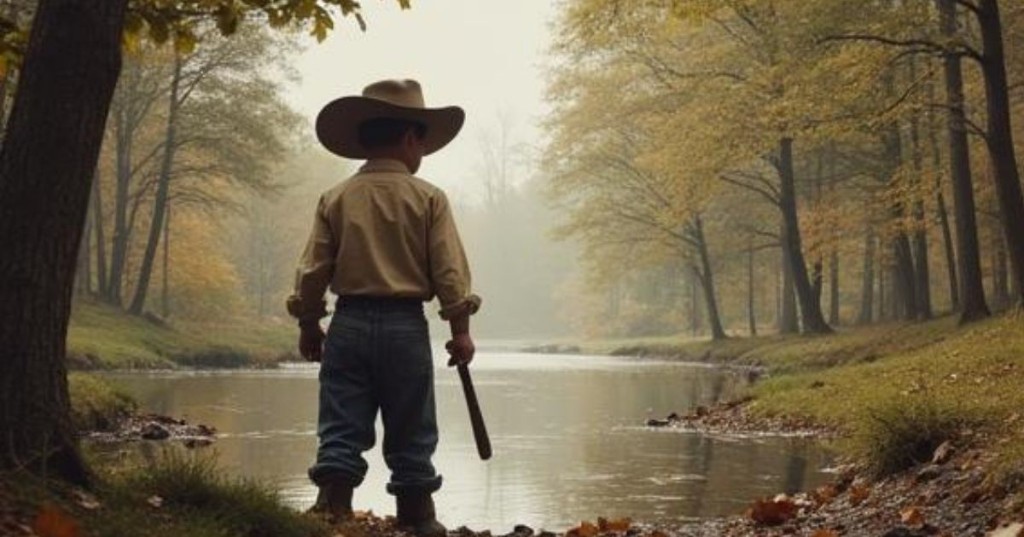
An excerpt from the original text.(complete · 2066 words)
hen Tom awoke in the morning, he wondered where he was. He sat up and
rubbed his eyes and looked around. Then he comprehended. It was the cool
gray dawn, and there was a delicious sense of repose and peace in the
deep pervading calm and silence of the woods. Not a leaf stirred; not
a sound obtruded upon great Nature’s meditation. Beaded dewdrops stood
upon the leaves and grasses. A white layer of ashes covered the fire,
and a thin blue breath of smoke rose straight into the air. Joe and Huck
still slept.
Now, far away in the woods a bird called; another answered; presently
the hammering of a woodpecker was heard. Gradually the cool dim gray
of the morning whitened, and as gradually sounds multiplied and life
manifested itself. The marvel of Nature shaking off sleep and going
to work unfolded itself to the musing boy. A little green worm came
crawling over a dewy leaf, lifting two-thirds of his body into the air
from time to time and “sniffing around,” then proceeding again—for he
was measuring, Tom said; and when the worm approached him, of its own
accord, he sat as still as a stone, with his hopes rising and falling,
by turns, as the creature still came toward him or seemed inclined to
go elsewhere; and when at last it considered a painful moment with its
curved body in the air and then came decisively down upon Tom’s leg and
began a journey over him, his whole heart was glad—for that meant that
he was going to have a new suit of clothes—without the shadow of a
doubt a gaudy piratical uniform. Now a procession of ants appeared,
from nowhere in particular, and went about their labors; one struggled
manfully by with a dead spider five times as big as itself in its arms,
and lugged it straight up a tree-trunk. A brown spotted lady-bug climbed
the dizzy height of a grass blade, and Tom bent down close to it and
said, “Lady-bug, lady-bug, fly away home, your house is on fire, your
children’s alone,” and she took wing and went off to see about it—which
did not surprise the boy, for he knew of old that this insect was
credulous about conflagrations, and he had practised upon its simplicity
more than once. A tumblebug came next, heaving sturdily at its ball, and
Tom touched the creature, to see it shut its legs against its body
and pretend to be dead. The birds were fairly rioting by this time. A
catbird, the Northern mocker, lit in a tree over Tom’s head, and trilled
out her imitations of her neighbors in a rapture of enjoyment; then
a shrill jay swept down, a flash of blue flame, and stopped on a twig
almost within the boy’s reach, cocked his head to one side and eyed the
strangers with a consuming curiosity; a gray squirrel and a big fellow
of the “fox” kind came skurrying along, sitting up at intervals to
inspect and chatter at the boys, for the wild things had probably never
seen a human being before and scarcely knew whether to be afraid or not.
All Nature was wide awake and stirring, now; long lances of sunlight
pierced down through the dense foliage far and near, and a few
butterflies came fluttering upon the scene.
Tom stirred up the other pirates and they all clattered away with
a shout, and in a minute or two were stripped and chasing after and
tumbling over each other in the shallow limpid water of the white
sandbar. They felt no longing for the little village sleeping in the
distance beyond the majestic waste of water. A vagrant current or a
slight rise in the river had carried off their raft, but this only
gratified them, since its going was something like burning the bridge
between them and civilization.
They came back to camp wonderfully refreshed, glad-hearted, and
ravenous; and they soon had the camp-fire blazing up again. Huck found a
spring of clear cold water close by, and the boys made cups of broad oak
or hickory leaves, and felt that water, sweetened with such a wildwood
charm as that, would be a good enough substitute for coffee. While Joe
was slicing bacon for breakfast, Tom and Huck asked him to hold on a
minute; they stepped to a promising nook in the river-bank and threw in
their lines; almost immediately they had reward. Joe had not had time
to get impatient before they were back again with some handsome bass,
a couple of sun-perch and a small catfish—provisions enough for quite a
family. They fried the fish with the bacon, and were astonished; for
no fish had ever seemed so delicious before. They did not know that the
quicker a fresh-water fish is on the fire after he is caught the better
he is; and they reflected little upon what a sauce open-air sleeping,
open-air exercise, bathing, and a large ingredient of hunger make, too.
They lay around in the shade, after breakfast, while Huck had a smoke,
and then went off through the woods on an exploring expedition. They
tramped gayly along, over decaying logs, through tangled underbrush,
among solemn monarchs of the forest, hung from their crowns to the
ground with a drooping regalia of grape-vines. Now and then they came
upon snug nooks carpeted with grass and jeweled with flowers.
They found plenty of things to be delighted with, but nothing to be
astonished at. They discovered that the island was about three miles
long and a quarter of a mile wide, and that the shore it lay closest to
was only separated from it by a narrow channel hardly two hundred yards
wide. They took a swim about every hour, so it was close upon the middle
of the afternoon when they got back to camp. They were too hungry to
stop to fish, but they fared sumptuously upon cold ham, and then threw
themselves down in the shade to talk. But the talk soon began to drag,
and then died. The stillness, the solemnity that brooded in the woods,
and the sense of loneliness, began to tell upon the spirits of the boys.
They fell to thinking. A sort of undefined longing crept upon them. This
took dim shape, presently—it was budding homesickness. Even Finn the
Red-Handed was dreaming of his doorsteps and empty hogsheads. But they
were all ashamed of their weakness, and none was brave enough to speak
his thought.
For some time, now, the boys had been dully conscious of a peculiar
sound in the distance, just as one sometimes is of the ticking of a
clock which he takes no distinct note of. But now this mysterious sound
became more pronounced, and forced a recognition. The boys started,
glanced at each other, and then each assumed a listening attitude. There
was a long silence, profound and unbroken; then a deep, sullen boom came
floating down out of the distance.
“What is it!” exclaimed Joe, under his breath.
“I wonder,” said Tom in a whisper.
“’Tain’t thunder,” said Huckleberry, in an awed tone, “becuz thunder—”
“Hark!” said Tom. “Listen—don’t talk.”
They waited a time that seemed an age, and then the same muffled boom
troubled the solemn hush.
“Let’s go and see.”
They sprang to their feet and hurried to the shore toward the town. They
parted the bushes on the bank and peered out over the water. The little
steam ferry-boat was about a mile below the village, drifting with the
current. Her broad deck seemed crowded with people. There were a great
many skiffs rowing about or floating with the stream in the neighborhood
of the ferryboat, but the boys could not determine what the men in
them were doing. Presently a great jet of white smoke burst from the
ferryboat’s side, and as it expanded and rose in a lazy cloud, that same
dull throb of sound was borne to the listeners again.
“I know now!” exclaimed Tom; “somebody’s drownded!”
“That’s it!” said Huck; “they done that last summer, when Bill Turner
got drownded; they shoot a cannon over the water, and that makes
him come up to the top. Yes, and they take loaves of bread and put
quicksilver in ’em and set ’em afloat, and wherever there’s anybody
that’s drownded, they’ll float right there and stop.”
“Yes, I’ve heard about that,” said Joe. “I wonder what makes the bread
do that.”
“Oh, it ain’t the bread, so much,” said Tom; “I reckon it’s mostly what
they say over it before they start it out.”
“But they don’t say anything over it,” said Huck. “I’ve seen ’em and
they don’t.”
“Well, that’s funny,” said Tom. “But maybe they say it to themselves. Of
course they do. Anybody might know that.”
The other boys agreed that there was reason in what Tom said, because
an ignorant lump of bread, uninstructed by an incantation, could not
be expected to act very intelligently when set upon an errand of such
gravity.
“By jings, I wish I was over there, now,” said Joe.
“I do too,” said Huck. “I’d give heaps to know who it is.”
The boys still listened and watched. Presently a revealing thought
flashed through Tom’s mind, and he exclaimed:
“Boys, I know who’s drownded—it’s us!”
They felt like heroes in an instant. Here was a gorgeous triumph; they
were missed; they were mourned; hearts were breaking on their account;
tears were being shed; accusing memories of unkindness to these poor
lost lads were rising up, and unavailing regrets and remorse were being
indulged; and best of all, the departed were the talk of the whole town,
and the envy of all the boys, as far as this dazzling notoriety was
concerned. This was fine. It was worth while to be a pirate, after all.
As twilight drew on, the ferryboat went back to her accustomed business
and the skiffs disappeared. The pirates returned to camp. They were
jubilant with vanity over their new grandeur and the illustrious trouble
they were making. They caught fish, cooked supper and ate it, and then
fell to guessing at what the village was thinking and saying about them;
and the pictures they drew of the public distress on their account were
gratifying to look upon—from their point of view. But when the shadows
of night closed them in, they gradually ceased to talk, and sat gazing
into the fire, with their minds evidently wandering elsewhere. The
excitement was gone, now, and Tom and Joe could not keep back thoughts
of certain persons at home who were not enjoying this fine frolic as
much as they were. Misgivings came; they grew troubled and unhappy; a
sigh or two escaped, unawares. By and by Joe timidly ventured upon a
roundabout “feeler” as to how the others might look upon a return to
civilization—not right now, but—
Tom withered him with derision! Huck, being uncommitted as yet, joined
in with Tom, and the waverer quickly “explained,” and was glad to get
out of the scrape with as little taint of chicken-hearted home-sickness
clinging to his garments as he could. Mutiny was effectually laid to
rest for the moment.
As the night deepened, Huck began to nod, and presently to snore.
Joe followed next. Tom lay upon his elbow motionless, for some time,
watching the two intently. At last he got up cautiously, on his knees,
and went searching among the grass and the flickering reflections flung
by the campfire. He picked up and inspected several large semi-cylinders
of the thin white bark of a sycamore, and finally chose two which seemed
to suit him. Then he knelt by the fire and painfully wrote something
upon each of these with his “red keel”; one he rolled up and put in his
jacket pocket, and the other he put in Joe’s hat and removed it to a
little distance from the owner. And he also put into the hat certain
schoolboy treasures of almost inestimable value—among them a lump of
chalk, an India-rubber ball, three fishhooks, and one of that kind
of marbles known as a “sure ’nough crystal.” Then he tiptoed his way
cautiously among the trees till he felt that he was out of hearing, and
straightway broke into a keen run in the direction of the sandbar.
Master this chapter. Complete your experience
Purchase the complete book to access all chapters and support classic literature
As an Amazon Associate, we earn a small commission from qualifying purchases at no additional cost to you.
Available in paperback, hardcover, and e-book formats
Let's Analyse the Pattern
Using disappearance or withdrawal as a way to force others to recognize your value, often backfiring by creating genuine isolation.
Why This Matters
Connect literature to life
This chapter teaches how to recognize when someone's dramatic behavior is actually a cry for recognition and connection.
Practice This Today
This week, notice when someone in your life creates drama or crisis—ask yourself what they might really need underneath the chaos.
Now let's explore the literary elements.
Key Quotes & Analysis
"It was the cool gray dawn, and there was a delicious sense of repose and peace in the deep pervading calm and silence of the woods."
Context: Tom waking up on the island to a perfect morning in nature
This peaceful moment contrasts sharply with the chaos and drama that will unfold when they discover everyone thinks they're dead. Twain shows us the seductive power of escape from civilization.
In Today's Words:
It was that perfect quiet morning where everything felt calm and right with the world.
"They felt like heroes in an instant. Here was a gorgeous triumph; they were missed; they were mourned; hearts were breaking on their account."
Context: When the boys realize the town thinks they're dead and is searching for their bodies
This reveals the dark appeal of self-pity and attention-seeking. The boys are thrilled to be the center of tragic attention, which shows how much they crave being seen as important.
In Today's Words:
They felt like celebrities - finally, people cared about them and were actually upset they were gone.
"But when the shadows of night closed them in, they gradually ceased to talk, and sat gazing into the fire, with their minds evidently wandering elsewhere."
Context: As night falls and the excitement wears off, reality sets in
The darkness brings honest emotion that daylight adventure could suppress. This is when homesickness and guilt start creeping in, showing that even the best escapes can't last forever.
In Today's Words:
When it got dark and quiet, they stopped joking around and started thinking about home.
Thematic Threads
Attention-seeking
In This Chapter
Tom is thrilled that the whole town is searching for him, imagining their grief and regret
Development
Evolution from earlier mischief-making to this ultimate attention-getting scheme
In Your Life:
You might recognize this in threatening to quit, going silent in relationships, or making dramatic announcements to get reactions.
Freedom vs. Connection
In This Chapter
The boys enjoy their freedom on the island but are secretly drawn to news from home
Development
Building tension between Tom's desire for independence and his need for social belonging
In Your Life:
You face this tension when wanting space from family or work while still craving their validation and concern.
Reality vs. Fantasy
In This Chapter
The romantic idea of being 'dead pirates' clashes with Joe's growing homesickness
Development
The adventure fantasy is starting to crack under the weight of actual consequences
In Your Life:
You might experience this when grand plans or dramatic gestures don't feel as satisfying as you imagined they would.
Secrecy and Control
In This Chapter
Tom sneaks away to write secret messages, planning something his friends don't know about
Development
Tom's pattern of keeping information to maintain control over situations
In Your Life:
You might do this when you have exit strategies or backup plans you don't share with others, trying to stay one step ahead.
Guilt and Responsibility
In This Chapter
Despite their excitement, the boys are beginning to feel the weight of the worry they've caused
Development
First real glimpse of Tom considering the impact of his actions on others
In Your Life:
You feel this when your dramatic gestures or disappearances start affecting people you actually care about.
You now have the context. Time to form your own thoughts.
Discussion Questions
- 1
Why do Tom and his friends feel excited when they realize the townspeople think they're dead?
analysis • surface - 2
What does their reaction to the cannon fire reveal about what they were really seeking by running away?
analysis • medium - 3
Where do you see people today using dramatic exits or disappearing acts to get attention or prove their worth?
application • medium - 4
If you were Tom's friend and noticed him planning something secret, how would you handle that situation?
application • deep - 5
What does this chapter reveal about the difference between wanting freedom and wanting to be missed?
reflection • deep
Critical Thinking Exercise
Map the Dramatic Exit Pattern
Think of a time when you or someone you know used a dramatic exit (quitting, blocking people, threatening to leave, disappearing) to send a message. Write down what the real underlying need was, what actually happened as a result, and what a more direct approach might have looked like. Then identify three warning signs that someone is about to make a dramatic exit for attention rather than genuine self-care.
Consider:
- •Dramatic exits often mask requests for recognition or appreciation
- •The power of absence only works if you're willing to stay absent
- •Direct communication about needs is usually more effective than manufactured crises
Journaling Prompt
Write about a time when you felt invisible or unappreciated. What were you hoping would happen? What actually happened? How might you handle similar feelings differently now?
Coming Up Next...
Chapter 15: The Secret Return Home
Tom embarks on a dangerous nighttime journey back toward St. Petersburg, carrying mysterious messages and a secret plan. What he discovers about the town's reaction to their disappearance will change everything for the young pirates.



