
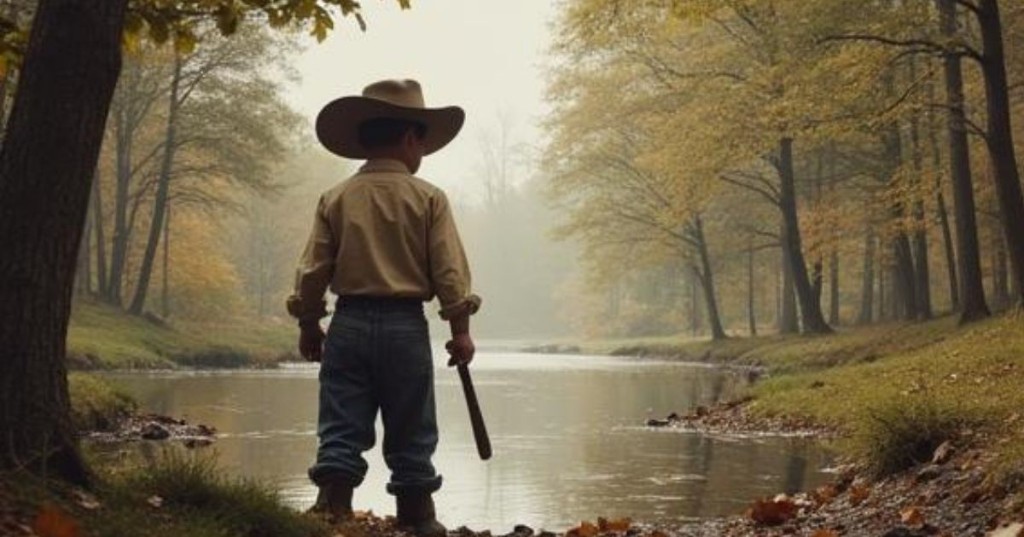
An excerpt from the original text.(complete · 2447 words)
om’s mind was made up now. He was gloomy and desperate. He was a
forsaken, friendless boy, he said; nobody loved him; when they found out
what they had driven him to, perhaps they would be sorry; he had tried
to do right and get along, but they would not let him; since nothing
would do them but to be rid of him, let it be so; and let them blame
him for the consequences—why shouldn’t they? What right had the
friendless to complain? Yes, they had forced him to it at last: he would
lead a life of crime. There was no choice.
By this time he was far down Meadow Lane, and the bell for school to
“take up” tinkled faintly upon his ear. He sobbed, now, to think he
should never, never hear that old familiar sound any more—it was very
hard, but it was forced on him; since he was driven out into the cold
world, he must submit—but he forgave them. Then the sobs came thick and
fast.
Just at this point he met his soul’s sworn comrade, Joe
Harper—hard-eyed, and with evidently a great and dismal purpose in his
heart. Plainly here were “two souls with but a single thought.” Tom,
wiping his eyes with his sleeve, began to blubber out something about
a resolution to escape from hard usage and lack of sympathy at home by
roaming abroad into the great world never to return; and ended by hoping
that Joe would not forget him.
But it transpired that this was a request which Joe had just been going
to make of Tom, and had come to hunt him up for that purpose. His mother
had whipped him for drinking some cream which he had never tasted and
knew nothing about; it was plain that she was tired of him and wished
him to go; if she felt that way, there was nothing for him to do but
succumb; he hoped she would be happy, and never regret having driven her
poor boy out into the unfeeling world to suffer and die.
As the two boys walked sorrowing along, they made a new compact to stand
by each other and be brothers and never separate till death relieved
them of their troubles. Then they began to lay their plans. Joe was for
being a hermit, and living on crusts in a remote cave, and dying,
some time, of cold and want and grief; but after listening to Tom, he
conceded that there were some conspicuous advantages about a life of
crime, and so he consented to be a pirate.
Three miles below St. Petersburg, at a point where the Mississippi River
was a trifle over a mile wide, there was a long, narrow, wooded island,
with a shallow bar at the head of it, and this offered well as a
rendezvous. It was not inhabited; it lay far over toward the further
shore, abreast a dense and almost wholly unpeopled forest. So Jackson’s
Island was chosen. Who were to be the subjects of their piracies was a
matter that did not occur to them. Then they hunted up Huckleberry Finn,
and he joined them promptly, for all careers were one to him; he was
indifferent. They presently separated to meet at a lonely spot on the
river-bank two miles above the village at the favorite hour—which was
midnight. There was a small log raft there which they meant to capture.
Each would bring hooks and lines, and such provision as he could steal
in the most dark and mysterious way—as became outlaws. And before the
afternoon was done, they had all managed to enjoy the sweet glory of
spreading the fact that pretty soon the town would “hear something.” All
who got this vague hint were cautioned to “be mum and wait.”
About midnight Tom arrived with a boiled ham and a few trifles,
and stopped in a dense undergrowth on a small bluff overlooking the
meeting-place. It was starlight, and very still. The mighty river lay
like an ocean at rest. Tom listened a moment, but no sound disturbed the
quiet. Then he gave a low, distinct whistle. It was answered from under
the bluff. Tom whistled twice more; these signals were answered in the
same way. Then a guarded voice said:
“Who goes there?”
“Tom Sawyer, the Black Avenger of the Spanish Main. Name your names.”
“Huck Finn the Red-Handed, and Joe Harper the Terror of the Seas.” Tom
had furnished these titles, from his favorite literature.
“’Tis well. Give the countersign.”
Two hoarse whispers delivered the same awful word simultaneously to the
brooding night:
“Blood!”
Then Tom tumbled his ham over the bluff and let himself down after it,
tearing both skin and clothes to some extent in the effort. There was
an easy, comfortable path along the shore under the bluff, but it lacked
the advantages of difficulty and danger so valued by a pirate.
The Terror of the Seas had brought a side of bacon, and had about worn
himself out with getting it there. Finn the Red-Handed had stolen a
skillet and a quantity of half-cured leaf tobacco, and had also brought
a few corn-cobs to make pipes with. But none of the pirates smoked or
“chewed” but himself. The Black Avenger of the Spanish Main said it
would never do to start without some fire. That was a wise thought;
matches were hardly known there in that day. They saw a fire smouldering
upon a great raft a hundred yards above, and they went stealthily
thither and helped themselves to a chunk. They made an imposing
adventure of it, saying, “Hist!” every now and then, and suddenly
halting with finger on lip; moving with hands on imaginary dagger-hilts;
and giving orders in dismal whispers that if “the foe” stirred, to “let
him have it to the hilt,” because “dead men tell no tales.” They knew
well enough that the raftsmen were all down at the village laying
in stores or having a spree, but still that was no excuse for their
conducting this thing in an unpiratical way.
They shoved off, presently, Tom in command, Huck at the after oar and
Joe at the forward. Tom stood amidships, gloomy-browed, and with folded
arms, and gave his orders in a low, stern whisper:
“Luff, and bring her to the wind!”
“Aye-aye, sir!”
“Steady, steady-y-y-y!”
“Steady it is, sir!”
“Let her go off a point!”
“Point it is, sir!”
As the boys steadily and monotonously drove the raft toward mid-stream
it was no doubt understood that these orders were given only for
“style,” and were not intended to mean anything in particular.
“What sail’s she carrying?”
“Courses, tops’ls, and flying-jib, sir.”
“Send the r’yals up! Lay out aloft, there, half a dozen of
ye—foretopmaststuns’l! Lively, now!”
“Aye-aye, sir!”
“Shake out that maintogalans’l! Sheets and braces! now my hearties!”
“Aye-aye, sir!”
“Hellum-a-lee—hard a port! Stand by to meet her when she comes! Port,
port! Now, men! With a will! Stead-y-y-y!”
“Steady it is, sir!”
The raft drew beyond the middle of the river; the boys pointed her head
right, and then lay on their oars. The river was not high, so there was
not more than a two or three mile current. Hardly a word was said during
the next three-quarters of an hour. Now the raft was passing before
the distant town. Two or three glimmering lights showed where it lay,
peacefully sleeping, beyond the vague vast sweep of star-gemmed water,
unconscious of the tremendous event that was happening. The Black
Avenger stood still with folded arms, “looking his last” upon the scene
of his former joys and his later sufferings, and wishing “she” could see
him now, abroad on the wild sea, facing peril and death with dauntless
heart, going to his doom with a grim smile on his lips. It was but
a small strain on his imagination to remove Jackson’s Island beyond
eye-shot of the village, and so he “looked his last” with a broken and
satisfied heart. The other pirates were looking their last, too; and
they all looked so long that they came near letting the current drift
them out of the range of the island. But they discovered the danger in
time, and made shift to avert it. About two o’clock in the morning the
raft grounded on the bar two hundred yards above the head of the island,
and they waded back and forth until they had landed their freight. Part
of the little raft’s belongings consisted of an old sail, and this they
spread over a nook in the bushes for a tent to shelter their provisions;
but they themselves would sleep in the open air in good weather, as
became outlaws.
They built a fire against the side of a great log twenty or thirty steps
within the sombre depths of the forest, and then cooked some bacon in
the frying-pan for supper, and used up half of the corn “pone” stock
they had brought. It seemed glorious sport to be feasting in that wild,
free way in the virgin forest of an unexplored and uninhabited island,
far from the haunts of men, and they said they never would return to
civilization. The climbing fire lit up their faces and threw its ruddy
glare upon the pillared tree-trunks of their forest temple, and upon the
varnished foliage and festooning vines.
When the last crisp slice of bacon was gone, and the last allowance
of corn pone devoured, the boys stretched themselves out on the grass,
filled with contentment. They could have found a cooler place, but
they would not deny themselves such a romantic feature as the roasting
campfire.
“Ain’t it gay?” said Joe.
“It’s nuts!” said Tom. “What would the boys say if they could see us?”
“Say? Well, they’d just die to be here—hey, Hucky!”
“I reckon so,” said Huckleberry; “anyways, I’m suited. I don’t want
nothing better’n this. I don’t ever get enough to eat, gen’ally—and here
they can’t come and pick at a feller and bullyrag him so.”
“It’s just the life for me,” said Tom. “You don’t have to get up,
mornings, and you don’t have to go to school, and wash, and all that
blame foolishness. You see a pirate don’t have to do anything, Joe,
when he’s ashore, but a hermit he has to be praying considerable, and
then he don’t have any fun, anyway, all by himself that way.”
“Oh yes, that’s so,” said Joe, “but I hadn’t thought much about it, you
know. I’d a good deal rather be a pirate, now that I’ve tried it.”
“You see,” said Tom, “people don’t go much on hermits, nowadays, like
they used to in old times, but a pirate’s always respected. And
a hermit’s got to sleep on the hardest place he can find, and put
sackcloth and ashes on his head, and stand out in the rain, and—”
“What does he put sackcloth and ashes on his head for?” inquired Huck.
“I dono. But they’ve got to do it. Hermits always do. You’d have to do
that if you was a hermit.”
“Dern’d if I would,” said Huck.
“Well, what would you do?”
“I dono. But I wouldn’t do that.”
“Why, Huck, you’d have to. How’d you get around it?”
“Why, I just wouldn’t stand it. I’d run away.”
“Run away! Well, you would be a nice old slouch of a hermit. You’d be
a disgrace.”
The Red-Handed made no response, being better employed. He had finished
gouging out a cob, and now he fitted a weed stem to it, loaded it with
tobacco, and was pressing a coal to the charge and blowing a cloud of
fragrant smoke—he was in the full bloom of luxurious contentment. The
other pirates envied him this majestic vice, and secretly resolved to
acquire it shortly. Presently Huck said:
“What does pirates have to do?”
Tom said:
“Oh, they have just a bully time—take ships and burn them, and get the
money and bury it in awful places in their island where there’s ghosts
and things to watch it, and kill everybody in the ships—make ’em walk a
plank.”
“And they carry the women to the island,” said Joe; “they don’t kill the
women.”
“No,” assented Tom, “they don’t kill the women—they’re too noble. And
the women’s always beautiful, too.”
“And don’t they wear the bulliest clothes! Oh no! All gold and silver
and di’monds,” said Joe, with enthusiasm.
“Who?” said Huck.
“Why, the pirates.”
Huck scanned his own clothing forlornly.
“I reckon I ain’t dressed fitten for a pirate,” said he, with a
regretful pathos in his voice; “but I ain’t got none but these.”
But the other boys told him the fine clothes would come fast enough,
after they should have begun their adventures. They made him understand
that his poor rags would do to begin with, though it was customary for
wealthy pirates to start with a proper wardrobe.
Gradually their talk died out and drowsiness began to steal upon the
eyelids of the little waifs. The pipe dropped from the fingers of the
Red-Handed, and he slept the sleep of the conscience-free and the weary.
The Terror of the Seas and the Black Avenger of the Spanish Main had
more difficulty in getting to sleep. They said their prayers inwardly,
and lying down, since there was nobody there with authority to make them
kneel and recite aloud; in truth, they had a mind not to say them at
all, but they were afraid to proceed to such lengths as that, lest they
might call down a sudden and special thunderbolt from heaven. Then at
once they reached and hovered upon the imminent verge of sleep—but an
intruder came, now, that would not “down.” It was conscience. They began
to feel a vague fear that they had been doing wrong to run away; and
next they thought of the stolen meat, and then the real torture came.
They tried to argue it away by reminding conscience that they had
purloined sweetmeats and apples scores of times; but conscience was not
to be appeased by such thin plausibilities; it seemed to them, in the
end, that there was no getting around the stubborn fact that taking
sweetmeats was only “hooking,” while taking bacon and hams and such
valuables was plain simple stealing—and there was a command against that
in the Bible. So they inwardly resolved that so long as they remained in
the business, their piracies should not again be sullied with the
crime of stealing. Then conscience granted a truce, and these curiously
inconsistent pirates fell peacefully to sleep.
Master this chapter. Complete your experience
Purchase the complete book to access all chapters and support classic literature
As an Amazon Associate, we earn a small commission from qualifying purchases at no additional cost to you.
Available in paperback, hardcover, and e-book formats
Let's Analyse the Pattern
When emotional pain transforms into a more powerful identity that feels better than addressing the original hurt.
Why This Matters
Connect literature to life
This chapter teaches how we unconsciously transform painful emotions into more powerful identities to regain control.
Practice This Today
This week, notice when you or someone else suddenly becomes 'the rebel,' 'the expert,' or 'the independent one' right after feeling hurt or dismissed - ask what pain might be driving the transformation.
Now let's explore the literary elements.
Key Quotes & Analysis
"He was a forsaken, friendless boy, he said; nobody loved him; when they found out what they had driven him to, perhaps they would be sorry"
Context: Tom's internal monologue as he decides to run away
This captures the self-pitying but very real pain of feeling misunderstood. Tom imagines everyone regretting their treatment of him - a classic fantasy when we feel wronged.
In Today's Words:
Nobody gets me, nobody cares about me, and when I'm gone they'll all feel bad about how they treated me
"Plainly here were two souls with but a single thought"
Context: When Tom meets Joe and realizes they both want to run away
Shows how powerful it is to find someone who shares your feelings. Their shared misery becomes the foundation for their adventure and makes them both feel less alone.
In Today's Words:
They were totally on the same wavelength
"There ain't any real pirates on these waters nowadays, so we'll just have to make the best of it"
Context: Planning their pirate adventure on the Mississippi
Tom adapts his fantasy to reality while keeping the excitement alive. It shows how kids negotiate between imagination and practical limitations.
In Today's Words:
We can't be actual pirates, but we'll make it work somehow
Thematic Threads
Identity
In This Chapter
Tom and Joe shed their identities as 'bad boys' to become pirates with grand titles and noble purposes
Development
Builds on Tom's earlier role-playing, but now identity becomes escape rather than just play
In Your Life:
You might recognize this when you find yourself dramatically reinventing who you are after a major disappointment or rejection.
Belonging
In This Chapter
The boys create their own brotherhood when they feel rejected by their families and community
Development
Introduced here as a driving force behind their rebellion
In Your Life:
This shows up when you seek acceptance in new groups after feeling excluded from your usual circles.
Social Expectations
In This Chapter
The boys rebel against society's rules by stealing and running away, yet still wrestle with their consciences
Development
Evolves from Tom's earlier rule-bending to outright rejection of social norms
In Your Life:
You see this when you break rules you normally follow during times of anger or hurt, then feel conflicted about it.
Personal Growth
In This Chapter
The boys must navigate their first real independence and moral choices without adult guidance
Development
Introduced here as they face consequences of their choices alone
In Your Life:
This appears when you're forced to make difficult decisions without your usual support systems.
You now have the context. Time to form your own thoughts.
Discussion Questions
- 1
What triggers Tom and Joe to decide they want to become pirates, and how do they recruit Huck?
analysis • surface - 2
Why do the boys create elaborate pirate titles and roles for themselves instead of just running away as regular kids?
analysis • medium - 3
Where do you see people today transforming hurt feelings into a more powerful identity - at work, in relationships, or online?
application • medium - 4
How can you tell the difference between healthy growth after disappointment versus just avoiding the real problem by creating a new identity?
application • deep - 5
What does the boys' guilt about stealing reveal about how we negotiate with our conscience when we want to justify questionable choices?
reflection • deep
Critical Thinking Exercise
Track Your Identity Shifts
Think of a time when you felt hurt, rejected, or powerless and responded by throwing yourself into a new role, hobby, or way of being. Write down what happened, what identity you adopted, and whether it actually solved the underlying problem or just made you feel better temporarily.
Consider:
- •Did the new identity give you genuine skills and growth, or just temporary relief?
- •What was the real need underneath - recognition, control, belonging, or something else?
- •How might you have addressed the original hurt more directly?
Journaling Prompt
Write about a current situation where you feel tempted to 'become someone new' rather than deal with difficult emotions. What would it look like to face the feelings directly instead of transforming them into a more heroic story?
Coming Up Next...
Chapter 14: The Price of Adventure
Morning arrives on Jackson's Island, bringing with it the harsh light of reality. The boys must face their first full day as 'pirates' and discover whether their romantic adventure can survive the practical challenges of island life.



