
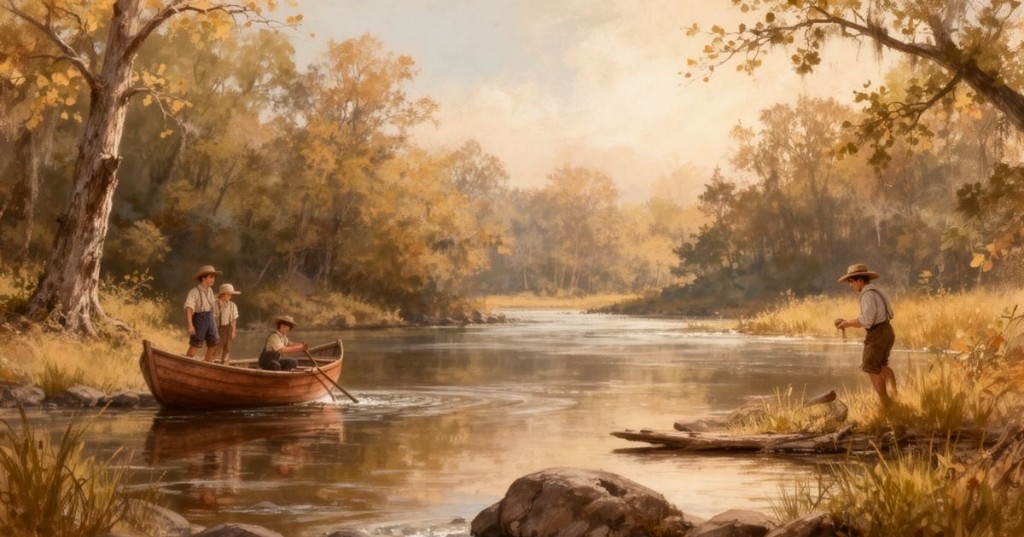
An excerpt from the original text.(complete · 2483 words)
im allowed the inscription was going to be the toughest of all. That’s
the one which the prisoner has to scrabble on the wall. But he had to
have it; Tom said he’d got to; there warn’t no case of a state
prisoner not scrabbling his inscription to leave behind, and his coat
of arms.
“Look at Lady Jane Grey,” he says; “look at Gilford Dudley; look at old
Northumberland! Why, Huck, s’pose it is considerble trouble?—what you
going to do?—how you going to get around it? Jim’s got to do his
inscription and coat of arms. They all do.”
Jim says:
“Why, Mars Tom, I hain’t got no coat o’ arm; I hain’t got nuffn but
dish yer ole shirt, en you knows I got to keep de journal on dat.”
“Oh, you don’t understand, Jim; a coat of arms is very different.”
“Well,” I says, “Jim’s right, anyway, when he says he ain’t got no coat
of arms, because he hain’t.”
“I reckon I knowed that,” Tom says, “but you bet he’ll have one
before he goes out of this—because he’s going out right, and there
ain’t going to be no flaws in his record.”
So whilst me and Jim filed away at the pens on a brickbat apiece, Jim
a-making his’n out of the brass and I making mine out of the spoon, Tom
set to work to think out the coat of arms. By-and-by he said he’d
struck so many good ones he didn’t hardly know which to take, but there
was one which he reckoned he’d decide on. He says:
“On the scutcheon we’ll have a bend or in the dexter base, a saltire
murrey in the fess, with a dog, couchant, for common charge, and
under his foot a chain embattled, for slavery, with a chevron vert in
a chief engrailed, and three invected lines on a field azure, with
the nombril points rampant on a dancette indented; crest, a runaway
nigger, sable, with his bundle over his shoulder on a bar sinister;
and a couple of gules for supporters, which is you and me; motto,
Maggiore fretta, minore atto. Got it out of a book—means the more
haste, the less speed.”
“Geewhillikins,” I says, “but what does the rest of it mean?”
“We ain’t got no time to bother over that,” he says; “we got to dig in
like all git-out.”
“Well, anyway,” I says, “what’s some of it? What’s a fess?”
“A fess—a fess is—you don’t need to know what a fess is. I’ll show
him how to make it when he gets to it.”
“Shucks, Tom,” I says, “I think you might tell a person. What’s a bar
sinister?”
“Oh, I don’t know. But he’s got to have it. All the nobility does.”
That was just his way. If it didn’t suit him to explain a thing to you,
he wouldn’t do it. You might pump at him a week, it wouldn’t make no
difference.
He’d got all that coat of arms business fixed, so now he started in to
finish up the rest of that part of the work, which was to plan out a
mournful inscription—said Jim got to have one, like they all done. He
made up a lot, and wrote them out on a paper, and read them off, so:
1. Here a captive heart busted.
2. Here a poor prisoner, forsook by the world and friends, fretted out
his sorrowful life.
3. Here a lonely heart broke, and a worn spirit went to its rest,
after thirty-seven years of solitary captivity.
4. Here, homeless and friendless, after thirty-seven years of bitter
captivity, perished a noble stranger, natural son of Louis XIV.
Tom’s voice trembled whilst he was reading them, and he most broke
down. When he got done he couldn’t no way make up his mind which one
for Jim to scrabble on to the wall, they was all so good; but at last
he allowed he would let him scrabble them all on. Jim said it would
take him a year to scrabble such a lot of truck on to the logs with a
nail, and he didn’t know how to make letters, besides; but Tom said he
would block them out for him, and then he wouldn’t have nothing to do
but just follow the lines. Then pretty soon he says:
“Come to think, the logs ain’t a-going to do; they don’t have log walls
in a dungeon: we got to dig the inscriptions into a rock. We’ll fetch a
rock.”
Jim said the rock was worse than the logs; he said it would take him
such a pison long time to dig them into a rock he wouldn’t ever get
out. But Tom said he would let me help him do it. Then he took a look
to see how me and Jim was getting along with the pens. It was most
pesky tedious hard work and slow, and didn’t give my hands no show to
get well of the sores, and we didn’t seem to make no headway, hardly;
so Tom says:
“I know how to fix it. We got to have a rock for the coat of arms and
mournful inscriptions, and we can kill two birds with that same rock.
There’s a gaudy big grindstone down at the mill, and we’ll smouch it,
and carve the things on it, and file out the pens and the saw on it,
too.”
It warn’t no slouch of an idea; and it warn’t no slouch of a grindstone
nuther; but we allowed we’d tackle it. It warn’t quite midnight yet, so
we cleared out for the mill, leaving Jim at work. We smouched the
grindstone, and set out to roll her home, but it was a most nation
tough job. Sometimes, do what we could, we couldn’t keep her from
falling over, and she come mighty near mashing us every time. Tom said
she was going to get one of us, sure, before we got through. We got her
half way; and then we was plumb played out, and most drownded with
sweat. We see it warn’t no use; we got to go and fetch Jim. So he
raised up his bed and slid the chain off of the bed-leg, and wrapt it
round and round his neck, and we crawled out through our hole and down
there, and Jim and me laid into that grindstone and walked her along
like nothing; and Tom superintended. He could out-superintend any boy I
ever see. He knowed how to do everything.
Our hole was pretty big, but it warn’t big enough to get the grindstone
through; but Jim he took the pick and soon made it big enough. Then Tom
marked out them things on it with the nail, and set Jim to work on
them, with the nail for a chisel and an iron bolt from the rubbage in
the lean-to for a hammer, and told him to work till the rest of his
candle quit on him, and then he could go to bed, and hide the
grindstone under his straw tick and sleep on it. Then we helped him fix
his chain back on the bed-leg, and was ready for bed ourselves. But Tom
thought of something, and says:
“You got any spiders in here, Jim?”
“No, sah, thanks to goodness I hain’t, Mars Tom.”
“All right, we’ll get you some.”
“But bless you, honey, I doan’ want none. I’s afeard un um. I jis’ ’s
soon have rattlesnakes aroun’.”
Tom thought a minute or two, and says:
“It’s a good idea. And I reckon it’s been done. It must a been done;
it stands to reason. Yes, it’s a prime good idea. Where could you keep
it?”
“Keep what, Mars Tom?”
“Why, a rattlesnake.”
“De goodness gracious alive, Mars Tom! Why, if dey was a rattlesnake to
come in heah I’d take en bust right out thoo dat log wall, I would, wid
my head.”
“Why, Jim, you wouldn’t be afraid of it after a little. You could tame
it.”
“Tame it!”
“Yes—easy enough. Every animal is grateful for kindness and petting,
and they wouldn’t think of hurting a person that pets them. Any book
will tell you that. You try—that’s all I ask; just try for two or three
days. Why, you can get him so, in a little while, that he’ll love you;
and sleep with you; and won’t stay away from you a minute; and will let
you wrap him round your neck and put his head in your mouth.”
“Please, Mars Tom—doan’ talk so! I can’t stan’ it! He’d let me
shove his head in my mouf—fer a favor, hain’t it? I lay he’d wait a
pow’ful long time ’fo’ I ast him. En mo’ en dat, I doan’ want him
to sleep wid me.”
“Jim, don’t act so foolish. A prisoner’s got to have some kind of a
dumb pet, and if a rattlesnake hain’t ever been tried, why, there’s
more glory to be gained in your being the first to ever try it than any
other way you could ever think of to save your life.”
“Why, Mars Tom, I doan’ want no sich glory. Snake take ’n bite Jim’s
chin off, den whah is de glory? No, sah, I doan’ want no sich
doin’s.”
“Blame it, can’t you try? I only want you to try—you needn’t keep
it up if it don’t work.”
“But de trouble all done ef de snake bite me while I’s a tryin’ him.
Mars Tom, I’s willin’ to tackle mos’ anything ’at ain’t onreasonable,
but ef you en Huck fetches a rattlesnake in heah for me to tame, I’s
gwyne to leave, dat’s shore.”
“Well, then, let it go, let it go, if you’re so bull-headed about it.
We can get you some garter-snakes, and you can tie some buttons on
their tails, and let on they’re rattlesnakes, and I reckon that’ll
have to do.”
“I k’n stan’ dem, Mars Tom, but blame’ ’f I couldn’ get along widout
um, I tell you dat. I never knowed b’fo’ ’t was so much bother and
trouble to be a prisoner.”
“Well, it always is when it’s done right. You got any rats around
here?”
“No, sah, I hain’t seed none.”
“Well, we’ll get you some rats.”
“Why, Mars Tom, I doan’ want no rats. Dey’s de dadblamedest creturs
to ’sturb a body, en rustle roun’ over ’im, en bite his feet, when he’s
tryin’ to sleep, I ever see. No, sah, gimme g’yarter-snakes, ’f I’s got
to have ’m, but doan’ gimme no rats; I hain’ got no use f’r um,
skasely.”
“But, Jim, you got to have ’em—they all do. So don’t make no more
fuss about it. Prisoners ain’t ever without rats. There ain’t no
instance of it. And they train them, and pet them, and learn them
tricks, and they get to be as sociable as flies. But you got to play
music to them. You got anything to play music on?”
“I ain’ got nuffn but a coase comb en a piece o’ paper, en a
juice-harp; but I reck’n dey wouldn’ take no stock in a juice-harp.”
“Yes they would. They don’t care what kind of music ’tis. A
jews-harp’s plenty good enough for a rat. All animals like music—in a
prison they dote on it. Specially, painful music; and you can’t get no
other kind out of a jews-harp. It always interests them; they come out
to see what’s the matter with you. Yes, you’re all right; you’re fixed
very well. You want to set on your bed nights before you go to sleep,
and early in the mornings, and play your jews-harp; play ‘The Last Link
is Broken’—that’s the thing that’ll scoop a rat quicker ’n anything
else; and when you’ve played about two minutes you’ll see all the rats,
and the snakes, and spiders, and things begin to feel worried about
you, and come. And they’ll just fairly swarm over you, and have a noble
good time.”
“Yes, dey will, I reck’n, Mars Tom, but what kine er time is Jim
havin’? Blest if I kin see de pint. But I’ll do it ef I got to. I
reck’n I better keep de animals satisfied, en not have no trouble in de
house.”
Tom waited to think it over, and see if there wasn’t nothing else; and
pretty soon he says:
“Oh, there’s one thing I forgot. Could you raise a flower here, do you
reckon?”
“I doan know but maybe I could, Mars Tom; but it’s tolable dark in
heah, en I ain’ got no use f’r no flower, nohow, en she’d be a pow’ful
sight o’ trouble.”
“Well, you try it, anyway. Some other prisoners has done it.”
“One er dem big cat-tail-lookin’ mullen-stalks would grow in heah, Mars
Tom, I reck’n, but she wouldn’t be wuth half de trouble she’d coss.”
“Don’t you believe it. We’ll fetch you a little one and you plant it in
the corner over there, and raise it. And don’t call it mullen, call it
Pitchiola—that’s its right name when it’s in a prison. And you want to
water it with your tears.”
“Why, I got plenty spring water, Mars Tom.”
“You don’t want spring water; you want to water it with your tears.
It’s the way they always do.”
“Why, Mars Tom, I lay I kin raise one er dem mullen-stalks twyste wid
spring water whiles another man’s a start’n one wid tears.”
“That ain’t the idea. You got to do it with tears.”
“She’ll die on my han’s, Mars Tom, she sholy will; kase I doan’ skasely
ever cry.”
So Tom was stumped. But he studied it over, and then said Jim would
have to worry along the best he could with an onion. He promised he
would go to the nigger cabins and drop one, private, in Jim’s
coffee-pot, in the morning. Jim said he would “jis’ ’s soon have
tobacker in his coffee;” and found so much fault with it, and with the
work and bother of raising the mullen, and jews-harping the rats, and
petting and flattering up the snakes and spiders and things, on top of
all the other work he had to do on pens, and inscriptions, and
journals, and things, which made it more trouble and worry and
responsibility to be a prisoner than anything he ever undertook, that
Tom most lost all patience with him; and said he was just loadened down
with more gaudier chances than a prisoner ever had in the world to make
a name for himself, and yet he didn’t know enough to appreciate them,
and they was just about wasted on him. So Jim he was sorry, and said he
wouldn’t behave so no more, and then me and Tom shoved for bed.
Master this chapter. Complete your experience
Purchase the complete book to access all chapters and support classic literature
As an Amazon Associate, we earn a small commission from qualifying purchases at no additional cost to you.
Available in paperback, hardcover, and e-book formats
Let's Analyse the Pattern
When people with power or privilege turn serious situations into entertainment or elaborate exercises, creating unnecessary suffering for those who can't afford to play along.
Why This Matters
Connect literature to life
This chapter teaches how to identify when someone uses their position to turn others' problems into their own practice ground.
Practice This Today
This week, notice when someone with authority makes simple requests complicated—ask yourself who benefits from the complexity and who pays the real cost.
Now let's explore the literary elements.
Key Quotes & Analysis
"Here's the way it ought to be done. The person that's being rescued, he ought to leave some kind of a record of how he's been treated, and how long he's been here, and all about his troubles."
Context: Tom insists Jim must follow proper prisoner protocols from adventure books
Shows how Tom treats Jim's real suffering as material for a romantic story. He's more concerned with following fictional rules than with Jim's actual freedom or safety.
In Today's Words:
We need to do this the right way according to the manual, even if it makes no sense for your situation.
"I don't see no sense in it. If I was going to dig out, I wouldn't fool around with no journal."
Context: Jim questions the logic of Tom's elaborate escape requirements
Jim's practical wisdom cuts through Tom's romantic nonsense. He understands the real stakes - his freedom and his life - while Tom treats it like a game.
In Today's Words:
This is ridiculous - if I'm trying to escape, I'm not going to waste time on paperwork.
"Tom told him he mustn't be so particular about a little thing like that."
Context: Tom dismisses Jim's concerns about the dangerous tasks he's being asked to do
Reveals Tom's complete disconnect from the reality of Jim's situation. What Tom calls 'a little thing' could literally cost Jim his life or freedom.
In Today's Words:
Don't worry about the details - it's not that big a deal.
Thematic Threads
Class
In This Chapter
Tom's privilege allows him to treat Jim's escape as entertainment while Jim faces real danger
Development
Deepening from earlier chapters where class differences were more subtle
In Your Life:
You might see this when managers implement complicated procedures without considering the burden on workers who actually have to follow them.
Identity
In This Chapter
Tom's identity as an adventure-book hero conflicts with Jim's identity as a person seeking freedom
Development
Building on Tom's earlier romantic notions, now shown as actively harmful
In Your Life:
You might struggle between who you think you should be and what your situation actually requires.
Social Expectations
In This Chapter
Tom insists on following book rules for prisoner escapes regardless of practical consequences
Development
Escalating from earlier themes about following social scripts
In Your Life:
You might feel pressured to do things 'the right way' even when a simpler approach would work better.
Human Relationships
In This Chapter
Jim endures Tom's torture because he needs white allies, showing how power imbalances corrupt relationships
Development
Continuing the complex dynamics between characters with different social positions
In Your Life:
You might find yourself going along with someone's difficult personality because you need their help or approval.
Personal Growth
In This Chapter
Huck's growing frustration shows his developing ability to see through Tom's nonsense
Development
Huck's moral development continues as he questions authority figures
In Your Life:
You might start recognizing when someone's 'expertise' is actually creating more problems than it solves.
You now have the context. Time to form your own thoughts.
Discussion Questions
- 1
What unnecessary complications does Tom force Jim to endure, and why does Jim go along with them?
analysis • surface - 2
Why does Tom insist on following the adventure books exactly when a simple escape would work better?
analysis • medium - 3
Where have you seen someone with power turn a serious situation into their personal entertainment or learning experience?
application • medium - 4
When someone with more privilege than you wants to make things complicated 'for the experience,' how do you protect yourself without creating conflict?
application • deep - 5
What does this chapter reveal about how privilege can blind people to the real consequences of their actions?
reflection • deep
Critical Thinking Exercise
Map the Power Dynamic
Think of a situation where someone with more power than you wanted to do things 'the right way' or 'by the book' even though it made your life harder. Draw a simple chart with two columns: what they gained vs. what you lost. Then write one sentence describing how you could handle a similar situation in the future.
Consider:
- •Consider who bears the real cost when someone insists on complexity
- •Notice how people with privilege often mistake elaborate processes for good intentions
- •Think about when 'playing along' is survival vs. when you can push back safely
Journaling Prompt
Write about a time when you had to endure someone else's complicated solution to your simple problem. What did that experience teach you about protecting your own interests?
Coming Up Next...
Chapter 39
The elaborate escape plan finally kicks into action, but Tom's insistence on doing everything 'by the book' leads to unexpected complications. As the boys put their scheme into motion, they discover that real-life adventures don't always follow the neat patterns found in stories.



