
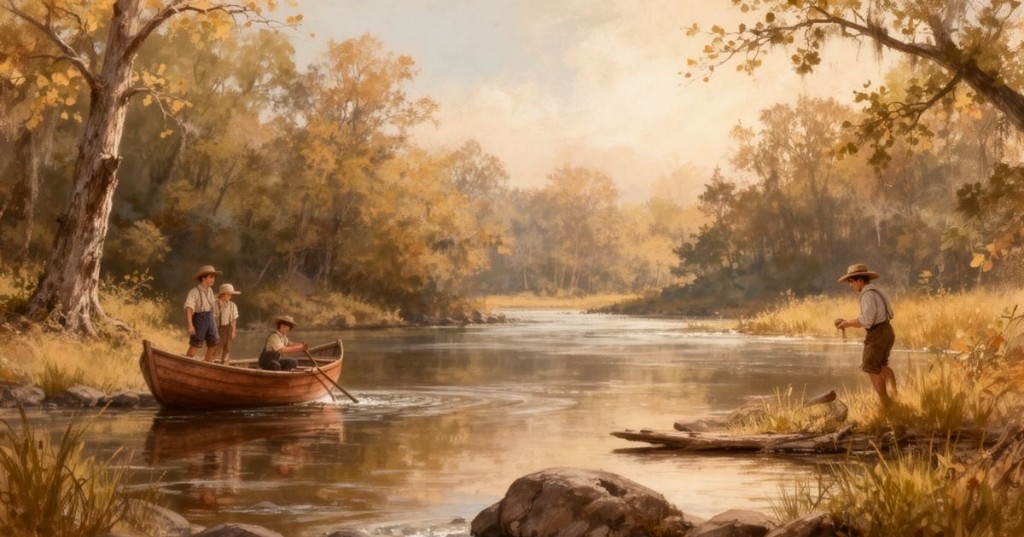
An excerpt from the original text.(complete · 3664 words)
own the river. We was down south in the warm weather now, and a mighty
long ways from home. We begun to come to trees with Spanish moss on
them, hanging down from the limbs like long, gray beards. It was the
first I ever see it growing, and it made the woods look solemn and
dismal. So now the frauds reckoned they was out of danger, and they
begun to work the villages again.
First they done a lecture on temperance; but they didn’t make enough
for them both to get drunk on. Then in another village they started a
dancing-school; but they didn’t know no more how to dance than a
kangaroo does; so the first prance they made the general public jumped
in and pranced them out of town. Another time they tried to go at
yellocution; but they didn’t yellocute long till the audience got up
and give them a solid good cussing, and made them skip out. They
tackled missionarying, and mesmerizing, and doctoring, and telling
fortunes, and a little of everything; but they couldn’t seem to have no
luck. So at last they got just about dead broke, and laid around the
raft as she floated along, thinking and thinking, and never saying
nothing, by the half a day at a time, and dreadful blue and desperate.
And at last they took a change and begun to lay their heads together in
the wigwam and talk low and confidential two or three hours at a time.
Jim and me got uneasy. We didn’t like the look of it. We judged they
was studying up some kind of worse deviltry than ever. We turned it
over and over, and at last we made up our minds they was going to break
into somebody’s house or store, or was going into the counterfeit-money
business, or something. So then we was pretty scared, and made up an
agreement that we wouldn’t have nothing in the world to do with such
actions, and if we ever got the least show we would give them the cold
shake and clear out and leave them behind. Well, early one morning we
hid the raft in a good, safe place about two mile below a little bit of
a shabby village named Pikesville, and the king he went ashore and told
us all to stay hid whilst he went up to town and smelt around to see if
anybody had got any wind of the Royal Nonesuch there yet. (“House to
rob, you mean,” says I to myself; “and when you get through robbing
it you’ll come back here and wonder what has become of me and Jim and
the raft—and you’ll have to take it out in wondering.”) And he said if
he warn’t back by midday the duke and me would know it was all right,
and we was to come along.
So we stayed where we was. The duke he fretted and sweated around, and
was in a mighty sour way. He scolded us for everything, and we couldn’t
seem to do nothing right; he found fault with every little thing.
Something was a-brewing, sure. I was good and glad when midday come and
no king; we could have a change, anyway—and maybe a chance for the
change on top of it. So me and the duke went up to the village, and
hunted around there for the king, and by-and-by we found him in the
back room of a little low doggery, very tight, and a lot of loafers
bullyragging him for sport, and he a-cussing and a-threatening with all
his might, and so tight he couldn’t walk, and couldn’t do nothing to
them. The duke he begun to abuse him for an old fool, and the king
begun to sass back, and the minute they was fairly at it I lit out and
shook the reefs out of my hind legs, and spun down the river road like
a deer, for I see our chance; and I made up my mind that it would be a
long day before they ever see me and Jim again. I got down there all
out of breath but loaded up with joy, and sung out:
“Set her loose, Jim! we’re all right now!”
But there warn’t no answer, and nobody come out of the wigwam. Jim was
gone! I set up a shout—and then another—and then another one; and run
this way and that in the woods, whooping and screeching; but it warn’t
no use—old Jim was gone. Then I set down and cried; I couldn’t help it.
But I couldn’t set still long. Pretty soon I went out on the road,
trying to think what I better do, and I run across a boy walking, and
asked him if he’d seen a strange nigger dressed so and so, and he says:
“Yes.”
“Whereabouts?” says I.
“Down to Silas Phelps’ place, two mile below here. He’s a runaway
nigger, and they’ve got him. Was you looking for him?”
“You bet I ain’t! I run across him in the woods about an hour or two
ago, and he said if I hollered he’d cut my livers out—and told me to
lay down and stay where I was; and I done it. Been there ever since;
afeard to come out.”
“Well,” he says, “you needn’t be afeard no more, becuz they’ve got him.
He run off f’m down South, som’ers.”
“It’s a good job they got him.”
“Well, I reckon! There’s two hunderd dollars reward on him. It’s like
picking up money out’n the road.”
“Yes, it is—and I could a had it if I’d been big enough; I see him
first. Who nailed him?”
“It was an old fellow—a stranger—and he sold out his chance in him for
forty dollars, becuz he’s got to go up the river and can’t wait. Think
o’ that, now! You bet I’d wait, if it was seven year.”
“That’s me, every time,” says I. “But maybe his chance ain’t worth no
more than that, if he’ll sell it so cheap. Maybe there’s something
ain’t straight about it.”
“But it is, though—straight as a string. I see the handbill myself.
It tells all about him, to a dot—paints him like a picture, and tells
the plantation he’s frum, below Newrleans. No-sirree-bob, they
ain’t no trouble ’bout that speculation, you bet you. Say, gimme a
chaw tobacker, won’t ye?”
I didn’t have none, so he left. I went to the raft, and set down in the
wigwam to think. But I couldn’t come to nothing. I thought till I wore
my head sore, but I couldn’t see no way out of the trouble. After all
this long journey, and after all we’d done for them scoundrels, here it
was all come to nothing, everything all busted up and ruined, because
they could have the heart to serve Jim such a trick as that, and make
him a slave again all his life, and amongst strangers, too, for forty
dirty dollars.
Once I said to myself it would be a thousand times better for Jim to be
a slave at home where his family was, as long as he’d got to be a
slave, and so I’d better write a letter to Tom Sawyer and tell him to
tell Miss Watson where he was. But I soon give up that notion for two
things: she’d be mad and disgusted at his rascality and ungratefulness
for leaving her, and so she’d sell him straight down the river again;
and if she didn’t, everybody naturally despises an ungrateful nigger,
and they’d make Jim feel it all the time, and so he’d feel ornery and
disgraced. And then think of me! It would get all around that Huck
Finn helped a nigger to get his freedom; and if I was ever to see
anybody from that town again I’d be ready to get down and lick his
boots for shame. That’s just the way: a person does a low-down thing,
and then he don’t want to take no consequences of it. Thinks as long as
he can hide it, it ain’t no disgrace. That was my fix exactly. The more
I studied about this, the more my conscience went to grinding me, and
the more wicked and low-down and ornery I got to feeling. And at last,
when it hit me all of a sudden that here was the plain hand of
Providence slapping me in the face and letting me know my wickedness
was being watched all the time from up there in heaven, whilst I was
stealing a poor old woman’s nigger that hadn’t ever done me no harm,
and now was showing me there’s One that’s always on the lookout, and
ain’t a-going to allow no such miserable doings to go only just so fur
and no further, I most dropped in my tracks I was so scared. Well, I
tried the best I could to kinder soften it up somehow for myself by
saying I was brung up wicked, and so I warn’t so much to blame; but
something inside of me kept saying, “There was the Sunday-school, you
could a gone to it; and if you’d a done it they’d a learnt you there
that people that acts as I’d been acting about that nigger goes to
everlasting fire.”
It made me shiver. And I about made up my mind to pray, and see if I
couldn’t try to quit being the kind of a boy I was and be better. So I
kneeled down. But the words wouldn’t come. Why wouldn’t they? It warn’t
no use to try and hide it from Him. Nor from me, neither. I knowed
very well why they wouldn’t come. It was because my heart warn’t right;
it was because I warn’t square; it was because I was playing double. I
was letting on to give up sin, but away inside of me I was holding on
to the biggest one of all. I was trying to make my mouth say I would
do the right thing and the clean thing, and go and write to that
nigger’s owner and tell where he was; but deep down in me I knowed it
was a lie, and He knowed it. You can’t pray a lie—I found that out.
So I was full of trouble, full as I could be; and didn’t know what to
do. At last I had an idea; and I says, I’ll go and write the letter—and
then see if I can pray. Why, it was astonishing, the way I felt as
light as a feather right straight off, and my troubles all gone. So I
got a piece of paper and a pencil, all glad and excited, and set down
and wrote:
Miss Watson, your runaway nigger Jim is down here two mile below
Pikesville, and Mr. Phelps has got him and he will give him up for the
reward if you send.
Huck Finn.
I felt good and all washed clean of sin for the first time I had ever
felt so in my life, and I knowed I could pray now. But I didn’t do it
straight off, but laid the paper down and set there thinking—thinking
how good it was all this happened so, and how near I come to being lost
and going to hell. And went on thinking. And got to thinking over our
trip down the river; and I see Jim before me all the time: in the day
and in the night-time, sometimes moonlight, sometimes storms, and we
a-floating along, talking and singing and laughing. But somehow I
couldn’t seem to strike no places to harden me against him, but only
the other kind. I’d see him standing my watch on top of his’n, ’stead
of calling me, so I could go on sleeping; and see him how glad he was
when I come back out of the fog; and when I come to him again in the
swamp, up there where the feud was; and such-like times; and would
always call me honey, and pet me and do everything he could think of
for me, and how good he always was; and at last I struck the time I
saved him by telling the men we had small-pox aboard, and he was so
grateful, and said I was the best friend old Jim ever had in the world,
and the only one he’s got now; and then I happened to look around and
see that paper.
It was a close place. I took it up, and held it in my hand. I was
a-trembling, because I’d got to decide, forever, betwixt two things,
and I knowed it. I studied a minute, sort of holding my breath, and
then says to myself:
“All right, then, I’ll go to hell”—and tore it up.
It was awful thoughts and awful words, but they was said. And I let
them stay said; and never thought no more about reforming. I shoved the
whole thing out of my head, and said I would take up wickedness again,
which was in my line, being brung up to it, and the other warn’t. And
for a starter I would go to work and steal Jim out of slavery again;
and if I could think up anything worse, I would do that, too; because
as long as I was in, and in for good, I might as well go the whole hog.
Then I set to thinking over how to get at it, and turned over some
considerable many ways in my mind; and at last fixed up a plan that
suited me. So then I took the bearings of a woody island that was down
the river a piece, and as soon as it was fairly dark I crept out with
my raft and went for it, and hid it there, and then turned in. I slept
the night through, and got up before it was light, and had my
breakfast, and put on my store clothes, and tied up some others and one
thing or another in a bundle, and took the canoe and cleared for shore.
I landed below where I judged was Phelps’s place, and hid my bundle in
the woods, and then filled up the canoe with water, and loaded rocks
into her and sunk her where I could find her again when I wanted her,
about a quarter of a mile below a little steam sawmill that was on the
bank.
Then I struck up the road, and when I passed the mill I see a sign on
it, “Phelps’s Sawmill,” and when I come to the farm-houses, two or
three hundred yards further along, I kept my eyes peeled, but didn’t
see nobody around, though it was good daylight now. But I didn’t mind,
because I didn’t want to see nobody just yet—I only wanted to get the
lay of the land. According to my plan, I was going to turn up there
from the village, not from below. So I just took a look, and shoved
along, straight for town. Well, the very first man I see when I got
there was the duke. He was sticking up a bill for the Royal
Nonesuch—three-night performance—like that other time. They had the
cheek, them frauds! I was right on him before I could shirk. He looked
astonished, and says:
“Hel-lo! Where’d you come from?” Then he says, kind of glad and
eager, “Where’s the raft?—got her in a good place?”
I says:
“Why, that’s just what I was going to ask your grace.”
Then he didn’t look so joyful, and says:
“What was your idea for asking me?” he says.
“Well,” I says, “when I see the king in that doggery yesterday I says
to myself, we can’t get him home for hours, till he’s soberer; so I
went a-loafing around town to put in the time and wait. A man up and
offered me ten cents to help him pull a skiff over the river and back
to fetch a sheep, and so I went along; but when we was dragging him to
the boat, and the man left me a-holt of the rope and went behind him to
shove him along, he was too strong for me and jerked loose and run, and
we after him. We didn’t have no dog, and so we had to chase him all
over the country till we tired him out. We never got him till dark;
then we fetched him over, and I started down for the raft. When I got
there and see it was gone, I says to myself, ‘they’ve got into trouble
and had to leave; and they’ve took my nigger, which is the only nigger
I’ve got in the world, and now I’m in a strange country, and ain’t got
no property no more, nor nothing, and no way to make my living;’ so I
set down and cried. I slept in the woods all night. But what did
become of the raft, then?—and Jim—poor Jim!”
“Blamed if I know—that is, what’s become of the raft. That old fool
had made a trade and got forty dollars, and when we found him in the
doggery the loafers had matched half-dollars with him and got every
cent but what he’d spent for whisky; and when I got him home late last
night and found the raft gone, we said, ‘That little rascal has stole
our raft and shook us, and run off down the river.’”
“I wouldn’t shake my nigger, would I?—the only nigger I had in the
world, and the only property.”
“We never thought of that. Fact is, I reckon we’d come to consider him
our nigger; yes, we did consider him so—goodness knows we had trouble
enough for him. So when we see the raft was gone and we flat broke,
there warn’t anything for it but to try the Royal Nonesuch another
shake. And I’ve pegged along ever since, dry as a powder-horn. Where’s
that ten cents? Give it here.”
I had considerable money, so I give him ten cents, but begged him to
spend it for something to eat, and give me some, because it was all the
money I had, and I hadn’t had nothing to eat since yesterday. He never
said nothing. The next minute he whirls on me and says:
“Do you reckon that nigger would blow on us? We’d skin him if he done
that!”
“How can he blow? Hain’t he run off?”
“No! That old fool sold him, and never divided with me, and the money’s
gone.”
“Sold him?” I says, and begun to cry; “why, he was my nigger, and
that was my money. Where is he?—I want my nigger.”
“Well, you can’t get your nigger, that’s all—so dry up your
blubbering. Looky here—do you think you’d venture to blow on us?
Blamed if I think I’d trust you. Why, if you was to blow on us—”
He stopped, but I never see the duke look so ugly out of his eyes
before. I went on a-whimpering, and says:
“I don’t want to blow on nobody; and I ain’t got no time to blow,
nohow. I got to turn out and find my nigger.”
He looked kinder bothered, and stood there with his bills fluttering on
his arm, thinking, and wrinkling up his forehead. At last he says:
“I’ll tell you something. We got to be here three days. If you’ll
promise you won’t blow, and won’t let the nigger blow, I’ll tell you
where to find him.”
So I promised, and he says:
“A farmer by the name of Silas Ph—” and then he stopped. You see, he
started to tell me the truth; but when he stopped that way, and begun
to study and think again, I reckoned he was changing his mind. And so
he was. He wouldn’t trust me; he wanted to make sure of having me out
of the way the whole three days. So pretty soon he says:
“The man that bought him is named Abram Foster—Abram G. Foster—and he
lives forty mile back here in the country, on the road to Lafayette.”
“All right,” I says, “I can walk it in three days. And I’ll start this
very afternoon.”
“No you wont, you’ll start now; and don’t you lose any time about it,
neither, nor do any gabbling by the way. Just keep a tight tongue in
your head and move right along, and then you won’t get into trouble
with us, d’ye hear?”
That was the order I wanted, and that was the one I played for. I
wanted to be left free to work my plans.
“So clear out,” he says; “and you can tell Mr. Foster whatever you want
to. Maybe you can get him to believe that Jim is your nigger—some
idiots don’t require documents—leastways I’ve heard there’s such down
South here. And when you tell him the handbill and the reward’s bogus,
maybe he’ll believe you when you explain to him what the idea was for
getting ’em out. Go ’long now, and tell him anything you want to; but
mind you don’t work your jaw any between here and there.”
So I left, and struck for the back country. I didn’t look around, but I
kinder felt like he was watching me. But I knowed I could tire him out
at that. I went straight out in the country as much as a mile before I
stopped; then I doubled back through the woods towards Phelps’. I
reckoned I better start in on my plan straight off without fooling
around, because I wanted to stop Jim’s mouth till these fellows could
get away. I didn’t want no trouble with their kind. I’d seen all I
wanted to of them, and wanted to get entirely shut of them.
Master this chapter. Complete your experience
Purchase the complete book to access all chapters and support classic literature
As an Amazon Associate, we earn a small commission from qualifying purchases at no additional cost to you.
Available in paperback, hardcover, and e-book formats
Let's Analyse the Pattern
The process where direct human experience gradually overrides programmed social beliefs, culminating in a choice between conformity and authentic conscience.
Why This Matters
Connect literature to life
This chapter teaches how to identify moments when you're being asked to compromise your integrity for institutional approval.
Practice This Today
This week, notice when someone asks you to agree with something that contradicts your direct experience - practice saying 'I need to think about that' instead of automatic compliance.
Now let's explore the literary elements.
Key Quotes & Analysis
"All right, then, I'll go to hell!"
Context: After tearing up the letter to Miss Watson and deciding to rescue Jim
This is one of literature's most powerful moments of moral courage. Huck genuinely believes he's damning his soul but chooses friendship anyway. It shows how he's learned to trust his heart over society's teachings.
In Today's Words:
Fine, I'll do what's right even if everyone says I'm wrong and it ruins me
"It was a close place. I took it up, and held it in my hand. I was a-trembling, because I'd got to decide, forever, betwixt two things, and I knowed it."
Context: Holding the letter that would turn Jim in, knowing this moment will define who he really is
Shows the weight of moral decisions and how Huck understands this choice will shape his entire life. The trembling shows his fear but also his awareness of the moment's importance.
In Today's Words:
This was it - the moment that would show what kind of person I really am, and I was scared to death
"I'd see him standing my watch on top of his'n, 'stead of calling me, so I could go on sleeping."
Context: Remembering Jim's kindness while deciding whether to turn him in
This memory of Jim's selfless care helps Huck see past society's lies about Jim being less than human. It shows how genuine kindness can overcome prejudice.
In Today's Words:
He'd stay up extra so I could sleep - that's the kind of person he really was
Thematic Threads
Moral Courage
In This Chapter
Huck chooses to help Jim despite believing he'll go to hell for it
Development
Evolved from earlier moral confusion to decisive action based on relationship
In Your Life:
You might face this when standing up for a coworker everyone else dismisses or defending an unpopular patient.
Social Programming
In This Chapter
Huck's internal struggle between taught racism and experienced friendship
Development
Consistent thread showing how society's lessons conflict with human reality
In Your Life:
You might recognize this when questioning workplace practices that seem normal but feel wrong.
Authentic Relationships
In This Chapter
Jim's genuine care and friendship becomes the evidence that changes Huck's mind
Development
Built throughout the journey as Huck sees Jim's full humanity
In Your Life:
You might experience this when a real relationship challenges your assumptions about a whole group of people.
Personal Growth
In This Chapter
Huck learns to think for himself rather than accept what he's been taught
Development
Culmination of his journey from passive acceptance to active moral choice
In Your Life:
You might face this when your life experience starts contradicting what your family or community always said was true.
Class
In This Chapter
The Duke and King's betrayal shows how money corrupts human decency
Development
Ongoing theme of how economic desperation drives moral compromise
In Your Life:
You might see this when financial pressure makes people you trusted act against their stated values.
You now have the context. Time to form your own thoughts.
Discussion Questions
- 1
What choice does Huck face when he discovers Jim has been sold, and what does society expect him to do?
analysis • surface - 2
Why does Huck's memory of Jim's kindness and loyalty matter more than what he was taught about slavery?
analysis • medium - 3
Where do you see people today choosing personal relationships over social expectations, even when it costs them?
application • medium - 4
How would you prepare yourself to make the right choice when your heart conflicts with what you've been taught?
application • deep - 5
What does Huck's decision reveal about how real relationships can change our deepest beliefs?
reflection • deep
Critical Thinking Exercise
Map Your Moral Awakening Moments
Think of a time when your direct experience with someone challenged what you'd been taught about their group, background, or situation. Write down what you believed before, what specific interactions changed your mind, and how that shift affected your actions. This could be about anything - class, culture, age, profession, lifestyle, or beliefs.
Consider:
- •Focus on specific moments or conversations that shifted your perspective
- •Notice how gradual this process usually is - rarely one dramatic moment
- •Consider what made you open to changing your mind versus defending old beliefs
Journaling Prompt
Write about a belief you inherited from family or society that you've questioned as an adult. What evidence from your own life made you reconsider it, and how do you handle the tension between old programming and new understanding?
Coming Up Next...
Chapter 32
With his mind made up to rescue Jim, Huck heads to the Phelps farm where his friend is being held prisoner. But when he arrives, he's mistaken for someone else entirely - a case of mistaken identity that might just give him the perfect cover for his rescue mission.



