
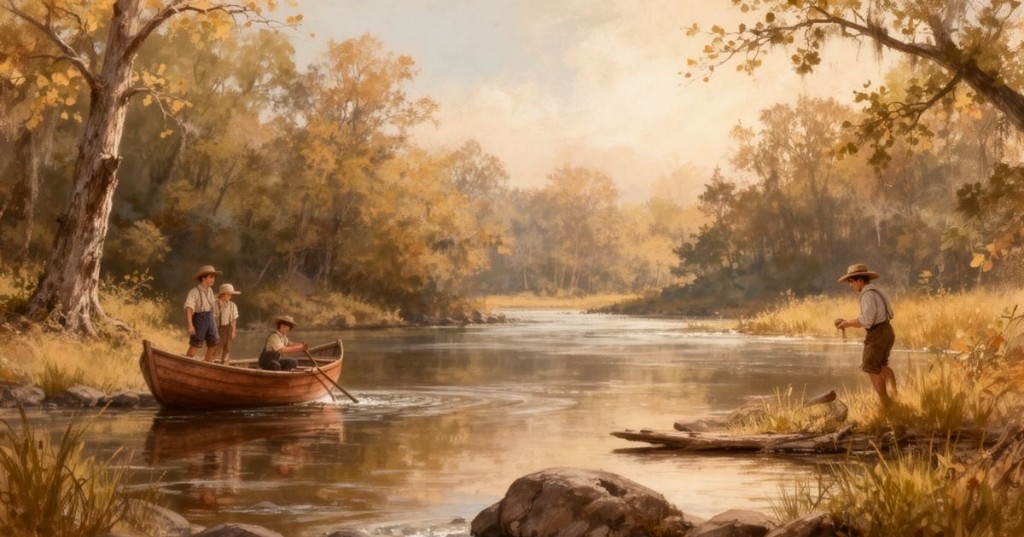
An excerpt from the original text.(complete · 4723 words)
nd so was his family. He was well born, as the saying is, and that’s
worth as much in a man as it is in a horse, so the Widow Douglas said,
and nobody ever denied that she was of the first aristocracy in our
town; and pap he always said it, too, though he warn’t no more quality
than a mudcat himself. Col. Grangerford was very tall and very slim,
and had a darkish-paly complexion, not a sign of red in it anywheres;
he was clean shaved every morning all over his thin face, and he had
the thinnest kind of lips, and the thinnest kind of nostrils, and a
high nose, and heavy eyebrows, and the blackest kind of eyes, sunk so
deep back that they seemed like they was looking out of caverns at you,
as you may say. His forehead was high, and his hair was black and
straight and hung to his shoulders. His hands was long and thin, and
every day of his life he put on a clean shirt and a full suit from head
to foot made out of linen so white it hurt your eyes to look at it; and
on Sundays he wore a blue tail-coat with brass buttons on it. He
carried a mahogany cane with a silver head to it. There warn’t no
frivolishness about him, not a bit, and he warn’t ever loud. He was as
kind as he could be—you could feel that, you know, and so you had
confidence. Sometimes he smiled, and it was good to see; but when he
straightened himself up like a liberty-pole, and the lightning begun to
flicker out from under his eyebrows, you wanted to climb a tree first,
and find out what the matter was afterwards. He didn’t ever have to
tell anybody to mind their manners—everybody was always good-mannered
where he was. Everybody loved to have him around, too; he was sunshine
most always—I mean he made it seem like good weather. When he turned
into a cloudbank it was awful dark for half a minute, and that was
enough; there wouldn’t nothing go wrong again for a week.
When him and the old lady come down in the morning all the family got
up out of their chairs and give them good-day, and didn’t set down
again till they had set down. Then Tom and Bob went to the sideboard
where the decanter was, and mixed a glass of bitters and handed it to
him, and he held it in his hand and waited till Tom’s and Bob’s was
mixed, and then they bowed and said, “Our duty to you, sir, and madam;”
and they bowed the least bit in the world and said thank you, and so
they drank, all three, and Bob and Tom poured a spoonful of water on
the sugar and the mite of whisky or apple brandy in the bottom of their
tumblers, and give it to me and Buck, and we drank to the old people
too.
Bob was the oldest and Tom next—tall, beautiful men with very broad
shoulders and brown faces, and long black hair and black eyes. They
dressed in white linen from head to foot, like the old gentleman, and
wore broad Panama hats.
Then there was Miss Charlotte; she was twenty-five, and tall and proud
and grand, but as good as she could be when she warn’t stirred up; but
when she was, she had a look that would make you wilt in your tracks,
like her father. She was beautiful.
So was her sister, Miss Sophia, but it was a different kind. She was
gentle and sweet like a dove, and she was only twenty.
Each person had their own nigger to wait on them—Buck too. My nigger
had a monstrous easy time, because I warn’t used to having anybody do
anything for me, but Buck’s was on the jump most of the time.
This was all there was of the family now, but there used to be
more—three sons; they got killed; and Emmeline that died.
The old gentleman owned a lot of farms and over a hundred niggers.
Sometimes a stack of people would come there, horseback, from ten or
fifteen mile around, and stay five or six days, and have such
junketings round about and on the river, and dances and picnics in the
woods daytimes, and balls at the house nights. These people was mostly
kinfolks of the family. The men brought their guns with them. It was a
handsome lot of quality, I tell you.
There was another clan of aristocracy around there—five or six
families—mostly of the name of Shepherdson. They was as high-toned and
well born and rich and grand as the tribe of Grangerfords. The
Shepherdsons and Grangerfords used the same steamboat landing, which
was about two mile above our house; so sometimes when I went up there
with a lot of our folks I used to see a lot of the Shepherdsons there
on their fine horses.
One day Buck and me was away out in the woods hunting, and heard a
horse coming. We was crossing the road. Buck says:
“Quick! Jump for the woods!”
We done it, and then peeped down the woods through the leaves. Pretty
soon a splendid young man come galloping down the road, setting his
horse easy and looking like a soldier. He had his gun across his
pommel. I had seen him before. It was young Harney Shepherdson. I heard
Buck’s gun go off at my ear, and Harney’s hat tumbled off from his
head. He grabbed his gun and rode straight to the place where we was
hid. But we didn’t wait. We started through the woods on a run. The
woods warn’t thick, so I looked over my shoulder to dodge the bullet,
and twice I seen Harney cover Buck with his gun; and then he rode away
the way he come—to get his hat, I reckon, but I couldn’t see. We never
stopped running till we got home. The old gentleman’s eyes blazed a
minute—’twas pleasure, mainly, I judged—then his face sort of smoothed
down, and he says, kind of gentle:
“I don’t like that shooting from behind a bush. Why didn’t you step
into the road, my boy?”
“The Shepherdsons don’t, father. They always take advantage.”
Miss Charlotte she held her head up like a queen while Buck was telling
his tale, and her nostrils spread and her eyes snapped. The two young
men looked dark, but never said nothing. Miss Sophia she turned pale,
but the color come back when she found the man warn’t hurt.
Soon as I could get Buck down by the corn-cribs under the trees by
ourselves, I says:
“Did you want to kill him, Buck?”
“Well, I bet I did.”
“What did he do to you?”
“Him? He never done nothing to me.”
“Well, then, what did you want to kill him for?”
“Why, nothing—only it’s on account of the feud.”
“What’s a feud?”
“Why, where was you raised? Don’t you know what a feud is?”
“Never heard of it before—tell me about it.”
“Well,” says Buck, “a feud is this way. A man has a quarrel with
another man, and kills him; then that other man’s brother kills him;
then the other brothers, on both sides, goes for one another; then the
cousins chip in—and by-and-by everybody’s killed off, and there ain’t
no more feud. But it’s kind of slow, and takes a long time.”
“Has this one been going on long, Buck?”
“Well, I should reckon! It started thirty year ago, or som’ers along
there. There was trouble ’bout something, and then a lawsuit to settle
it; and the suit went agin one of the men, and so he up and shot the
man that won the suit—which he would naturally do, of course. Anybody
would.”
“What was the trouble about, Buck?—land?”
“I reckon maybe—I don’t know.”
“Well, who done the shooting? Was it a Grangerford or a Shepherdson?”
“Laws, how do I know? It was so long ago.”
“Don’t anybody know?”
“Oh, yes, pa knows, I reckon, and some of the other old people; but
they don’t know now what the row was about in the first place.”
“Has there been many killed, Buck?”
“Yes; right smart chance of funerals. But they don’t always kill. Pa’s
got a few buckshot in him; but he don’t mind it ’cuz he don’t weigh
much, anyway. Bob’s been carved up some with a bowie, and Tom’s been
hurt once or twice.”
“Has anybody been killed this year, Buck?”
“Yes; we got one and they got one. ’Bout three months ago my cousin
Bud, fourteen year old, was riding through the woods on t’other side of
the river, and didn’t have no weapon with him, which was blame’
foolishness, and in a lonesome place he hears a horse a-coming behind
him, and sees old Baldy Shepherdson a-linkin’ after him with his gun in
his hand and his white hair a-flying in the wind; and ’stead of jumping
off and taking to the brush, Bud ’lowed he could out-run him; so they
had it, nip and tuck, for five mile or more, the old man a-gaining all
the time; so at last Bud seen it warn’t any use, so he stopped and
faced around so as to have the bullet holes in front, you know, and the
old man he rode up and shot him down. But he didn’t git much chance to
enjoy his luck, for inside of a week our folks laid him out.”
“I reckon that old man was a coward, Buck.”
“I reckon he warn’t a coward. Not by a blame’ sight. There ain’t a
coward amongst them Shepherdsons—not a one. And there ain’t no cowards
amongst the Grangerfords either. Why, that old man kep’ up his end in a
fight one day for half an hour against three Grangerfords, and come out
winner. They was all a-horseback; he lit off of his horse and got
behind a little woodpile, and kep’ his horse before him to stop the
bullets; but the Grangerfords stayed on their horses and capered around
the old man, and peppered away at him, and he peppered away at them.
Him and his horse both went home pretty leaky and crippled, but the
Grangerfords had to be fetched home—and one of ’em was dead, and
another died the next day. No, sir; if a body’s out hunting for cowards
he don’t want to fool away any time amongst them Shepherdsons, becuz
they don’t breed any of that kind.”
Next Sunday we all went to church, about three mile, everybody
a-horseback. The men took their guns along, so did Buck, and kept them
between their knees or stood them handy against the wall. The
Shepherdsons done the same. It was pretty ornery preaching—all about
brotherly love, and such-like tiresomeness; but everybody said it was a
good sermon, and they all talked it over going home, and had such a
powerful lot to say about faith and good works and free grace and
preforeordestination, and I don’t know what all, that it did seem to me
to be one of the roughest Sundays I had run across yet.
About an hour after dinner everybody was dozing around, some in their
chairs and some in their rooms, and it got to be pretty dull. Buck and
a dog was stretched out on the grass in the sun sound asleep. I went up
to our room, and judged I would take a nap myself. I found that sweet
Miss Sophia standing in her door, which was next to ours, and she took
me in her room and shut the door very soft, and asked me if I liked
her, and I said I did; and she asked me if I would do something for her
and not tell anybody, and I said I would. Then she said she’d forgot
her Testament, and left it in the seat at church between two other
books, and would I slip out quiet and go there and fetch it to her, and
not say nothing to nobody. I said I would. So I slid out and slipped
off up the road, and there warn’t anybody at the church, except maybe a
hog or two, for there warn’t any lock on the door, and hogs likes a
puncheon floor in summer-time because it’s cool. If you notice, most
folks don’t go to church only when they’ve got to; but a hog is
different.
Says I to myself, something’s up; it ain’t natural for a girl to be in
such a sweat about a Testament. So I give it a shake, and out drops a
little piece of paper with “Half-past two” wrote on it with a pencil.
I ransacked it, but couldn’t find anything else. I couldn’t make
anything out of that, so I put the paper in the book again, and when I
got home and upstairs there was Miss Sophia in her door waiting for me.
She pulled me in and shut the door; then she looked in the Testament
till she found the paper, and as soon as she read it she looked glad;
and before a body could think she grabbed me and give me a squeeze, and
said I was the best boy in the world, and not to tell anybody. She was
mighty red in the face for a minute, and her eyes lighted up, and it
made her powerful pretty. I was a good deal astonished, but when I got
my breath I asked her what the paper was about, and she asked me if I
had read it, and I said no, and she asked me if I could read writing,
and I told her “no, only coarse-hand,” and then she said the paper
warn’t anything but a book-mark to keep her place, and I might go and
play now.
I went off down to the river, studying over this thing, and pretty soon
I noticed that my nigger was following along behind. When we was out of
sight of the house he looked back and around a second, and then comes
a-running, and says:
“Mars Jawge, if you’ll come down into de swamp I’ll show you a whole
stack o’ water-moccasins.”
Thinks I, that’s mighty curious; he said that yesterday. He oughter
know a body don’t love water-moccasins enough to go around hunting for
them. What is he up to, anyway? So I says:
“All right; trot ahead.”
I followed a half a mile; then he struck out over the swamp, and waded
ankle deep as much as another half-mile. We come to a little flat piece
of land which was dry and very thick with trees and bushes and vines,
and he says:
“You shove right in dah jist a few steps, Mars Jawge; dah’s whah dey
is. I’s seed ’m befo’; I don’t k’yer to see ’em no mo’.”
Then he slopped right along and went away, and pretty soon the trees
hid him. I poked into the place a-ways and come to a little open patch
as big as a bedroom all hung around with vines, and found a man laying
there asleep—and, by jings, it was my old Jim!
I waked him up, and I reckoned it was going to be a grand surprise to
him to see me again, but it warn’t. He nearly cried he was so glad, but
he warn’t surprised. Said he swum along behind me that night, and heard
me yell every time, but dasn’t answer, because he didn’t want nobody to
pick him up and take him into slavery again. Says he:
“I got hurt a little, en couldn’t swim fas’, so I wuz a considable ways
behine you towards de las’; when you landed I reck’ned I could ketch up
wid you on de lan’ ’dout havin’ to shout at you, but when I see dat
house I begin to go slow. I ’uz off too fur to hear what dey say to
you—I wuz ’fraid o’ de dogs; but when it ’uz all quiet agin, I knowed
you’s in de house, so I struck out for de woods to wait for day. Early
in de mawnin’ some er de niggers come along, gwyne to de fields, en dey
tuk me en showed me dis place, whah de dogs can’t track me on accounts
o’ de water, en dey brings me truck to eat every night, en tells me how
you’s a-gitt’n along.”
“Why didn’t you tell my Jack to fetch me here sooner, Jim?”
“Well, ’twarn’t no use to ’sturb you, Huck, tell we could do sumfn—but
we’s all right now. I ben a-buyin’ pots en pans en vittles, as I got a
chanst, en a-patchin’ up de raf’ nights when—”
“What raft, Jim?”
“Our ole raf’.”
“You mean to say our old raft warn’t smashed all to flinders?”
“No, she warn’t. She was tore up a good deal—one en’ of her was; but
dey warn’t no great harm done, on’y our traps was mos’ all los’. Ef we
hadn’ dive’ so deep en swum so fur under water, en de night hadn’ ben
so dark, en we warn’t so sk’yerd, en ben sich punkin-heads, as de
sayin’ is, we’d a seed de raf’. But it’s jis’ as well we didn’t, ’kase
now she’s all fixed up agin mos’ as good as new, en we’s got a new lot
o’ stuff, in de place o’ what ’uz los’.”
“Why, how did you get hold of the raft again, Jim—did you catch her?”
“How I gwyne to ketch her en I out in de woods? No; some er de niggers
foun’ her ketched on a snag along heah in de ben’, en dey hid her in a
crick ’mongst de willows, en dey wuz so much jawin’ ’bout which un ’um
she b’long to de mos’ dat I come to heah ’bout it pooty soon, so I ups
en settles de trouble by tellin’ ’um she don’t b’long to none uv um,
but to you en me; en I ast ’m if dey gwyne to grab a young white
genlman’s propaty, en git a hid’n for it? Den I gin ’m ten cents
apiece, en dey ’uz mighty well satisfied, en wisht some mo’ raf’s ’ud
come along en make ’m rich agin. Dey’s mighty good to me, dese niggers
is, en whatever I wants ’m to do fur me, I doan’ have to ast ’m twice,
honey. Dat Jack’s a good nigger, en pooty smart.”
“Yes, he is. He ain’t ever told me you was here; told me to come, and
he’d show me a lot of water-moccasins. If anything happens he ain’t
mixed up in it. He can say he never seen us together, and it’ll be the
truth.”
I don’t want to talk much about the next day. I reckon I’ll cut it
pretty short. I waked up about dawn, and was a-going to turn over and
go to sleep again, when I noticed how still it was—didn’t seem to be
anybody stirring. That warn’t usual. Next I noticed that Buck was up
and gone. Well, I gets up, a-wondering, and goes down stairs—nobody
around; everything as still as a mouse. Just the same outside. Thinks
I, what does it mean? Down by the wood-pile I comes across my Jack, and
says:
“What’s it all about?”
Says he:
“Don’t you know, Mars Jawge?”
“No,” says I, “I don’t.”
“Well, den, Miss Sophia’s run off! ’deed she has. She run off in de
night some time—nobody don’t know jis’ when; run off to get married to
dat young Harney Shepherdson, you know—leastways, so dey ’spec. De
fambly foun’ it out ’bout half an hour ago—maybe a little mo’—en’ I
tell you dey warn’t no time los’. Sich another hurryin’ up guns en
hosses you never see! De women folks has gone for to stir up de
relations, en ole Mars Saul en de boys tuck dey guns en rode up de
river road for to try to ketch dat young man en kill him ’fo’ he kin
git acrost de river wid Miss Sophia. I reck’n dey’s gwyne to be mighty
rough times.”
“Buck went off ’thout waking me up.”
“Well, I reck’n he did! Dey warn’t gwyne to mix you up in it. Mars
Buck he loaded up his gun en ’lowed he’s gwyne to fetch home a
Shepherdson or bust. Well, dey’ll be plenty un ’m dah, I reck’n, en you
bet you he’ll fetch one ef he gits a chanst.”
I took up the river road as hard as I could put. By-and-by I begin to
hear guns a good ways off. When I come in sight of the log store and
the woodpile where the steamboats lands, I worked along under the trees
and brush till I got to a good place, and then I clumb up into the
forks of a cottonwood that was out of reach, and watched. There was a
wood-rank four foot high a little ways in front of the tree, and first
I was going to hide behind that; but maybe it was luckier I didn’t.
There was four or five men cavorting around on their horses in the open
place before the log store, cussing and yelling, and trying to get at a
couple of young chaps that was behind the wood-rank alongside of the
steamboat landing; but they couldn’t come it. Every time one of them
showed himself on the river side of the woodpile he got shot at. The
two boys was squatting back to back behind the pile, so they could
watch both ways.
By-and-by the men stopped cavorting around and yelling. They started
riding towards the store; then up gets one of the boys, draws a steady
bead over the wood-rank, and drops one of them out of his saddle. All
the men jumped off of their horses and grabbed the hurt one and started
to carry him to the store; and that minute the two boys started on the
run. They got half way to the tree I was in before the men noticed.
Then the men see them, and jumped on their horses and took out after
them. They gained on the boys, but it didn’t do no good, the boys had
too good a start; they got to the woodpile that was in front of my
tree, and slipped in behind it, and so they had the bulge on the men
again. One of the boys was Buck, and the other was a slim young chap
about nineteen years old.
The men ripped around awhile, and then rode away. As soon as they was
out of sight I sung out to Buck and told him. He didn’t know what to
make of my voice coming out of the tree at first. He was awful
surprised. He told me to watch out sharp and let him know when the men
come in sight again; said they was up to some devilment or
other—wouldn’t be gone long. I wished I was out of that tree, but I
dasn’t come down. Buck begun to cry and rip, and ’lowed that him and
his cousin Joe (that was the other young chap) would make up for this
day yet. He said his father and his two brothers was killed, and two or
three of the enemy. Said the Shepherdsons laid for them in ambush. Buck
said his father and brothers ought to waited for their relations—the
Shepherdsons was too strong for them. I asked him what was become of
young Harney and Miss Sophia. He said they’d got across the river and
was safe. I was glad of that; but the way Buck did take on because he
didn’t manage to kill Harney that day he shot at him—I hain’t ever
heard anything like it.
All of a sudden, bang! bang! bang! goes three or four guns—the men had
slipped around through the woods and come in from behind without their
horses! The boys jumped for the river—both of them hurt—and as they
swum down the current the men run along the bank shooting at them and
singing out, “Kill them, kill them!” It made me so sick I most fell out
of the tree. I ain’t a-going to tell all that happened—it would make
me sick again if I was to do that. I wished I hadn’t ever come ashore
that night to see such things. I ain’t ever going to get shut of
them—lots of times I dream about them.
I stayed in the tree till it begun to get dark, afraid to come down.
Sometimes I heard guns away off in the woods; and twice I seen little
gangs of men gallop past the log store with guns; so I reckoned the
trouble was still a-going on. I was mighty downhearted; so I made up my
mind I wouldn’t ever go anear that house again, because I reckoned I
was to blame, somehow. I judged that that piece of paper meant that
Miss Sophia was to meet Harney somewheres at half-past two and run off;
and I judged I ought to told her father about that paper and the
curious way she acted, and then maybe he would a locked her up, and
this awful mess wouldn’t ever happened.
When I got down out of the tree, I crept along down the river bank a
piece, and found the two bodies laying in the edge of the water, and
tugged at them till I got them ashore; then I covered up their faces,
and got away as quick as I could. I cried a little when I was covering
up Buck’s face, for he was mighty good to me.
It was just dark now. I never went near the house, but struck through
the woods and made for the swamp. Jim warn’t on his island, so I
tramped off in a hurry for the crick, and crowded through the willows,
red-hot to jump aboard and get out of that awful country. The raft was
gone! My souls, but I was scared! I couldn’t get my breath for most a
minute. Then I raised a yell. A voice not twenty-five foot from me
says:
“Good lan’! is dat you, honey? Doan’ make no noise.”
It was Jim’s voice—nothing ever sounded so good before. I run along the
bank a piece and got aboard, and Jim he grabbed me and hugged me, he
was so glad to see me. He says:
“Laws bless you, chile, I ’uz right down sho’ you’s dead agin. Jack’s
been heah; he say he reck’n you’s ben shot, kase you didn’ come home no
mo’; so I’s jes’ dis minute a startin’ de raf’ down towards de mouf er
de crick, so’s to be all ready for to shove out en leave soon as Jack
comes agin en tells me for certain you is dead. Lawsy, I’s mighty
glad to git you back agin, honey.”
I says:
“All right—that’s mighty good; they won’t find me, and they’ll think
I’ve been killed, and floated down the river—there’s something up there
that’ll help them think so—so don’t you lose no time, Jim, but just
shove off for the big water as fast as ever you can.”
I never felt easy till the raft was two mile below there and out in the
middle of the Mississippi. Then we hung up our signal lantern, and
judged that we was free and safe once more. I hadn’t had a bite to eat
since yesterday, so Jim he got out some corn-dodgers and buttermilk,
and pork and cabbage and greens—there ain’t nothing in the world so
good when it’s cooked right—and whilst I eat my supper we talked, and
had a good time. I was powerful glad to get away from the feuds, and so
was Jim to get away from the swamp. We said there warn’t no home like a
raft, after all. Other places do seem so cramped up and smothery, but a
raft don’t. You feel mighty free and easy and comfortable on a raft.
Master this chapter. Complete your experience
Purchase the complete book to access all chapters and support classic literature
As an Amazon Associate, we earn a small commission from qualifying purchases at no additional cost to you.
Available in paperback, hardcover, and e-book formats
Let's Analyse the Pattern
The Road of Inherited Hatred - How We Carry Wars We Didn't Start
Why This Matters
Connect literature to life
This chapter teaches how to spot when you're being recruited into someone else's old fight that no longer serves any real purpose.
Practice This Today
This week, notice when people expect you to dislike someone just because they do - ask yourself if you actually have a problem with that person or if you're just carrying inherited beef.
Now let's explore the literary elements.
Key Quotes & Analysis
"Well, then, what did you want to kill him for?... Why, nothing--only it's on account of the feud."
Context: Buck explains to Huck why he wants to shoot a Shepherdson
This quote captures the absurdity of inherited hatred. Buck admits there's no personal reason for violence--he just follows family tradition. It shows how people can be programmed to hate without understanding why, revealing the mindless nature of cycles of revenge.
In Today's Words:
I don't have any real reason to hurt him, that's just what our families do to each other.
"It was a mighty nice family, and a mighty nice house, too."
Context: Huck describes the Grangerfords despite witnessing their violence
This shows Huck's confusion about how people can be kind to him personally while being murderous to others. It highlights the human capacity to compartmentalize--being genuinely good in some relationships while being terrible in others.
In Today's Words:
They were really good people to me, even though they were capable of horrible things.
"I ain't a-going to tell all that happened--it would make me sick again if I was to do that."
Context: Huck refuses to describe the massacre in detail
This shows how trauma affects even someone as resilient as Huck. The violence is so senseless and brutal that he can't bear to relive it. It emphasizes that some experiences are too painful to fully process or share.
In Today's Words:
I can't talk about what I saw--it still makes me feel sick to think about it.
Thematic Threads
Class
In This Chapter
The Grangerfords' wealth and refinement mask their savage behavior—fine clothes and good manners hiding murderous hatred
Development
Builds on earlier class critiques, showing how upper-class 'civilization' can be more brutal than lower-class honesty
In Your Life:
You might see this in how respectable institutions or polished professionals can treat people worse than obviously rough characters
Identity
In This Chapter
Buck defines himself entirely as 'a Grangerford' rather than as Buck—family identity overrides individual judgment
Development
Continues Huck's journey of choosing personal values over inherited roles and expectations
In Your Life:
You might recognize when you're acting out family patterns or group loyalties instead of thinking for yourself
Social Expectations
In This Chapter
Both families follow elaborate codes of honor and hospitality while planning to murder each other
Development
Deepens the theme of civilized society's hypocritical rules and deadly contradictions
In Your Life:
You might notice how social politeness can mask genuine hostility or competition in your workplace or community
Personal Growth
In This Chapter
Huck's horror at the senseless violence strengthens his rejection of 'sivilized' society's values
Development
Major step in Huck's moral development—he's actively choosing his own ethical framework over society's
In Your Life:
You might find moments where witnessing others' behavior clarifies what you don't want to become
Human Relationships
In This Chapter
Love (Sophia and Harney's elopement) triggers the deadliest violence, showing how personal bonds threaten group identity
Development
Explores how individual relationships can challenge inherited group loyalties
In Your Life:
You might face situations where caring about someone puts you at odds with family or group expectations
You now have the context. Time to form your own thoughts.
Discussion Questions
- 1
What keeps the Grangerford-Shepherdson feud going when nobody can remember how it started?
analysis • surface - 2
Why do you think both families can sit together in church hearing about love while planning to kill each other?
analysis • medium - 3
Where have you seen people continuing conflicts or rivalries without really knowing why they started?
application • medium - 4
If you were Huck watching this feud destroy young people like Buck, how would you try to break the cycle?
application • deep - 5
What does this chapter suggest about the difference between being civilized and being truly decent?
reflection • deep
Critical Thinking Exercise
Map Your Inherited Conflicts
Think about conflicts in your life that you might have inherited rather than chosen. List any ongoing tensions in your family, workplace, or community where people take sides automatically. For each one, try to identify: who benefits from keeping this conflict alive, what would happen if you simply stopped participating, and whether the original cause still matters to your actual life.
Consider:
- •Some conflicts serve other people's interests more than yours
- •Stepping out of inherited fights often reveals how pointless they were
- •The people most invested in continuing feuds are usually those who gain power from the division
Journaling Prompt
Write about a time when you realized you were carrying someone else's anger or continuing a fight that wasn't really yours. What happened when you stopped participating?
Coming Up Next...
Chapter 19
Devastated by the senseless bloodshed he's witnessed, Huck escapes back to the river where he's reunited with Jim. But their joy at being together again is complicated by new challenges to their journey toward freedom.



