
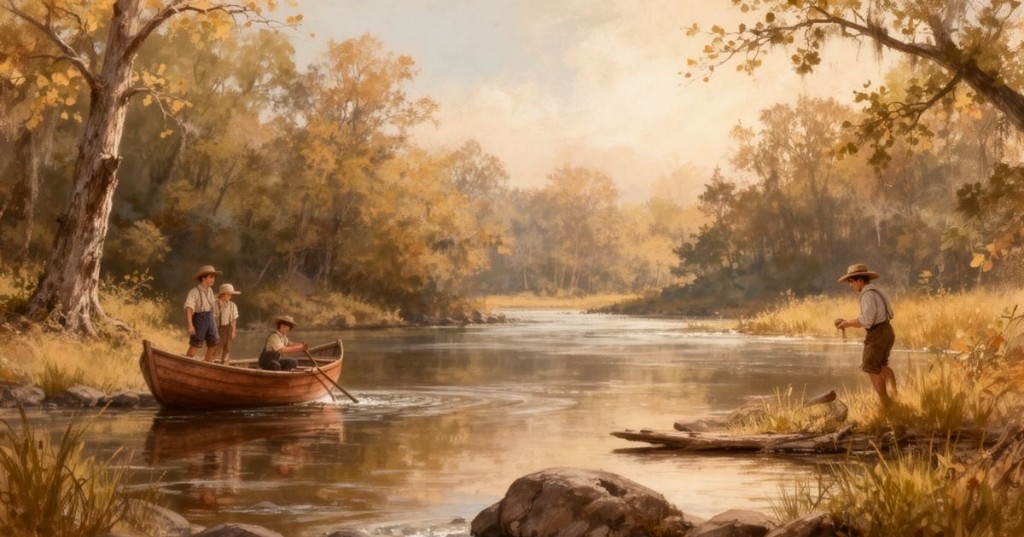
An excerpt from the original text.(complete · 2416 words)
f Illinois, where the Ohio River comes in, and that was what we was
after. We would sell the raft and get on a steamboat and go way up the
Ohio amongst the free States, and then be out of trouble.
Well, the second night a fog begun to come on, and we made for a
tow-head to tie to, for it wouldn’t do to try to run in a fog; but when
I paddled ahead in the canoe, with the line to make fast, there warn’t
anything but little saplings to tie to. I passed the line around one of
them right on the edge of the cut bank, but there was a stiff current,
and the raft come booming down so lively she tore it out by the roots
and away she went. I see the fog closing down, and it made me so sick
and scared I couldn’t budge for most a half a minute it seemed to
me—and then there warn’t no raft in sight; you couldn’t see twenty
yards. I jumped into the canoe and run back to the stern, and grabbed
the paddle and set her back a stroke. But she didn’t come. I was in
such a hurry I hadn’t untied her. I got up and tried to untie her, but
I was so excited my hands shook so I couldn’t hardly do anything with
them.
As soon as I got started I took out after the raft, hot and heavy,
right down the tow-head. That was all right as far as it went, but the
tow-head warn’t sixty yards long, and the minute I flew by the foot of
it I shot out into the solid white fog, and hadn’t no more idea which
way I was going than a dead man.
Thinks I, it won’t do to paddle; first I know I’ll run into the bank or
a tow-head or something; I got to set still and float, and yet it’s
mighty fidgety business to have to hold your hands still at such a
time. I whooped and listened. Away down there somewheres I hears a
small whoop, and up comes my spirits. I went tearing after it,
listening sharp to hear it again. The next time it come, I see I warn’t
heading for it, but heading away to the right of it. And the next time
I was heading away to the left of it—and not gaining on it much either,
for I was flying around, this way and that and t’other, but it was
going straight ahead all the time.
I did wish the fool would think to beat a tin pan, and beat it all the
time, but he never did, and it was the still places between the whoops
that was making the trouble for me. Well, I fought along, and directly
I hears the whoop behind me. I was tangled good now. That was
somebody else’s whoop, or else I was turned around.
I throwed the paddle down. I heard the whoop again; it was behind me
yet, but in a different place; it kept coming, and kept changing its
place, and I kept answering, till by-and-by it was in front of me
again, and I knowed the current had swung the canoe’s head down-stream,
and I was all right if that was Jim and not some other raftsman
hollering. I couldn’t tell nothing about voices in a fog, for nothing
don’t look natural nor sound natural in a fog.
The whooping went on, and in about a minute I come a-booming down on a
cut bank with smoky ghosts of big trees on it, and the current throwed
me off to the left and shot by, amongst a lot of snags that fairly
roared, the current was tearing by them so swift.
In another second or two it was solid white and still again. I set
perfectly still then, listening to my heart thump, and I reckon I
didn’t draw a breath while it thumped a hundred.
I just give up then. I knowed what the matter was. That cut bank was an
island, and Jim had gone down t’other side of it. It warn’t no tow-head
that you could float by in ten minutes. It had the big timber of a
regular island; it might be five or six miles long and more than half a
mile wide.
I kept quiet, with my ears cocked, about fifteen minutes, I reckon. I
was floating along, of course, four or five miles an hour; but you
don’t ever think of that. No, you feel like you are laying dead still
on the water; and if a little glimpse of a snag slips by you don’t
think to yourself how fast you’re going, but you catch your breath
and think, my! how that snag’s tearing along. If you think it ain’t
dismal and lonesome out in a fog that way by yourself in the night, you
try it once—you’ll see.
Next, for about a half an hour, I whoops now and then; at last I hears
the answer a long ways off, and tries to follow it, but I couldn’t do
it, and directly I judged I’d got into a nest of tow-heads, for I had
little dim glimpses of them on both sides of me—sometimes just a narrow
channel between, and some that I couldn’t see I knowed was there
because I’d hear the wash of the current against the old dead brush and
trash that hung over the banks. Well, I warn’t long loosing the whoops
down amongst the tow-heads; and I only tried to chase them a little
while, anyway, because it was worse than chasing a Jack-o’-lantern. You
never knowed a sound dodge around so, and swap places so quick and so
much.
I had to claw away from the bank pretty lively four or five times, to
keep from knocking the islands out of the river; and so I judged the
raft must be butting into the bank every now and then, or else it would
get further ahead and clear out of hearing—it was floating a little
faster than what I was.
Well, I seemed to be in the open river again by-and-by, but I couldn’t
hear no sign of a whoop nowheres. I reckoned Jim had fetched up on a
snag, maybe, and it was all up with him. I was good and tired, so I
laid down in the canoe and said I wouldn’t bother no more. I didn’t
want to go to sleep, of course; but I was so sleepy I couldn’t help it;
so I thought I would take jest one little cat-nap.
But I reckon it was more than a cat-nap, for when I waked up the stars
was shining bright, the fog was all gone, and I was spinning down a big
bend stern first. First I didn’t know where I was; I thought I was
dreaming; and when things began to come back to me they seemed to come
up dim out of last week.
It was a monstrous big river here, with the tallest and the thickest
kind of timber on both banks; just a solid wall, as well as I could see
by the stars. I looked away down-stream, and seen a black speck on the
water. I took after it; but when I got to it it warn’t nothing but a
couple of sawlogs made fast together. Then I see another speck, and
chased that; then another, and this time I was right. It was the raft.
When I got to it Jim was setting there with his head down between his
knees, asleep, with his right arm hanging over the steering-oar. The
other oar was smashed off, and the raft was littered up with leaves and
branches and dirt. So she’d had a rough time.
I made fast and laid down under Jim’s nose on the raft, and began to
gap, and stretch my fists out against Jim, and says:
“Hello, Jim, have I been asleep? Why didn’t you stir me up?”
“Goodness gracious, is dat you, Huck? En you ain’ dead—you ain’
drownded—you’s back agin? It’s too good for true, honey, it’s too good
for true. Lemme look at you chile, lemme feel o’ you. No, you ain’
dead! you’s back agin, ’live en soun’, jis de same ole Huck—de same ole
Huck, thanks to goodness!”
“What’s the matter with you, Jim? You been a-drinking?”
“Drinkin’? Has I ben a-drinkin’? Has I had a chance to be a-drinkin’?”
“Well, then, what makes you talk so wild?”
“How does I talk wild?”
“How? Why, hain’t you been talking about my coming back, and all that
stuff, as if I’d been gone away?”
“Huck—Huck Finn, you look me in de eye; look me in de eye. Hain’t you
ben gone away?”
“Gone away? Why, what in the nation do you mean? I hain’t been gone
anywheres. Where would I go to?”
“Well, looky here, boss, dey’s sumf’n wrong, dey is. Is I me, or who
is I? Is I heah, or whah is I? Now dat’s what I wants to know.”
“Well, I think you’re here, plain enough, but I think you’re a
tangle-headed old fool, Jim.”
“I is, is I? Well, you answer me dis: Didn’t you tote out de line in de
canoe fer to make fas’ to de tow-head?”
“No, I didn’t. What tow-head? I hain’t see no tow-head.”
“You hain’t seen no tow-head? Looky here, didn’t de line pull loose en
de raf’ go a-hummin’ down de river, en leave you en de canoe behine in
de fog?”
“What fog?”
“Why, de fog!—de fog dat’s been aroun’ all night. En didn’t you
whoop, en didn’t I whoop, tell we got mix’ up in de islands en one un
us got los’ en t’other one was jis’ as good as los’, ’kase he didn’
know whah he wuz? En didn’t I bust up agin a lot er dem islands en have
a turrible time en mos’ git drownded? Now ain’ dat so, boss—ain’t it
so? You answer me dat.”
“Well, this is too many for me, Jim. I hain’t seen no fog, nor no
islands, nor no troubles, nor nothing. I been setting here talking with
you all night till you went to sleep about ten minutes ago, and I
reckon I done the same. You couldn’t a got drunk in that time, so of
course you’ve been dreaming.”
“Dad fetch it, how is I gwyne to dream all dat in ten minutes?”
“Well, hang it all, you did dream it, because there didn’t any of it
happen.”
“But, Huck, it’s all jis’ as plain to me as—”
“It don’t make no difference how plain it is; there ain’t nothing in
it. I know, because I’ve been here all the time.”
Jim didn’t say nothing for about five minutes, but set there studying
over it. Then he says:
“Well, den, I reck’n I did dream it, Huck; but dog my cats ef it ain’t
de powerfullest dream I ever see. En I hain’t ever had no dream b’fo’
dat’s tired me like dis one.”
“Oh, well, that’s all right, because a dream does tire a body like
everything sometimes. But this one was a staving dream; tell me all
about it, Jim.”
So Jim went to work and told me the whole thing right through, just as
it happened, only he painted it up considerable. Then he said he must
start in and “’terpret” it, because it was sent for a warning. He said
the first tow-head stood for a man that would try to do us some good,
but the current was another man that would get us away from him. The
whoops was warnings that would come to us every now and then, and if we
didn’t try hard to make out to understand them they’d just take us into
bad luck, ’stead of keeping us out of it. The lot of tow-heads was
troubles we was going to get into with quarrelsome people and all kinds
of mean folks, but if we minded our business and didn’t talk back and
aggravate them, we would pull through and get out of the fog and into
the big clear river, which was the free States, and wouldn’t have no
more trouble.
It had clouded up pretty dark just after I got on to the raft, but it
was clearing up again now.
“Oh, well, that’s all interpreted well enough as far as it goes, Jim,”
I says; “but what does these things stand for?”
It was the leaves and rubbish on the raft and the smashed oar. You
could see them first-rate now.
Jim looked at the trash, and then looked at me, and back at the trash
again. He had got the dream fixed so strong in his head that he
couldn’t seem to shake it loose and get the facts back into its place
again right away. But when he did get the thing straightened around he
looked at me steady without ever smiling, and says:
“What do dey stan’ for? I’se gwyne to tell you. When I got all wore out
wid work, en wid de callin’ for you, en went to sleep, my heart wuz
mos’ broke bekase you wuz los’, en I didn’ k’yer no’ mo’ what become er
me en de raf’. En when I wake up en fine you back agin, all safe en
soun’, de tears come, en I could a got down on my knees en kiss yo’
foot, I’s so thankful. En all you wuz thinkin’ ’bout wuz how you could
make a fool uv ole Jim wid a lie. Dat truck dah is trash; en trash is
what people is dat puts dirt on de head er dey fren’s en makes ’em
ashamed.”
Then he got up slow and walked to the wigwam, and went in there without
saying anything but that. But that was enough. It made me feel so mean
I could almost kissed his foot to get him to take it back.
It was fifteen minutes before I could work myself up to go and humble
myself to a nigger; but I done it, and I warn’t ever sorry for it
afterwards, neither. I didn’t do him no more mean tricks, and I
wouldn’t done that one if I’d a knowed it would make him feel that way.
Master this chapter. Complete your experience
Purchase the complete book to access all chapters and support classic literature
As an Amazon Associate, we earn a small commission from qualifying purchases at no additional cost to you.
Available in paperback, hardcover, and e-book formats
Let's Analyse the Pattern
The instant when someone's authentic character breaks through our assumptions and forces us to see them as they truly are.
Why This Matters
Connect literature to life
This chapter teaches how people reveal their true selves under pressure, not through their words but through their genuine emotional responses.
Practice This Today
This week, notice when someone responds to stress with unexpected depth or dignity—that's often when you see who they really are.
Now let's explore the literary elements.
Key Quotes & Analysis
"What do dey stan' for? I'se gwyne to tell you. When I got all wore out wid work, en wid de callin' for you, en went to sleep, my heart wuz mos' broke bekase you wuz los', en I didn' k'yer no' mo' what become er me en de raf'."
Context: Jim explains how worried and heartbroken he was when they were separated
This shows Jim's deep emotional investment in their friendship and his genuine care for Huck. It reveals Jim as a complex person with real feelings, not the stereotype Huck was raised to see.
In Today's Words:
I was exhausted and heartbroken looking for you, and I didn't even care what happened to me because I thought I'd lost my friend.
"En when I wake up en fine you back agin, all safe en soun', de tears come, en I could a got down on my knees en kiss yo' foot, I's so thankful."
Context: Jim describes his joy and relief at finding Huck safe
Shows the depth of Jim's love and loyalty. His vulnerability here makes Huck's trick even crueler and helps explain why Huck feels so ashamed.
In Today's Words:
When I found you safe, I was so grateful I almost cried with relief.
"It was fifteen minutes before I could work myself up to go and humble myself to a nigger; but I done it, and I warn't ever sorry for it afterwards, neither."
Context: Huck struggles with apologizing to Jim because of his racist upbringing
Shows how hard it was for Huck to overcome his social conditioning, but also his moral growth. The racist language reflects the attitudes Huck is fighting against in himself.
In Today's Words:
It took me a while to swallow my pride and apologize, but I did it and never regretted it.
Thematic Threads
Recognition
In This Chapter
Huck finally sees Jim as a full human being with real feelings, not just property or a traveling companion
Development
Introduced here
In Your Life:
You might experience this when someone you've underestimated reveals unexpected depth or wisdom
Dignity
In This Chapter
Jim responds to Huck's cruel trick with quiet hurt rather than anger, showing his emotional maturity
Development
Building from earlier glimpses of Jim's humanity
In Your Life:
You might need to maintain your dignity when someone treats you as less than you are
Shame
In This Chapter
Huck feels genuine remorse for hurting Jim and actually apologizes to him
Development
First time Huck shows real moral growth regarding race
In Your Life:
You might feel this when you realize you've wronged someone you care about
Friendship
In This Chapter
The relationship shifts from convenience to genuine care as both recognize each other's humanity
Development
Evolving from practical partnership to real bond
In Your Life:
You might discover that real friendship requires seeing past surface differences
Moral Growth
In This Chapter
Huck crosses a huge social boundary by apologizing to a Black man in the 1840s
Development
Major breakthrough in Huck's character development
In Your Life:
You might face moments where doing right conflicts with what you were taught was normal
You now have the context. Time to form your own thoughts.
Discussion Questions
- 1
What exactly did Huck do to Jim when they reunited after getting lost in the fog, and how did Jim figure out he was being tricked?
analysis • surface - 2
Why do you think Huck's trick backfired so completely? What did he expect Jim's reaction to be versus what actually happened?
analysis • medium - 3
Think about a time when someone surprised you by showing more depth or dignity than you expected. What assumptions were you making about them beforehand?
application • medium - 4
If you were in Jim's position—hurt by a friend's cruel joke—how would you handle it? What would make you feel respected again?
application • deep - 5
What does Jim's response teach us about the difference between reacting with anger versus responding with dignity when someone hurts us?
reflection • deep
Critical Thinking Exercise
Rewrite the Reunion from Jim's Perspective
Write a short paragraph describing the reunion scene from Jim's point of view. Start from when he finds Huck asleep on the raft. Focus on what Jim is thinking and feeling as Huck tries to convince him the separation was just a dream, and especially when Jim realizes he's being tricked.
Consider:
- •How would Jim feel after hours of worrying about his friend in the dangerous fog?
- •What would it be like to have someone make light of your genuine fear and concern?
- •How does it feel when you realize someone is lying to you about something that mattered to you?
Journaling Prompt
Write about a time when someone dismissed or made light of something that was important to you. How did you respond, and what would you want them to understand about how their actions affected you?
Coming Up Next...
Chapter 16
As Huck and Jim continue down the river, their bond deepened by honesty, they're approaching Cairo - the place where Jim hopes to gain his freedom. But the closer they get to Jim's potential liberation, the more conflicted Huck becomes about helping a runaway slave.



