
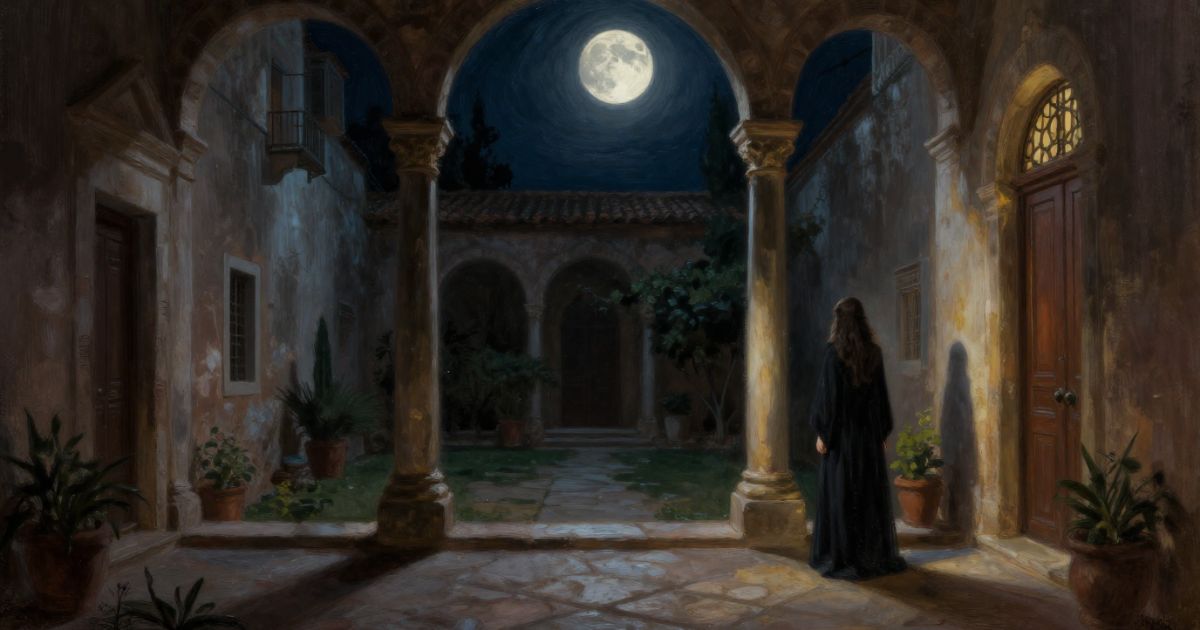
An excerpt from the original text.(complete · 1200 words)
owards the close of day Madame de Menon arrived at a small village
situated among the mountains, where she purposed to pass the night.
The evening was remarkably fine, and the romantic beauty of the
surrounding scenery invited her to walk. She followed the windings of
a stream, which was lost at some distance amongst luxuriant groves of
chesnut. The rich colouring of evening glowed through the dark
foliage, which spreading a pensive gloom around, offered a scene
congenial to the present temper of her mind, and she entered the
shades. Her thoughts, affected by the surrounding objects, gradually
sunk into a pleasing and complacent melancholy, and she was insensibly
led on. She still followed the course of the stream to where the deep
shades retired, and the scene again opening to day, yielded to her a
view so various and sublime, that she paused in thrilling and
delightful wonder. A group of wild and grotesque rocks rose in a
semicircular form, and their fantastic shapes exhibited Nature in her
most sublime and striking attitudes. Here her vast magnificence
elevated the mind of the beholder to enthusiasm. Fancy caught the
thrilling sensation, and at her touch the towering steeps became
shaded with unreal glooms; the caves more darkly frowned--the
projecting cliffs assumed a more terrific aspect, and the wild
overhanging shrubs waved to the gale in deeper murmurs. The scene
inspired madame with reverential awe, and her thoughts involuntarily
rose, 'from Nature up to Nature's God.' The last dying gleams of day
tinted the rocks and shone upon the waters, which retired through a
rugged channel and were lost afar among the receding cliffs. While she
listened to their distant murmur, a voice of liquid and melodious
sweetness arose from among the rocks; it sung an air, whose melancholy
expression awakened all her attention, and captivated her heart. The
tones swelled and died faintly away among the clear, yet languishing
echoes which the rocks repeated with an effect like that of
enchantment. Madame looked around in search of the sweet warbler, and
observed at some distance a peasant girl seated on a small projection
of the rock, overshadowed by drooping sycamores. She moved slowly
towards the spot, which she had almost reached, when the sound of her
steps startled and silenced the syren, who, on perceiving a stranger,
arose in an attitude to depart. The voice of madame arrested her, and
she approached. Language cannot paint the sensation of madame, when in
the disguise of a peasant girl, she distinguished the features of
Julia, whose eyes lighted up with sudden recollection, and who sunk
into her arms overcome with joy. When their first emotions were
subsided, and Julia had received answers to her enquiries concerning
Ferdinand and Emilia, she led madame to the place of her concealment.
This was a solitary cottage, in a close valley surrounded by
mountains, whose cliffs appeared wholly inaccessible to mortal foot.
The deep solitude of the scene dissipated at once madame's wonder that
Julia had so long remained undiscovered, and excited surprize how she
had been able to explore a spot thus deeply sequestered; but madame
observed with extreme concern, that the countenance of Julia no longer
wore the smile of health and gaiety. Her fine features had received
the impressions not only of melancholy, but of grief. Madame sighed as
she gazed, and read too plainly the cause of the change. Julia
understood that sigh, and answered it with her tears. She pressed the
hand of madame in mournful silence to her lips, and her cheeks were
suffused with a crimson glow. At length, recovering herself, 'I have
much, my dear madam, to tell,' said she, 'and much to explain, 'ere
you will admit me again to that esteem of which I was once so justly
proud. I had no resource from misery, but in flight; and of that I
could not make you a confidant, without meanly involving you in its
disgrace.'--'Say no more, my love, on the subject,' replied madame;
'with respect to myself, I admired your conduct, and felt severely for
your situation. Rather let me hear by what means you effected your
escape, and what has since be fallen you.'--Julia paused a moment, as
if to stifle her rising emotion, and then commenced her narrative.
'You are already acquainted with the secret of that night, so fatal to
my peace. I recall the remembrance of it with an anguish which I
cannot conceal; and why should I wish its concealment, since I mourn
for one, whose noble qualities justified all my admiration, and
deserved more than my feeble praise can bestow; the idea of whom will
be the last to linger in my mind till death shuts up this painful
scene.' Her voice trembled, and she paused. After a few moments she
resumed her tale. 'I will spare myself the pain of recurring to scenes
with which you are not unacquainted, and proceed to those which more
immediately attract your interest. Caterina, my faithful servant, you
know, attended me in my confinement; to her kindness I owe my escape.
She obtained from her lover, a servant in the castle, that assistance
which gave me liberty. One night when Carlo, who had been appointed my
guard, was asleep, Nicolo crept into his chamber, and stole from him
the keys of my prison. He had previously procured a ladder of ropes.
O! I can never forget my emotions, when in the dead hour of that
night, which was meant to precede the day of my sacrifice, I heard the
door of my prison unlock, and found myself half at liberty! My
trembling limbs with difficulty supported me as I followed Caterina to
the saloon, the windows of which being low and near to the terrace,
suited our purpose. To the terrace we easily got, where Nicolo
awaited us with the rope-ladder. He fastened it to the ground; and
having climbed to the top of the parapet, quickly slided down on the
other side. There he held it, while we ascended and descended; and I
soon breathed the air of freedom again. But the apprehension of being
retaken was still too powerful to permit a full enjoyment of my
escape. It was my plan to proceed to the place of my faithful
Caterina's nativity, where she had assured me I might find a safe
asylum in the cottage of her parents, from whom, as they had never
seen me, I might conceal my birth. This place, she said, was entirely
unknown to the marquis, who had hired her at Naples only a few months
before, without any enquiries concerning her family. She had informed
me that the village was many leagues distant from the castle, but that
she was very well acquainted with the road. At the foot of the walls
we left Nicolo, who returned to the castle to prevent suspicion, but
with an intention to leave it at a less dangerous time, and repair to
Farrini to his good Caterina. I parted from him with many thanks, and
gave him a small diamond cross, which, for that purpose, I had taken
from the jewels sent to me for wedding ornaments.'
Master this chapter. Complete your experience
Purchase the complete book to access all chapters and support classic literature
As an Amazon Associate, we earn a small commission from qualifying purchases at no additional cost to you.
Available in paperback, hardcover, and e-book formats
Let's Analyse the Pattern
The Sanctuary Pattern - Finding Refuge When Systems Fail You
Official systems protect themselves first, while real help comes from those who understand what it means to need support.
Why This Matters
Connect literature to life
This chapter teaches how to recognize the difference between people who benefit from existing power structures and those who will genuinely help during crisis.
Practice This Today
This week, notice who actually shows up when you need small favors versus who just offers thoughts and prayers - those patterns predict behavior during real emergencies.
Now let's explore the literary elements.
Key Quotes & Analysis
"The scene inspired madame with reverential awe, and her thoughts involuntarily rose, 'from Nature up to Nature's God.'"
Context: When Madame de Menon discovers the sublime landscape of wild rocks and caves
This shows how 18th-century people believed nature could lead you to spiritual insight. The overwhelming beauty doesn't just make her feel good—it connects her to something larger than her personal troubles. This elevated state of mind prepares her to help Julia.
In Today's Words:
The view was so incredible it made her feel connected to something bigger than herself.
"Her thoughts, affected by the surrounding objects, gradually sunk into a pleasing and complacent melancholy"
Context: As Madame walks into the shaded grove following the stream
This describes the Romantic ideal of productive sadness—not depression, but a gentle, thoughtful mood that helps you process emotions. The natural setting doesn't cheer her up artificially; instead, it gives her space to feel her feelings in a healthy way.
In Today's Words:
Being in nature put her in that peaceful, slightly sad mood where you can actually think clearly about your problems.
"The voice belonged to a peasant girl who turned out to be Julia in disguise"
Context: When the beautiful singing leads Madame to discover Julia's true identity
The recognition scene shows how true nature can't be completely hidden by external circumstances. Julia's voice gives her away because authentic beauty and refinement shine through even the roughest disguise. It also shows how art and music reveal character.
In Today's Words:
You can dress down and try to blend in, but who you really are always shows through somehow.
Thematic Threads
Class
In This Chapter
Servants risk everything to help Julia while her aristocratic father forces her into marriage for political gain
Development
Deepens from earlier hints to show class solidarity transcends formal loyalty structures
In Your Life:
The people who understand your struggles are often those facing similar challenges, not those above you in hierarchy
Identity
In This Chapter
Julia transforms from sheltered aristocrat to resourceful survivor, disguising herself as a peasant
Development
Continues her evolution from passive victim to active agent of her own fate
In Your Life:
Crisis often reveals capabilities you didn't know you had and forces you to shed old versions of yourself
Human Relationships
In This Chapter
Madame de Menon and Julia's reunion shows how genuine bonds survive separation and hardship
Development
Builds on earlier themes of chosen family being stronger than blood ties
In Your Life:
The people who seek you out during your worst times are the ones worth keeping in your life
Personal Growth
In This Chapter
Julia's physical and emotional changes reflect the real cost of trauma but also her increased resilience
Development
Shows growth isn't always positive—sometimes it's survival adaptation
In Your Life:
Surviving difficult experiences changes you in ways that are both loss and strength
Social Expectations
In This Chapter
Julia completely abandons aristocratic expectations to live as a peasant in hiding
Development
Escalates from questioning social norms to completely rejecting them for survival
In Your Life:
Sometimes protecting yourself requires disappointing people who never had your best interests at heart
You now have the context. Time to form your own thoughts.
Discussion Questions
- 1
Who actually helped Julia escape, and who failed to protect her despite having more power?
analysis • surface - 2
Why were Julia's servants willing to risk everything to help her, while her own father forced her into an unwanted marriage?
analysis • medium - 3
Think about a workplace crisis, family emergency, or community problem you've witnessed. Who provided real help versus who just offered empty sympathy?
application • medium - 4
When you're facing a serious problem, how do you decide who to ask for help? What signs tell you someone will actually follow through?
application • deep - 5
What does Julia's story reveal about the difference between official authority and genuine loyalty?
reflection • deep
Critical Thinking Exercise
Map Your Support Network
Draw three circles: your inner circle (people who'd help you move at midnight), middle circle (people who'd lend you $50), and outer circle (people who'd share your social media post). Think about a current challenge you're facing. Which circle would you turn to first, and why? Notice whether the people with the most official power to help you are actually in your inner circle.
Consider:
- •Consider whether you're asking for help from the right people or just the obvious people
- •Notice if you're investing time in relationships that go both ways
- •Think about whether you're someone else's inner circle and what that requires
Journaling Prompt
Write about a time when someone unexpected stepped up to help you, or when someone you expected to help you didn't. What did that teach you about building reliable support networks?
Coming Up Next...
Chapter 8: Mistaken Identity and Sanctuary Found
Julia continues her tale of survival in the wilderness, revealing the challenges she faced alone and the mysterious circumstances that led her to this remote hiding place. But her story may hold more secrets than Madame de Menon expects.



