
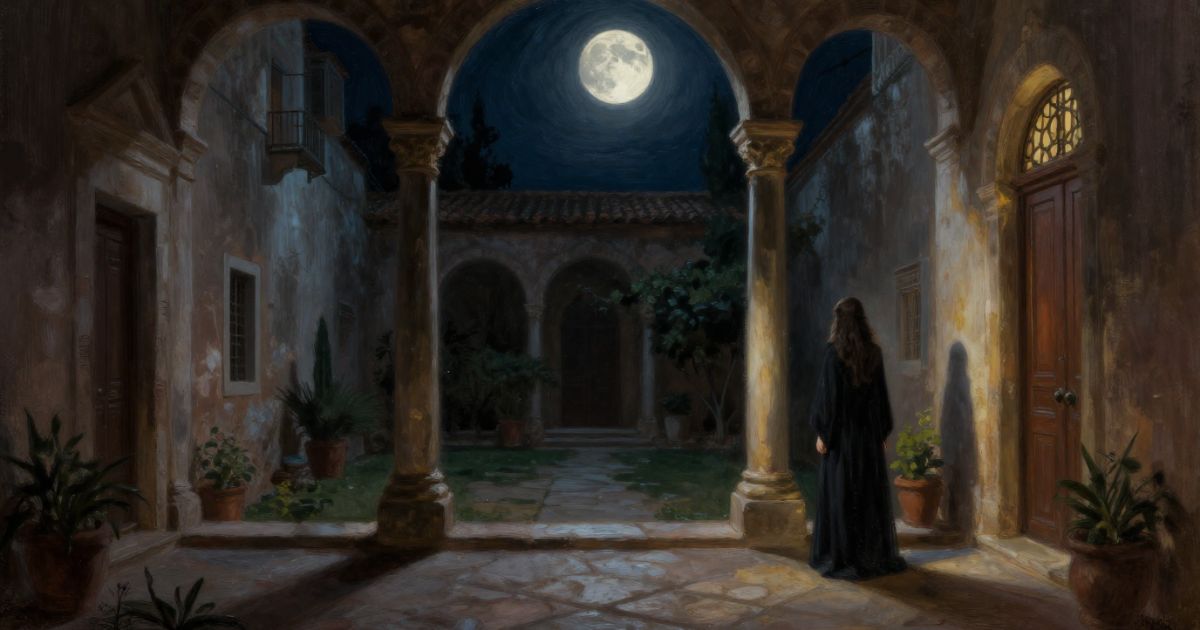
An excerpt from the original text.(complete · 4646 words)
n turning up the ground of the cell, it was discovered that it
communicated with the dungeon in which Ferdinand had been confined,
and where he had heard those groans which had occasioned him so much
terror.
The story which the marquis formerly related to his son, concerning
the southern buildings, it was now evident was fabricated for the
purpose of concealing the imprisonment of the marchioness. In the
choice of his subject, he certainly discovered some art; for the
circumstance related was calculated, by impressing terror, to prevent
farther enquiry into the recesses of these buildings. It served, also,
to explain, by supernatural evidence, the cause of those sounds, and
of that appearance which had been there observed, but which were, in
reality, occasioned only by the marquis.
The event of the examination in the cell threw Ferdinand into new
perplexity. The marquis had confessed that he poisoned his wife--yet
her remains were not to be found; and the place which he signified to
be that of her confinement, bore no vestige of her having been there.
There appeared no way by which she could have escaped from her prison;
for both the door which opened upon the cell, and that which
terminated the avenue beyond, were fastened when tried by Ferdinand.
But the young marquis had no time for useless speculation--serious
duties called upon him. He believed that Julia was still in the power
of banditti; and, on the conclusion of his father's funeral, he set
forward himself to Palermo, to give information of the abode of the
robbers, and to repair with the officers of justice, accompanied by a
party of his own people, to the rescue of his sister. On his arrival
at Palermo he was informed, that a banditti, whose retreat had been
among the ruins of a monastery, situated in the forest of Marentino,
was already discovered; that their abode had been searched, and
themselves secured for examples of public justice--but that no captive
lady had been found amongst them. This latter intelligence excited in
Ferdinand a very serious distress, and he was wholly unable to
conjecture her fate. He obtained leave, however, to interrogate those
of the robbers, who were imprisoned at Palermo, but could draw from
them no satisfactory or certain information.
At length he quitted Palermo for the forest of Marentino, thinking it
possible that Julia might be heard of in its neighbourhood. He
travelled on in melancholy and dejection, and evening overtook him
long before he reached the place of his destination. The night came on
heavily in clouds, and a violent storm of wind and rain arose. The
road lay through a wild and rocky country, and Ferdinand could obtain
no shelter. His attendants offered him their cloaks, but he refused to
expose a servant to the hardship he would not himself endure. He
travelled for some miles in a heavy rain; and the wind, which howled
mournfully among the rocks, and whose solemn pauses were filled by the
distant roarings of the sea, heightened the desolation of the scene.
At length he discerned, amid the darkness from afar, a red light
waving in the wind: it varied with the blast, but never totally
disappeared. He pushed his horse into a gallop, and made towards it.
The flame continued to direct his course; and on a nearer approach, he
perceived, by the red reflection of its fires, streaming a long
radiance upon the waters beneath--a lighthouse situated upon a point
of rock which overhung the sea. He knocked for admittance, and the
door was opened by an old man, who bade him welcome.
Within appeared a cheerful blazing fire, round which were seated
several persons, who seemed like himself to have sought shelter from
the tempest of the night. The sight of the fire cheered him, and he
advanced towards it, when a sudden scream seized his attention; the
company rose up in confusion, and in the same instant he discovered
Julia and Hippolitus. The joy of that moment is not to be described,
but his attention was quickly called off from his own situation to
that of a lady, who during the general transport had fainted. His
sensations on learning she was his mother cannot be described.
She revived. 'My son!' said she, in a languid voice, as she pressed
him to her heart. 'Great God, I am recompensed! Surely this moment may
repay a life of misery!' He could only receive her caresses in
silence; but the sudden tears which started in his eyes spoke a
language too expressive to be misunderstood.
When the first emotion of the scene was passed, Julia enquired by what
means Ferdinand had come to this spot. He answered her generally, and
avoided for the present entering upon the affecting subject of the
late events at the castle of Mazzini. Julia related the history of her
adventures since she parted with her brother. In her narration, it
appeared that Hippolitus, who was taken by the Duke de Luovo at the
mouth of the cave, had afterwards escaped, and returned to the cavern
in search of Julia. The low recess in the rock, through which Julia
had passed, he perceived by the light of his flambeau. He penetrated
to the cavern beyond, and from thence to the prison of the
marchioness. No colour of language can paint the scene which followed;
it is sufficient to say that the whole party agreed to quit the cell
at the return of night. But this being a night on which it was known
the marquis would visit the prison, they agreed to defer their
departure till after his appearance, and thus elude the danger to be
expected from an early discovery of the escape of the marchioness.
At the sound of footsteps above, Hippolitus and Julia had secreted
themselves in the avenue; and immediately on the marquis's departure
they all repaired to the cavern, leaving, in the hurry of their
flight, untouched the poisonous food he had brought. Having escaped
from thence they proceeded to a neighbouring village, where horses
were procured to carry them towards Palermo. Here, after a tedious
journey, they arrived, in the design of embarking for Italy. Contrary
winds had detained them till the day on which Ferdinand left that
city, when, apprehensive and weary of delay, they hired a small
vessel, and determined to brave the winds. They had soon reason to
repent their temerity; for the vessel had not been long at sea when
the storm arose, which threw them back upon the shores of Sicily, and
brought them to the lighthouse, where they were discovered by
Ferdinand.
On the following morning Ferdinand returned with his friends to
Palermo, where he first disclosed the late fatal events of the castle.
They now settled their future plans; and Ferdinand hastened to the
castle of Mazzini to fetch Emilia, and to give orders for the removal
of his household to his palace at Naples, where he designed to fix his
future residence. The distress of Emilia, whom he found recovered from
her indisposition, yielded to joy and wonder, when she heard of the
existence of her mother, and the safety of her sister. She departed
with Ferdinand for Palermo, where her friends awaited her, and where
the joy of the meeting was considerably heightened by the appearance
of Madame de Menon, for whom the marchioness had dispatched a
messenger to St Augustin's. Madame had quitted the abbey for another
convent, to which, however, the messenger was directed. This happy
party now embarked for Naples.
From this period the castle of Mazzini, which had been the theatre of
a dreadful catastrophe; and whose scenes would have revived in the
minds of the chief personages connected with it, painful and shocking
reflections--was abandoned.
On their arrival at Naples, Ferdinand presented to the king a clear
and satisfactory account of the late events at the castle, in
consequence of which the marchioness was confirmed in her rank, and
Ferdinand was received as the sixth Marquis de Mazzini.
The marchioness, thus restored to the world, and to happiness, resided
with her children in the palace at Naples, where, after time had
somewhat mellowed the remembrance of the late calamity, the nuptials
of Hippolitus and Julia were celebrated. The recollection of the
difficulties they had encountered, and of the distress they had
endured for each other, now served only to heighten by contrast the
happiness of the present period.
Ferdinand soon after accepted a command in the Neapolitan army; and
amidst the many heroes of that warlike and turbulent age,
distinguished himself for his valour and ability. The occupations of
war engaged his mind, while his heart was solicitous in promoting the
happiness of his family.
Madame de Menon, whose generous attachment to the marchioness had been
fully proved, found in the restoration of her friend a living witness
of her marriage, and thus recovered those estates which had been
unjustly withheld from her. But the marchioness and her family,
grateful to her friendship, and attached to her virtues, prevailed
upon her to spend the remainder of her life at the palace of Mazzini.
Emilia, wholly attached to her family, continued to reside with the
marchioness, who saw her race renewed in the children of Hippolitus
and Julia. Thus surrounded by her children and friends, and engaged in
forming the minds of the infant generation, she seemed to forget that
she had ever been otherwise than happy.
* * * * *
Here the manuscript annals conclude. In reviewing this story, we
perceive a singular and striking instance of moral retribution. We
learn, also, that those who do only THAT WHICH IS RIGHT, endure
nothing in misfortune but a trial of their virtue, and from trials
well endured derive the surest claim to the protection of heaven.
FINIS
[Transcriber's Note: Some words which appear to be typos are printed
thus in the original book. A list of these possible words follows:
cioset, skriek, ladyrinth, and bad (presumably for bade, "he bad
Julia good-night"). In addition, the book contains (and I have
retained) inconsistant spelling of both common words (e.g. extacy,
exstacy) and proper nouns (Farrini, Ferrini). I have used the
underscore notation to indicate italics. (The text in CAPITALS is
printed as it appears in the original book). Finally, the line of
spaced asterisks, was used to indicate an additional blank line
seperating sections of the text.]
*** END OF THE PROJECT GUTENBERG EBOOK A SICILIAN ROMANCE ***
Updated editions will replace the previous one—the old editions will
be renamed.
Creating the works from print editions not protected by U.S. copyright
law means that no one owns a United States copyright in these works,
so the Foundation (and you!) can copy and distribute it in the United
States without permission and without paying copyright
royalties. Special rules, set forth in the General Terms of Use part
of this license, apply to copying and distributing Project
Gutenberg™ electronic works to protect the PROJECT GUTENBERG™
concept and trademark. Project Gutenberg is a registered trademark,
and may not be used if you charge for an eBook, except by following
the terms of the trademark license, including paying royalties for use
of the Project Gutenberg trademark. If you do not charge anything for
copies of this eBook, complying with the trademark license is very
easy. You may use this eBook for nearly any purpose such as creation
of derivative works, reports, performances and research. Project
Gutenberg eBooks may be modified and printed and given away—you may
do practically ANYTHING in the United States with eBooks not protected
by U.S. copyright law. Redistribution is subject to the trademark
license, especially commercial redistribution.
START: FULL LICENSE
THE FULL PROJECT GUTENBERG LICENSE
PLEASE READ THIS BEFORE YOU DISTRIBUTE OR USE THIS WORK
To protect the Project Gutenberg™ mission of promoting the free
distribution of electronic works, by using or distributing this work
(or any other work associated in any way with the phrase “Project
Gutenberg”), you agree to comply with all the terms of the Full
Project Gutenberg™ License available with this file or online at
www.gutenberg.org/license.
Section 1. General Terms of Use and Redistributing Project Gutenberg™
electronic works
1.A. By reading or using any part of this Project Gutenberg™
electronic work, you indicate that you have read, understand, agree to
and accept all the terms of this license and intellectual property
(trademark/copyright) agreement. If you do not agree to abide by all
the terms of this agreement, you must cease using and return or
destroy all copies of Project Gutenberg™ electronic works in your
possession. If you paid a fee for obtaining a copy of or access to a
Project Gutenberg™ electronic work and you do not agree to be bound
by the terms of this agreement, you may obtain a refund from the person
or entity to whom you paid the fee as set forth in paragraph 1.E.8.
1.B. “Project Gutenberg” is a registered trademark. It may only be
used on or associated in any way with an electronic work by people who
agree to be bound by the terms of this agreement. There are a few
things that you can do with most Project Gutenberg™ electronic works
even without complying with the full terms of this agreement. See
paragraph 1.C below. There are a lot of things you can do with Project
Gutenberg™ electronic works if you follow the terms of this
agreement and help preserve free future access to Project Gutenberg™
electronic works. See paragraph 1.E below.
1.C. The Project Gutenberg Literary Archive Foundation (“the
Foundation” or PGLAF), owns a compilation copyright in the collection
of Project Gutenberg™ electronic works. Nearly all the individual
works in the collection are in the public domain in the United
States. If an individual work is unprotected by copyright law in the
United States and you are located in the United States, we do not
claim a right to prevent you from copying, distributing, performing,
displaying or creating derivative works based on the work as long as
all references to Project Gutenberg are removed. Of course, we hope
that you will support the Project Gutenberg™ mission of promoting
free access to electronic works by freely sharing Project Gutenberg™
works in compliance with the terms of this agreement for keeping the
Project Gutenberg™ name associated with the work. You can easily
comply with the terms of this agreement by keeping this work in the
same format with its attached full Project Gutenberg™ License when
you share it without charge with others.
1.D. The copyright laws of the place where you are located also govern
what you can do with this work. Copyright laws in most countries are
in a constant state of change. If you are outside the United States,
check the laws of your country in addition to the terms of this
agreement before downloading, copying, displaying, performing,
distributing or creating derivative works based on this work or any
other Project Gutenberg™ work. The Foundation makes no
representations concerning the copyright status of any work in any
country other than the United States.
1.E. Unless you have removed all references to Project Gutenberg:
1.E.1. The following sentence, with active links to, or other
immediate access to, the full Project Gutenberg™ License must appear
prominently whenever any copy of a Project Gutenberg™ work (any work
on which the phrase “Project Gutenberg” appears, or with which the
phrase “Project Gutenberg” is associated) is accessed, displayed,
performed, viewed, copied or distributed:
This eBook is for the use of anyone anywhere in the United States and most
other parts of the world at no cost and with almost no restrictions
whatsoever. You may copy it, give it away or re-use it under the terms
of the Project Gutenberg License included with this eBook or online
at www.gutenberg.org. If you
are not located in the United States, you will have to check the laws
of the country where you are located before using this eBook.
1.E.2. If an individual Project Gutenberg™ electronic work is
derived from texts not protected by U.S. copyright law (does not
contain a notice indicating that it is posted with permission of the
copyright holder), the work can be copied and distributed to anyone in
the United States without paying any fees or charges. If you are
redistributing or providing access to a work with the phrase “Project
Gutenberg” associated with or appearing on the work, you must comply
either with the requirements of paragraphs 1.E.1 through 1.E.7 or
obtain permission for the use of the work and the Project Gutenberg™
trademark as set forth in paragraphs 1.E.8 or 1.E.9.
1.E.3. If an individual Project Gutenberg™ electronic work is posted
with the permission of the copyright holder, your use and distribution
must comply with both paragraphs 1.E.1 through 1.E.7 and any
additional terms imposed by the copyright holder. Additional terms
will be linked to the Project Gutenberg™ License for all works
posted with the permission of the copyright holder found at the
beginning of this work.
1.E.4. Do not unlink or detach or remove the full Project Gutenberg™
License terms from this work, or any files containing a part of this
work or any other work associated with Project Gutenberg™.
1.E.5. Do not copy, display, perform, distribute or redistribute this
electronic work, or any part of this electronic work, without
prominently displaying the sentence set forth in paragraph 1.E.1 with
active links or immediate access to the full terms of the Project
Gutenberg™ License.
1.E.6. You may convert to and distribute this work in any binary,
compressed, marked up, nonproprietary or proprietary form, including
any word processing or hypertext form. However, if you provide access
to or distribute copies of a Project Gutenberg™ work in a format
other than “Plain Vanilla ASCII” or other format used in the official
version posted on the official Project Gutenberg™ website
(www.gutenberg.org), you must, at no additional cost, fee or expense
to the user, provide a copy, a means of exporting a copy, or a means
of obtaining a copy upon request, of the work in its original “Plain
Vanilla ASCII” or other form. Any alternate format must include the
full Project Gutenberg™ License as specified in paragraph 1.E.1.
1.E.7. Do not charge a fee for access to, viewing, displaying,
performing, copying or distributing any Project Gutenberg™ works
unless you comply with paragraph 1.E.8 or 1.E.9.
1.E.8. You may charge a reasonable fee for copies of or providing
access to or distributing Project Gutenberg™ electronic works
provided that:
• You pay a royalty fee of 20% of the gross profits you derive from
the use of Project Gutenberg™ works calculated using the method
you already use to calculate your applicable taxes. The fee is owed
to the owner of the Project Gutenberg™ trademark, but he has
agreed to donate royalties under this paragraph to the Project
Gutenberg Literary Archive Foundation. Royalty payments must be paid
within 60 days following each date on which you prepare (or are
legally required to prepare) your periodic tax returns. Royalty
payments should be clearly marked as such and sent to the Project
Gutenberg Literary Archive Foundation at the address specified in
Section 4, “Information about donations to the Project Gutenberg
Literary Archive Foundation.”
• You provide a full refund of any money paid by a user who notifies
you in writing (or by e-mail) within 30 days of receipt that s/he
does not agree to the terms of the full Project Gutenberg™
License. You must require such a user to return or destroy all
copies of the works possessed in a physical medium and discontinue
all use of and all access to other copies of Project Gutenberg™
works.
• You provide, in accordance with paragraph 1.F.3, a full refund of
any money paid for a work or a replacement copy, if a defect in the
electronic work is discovered and reported to you within 90 days of
receipt of the work.
• You comply with all other terms of this agreement for free
distribution of Project Gutenberg™ works.
1.E.9. If you wish to charge a fee or distribute a Project
Gutenberg™ electronic work or group of works on different terms than
are set forth in this agreement, you must obtain permission in writing
from the Project Gutenberg Literary Archive Foundation, the manager of
the Project Gutenberg™ trademark. Contact the Foundation as set
forth in Section 3 below.
1.F.
1.F.1. Project Gutenberg volunteers and employees expend considerable
effort to identify, do copyright research on, transcribe and proofread
works not protected by U.S. copyright law in creating the Project
Gutenberg™ collection. Despite these efforts, Project Gutenberg™
electronic works, and the medium on which they may be stored, may
contain “Defects,” such as, but not limited to, incomplete, inaccurate
or corrupt data, transcription errors, a copyright or other
intellectual property infringement, a defective or damaged disk or
other medium, a computer virus, or computer codes that damage or
cannot be read by your equipment.
1.F.2. LIMITED WARRANTY, DISCLAIMER OF DAMAGES - Except for the “Right
of Replacement or Refund” described in paragraph 1.F.3, the Project
Gutenberg Literary Archive Foundation, the owner of the Project
Gutenberg™ trademark, and any other party distributing a Project
Gutenberg™ electronic work under this agreement, disclaim all
liability to you for damages, costs and expenses, including legal
fees. YOU AGREE THAT YOU HAVE NO REMEDIES FOR NEGLIGENCE, STRICT
LIABILITY, BREACH OF WARRANTY OR BREACH OF CONTRACT EXCEPT THOSE
PROVIDED IN PARAGRAPH 1.F.3. YOU AGREE THAT THE FOUNDATION, THE
TRADEMARK OWNER, AND ANY DISTRIBUTOR UNDER THIS AGREEMENT WILL NOT BE
LIABLE TO YOU FOR ACTUAL, DIRECT, INDIRECT, CONSEQUENTIAL, PUNITIVE OR
INCIDENTAL DAMAGES EVEN IF YOU GIVE NOTICE OF THE POSSIBILITY OF SUCH
DAMAGE.
1.F.3. LIMITED RIGHT OF REPLACEMENT OR REFUND - If you discover a
defect in this electronic work within 90 days of receiving it, you can
receive a refund of the money (if any) you paid for it by sending a
written explanation to the person you received the work from. If you
received the work on a physical medium, you must return the medium
with your written explanation. The person or entity that provided you
with the defective work may elect to provide a replacement copy in
lieu of a refund. If you received the work electronically, the person
or entity providing it to you may choose to give you a second
opportunity to receive the work electronically in lieu of a refund. If
the second copy is also defective, you may demand a refund in writing
without further opportunities to fix the problem.
1.F.4. Except for the limited right of replacement or refund set forth
in paragraph 1.F.3, this work is provided to you ‘AS-IS’, WITH NO
OTHER WARRANTIES OF ANY KIND, EXPRESS OR IMPLIED, INCLUDING BUT NOT
LIMITED TO WARRANTIES OF MERCHANTABILITY OR FITNESS FOR ANY PURPOSE.
1.F.5. Some states do not allow disclaimers of certain implied
warranties or the exclusion or limitation of certain types of
damages. If any disclaimer or limitation set forth in this agreement
violates the law of the state applicable to this agreement, the
agreement shall be interpreted to make the maximum disclaimer or
limitation permitted by the applicable state law. The invalidity or
unenforceability of any provision of this agreement shall not void the
remaining provisions.
1.F.6. INDEMNITY - You agree to indemnify and hold the Foundation, the
trademark owner, any agent or employee of the Foundation, anyone
providing copies of Project Gutenberg™ electronic works in
accordance with this agreement, and any volunteers associated with the
production, promotion and distribution of Project Gutenberg™
electronic works, harmless from all liability, costs and expenses,
including legal fees, that arise directly or indirectly from any of
the following which you do or cause to occur: (a) distribution of this
or any Project Gutenberg™ work, (b) alteration, modification, or
additions or deletions to any Project Gutenberg™ work, and (c) any
Defect you cause.
Section 2. Information about the Mission of Project Gutenberg™
Project Gutenberg™ is synonymous with the free distribution of
electronic works in formats readable by the widest variety of
computers including obsolete, old, middle-aged and new computers. It
exists because of the efforts of hundreds of volunteers and donations
from people in all walks of life.
Volunteers and financial support to provide volunteers with the
assistance they need are critical to reaching Project Gutenberg™’s
goals and ensuring that the Project Gutenberg™ collection will
remain freely available for generations to come. In 2001, the Project
Gutenberg Literary Archive Foundation was created to provide a secure
and permanent future for Project Gutenberg™ and future
generations. To learn more about the Project Gutenberg Literary
Archive Foundation and how your efforts and donations can help, see
Sections 3 and 4 and the Foundation information page at www.gutenberg.org.
Section 3. Information about the Project Gutenberg Literary Archive Foundation
The Project Gutenberg Literary Archive Foundation is a non-profit
501(c)(3) educational corporation organized under the laws of the
state of Mississippi and granted tax exempt status by the Internal
Revenue Service. The Foundation’s EIN or federal tax identification
number is 64-6221541. Contributions to the Project Gutenberg Literary
Archive Foundation are tax deductible to the full extent permitted by
U.S. federal laws and your state’s laws.
The Foundation’s business office is located at 809 North 1500 West,
Salt Lake City, UT 84116, (801) 596-1887. Email contact links and up
to date contact information can be found at the Foundation’s website
and official page at www.gutenberg.org/contact
Section 4. Information about Donations to the Project Gutenberg
Literary Archive Foundation
Project Gutenberg™ depends upon and cannot survive without widespread
public support and donations to carry out its mission of
increasing the number of public domain and licensed works that can be
freely distributed in machine-readable form accessible by the widest
array of equipment including outdated equipment. Many small donations
($1 to $5,000) are particularly important to maintaining tax exempt
status with the IRS.
The Foundation is committed to complying with the laws regulating
charities and charitable donations in all 50 states of the United
States. Compliance requirements are not uniform and it takes a
considerable effort, much paperwork and many fees to meet and keep up
with these requirements. We do not solicit donations in locations
where we have not received written confirmation of compliance. To SEND
DONATIONS or determine the status of compliance for any particular state
visit www.gutenberg.org/donate.
While we cannot and do not solicit contributions from states where we
have not met the solicitation requirements, we know of no prohibition
against accepting unsolicited donations from donors in such states who
approach us with offers to donate.
International donations are gratefully accepted, but we cannot make
any statements concerning tax treatment of donations received from
outside the United States. U.S. laws alone swamp our small staff.
Please check the Project Gutenberg web pages for current donation
methods and addresses. Donations are accepted in a number of other
ways including checks, online payments and credit card donations. To
donate, please visit: www.gutenberg.org/donate.
Section 5. General Information About Project Gutenberg™ electronic works
Professor Michael S. Hart was the originator of the Project
Gutenberg™ concept of a library of electronic works that could be
freely shared with anyone. For forty years, he produced and
distributed Project Gutenberg™ eBooks with only a loose network of
volunteer support.
Project Gutenberg™ eBooks are often created from several printed
editions, all of which are confirmed as not protected by copyright in
the U.S. unless a copyright notice is included. Thus, we do not
necessarily keep eBooks in compliance with any particular paper
edition.
Most people start at our website which has the main PG search
facility: www.gutenberg.org.
This website includes information about Project Gutenberg™,
including how to make donations to the Project Gutenberg Literary
Archive Foundation, how to help produce our new eBooks, and how to
subscribe to our email newsletter to hear about new eBooks.
Master this chapter. Complete your experience
Purchase the complete book to access all chapters and support classic literature
As an Amazon Associate, we earn a small commission from qualifying purchases at no additional cost to you.
Available in paperback, hardcover, and e-book formats
Let's Analyse the Pattern
Authority figures create imaginary dangers to control behavior and prevent investigation of their real actions.
Why This Matters
Connect literature to life
This chapter teaches how to recognize when authority figures create false dangers to prevent investigation of their real wrongdoing.
Practice This Today
This week, notice when warnings seem designed more to control your behavior than protect your safety - ask what you're being prevented from examining.
Now let's explore the literary elements.
Key Quotes & Analysis
"The story which the marquis formerly related to his son, concerning the southern buildings, it was now evident was fabricated for the purpose of concealing the imprisonment of the marchioness."
Context: Ferdinand realizes his father's ghost stories were lies to hide his crime
This reveals how abusers use fear and manipulation to keep their victims hidden. The marquis weaponized his son's natural fear to prevent discovery of his wife's imprisonment.
In Today's Words:
All those scary stories dad told about that part of the house? Turns out he made them up to keep us from finding mom.
"But the young marquis had no time for useless speculation--serious duties called upon him."
Context: Ferdinand chooses action over endless analysis when Julia is still in danger
This shows emotional maturity and the ability to prioritize. Ferdinand doesn't get paralyzed by confusion but focuses on what matters most - protecting the people he loves.
In Today's Words:
He could have spent forever trying to figure it all out, but Julia was still missing and that's what mattered.
"The circumstance related was calculated, by impressing terror, to prevent farther enquiry into the recesses of these buildings."
Context: Explaining how the marquis used fear as a weapon
This exposes a classic manipulation tactic - using fear to control behavior. The marquis understood that scared people don't ask questions or investigate further.
In Today's Words:
He told scary stories specifically to make sure nobody would go snooping around where they shouldn't.
Thematic Threads
Truth
In This Chapter
All the family's mysteries are finally revealed - the marquis's lies, the mother's survival, the real reason for the forbidden areas
Development
Throughout the novel, truth has been buried under layers of deception, finally emerging completely
In Your Life:
You might recognize this when long-held family secrets finally come to light and everything suddenly makes sense
Justice
In This Chapter
The evil marquis is dead, the innocent are reunited and rewarded, and even Madame de Menon gets her stolen inheritance back
Development
Justice has been delayed throughout the story but finally arrives completely
In Your Life:
You see this when people who have caused harm finally face consequences and those who suffered are vindicated
Family
In This Chapter
The scattered family is reunited - Ferdinand finds his mother alive, Julia marries Hippolitus, and they all start fresh together
Development
Family bonds have been tested and broken throughout, now restored stronger than before
In Your Life:
You experience this when family members reconcile after major conflicts and rebuild their relationships
Power
In This Chapter
Ferdinand becomes the new marquis, but the corrupt use of power dies with his father
Development
Power has been abused throughout the novel, now transferred to someone who will use it responsibly
In Your Life:
You see this when leadership changes hands from someone who abused authority to someone who will use it ethically
Identity
In This Chapter
Everyone's true identity is restored - the marchioness reclaims her place, Ferdinand accepts his inheritance, Julia finds her freedom
Development
Identity has been confused and suppressed throughout, finally emerging clearly for all
In Your Life:
You feel this when you finally stop pretending to be someone you're not and embrace who you really are
You now have the context. Time to form your own thoughts.
Discussion Questions
- 1
How did the marquis use fear stories about the southern buildings to hide his real crime?
analysis • surface - 2
Why was creating ghost stories more effective than simply locking doors or posting guards?
analysis • medium - 3
Where do you see people today using scary stories to prevent others from looking too closely at something?
application • medium - 4
When someone warns you away from investigating something with dramatic fear stories, what questions should you ask yourself?
application • deep - 5
What does this story reveal about the relationship between manufactured fear and real power?
reflection • deep
Critical Thinking Exercise
Detect the Fear Factory
Think of a situation where someone warned you away from something with dramatic language or scary stories rather than clear facts. Map out who benefited from your fear and what they might have been protecting. Write down the difference between their warning and what you discovered when you looked for yourself.
Consider:
- •Notice when warnings are heavy on emotion but light on specific evidence
- •Ask who gains power or avoids scrutiny when you stay afraid
- •Remember that real dangers usually come with concrete details, not vague drama
Journaling Prompt
Write about a time when you discovered that something you'd been afraid of was much less scary than the stories made it seem. What did you learn about who was telling those stories and why?



