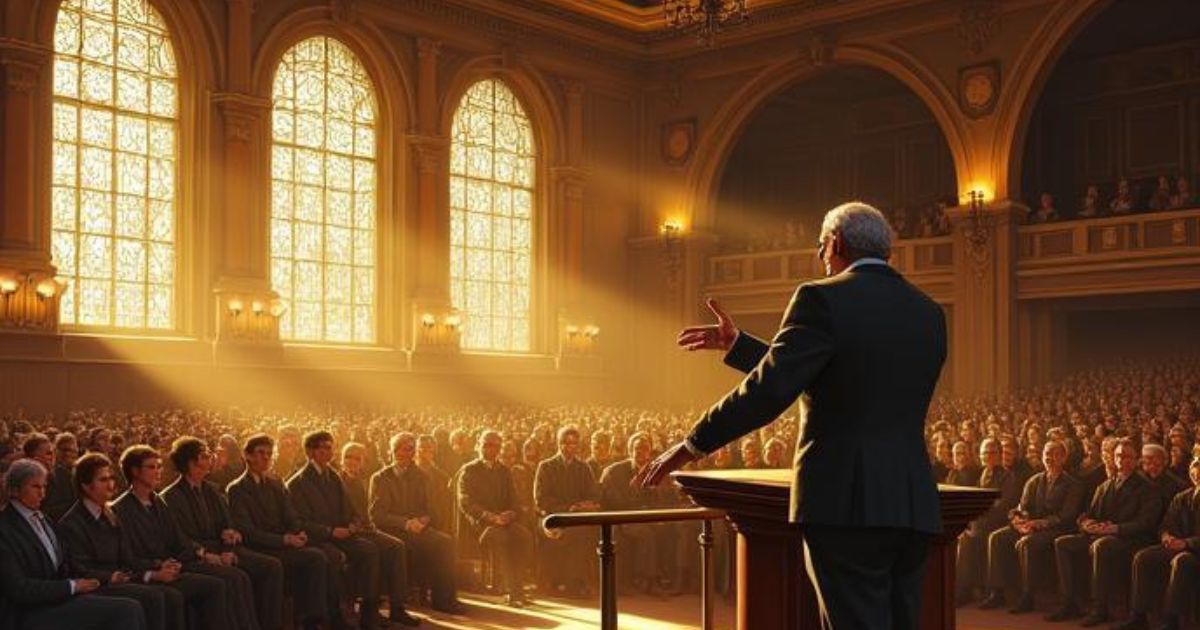
An excerpt from the original text.(complete · 7745 words)
what manner our own judgments refer to what ought to be the judgments of others: and of the origin of general rules.
A great part, perhaps the greatest part, of human
happiness and misery arises from the view of our
past conduct, and from the degree of approbation or
disapprobation which we feel from the consideration
of it. But in whatever manner it may affect us, our
sentiments of this kind have always some secret reference
either to what are, or to what upon a certain
condition would be, or to what we imagine ought to
be the sentiments of others. We examine it as we
imagine an impartial spectator would examine it. If
upon placing ourselves in his situation we thoroughly
enter into all the passions and motives which influenced
it, we approve of it by sympathy with the approbation
of this supposed equitable judge. If otherwise,
we enter into his disapprobation and condemn
it.
Was it possible that a human creature could grow
up to manhood in some solitary place without any
communication with his own species, he could no
more think of his own character, of the propriety or
demerit of his own sentiments and conduct, of the
beauty or deformity of his own mind, than of the
beauty or deformity of his own face. All these are
objects which he cannot easily see, which naturally
he does not look at; and with regard to which he
181is provided with no mirror which can present them
to his view. Bring him into society, and he is immediately
provided with the mirror which he wanted
before. It is placed in the countenance and behaviour
of those he lives with, which always mark
when they enter into, and when they disapprove
of his sentiments; and it is here that he first
views the propriety and impropriety of his own
passions, the beauty and deformity of his own
mind. To a man who from his birth was a stranger
to society, the objects of his passions, the external
bodies which either pleased or hurt him, would
occupy his whole attention. The passions themselves,
the desires or aversions, the joys or sorrows,
which those objects excited, though of all things
the most immediately present to him, could scarce
ever be the objects of his thoughts. The idea of
them could never interest him so much as to call
upon his attentive consideration. The consideration
of his joy could in him excite no new joy, nor that
of his sorrow any new sorrow, though the consideration
of the causes of those passions might often excite
both. Bring him into society, and all his own
passions will immediately become the causes of new
passions. He will observe that mankind approve of
some of them, and are disgusted by others. He will
be elevated in the one case, and cast down in the
other; his desires and aversions, his joys and sorrows
will now often become the causes of new desires
and new aversions, new joys and new sorrows:
they will now therefore interest him deeply, and often
call upon his most attentive consideration.
Our first ideas of personal beauty and deformity,
are drawn from the shape and appearance of others,
not from our own. We soon become sensible, however,
182that others exercise the same criticism upon us.
We are pleased when they approve of our figure,
and are disobliged when they seem to be disgusted.
We become anxious to know how far our appearance
deserves either their blame or approbation. We
examine our own persons limb by limb, and by
placing ourselves before a looking-glass, or by some
such expedient, endeavour, as much as possible, to
view ourselves at the distance and with the eyes of
other people. If after this examination we are satisfied
with our own appearance, we can more easily
support the most disadvantageous judgments of
others: if, on the contrary, we are sensible that we
are the natural objects of distaste, every appearance
of their disapprobation mortifies us beyond all measure.
A man who is tolerably handsome, will allow
you to laugh at any little irregularity in his person;
but all such jokes are commonly insupportable to one
who is really deformed. It is evident, however,
that we are anxious about our own beauty and deformity
only on account of its effect upon others. If
we had no connexion with society, we should be altogether
indifferent about either.
In the same manner our first moral criticisms are
exercised upon the characters and conduct of other
people; and we are all very forward to observe how
each of these affects us. But we soon learn, that
others are equally frank with regard to our own.
We become anxious to know how far we deserve
their censure or applause, and whether to them we
must necessarily appear those agreeable or disagreeable
creatures which they represent us. We begin
upon this account to examine our own passions and
conduct, and to consider how these must appear to
them, by considering how they would appear to
183us if in their situation. We suppose ourselves the
spectators of our own behaviour, and endeavour to
imagine what effect it would, in this light, produce
upon us. This is the only looking-glass by which
we can, in some measure, with the eyes of others,
scrutinize the propriety of our own conduct. If in
this view it pleases us, we are tolerably satisfied. We
can be more indifferent about the applause, and, in
some measure, despise the censure of others; secure
that, however misunderstood or misrepresented, we
are the natural and proper objects of approbation.
On the contrary, if we are displeased with it, we are
often upon that very account more anxious to gain
their approbation, and, provided we have not already,
as they say, shaken hands with infamy, we are
altogether distracted at the thoughts of their censure,
which then strikes us with double severity.
When I endeavour to examine my own conduct,
when I endeavour to pass sentence upon it, and either
to approve or condemn it, it is evident that, in
all such cases, I divide myself, as it were, into two
persons, and that I, the examiner and judge, represent
a different character from that other I, the person
whose conduct is examined into and judged of.
The first is the spectator, whose sentiments with regard
to my own conduct I endeavour to enter into,
by placing myself in his situation, and by considering
how it would appear to me when seen from that
particular point of view. The second is the agent,
the person whom I properly call myself, and of
whose conduct, under the character of a spectator,
I was endeavouring to form some opinion. The
first is the judge; the second the pannel. But that
the judge should, in every respect, be the same
184with the pannel, is as impossible, as that the cause
should, in every respect, be the same with the effect.
To be amiable and to be meritorious, that is, to
deserve love and to deserve reward, are the great
characters of virtue, and to be odious and punishable,
of vice. But all these characters have an immediate
reference to the sentiments of others. Virtue
is not said to be amiable or to be meritorious, because
it is the object of its own love, or of its own
gratitude; but because it excites those sentiments in
other men. The consciousness that it is the object
of such favourable regards is the source of that inward
tranquillity and self-satisfaction with which it
is naturally attended, as the suspicion of the contrary
gives occasion to the torments of vice. What so
great happiness as to be beloved, and to know that
we deserve to be beloved? What so great misery
as to be hated, and to know that we deserve to be
hated?
Man is considered as a moral, because he is regarded
as an accountable being. But an accountable
being, as the word expresses, is a being that
must give an account of its actions to some other,
and that consequently must regulate them according
to the good liking of this other. Man is accountable
to God and his fellow-creatures. But
though he is, no doubt, principally accountable to
God; in the order of time, he must necessarily conceive
himself as accountable to his fellow-creatures,
before he can form any idea of the Deity, or of the
rules by which that divine being will judge of his
conduct. A child surely conceives itself as accountable
to its parents, and is elevated or cast down by
185the thought of their merited approbation or disapprobation,
long before it forms any idea of its accountableness
to the Deity, or of the rules by which
that divine being will judge of its conduct.
The great judge of the world, has, for the wisest
reasons, thought proper to interpose, between the
weak eye of human reason, and the throne of his
eternal justice, a degree of obscurity and darkness,
which though it does not entirely cover that great
tribunal from the view of mankind, yet renders the
impression of it faint and feeble in comparison of
what might be expected from the grandeur and importance
of so mighty an object. If those infinite
rewards and punishments which the Almighty has
prepared for those who obey or transgress his will,
were perceived as distinctly as we foresee the frivolous
and temporary retaliations which we may expect
from one another, the weakness of human nature,
astonished at the immensity of objects so little
fitted to its comprehension, could no longer attend
to the little affairs of this world; and it is absolutely
impossible that the business of society could have
been carried on, if, in this respect, there had been a
fuller revelation of the intentions of Providence
than that which has already been made. That
men, however, might never be without a rule to
direct their conduct by, nor without a judge whose
authority should enforce its observation, the Author
of nature has made man the immediate judge of
mankind, and has, in this respect, as in many
others, created him after his own image, and appointed
him his vicegerent upon earth, to superintend
the behaviour of his brethren. They are
taught by nature to acknowledge that power and
186jurisdiction which has thus been conferred upon him,
and to tremble and exult according as they imagine
that they have either merited his censure, or deserved
his applause.
But whatever may be the authority of this inferior
tribunal which is continually before their eyes, if at
any time it should decide contrary to those principles
and rules, which Nature has established for regulating
its judgments, men feel that they may appeal
from this unjust decision, and call upon a superior
tribunal, the tribunal established in their own
breasts, to redress the injustice of this weak or partial
judgment.
There are certain principles established by Nature
for governing our judgment concerning the conduct
of those we live with. As long as we decide according
to those principles, and neither applaud nor condemn
any thing which Nature has not rendered the
proper object of applause or condemnation, nor any
further than she has rendered it such, as our sentence
is, in this case, if I may say so, quite agreeable to
law, it is liable neither to repeal nor to correction of
any kind. The person concerning whom we form
these judgments, must himself necessarily approve of
them. When he puts himself into our situation, he
cannot avoid viewing his own conduct in the very
same light in which we appear to view it. He is
sensible, that to us, and to every impartial spectator,
he must necessarily appear the natural and proper object
of those sentiments which we express with regard
to him. Those sentiments, therefore, must necessarily
produce their full effect upon him, and he cannot
fail to conceive all the triumph of self-approbation
187from, what appears to him, such merited applause,
as well as all the horrors of shame from, what, he
is sensible, is such deserved condemnation.
But it is otherwise, if we have either applauded or
condemned him, contrary to those principles and
rules which Nature has established for the direction
of our judgments concerning every thing of this
kind. If we have either applauded or condemned
him for what, when he put himself into our situation,
does not appear to him to be the object either of applause
or condemnation; as in this case he cannot
enter into our sentiments, provided he has any constancy
or firmness, he is but little affected by them,
and can neither be much elevated by the favourable,
nor greatly mortified by the unfavourable decision.
The applause of the whole world will avail but little,
if our own conscience condemn us; and the disapprobation
of all mankind is not capable of oppressing
us, when we are absolved by the tribunal within our
own breast, and when our own mind tells us that
mankind are in the wrong.
But though this tribunal within the breast be thus
the supreme arbiter of all our actions, though it can
reverse the decisions of all mankind with regard to
our character and conduct, and mortify us amidst
the applause, or support us under the censure of the
world; yet, if we inquire into the origin of its institution,
its jurisdiction we shall find is in a great
measure derived from the authority of that very tribunal,
whose decisions it so often and so justly reverses.
When we first come into the world, from the natural
desire to please, we accustom ourselves to consider
188what behaviour is likely to be agreeable to every
person we converse with, to our parents, to our masters,
to our companions. We address ourselves to
individuals, and for some time fondly pursue the impossible
and absurd project of gaining the good-will
and approbation of every body. We are soon
taught by experience, however, that this universal
approbation is altogether unattainable. As soon as
we come to have more important interests to manage,
we find, that by pleasing one man, we almost certainly
disoblige another, and that by humouring an
individual, we may often irritate a whole people.
The fairest and most equitable conduct must
frequently obstruct the interests, or thwart the
inclinations of particular persons, who will seldom
have candour enough to enter into the propriety of our
motives, or to see that this conduct, how disagreeable
soever to them, is perfectly suitable to our situation.
In order to defend ourselves from such partial judgments,
we soon learn to set up in our own minds a
judge between ourselves and those we live with. We
conceive ourselves as acting in the presence of a person
quite candid and equitable, of one who has no
particular relation either to ourselves, or to those
whose interests are affected by our conduct, who is
neither father, nor brother, nor friend either to them
or to us, but is merely a man in general, an impartial
spectator who considers our conduct with the
same indifference with which we regard that of other
people. If, when we place ourselves in the situation
of such a person, our own actions appear to us under
an agreeable aspect, if we feel that such a spectator
cannot avoid entering into all the motives which
189influenced us, whatever may be the judgments of the
world, we must still be pleased with our own behaviour,
and regard ourselves, in spite of the censure
of our companions, as the just and proper objects of
approbation.
On the contrary, if the man within condemns us,
the loudest acclamations of mankind appear but as
the noise of ignorance and folly, and whenever we
assume the character of this impartial judge, we cannot
avoid viewing our own actions with this distaste
and dissatisfaction. The weak, the vain, and the frivolous,
indeed, may be mortified by the most groundless
censure, or elated by the most absurd applause.
Such persons are not accustomed to consult the judge
within concerning the opinion which they ought to
form of their own conduct. This inmate of the
breast, this abstract man, the representative of mankind,
and substitute of the Deity, whom Nature has
constituted the supreme judge of all their actions, is
seldom appealed to by them. They are contented
with the decision of the inferior tribunal. The approbation
of their companions, of the particular persons
whom they have lived and conversed with, has
generally been the ultimate object of all their wishes.
If they obtain this, their joy is complete; and if they
fail, they are entirely disappointed. They never
think of appealing to the superior court. They have
seldom inquired after its decisions, and are altogether
unacquainted with the rules and forms of its
procedure. When the world injures them, therefore,
they are incapable of doing themselves justice,
and are, in consequence, necessarily the slaves of the
190world. But it is otherwise with the man who has,
upon all occasions, been accustomed to have recourse
to the judge within, and to consider, not what the
world approves or disapproves of, but what appears
to this impartial spectator, the natural and proper
object of approbation or disapprobation. The judgment
of this supreme arbiter of his conduct, is the
applause, which he has been accustomed principally
to court, is the censure which he has been accustomed
principally to fear. Compared with this final decision,
the sentiments of all mankind, though not
altogether indifferent, appear to be but of small moment;
and he is incapable of being either much
elevated by their favourable, or greatly depressed by
their most disadvantageous judgment.
It is only by consulting this judge within, that we
can see whatever relates to ourselves in its proper
shape and dimensions, or that we can make any proper
comparison between our own interests and those
of other men.
As to the eye of the body, objects appear great or
small, not so much according to their real dimensions,
as according to the nearness or distance of their situation;
so do they likewise to what may be called the
natural eye of the mind: and we remedy the defects
of both these organs pretty much in the same manner.
In my present situation an immense landscape of
lawns, and woods, and distant mountains, seems to
do no more than cover the little window which I
write by, and to be out of all proportion less than the
chamber in which I am sitting. I can form a just
comparison between those great objects and the
little objects around me, in no other way, than by
191transporting myself, at least in fancy, to a different
station, from whence I can survey both at nearly
equal distances, and thereby form some judgment
of their real proportions. Habit and experience have
taught me to do this so easily and so readily, that I
am scarce sensible that I do it; and a man must be,
in some measure, acquainted with the philosophy of
vision, before he can be thoroughly convinced, how
little those distant objects would appear to the eye,
if the imagination, from a knowledge of their real
magnitudes, did not swell and dilate them.
In the same manner, to the selfish and original
passions of human nature, the loss or gain of a very
small interest of our own, appears to be of vastly
more importance, excites a much more passionate
joy or sorrow, a much more ardent desire or aversion,
than the greatest concern of another with whom we
have no particular connexion. His interests, as long
as they are surveyed from this station, can never be
put into the balance with our own, can never restrain
us from doing whatever may tend to promote
our own, how ruinous soever to him. Before we
can make any proper comparison of those opposite
interests, we must change our position. We must
view them, neither from our own place, nor yet
from his, neither with our own eyes nor yet with his,
but from the place, and with the eyes of a third person,
who has no particular connexion with either, and
who judges with impartiality between us. Here too,
habit and experience have taught us to do this so
easily and so readily, that we are scarce sensible that
we do it; and it requires, in this case too, some
degree of reflection, and even of philosophy to convince
us, how little interest we should take in the
192greatest concerns of our neighbour, how little we
should be affected by whatever relates to him, if the
sense of propriety and justice did not correct the
otherwise natural inequality of our sentiments.
Let us suppose that the great empire of China,
with all its myriads of inhabitants, was suddenly
swallowed up by an earthquake, and let us consider
how a man of humanity in Europe, who had no sort
of connexion with that part of the world, would be
affected upon receiving intelligence of this dreadful
calamity. He would, I imagine, first of all, express
very strongly his sorrow for the misfortune of that
unhappy people, he would make many melancholy
reflections upon the precariousness of human life, and
the vanity of all the labours of man, which could
thus be annihilated in a moment. He would too,
perhaps, if he was a man of speculation, enter into
many reasonings concerning the effects which this
disaster might produce upon the commerce of Europe,
and the trade and business of the world in general.
And when all this fine philosophy was over, when all
these humane sentiments had been once fairly expressed,
he would pursue his business or his pleasure,
take his repose or his diversion, with the same ease
and tranquility, as if no such accident had happened.
The most frivolous disaster which could befal himself
would occasion a more real disturbance. If he was
to lose his little finger to-morrow, he would not sleep
to-night; but provided he never saw them, he will
snore with the most profound security over the ruin
of a hundred millions of his brethren, and the destruction
of that immense multitude seems plainly
an object less interesting to him, than this paultry
misfortune of his own. To prevent therefore, this
193paultry misfortune to himself would a man of humanity
be willing to sacrifice the lives of a hundred
millions of his brethren, provided he had never seen
them? Human nature startles with horror at the
thought, and the world, in its greatest depravity and
corruption, never produced such a villain as could
be capable of entertaining it. But what makes this
difference? When our passive feelings are almost always
so sordid and so selfish, how comes it that our
active principles should often be so generous and so
noble? When we are always so much more deeply
affected by whatever concerns ourselves, than by
whatever concerns other men; what is it which
prompts the generous, upon all occasions, and the
mean upon many, to sacrifice their own interests to
the greater interests of others? It is not the soft power
of humanity, it is not that feeble spark of benevolence
which Nature has lighted up in the human
heart, that is thus capable of counteracting the
strongest impulses of self-love. It is a stronger
power, a more forcible motive, which exerts itself
upon such occasions. It is reason, principle, conscience,
the inhabitant of the breast, the man within,
the great judge and arbiter of our conduct. It is he,
who, whenever we are about to act so as to affect the
happiness of others, calls to us with a voice capable
of astonishing the most presumptuous of our passions,
that we are but one of the multitude, in no respect
better than any other in it; and that when we prefer
ourselves so shamefully and so blindly to others, we
become the proper objects of resentment, abhorrence,
and execration. It is from him only that we
learn the real littleness of ourselves, and of whatever
relates to ourselves, and the natural misrepresentations
of self-love can be corrected only by the eye of
194this impartial spectator. It is he who shows us
the propriety of generality and the deformity of injustice;
the propriety of resigning the greatest interests
of our own, for the yet greater interests
of others, and the deformity of doing the
smallest injury to another, in order to obtain the
greatest benefit to ourselves. It is not the love of
our neighbour, it is not the love of mankind, which
upon many occasions prompts us to the practice of
those divine virtues. It is a stronger love, a more
powerful affection which generally takes place upon
such occasions, the love of what is honourable and
noble, of the grandeur, and dignity, and superiority
of our own characters.
When the happiness or misery of others depends
in any respect upon our conduct, we dare not, as
self-love would suggest to us, prefer any little interest
of our own, to the yet greater interest of our neighbour.
We feel that we should become the proper objects
of the resentment and indignation of our brethren,
and the sense of the impropriety of this affection
is supported and enlivened by the yet stronger
sense of the demerit of the action, which it would in
this case give occasion to. But when the happiness
or misery of others in no respect depends upon our
conduct, when our own interests are altogether separated
and detached from theirs, so that there is neither
connexion nor competition between them, as
the sense of demerit does not in this case interpose,
the mere sense of impropriety is seldom able to restrain
us from abandoning ourselves to our natural
anxiety about our own affairs, and to our natural indifference
about those of other men. The most vulgar
education teaches us to act, upon all important
occasions, with some sort of impartiality between
195ourselves and others, and even the ordinary commerce
of the world is capable of adjusting our active
principles to some degree of propriety. But it is
the most artificial and refined education only, which
pretends to correct the inequalities of our passive
feelings, and we must for this purpose have recourse
to the severest, as well as to the profoundest philosophy.
Two different sets of philosophers have attempted
to teach us this hardest of all the lessons of morality.
One set have laboured to increase our sensibility to
the interests of others; another to diminish that to
our own. The first would have us feel for others as
we naturally feel for ourselves. The second would
have us feel for ourselves, as we naturally feel for
others.
The first are those melancholy moralists, who are
perpetually reproaching us with our happiness, while
so many of our brethren are in misery,[6] who regard
as impious the natural joy of prosperity, which does
not think of the many wretches that are at every instant
labouring under all sorts of calamities, in the
languor of poverty, in the agony of disease, in the
horrors of death, under the insults and oppression of
their enemies. Commiseration for those miseries
which we never saw, which we never heard of, but
which we may be assured are at all times infecting
such numbers of our fellow-creatures, ought, they
think, to damp the pleasures of the fortunate, and to
render a certain melancholy dejection habitual to all
men. But first of all, this extreme sympathy with
196misfortunes, which we know nothing about, seems
altogether absurd and unreasonable. Take the whole
earth at an average, for one man who suffers pain or
misery, you will find twenty in prosperity and joy,
or at least in tolerable circumstances. No reason,
surely, can be assigned why we should rather weep
with the one than rejoice with the twenty. This
artificial commiseration, besides, is not only absurd,
but seems altogether unattainable; and those who
affect this character have commonly nothing but a
certain hypocritical sadness, which, without reaching
the heart, serves only to render the countenance and
convocation impertinently dismal and disagreeable.
And last of all, this disposition of mind, though it
could be attained, would be perfectly useless, and
could serve no other purpose than to render miserable
the person who was possessed of it. Whatever interest
we take in the fortune of those with whom
we have no acquaintance or connexion, and who
are placed altogether out of the sphere of our activity,
can produce only anxiety to ourselves, without any
manner of advantage to them. To what purpose
should we trouble ourselves about the world in the
moon? All men, even those at the greatest distance,
are no doubt entitled to our good wishes, and our
good wishes we naturally give them. But if, notwithstanding,
they should be unfortunate, to give
ourselves any anxiety upon that account, seems to
be no part of our duty. That we should be but
little interested, therefore, in the fortune of those
whom we can neither serve nor hurt, and who are in
every respect so very remote from us, seems wisely
ordered by nature; and if it were possible to
alter in this respect the original constitution of our
frame, we could yet gain nothing by the change.
6. See Thomson’s Seasons, Winter:
“Ah! little think the gay licentious proud,” &c.
See also Pascal.
197Among the moralists who endeavour to correct
the natural inequality of our passive feelings by diminishing
our sensibility to what peculiarly concerns
ourselves, we may count all the ancient sects of philosophers,
but particularly the ancient stoics. Man,
according to the stoics, ought to regard himself, not
as something separated and detached, but as a citizen
of the world, a member of the vast commonwealth
of nature. To the interest of this great community,
he ought at all times to be willing that his
own little interest should be sacrificed. Whatever
concerns himself, ought to affect him no more than
whatever concerns any other equally important part
of this immense system. We should view ourselves,
not in the light in which our own selfish passions are
apt to place us, but in the light in which any other
citizen of the world would view us. What befalls
ourselves we should regard as what befalls our neighbour,
or, what comes to the same thing, as our
neighbour regards what befalls us. “When our
neighbour,” says Epictetus, “loses his wife or his
son, there is nobody who is not sensible that this is a
human calamity, a natural event altogether, according
to the ordinary course of things: but when
the same thing happens to ourselves, then we cry
out, as if we had suffered the most dreadful misfortune.
We ought, however, to remember how
we were affected when this accident happened to
another, and such as we were in his case, such
ought we to be in our own.” How difficult
soever it may be to attain this supreme degree
of magnanimity and firmness, it is by no means either
absurd or useless to attempt it. Though few
men have the stoical idea of what this perfect propriety
requires, yet all men endeavour in some measure
198to command themselves, and to bring down
their selfish passions to something which their neighbour
can go along with. But this can never be done
so effectually as by viewing whatever befalls themselves
in the light in which their neighbours are apt
to view it. The stoical philosophy, in this respect,
does little more than unfold our natural ideas of
perfection. There is nothing absurd or improper,
therefore, in aiming at this perfect self-command.
Neither would the attainment of it be useless, but,
on the contrary, the most advantageous of all things,
as establishing our happiness upon the most solid and
secure foundation, a firm confidence in that wisdom
and justice which governs the world, and an entire
resignation of ourselves, and of whatever relates to
ourselves to the all-wise disposal of this ruling principle
in nature.
It scarce ever happens, however, that we are capable
of adjusting our passive feelings to this perfect
propriety. We indulge ourselves, and even the
world indulges us, in some degree of irregularity in
this respect. Though we should be too much affected
by what concerns ourselves, and too little by
what concerns other men, yet, if we always act with
impartiality between ourselves and others, if we never
actually sacrifice any great interest of others, to
any little interest of our own, we are easily pardoned:
and it were well, if, upon all occasions, those
who desire to do their duty were capable of maintaining
even this degree of impartiality between
themselves and others. But this is very far from
being the case. Even in good men, the judge within
is often in danger of being corrupted by the violence
and injustice of their selfish passions, and is
199often induced to make a report very different from
what the real circumstances of the case are capable
of authorizing.
There are two different occasions, upon which we
examine our own conduct, and endeavour to view
it in the light in which the impartial spectator would
view it. First, when we are about to act; and, secondly,
after we have acted. Our views are very
partial in both cases, but they are most so, when it
is of most importance that they should be otherwise.
When we are about to act, the eagerness of passion
will seldom allow us to consider what we are
doing with the candour of an indifferent person.
The violent emotions which at that time agitate us,
discolour our views of things, even when we are endeavouring
to place ourselves in the situation of another,
and to regard the objects that interest us, in
the light in which they will naturally appear to him.
The fury of our own passions constantly calls us
back to our own place, where every thing appears
magnified and misrepresented by self-love. Of the
manner in which those objects would appear to another,
of the view which he would take of them, we
can obtain, if I may say so, but instantaneous
glimpses, which vanish in a moment, and which
even while they last are not altogether just. We
cannot even for that moment divest ourselves entirely
of the heat and keenness with which our peculiar
situation inspires us, nor consider what we are about
to do with the complete impartiality of an equitable
judge. The passions, upon this account, as father
Malebranche says, all justify themselves, and seem
200reasonable, and proportioned to their objects, as
long as we continue to feel them.
When the action is over, indeed, and the passions
which prompted it have subsided, we can enter more
coolly into sentiments of the indifferent spectator.
What before interested us, is now become almost as
indifferent to us as it always was to him, and we can
now examine our own conduct with his candour and
impartiality. But our judgments now are of little
importance, compared to what they were before;
and when they are most severely impartial, can commonly
produce nothing but vain regret, and unavailing
repentance, without securing us from the
like errors for the future. It is seldom, however,
that they are quite candid even in this case. The
opinion which we entertain of our own character,
depends entirely on our judgment concerning our
past conduct. It is so disagreeable to think ill of
ourselves, that we often purposely turn away our
view from those circumstances which might render
that judgment unfavourable. He is a bold surgeon,
they say, whose hand does not tremble when he
performs an operation upon his own person; and he
is often equally bold who does not hesitate to pull
off the mysterious veil of self-delusion, which covers
from his view the deformities of his own conduct.
Rather than see our own behaviour under so disagreeable
an aspect, we too often, foolishly and weakly,
endeavour to exasperate anew those unjust passions
which had formerly misled us; we endeavour by artifice
to awaken our old hatreds, and irritate afresh
our almost forgotten resentments: we even exert
ourselves for this miserable purpose, and thus persevere
in injustice, merely because we once were unjust,
201and because we are ashamed and afraid to see
that we were so.
So partial are the views of mankind with regard
to the propriety of their own conduct, both at the
time of action and after it; and so difficult is it for
them to view it in the light in which any indifferent
spectator would consider it. But if it was by a peculiar
faculty, such as the moral sense is supposed to
be, that they judged of their own conduct, if they
were endued with a particular power of perception,
which distinguished the beauty or deformity of passions
and affections; as their own passions would be
more immediately exposed to the view of this faculty,
it would judge with more accuracy concerning
them, than concerning those of other men, of
which it had only a more distant prospect.
This self-deceit, this fatal weakness of mankind,
is the source of half the disorders of human life. If
we saw ourselves in the light in which others see us,
or in which they would see us if they knew all, a reformation
would generally be unavoidable. We
could not otherwise endure the sight.
Nature, however, has not left this weakness, which
is of so much importance, altogether without a remedy;
nor has she abandoned us entirely to the delusions
of self-love. Our continual observations upon
the conduct of others, insensibly lead us to form
to ourselves certain general rules concerning what is
fit and proper either to be done or to be avoided.
Some of their actions shock all our natural sentiments.
We hear every body about us express the
like detestation against them. This still further confirms,
and even exasperates our natural sense of
202their deformity. It satisfies us that we view them
in the proper light, when we see other people view
them in the same light. We resolve never to be
guilty of the like, nor ever, upon any account, to
render ourselves in this manner the objects of universal
disapprobation. We thus naturally lay down
to ourselves a general rule, that all such actions are
to be avoided, as tending to render us odious, contemptible,
or punishable, the objects of all those
sentiments for which we have the greatest dread and
aversion. Other actions, on the contrary, call forth
our approbation, and we hear every body around us
express the same favourable opinion concerning
them. Every body is eager to honour and reward
them. They excite all those sentiments for which
we have by nature the strongest desire; the love, the
gratitude, the admiration of mankind. We become
ambitious of performing the like; and thus naturally
lay down to ourselves a rule of another kind, that
every opportunity of acting in this manner is carefully
to be sought after.
It is thus that the general rules of morality are
formed. They are ultimately founded upon experience
of what, in particular instances, our moral faculties,
our natural sense of merit and propriety,
approve, or disapprove of. We do not originally
approve or condemn particular actions; because, upon
examination, they appear to be agreeable or inconsistent
with a certain general rule. The general
rule, on the contrary, is formed by finding from experience,
that all actions of a certain kind, or circumstanced
in a certain manner, are approved or
disapproved of. To the man who first saw an inhuman
murder, committed from avarice, envy, or
203unjust resentment, and upon one too that loved and
trusted the murderer, who beheld the last agonies of
the dying person, who heard him, with his expiring
breath, complain more of the perfidy and ingratitude
of his false friend, than of the violence which
had been done to him, there could be no occasion,
in order to conceive how horrible such an action was,
that he should reflect, that one of the most sacred
rules of conduct was what prohibited the taking
away the life of an innocent person, that this was a
plain violation of that rule, and consequently a very
blamable action. His detestation of this crime, it
is evident, would arise instantaneously and antecedent
to his having formed to himself any such general
rule. The general rule, on the contrary,
which he might afterwards form, would be founded
upon the detestation which he felt necessarily arise in
his own breast, at the thought of this, and every
other particular action of the same kind.
When we read in history or romance, the account
of actions either of generosity or of baseness, the admiration
which we conceive for the one, and the
contempt which we feel for the other, neither
of them arise from reflecting that there are certain
general rules which declare all actions of the one
kind admirable, and all actions of the other contemptible.
Those general rules, on the contrary,
are all formed from the experience we have had of
the effects which actions of all different kinds naturally
produce upon us.
An amiable action, a respectable action, an horrid
action, are all of them actions which naturally
excite the love, the respect, or the horror of the
204spectator, for the person who performs them. The
general rules which determine what actions are,
and what are not, the objects of each of those sentiments,
can be formed no other way than by observing
what actions actually and in fact excite them.
When these general rules, indeed, have been
formed, when they are universally acknowledged
and established, by the concurring sentiments of
mankind, we frequently appeal to them as to the
standards of judgment, in debating concerning the
degree of praise or blame that is due to certain actions
of a complicated and dubious nature. They
are upon these occasions commonly cited as the ultimate
foundations of what is just and unjust in human
conduct; and this circumstance seems to have
misled several very eminent authors, to draw up
their systems in such a manner, as if they had supposed
that the original judgments of mankind with
regard to right and wrong, were formed like the
decisions of a court of judicatory, by considering
first the general rule, and then, secondly, whether
the particular action under consideration fell properly
within its comprehension.
Those general rules of conduct, when they have
been fixed in our mind by habitual reflection, are of
great use in correcting misrepresentations of self-love
concerning what is fit and proper to be done in our
particular situation. The man of furious resentment,
if he was to listen to the dictates of that passion,
would perhaps regard the death of his enemy, as but
a small compensation for the wrong, he imagines,
he has received; which, however, may be no more
than a very slight provocation. But his observations
205upon the conduct of others, have taught him how
horrible all such sanguinary revenges appear. Unless
his education has been very singular, he has laid
it down to himself as an inviolable rule, to abstain
from them upon all occasions. This rule preserves
its authority with him, and renders him incapable of
being guilty of such a violence. Yet the fury of his
own temper may be such, that had this been the
first time in which he considered such an action, he
would undoubtedly have determined it to be quite
just and proper, and what every impartial spectator
would approve of. But that reverence for the rule
which past experience has impressed upon him, checks
the impetuosity of his passion, and helps him to correct
the too partial views which self-love might
otherwise suggest, of what was proper to be done
in his situation. If he should allow himself to be
so far transported by passion as to violate this rule,
yet even in this case, he cannot throw off altogether
the awe and respect with which he has been accustomed
to regard it. At the very time of acting, at
the moment in which passion mounts the highest, he
hesitates and trembles at the thought of what he is
about to do: he is secretly conscious to himself that
he is breaking through those measures of conduct,
which, in all his cool hours, he had resolved never
to infringe, which he had never seen infringed by
others without the highest disapprobation, and of
which the infringement, his own mind forebodes,
must soon render him the object of the same disagreeable
sentiments. Before he can take the last
fatal resolution, he is tormented with all the agonies
of doubt and uncertainty; he is terrified at the
thought of violating so sacred a rule, and at the same
time is urged and goaded on by the fury of his desires
206to violate it. He changes his purpose every
moment; sometimes he resolves to adhere to his
principle, and not indulge a passion which may corrupt
the remaining part of his life with the horrors of
shame and repentance; and a momentary calm
takes possession of his breast, from the prospect of
that security and tranquillity which he will enjoy
when he thus determines not to expose himself to
the hazard of a contrary conduct. But immediately
the passion rouses anew, and with fresh fury drives
him on to commit what he had the instant before resolved
to abstain from. Wearied and distracted
with those continual irresolutions, he at length,
from a sort of despair, makes the last fatal and irrecoverable
step; but with that terror and amazement
with which one flying from an enemy, throws
himself over a precipice, where he is sure of meeting
with more certain destruction than from any
thing that pursues him from behind. Such are his
sentiments even at the time of acting; though he is
then, no doubt, less sensible of the impropriety of
his own conduct than afterwards, when his passion
being gratified and palled, he begins to view what
he has done in the light in which others are apt to
view it; and actually feels, what he had only foreseen
very imperfectly before, the stings of remorse
and repentance begin to agitate and torment him.
207
Master this chapter. Complete your experience
Purchase the complete book to access all chapters and support classic literature
As an Amazon Associate, we earn a small commission from qualifying purchases at no additional cost to you.
Available in paperback, hardcover, and e-book formats
Let's Analyse the Pattern
We judge ourselves through an imaginary impartial observer, but this inner moral compass gets distorted by self-interest, emotions, and toxic social influences.
Why This Matters
Connect literature to life
This chapter teaches you to recognize when your moral compass has been corrupted by the wrong mirrors—fear, pressure, or people-pleasing.
Practice This Today
This week, notice when you feel guilty or proud about something, then ask yourself: whose imagined judgment am I really responding to, and would a truly fair person see it the same way?
Now let's explore the literary elements.
Key Quotes & Analysis
"We examine it as we imagine an impartial spectator would examine it."
Context: Smith explaining how we judge our own past actions
This reveals the core of Smith's moral theory - we don't judge ourselves directly, but by imagining how a fair, unbiased observer would see us. Our moral sense comes from this mental exercise of stepping outside ourselves.
In Today's Words:
We judge ourselves by thinking 'What would someone fair and reasonable think if they saw me do this?'
"A human creature could grow up to manhood in some solitary place without any communication with his own species, he could no more think of his own character...than of the beauty or deformity of his own face."
Context: Smith's thought experiment about moral development in isolation
This comparison between moral and physical appearance shows that both require outside perspective to be understood. Just as we need mirrors for our looks, we need society for our moral character. It proves morality is learned, not innate.
In Today's Words:
If you grew up completely alone, you'd have no idea if you were a good or bad person, just like you wouldn't know if you were attractive without ever seeing a mirror.
"All these are objects which he cannot easily see, which naturally he does not look at; and with regard to which he is provided with no mirror which can present them to his view."
Context: Continuing the mirror metaphor for moral self-awareness
Smith emphasizes that moral self-knowledge is impossible without social reflection. The mirror metaphor makes abstract moral philosophy concrete - we literally cannot see our own moral character without others to reflect it back to us.
In Today's Words:
You can't see your own moral character any more than you can see your own face - you need others to show you what you look like morally.
Thematic Threads
Social Expectations
In This Chapter
Smith shows how moral standards come from society's reactions, not abstract rules—we learn right and wrong by watching what gets rewarded or punished
Development
Introduced here
In Your Life:
You might find yourself following unspoken rules that don't actually serve you, like never asking for help because you learned 'independence is virtue.'
Identity
In This Chapter
Our sense of moral self comes entirely from imagining how others see us—without social mirrors, we'd have no moral identity at all
Development
Introduced here
In Your Life:
Your self-worth might depend too heavily on others' approval, making it hard to make decisions that disappoint people but serve your wellbeing.
Human Relationships
In This Chapter
Smith reveals that morality is fundamentally social—it emerges from our need to live together and predict each other's behavior
Development
Introduced here
In Your Life:
You might struggle with moral decisions when isolated, but find clarity by imagining how someone you respect would view the situation.
Personal Growth
In This Chapter
Developing a more accurate inner judge requires conscious effort to resist corruption from self-interest and social pressure
Development
Introduced here
In Your Life:
Growth happens when you learn to question your automatic moral reactions and ask whether they're based on fairness or fear.
You now have the context. Time to form your own thoughts.
Discussion Questions
- 1
According to Smith, why would a person raised in complete isolation have no sense of right and wrong?
analysis • surface - 2
How does the 'impartial spectator' in our minds get corrupted by self-interest and emotions?
analysis • medium - 3
Where do you see people's inner moral judges being shaped by social media, workplace culture, or family dynamics today?
application • medium - 4
Think of a time when you felt guilty about something that wasn't actually wrong. How might your inner spectator have been corrupted in that situation?
application • deep - 5
If we develop moral judgment by watching others' reactions over time, what does this reveal about the responsibility we have in how we respond to people's actions?
reflection • deep
Critical Thinking Exercise
Audit Your Inner Judge
Think of a recent situation where you felt guilty, ashamed, or morally conflicted. Write down what your inner voice was telling you, then imagine you're explaining the situation to a fair stranger who has no stake in the outcome. What would this truly impartial observer say about your actions? Compare the two perspectives and notice where your inner judge might have been corrupted by fear, people-pleasing, or past experiences.
Consider:
- •Your inner judge was shaped by specific people and experiences - it's not neutral
- •Guilt and shame aren't always accurate moral indicators
- •An impartial spectator would focus on fairness, not on keeping others comfortable
Journaling Prompt
Write about a moral rule or expectation you follow that might actually be corrupted by someone else's interests rather than true fairness. How would you recalibrate this inner voice?
Coming Up Next...
Chapter 27: When Rules Matter More Than Feelings
Having established how our inner moral judge develops, Smith next explores why these general moral rules carry such powerful authority over us—and how they connect to our deepest beliefs about divine justice and cosmic order.