
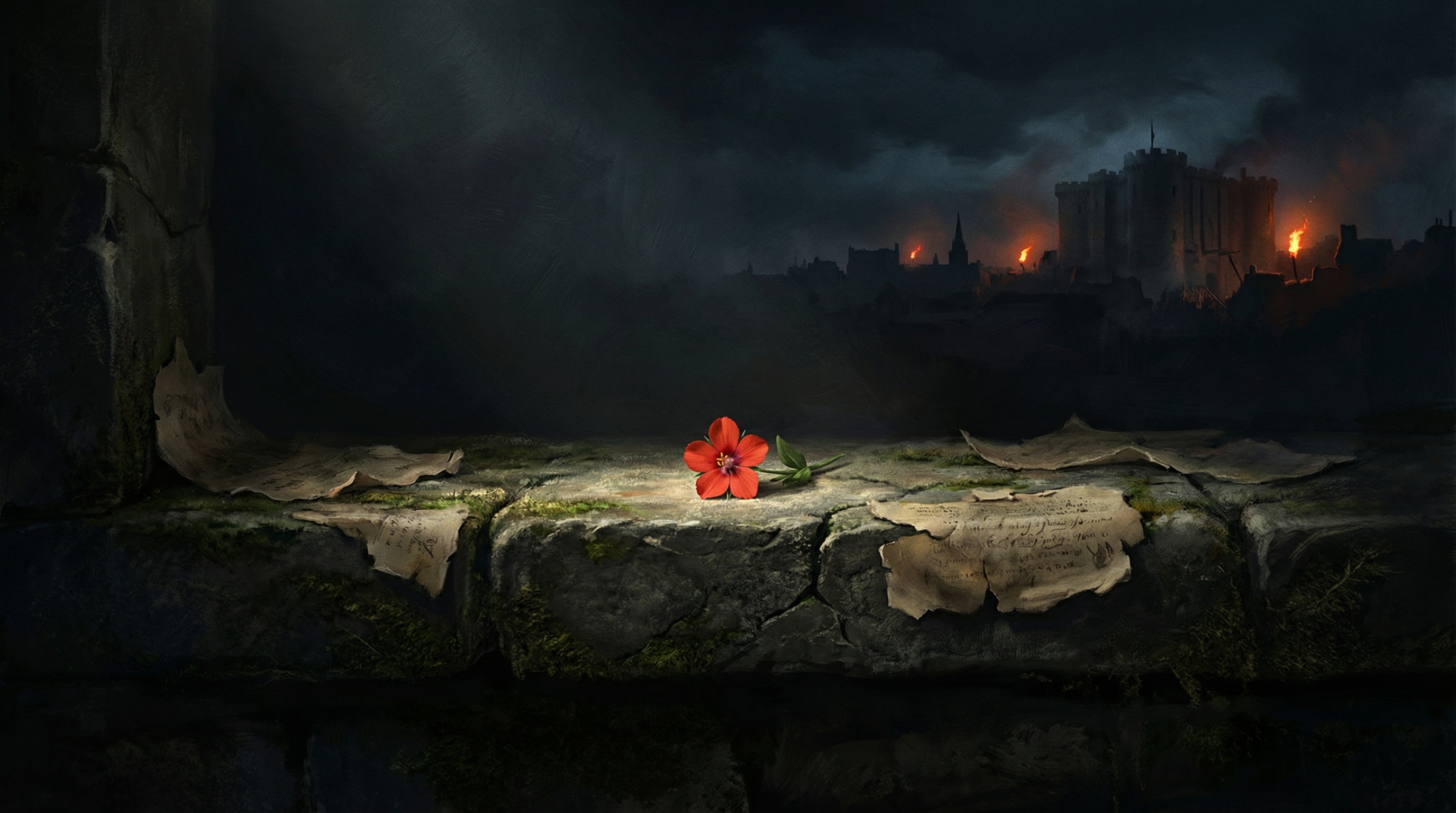
An excerpt from the original text.(complete · 2182 words)
THE OUTRAGE
A beautiful starlit night had followed on the day of incessant rain: a
cool, balmy, late summer’s night, essentially English in its suggestion
of moisture and scent of wet earth and dripping leaves.
The magnificent coach, drawn by four of the finest thoroughbreds in
England, had driven off along the London road, with Sir Percy Blakeney
on the box, holding the reins in his slender feminine hands, and beside
him Lady Blakeney wrapped in costly furs. A fifty-mile drive on a
starlit summer’s night! Marguerite had hailed the notion of it with
delight. . . . Sir Percy was an enthusiastic whip; his four
thoroughbreds, which had been sent down to Dover a couple of days
before, were just sufficiently fresh and restive to add zest to the
expedition, and Marguerite revelled in anticipation of the few hours of
solitude, with the soft night breeze fanning her cheeks, her thoughts
wandering, whither away? She knew from old experience that Sir Percy
would speak little, if at all: he had often driven her on his beautiful
coach for hours at night, from point to point, without making more than
one or two casual remarks upon the weather or the state of the roads.
He was very fond of driving by night, and she had very quickly adopted
his fancy: as she sat next to him hour after hour, admiring the
dexterous, certain way in which he handled the reins, she often
wondered what went on in that slow-going head of his. He never told
her, and she had never cared to ask.
At “The Fisherman’s Rest” Mr. Jellyband was going the round, putting
out the lights. His bar customers had all gone, but upstairs in the
snug little bedrooms, Mr. Jellyband had quite a few important guests:
the Comtesse de Tournay, with Suzanne, and the Vicomte, and there were
two more bedrooms ready for Sir Andrew Ffoulkes and Lord Antony
Dewhurst, if the two young men should elect to honour the ancient
hostelry and stay the night.
For the moment these two young gallants were comfortably installed in
the coffee-room, before the huge log-fire, which, in spite of the
mildness of the evening, had been allowed to burn merrily.
“I say, Jelly, has everyone gone?” asked Lord Tony, as the worthy
landlord still busied himself clearing away glasses and mugs.
“Everyone, as you see, my lord.”
“And all your servants gone to bed?”
“All except the boy on duty in the bar, and,” added Mr. Jellyband with
a laugh, “I expect he’ll be asleep afore long, the rascal.”
“Then we can talk here undisturbed for half an hour?”
“At your service, my lord. . . . I’ll leave your candles on the dresser
. . . and your rooms are quite ready . . . I sleep at the top of the
house myself, but if your lordship’ll only call loudly enough, I
daresay I shall hear.”
“All right, Jelly . . . and . . . I say, put the lamp out—the fire’ll
give us all the light we need—and we don’t want to attract the
passer-by.”
“All ri’, my lord.”
Mr. Jellyband did as he was bid—he turned out the quaint old lamp that
hung from the raftered ceiling and blew out all the candles.
“Let’s have a bottle of wine, Jelly,” suggested Sir Andrew.
“All ri’, sir!”
Jellyband went off to fetch the wine. The room now was quite dark, save
for the circle of ruddy and fitful light formed by the brightly blazing
logs in the hearth.
“Is that all, gentlemen?” asked Jellyband, as he returned with a bottle
of wine and a couple of glasses, which he placed on the table.
“That’ll do nicely, thanks, Jelly!” said Lord Tony.
“Good-night, my lord! Good-night, sir!”
“Good-night, Jelly!”
The two young men listened, whilst the heavy tread of Mr. Jellyband was
heard echoing along the passage and staircase. Presently even that
sound died out, and the whole of “The Fisherman’s Rest” seemed wrapt in
sleep, save the two young men drinking in silence beside the hearth.
For a while no sound was heard, even in the coffee-room, save the
ticking of the old grandfather’s clock and the crackling of the burning
wood.
“All right again this time, Ffoulkes?” asked Lord Antony at last.
Sir Andrew had been dreaming evidently, gazing into the fire, and
seeing therein, no doubt, a pretty, piquant face, with large brown eyes
and a wealth of dark curls round a childish forehead.
“Yes!” he said, still musing, “all right!”
“No hitch?”
“None.”
Lord Antony laughed pleasantly as he poured himself out another glass
of wine.
“I need not ask, I suppose, whether you found the journey pleasant this
time?”
“No, friend, you need not ask,” replied Sir Andrew, gaily. “It was all
right.”
“Then here’s to her very good health,” said jovial Lord Tony. “She’s a
bonnie lass, though she is a French one. And here’s to your
courtship—may it flourish and prosper exceedingly.”
He drained his glass to the last drop, then joined his friend beside
the hearth.
“Well! you’ll be doing the journey next, Tony, I expect,” said Sir
Andrew, rousing himself from his meditations, “you and Hastings,
certainly; and I hope you may have as pleasant a task as I had, and as
charming a travelling companion. You have no idea, Tony. . . .”
“No! I haven’t,” interrupted his friend pleasantly, “but I’ll take your
word for it. And now,” he added, whilst a sudden earnestness crept over
his jovial young face, “how about business?”
The two young men drew their chairs closer together, and
instinctively, though they were alone, their voices sank to a whisper.
“I saw the Scarlet Pimpernel alone, for a few moments in Calais,” said
Sir Andrew, “a day or two ago. He crossed over to England two days
before we did. He had escorted the party all the way from Paris,
dressed—you’ll never credit it!—as an old market woman, and
driving—until they were safely out of the city—the covered cart, under
which the Comtesse de Tournay, Mlle. Suzanne, and the Vicomte lay
concealed among the turnips and cabbages. They, themselves, of course,
never suspected who their driver was. He drove them right through a
line of soldiery and a yelling mob, who were screaming, ‘À bas les
aristos!’ But the market cart got through along with some others, and
the Scarlet Pimpernel, in shawl, petticoat and hood, yelled ‘À bas les
aristos!’ louder than anybody. Faith!” added the young man, as his eyes
glowed with enthusiasm for the beloved leader, “that man’s a marvel!
His cheek is preposterous, I vow!—and that’s what carries him through.”
Lord Antony, whose vocabulary was more limited than that of his friend,
could only find an oath or two with which to show his admiration for
his leader.
“He wants you and Hastings to meet him at Calais,” said Sir Andrew,
more quietly, “on the 2nd of next month. Let me see! that will be next
Wednesday.”
“Yes.”
“It is, of course, the case of the Comte de Tournay, this time; a
dangerous task, for the Comte, whose escape from his château, after he
had been declared a ‘suspect’ by the Committee of Public Safety, was a
masterpiece of the Scarlet Pimpernel’s ingenuity, is now under sentence
of death. It will be rare sport to get him out of France, and you
will have a narrow escape, if you get through at all. St. Just has
actually gone to meet him—of course, no one suspects St. Just as yet;
but after that . . . to get them both out of the country! I’faith,
’twill be a tough job, and tax even the ingenuity of our chief. I hope
I may yet have orders to be of the party.”
“Have you any special instructions for me?”
“Yes! rather more precise ones than usual. It appears that the
Republican Government have sent an accredited agent over to England, a
man named Chauvelin, who is said to be terribly bitter against our
league, and determined to discover the identity of our leader, so that
he may have him kidnapped, the next time he attempts to set foot in
France. This Chauvelin has brought a whole army of spies with him, and
until the chief has sampled the lot, he thinks we should meet as seldom
as possible on the business of the league, and on no account should
talk to each other in public places for a time. When he wants to speak
to us, he will contrive to let us know.”
The two young men were both bending over the fire, for the blaze had
died down, and only a red glow from the dying embers cast a lurid light
on a narrow semicircle in front of the hearth. The rest of the room lay
buried in complete gloom; Sir Andrew had taken a pocket-book from his
pocket, and drawn therefrom a paper, which he unfolded, and together
they tried to read it by the dim red firelight. So intent were they
upon this, so wrapt up in the cause, the business they had so much at
heart, so precious was this document which came from the very hand of
their adored leader, that they had eyes and ears only for that. They
lost count of the sounds around them, of the dropping of crisp ash from
the grate, of the monotonous ticking of the clock, of the soft, almost
imperceptible rustle of something on the floor close beside them. A
figure had emerged from under one of the benches; with snake-like,
noiseless movements it crept closer and closer to the two young men,
not breathing, only gliding along the floor, in the inky blackness of
the room.
“You are to read these instructions and commit them to memory,” said
Sir Andrew, “then destroy them.”
He was about to replace the letter-case into his pocket, when a tiny
slip of paper fluttered from it and fell on to the floor. Lord Antony
stooped and picked it up.
“What’s that?” he asked.
“I don’t know,” replied Sir Andrew.
“It dropped out of your pocket just now. It certainly did not seem to
be with the other paper.”
“Strange!—I wonder when it got there? It is from the chief,” he added,
glancing at the paper.
Both stooped to try and decipher this last tiny scrap of paper on which
a few words had been hastily scrawled, when suddenly a slight noise
attracted their attention, which seemed to come from the passage
beyond.
“What’s that?” said both instinctively. Lord Antony crossed the room
towards the door, which he threw open quickly and suddenly; at that
very moment he received a stunning blow between the eyes, which threw
him back violently into the room. Simultaneously the crouching,
snake-like figure in the gloom had jumped up and hurled itself from
behind upon the unsuspecting Sir Andrew, felling him to the ground.
All this occurred within the short space of two or three seconds, and
before either Lord Antony or Sir Andrew had time or chance to utter a
cry or to make the faintest struggle. They were each seized by two men,
a muffler was quickly tied round the mouth of each, and they were
pinioned to one another back to back, their arms, hands, and legs
securely fastened.
One man had in the meanwhile quietly shut the door; he wore a mask and
now stood motionless while the others completed their work.
“All safe, citoyen!” said one of the men, as he took a final survey of
the bonds which secured the two young men.
“Good!” replied the man at the door; “now search their pockets and give
me all the papers you find.”
This was promptly and quietly done. The masked man having taken
possession of all the papers, listened for a moment or two if there
were any sound within “The Fisherman’s Rest.” Evidently satisfied that
this dastardly outrage had remained unheard, he once more opened the
door and pointed peremptorily down the passage. The four men lifted Sir
Andrew and Lord Antony from the ground, and as quietly, as noiselessly
as they had come, they bore the two pinioned young gallants out of the
inn and along the Dover Road into the gloom beyond.
In the coffee-room the masked leader of this daring attempt was quickly
glancing through the stolen papers.
“Not a bad day’s work on the whole,” he muttered, as he quietly took
off his mask, and his pale, fox-like eyes glittered in the red glow of
the fire. “Not a bad day’s work.”
He opened one or two more letters from Sir Andrew Ffoulkes’
pocket-book, noted the tiny scrap of paper which the two young men had
only just had time to read; but one letter specially, signed Armand St.
Just, seemed to give him strange satisfaction.
“Armand St. Just a traitor after all,” he murmured. “Now, fair
Marguerite Blakeney,” he added viciously between his clenched teeth, “I
think that you will help me to find the Scarlet Pimpernel.”
Master this chapter. Complete your experience
Purchase the complete book to access all chapters and support classic literature
As an Amazon Associate, we earn a small commission from qualifying purchases at no additional cost to you.
Available in paperback, hardcover, and e-book formats
Let's Analyse the Pattern
Competent people drop their guard in familiar environments, creating opportunities for those who understand this predictable vulnerability.
Why This Matters
Connect literature to life
This chapter teaches how to scan for hidden dangers in seemingly safe spaces before sharing sensitive information.
Practice This Today
This week, notice when you discuss important matters—do a literal 360-degree scan first and ask yourself who would benefit from overhearing this conversation.
Now let's explore the literary elements.
Key Quotes & Analysis
"She often wondered what went on in that slow-going head of his."
Context: Marguerite thinking about Percy during their quiet drive
This reveals the emotional distance in their marriage despite physical closeness. Marguerite sees Percy as slow-witted, not realizing his quiet nature hides his secret identity and the weight of dangerous responsibilities.
In Today's Words:
She couldn't figure out what he was really thinking about.
"The French government has sent Chauvelin to England specifically to unmask the Scarlet Pimpernel."
Context: During their fateful conversation at the inn
This quote shows how high the stakes have become - this isn't just local trouble but an international manhunt. It also reveals how carelessly they're discussing life-or-death secrets in a public place.
In Today's Words:
The French sent their best agent here just to catch our guy.
"He can use Marguerite's brother against her to force her help."
Context: Chauvelin's realization after reading Armand's letter
This reveals Chauvelin's ruthless strategy - he understands that threatening family is the most effective way to control someone. It shows how personal relationships become weapons in political conflicts.
In Today's Words:
He's going to blackmail her using her brother to make her cooperate.
Thematic Threads
Deception
In This Chapter
Chauvelin uses stealth and misdirection to capture the men while they believe themselves safe
Development
Evolved from earlier social deceptions to deadly operational deception with real consequences
In Your Life:
You might face this when someone lets you believe you're safe while gathering information to use against you.
Class
In This Chapter
The aristocratic rescue network's informal, gentlemanly approach proves inadequate against professional espionage
Development
Continued theme of class privilege creating blind spots in practical situations
In Your Life:
You might see this when people from privileged backgrounds underestimate street-smart opponents.
Identity
In This Chapter
The Scarlet Pimpernel's secret identity becomes a weapon against his own network when operational details are compromised
Development
Identity secrecy, previously protective, now creates vulnerability through the people who know pieces of it
In Your Life:
You might experience this when keeping secrets requires trusting others, making you vulnerable to their mistakes.
Personal Relationships
In This Chapter
Chauvelin plans to exploit Marguerite's love for her brother Armand to force her cooperation
Development
Relationships shift from background elements to primary weapons in the conflict
In Your Life:
You might face this when someone threatens people you love to control your behavior.
Human Relationships
In This Chapter
Trust between the rescue network members becomes their greatest vulnerability when exploited by enemies
Development
Trust, previously shown as strength, now reveals its dangerous side when security is compromised
In Your Life:
You might encounter this when your loyalty to friends or family is used to manipulate you into harmful situations.
You now have the context. Time to form your own thoughts.
Discussion Questions
- 1
What specific mistake did Sir Andrew and Lord Tony make that led to their capture?
analysis • surface - 2
Why did Chauvelin choose to wait and listen rather than attack immediately when he discovered them?
analysis • medium - 3
Where have you seen people drop their guard in 'safe' spaces and accidentally reveal sensitive information?
application • medium - 4
How would you create a personal system to avoid discussing sensitive topics in potentially unsafe environments?
application • deep - 5
What does this chapter reveal about how success can make us vulnerable to our enemies?
reflection • deep
Critical Thinking Exercise
Map Your Information Vulnerabilities
Think about the sensitive information in your life - work situations, family issues, financial concerns, relationship problems. Map out where you typically discuss these topics and who might overhear. Then identify three specific places or situations where you need better information security.
Consider:
- •Consider both obvious listeners (coworkers, family members) and hidden ones (people in adjacent restaurant booths, neighbors)
- •Think about digital vulnerabilities too - phone calls in public, texts that could be seen over your shoulder
- •Remember that the most dangerous listeners are often those who seem friendly or harmless
Journaling Prompt
Write about a time when information you shared privately ended up causing problems. What would you do differently now, knowing what you know about information security?
Coming Up Next...
Chapter 10: Trapped in the Opera Box
The scene shifts to London's glittering opera house, where Marguerite will face an impossible choice between her brother's life and her husband's secret mission. Chauvelin is ready to play his hand.



