
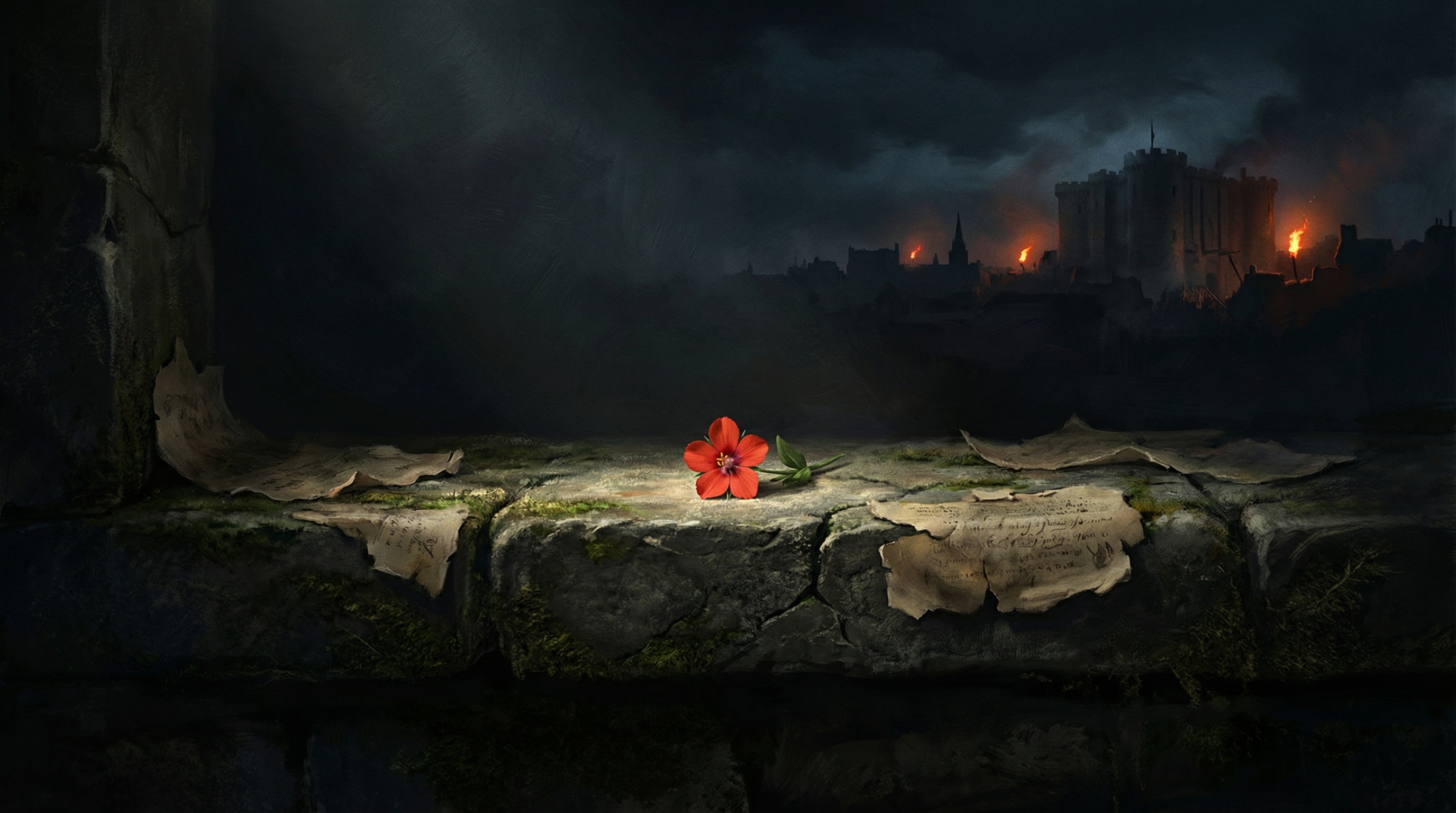
An excerpt from the original text.(complete · 2535 words)
THE REFUGEES
Feeling in every part of England certainly ran very high at this time
against the French and their doings. Smugglers and legitimate traders
between the French and English coasts brought snatches of news from
over the water, which made every honest Englishman’s blood boil, and
made him long to have “a good go” at those murderers, who had
imprisoned their king and all his family, subjected the queen and the
royal children to every species of indignity, and were even now loudly
demanding the blood of the whole Bourbon family and of every one of its
adherents.
The execution of the Princesse de Lamballe, Marie Antoinette’s young
and charming friend, had filled everyone in England with unspeakable
horror, the daily execution of scores of royalists of good family,
whose only sin was their aristocratic name, seemed to cry for vengeance
to the whole of civilised Europe.
Yet, with all that, no one dared to interfere. Burke had exhausted all
his eloquence in trying to induce the British Government to fight the
revolutionary government of France, but Mr. Pitt, with characteristic
prudence, did not feel that this country was fit yet to embark on
another arduous and costly war. It was for Austria to take the
initiative; Austria, whose fairest daughter was even now a dethroned
queen, imprisoned and insulted by a howling mob; and surely ’twas
not—so argued Mr. Fox—for the whole of England to take up arms, because
one set of Frenchmen chose to murder another.
As for Mr. Jellyband and his fellow John Bulls, though they looked upon
all foreigners with withering contempt, they were royalist and
anti-revolutionists to a man, and at this present moment were furious
with Pitt for his caution and moderation, although they naturally
understood nothing of the diplomatic reasons which guided that great
man’s policy.
But now Sally came running back, very excited and very eager. The
joyous company in the coffee-room had heard nothing of the noise
outside, but she had spied a dripping horse and rider who had stopped
at the door of “The Fisherman’s Rest,” and while the stable boy ran
forward to take charge of the horse, pretty Miss Sally went to the
front door to greet the welcome visitor.
“I think I see’d my Lord Antony’s horse out in the yard, father,” she
said, as she ran across the coffee-room.
But already the door had been thrown open from outside, and the next
moment an arm, covered in drab cloth and dripping with the heavy rain,
was round pretty Sally’s waist, while a hearty voice echoed along the
polished rafters of the coffee-room.
“Aye, and bless your brown eyes for being so sharp, my pretty Sally,”
said the man who had just entered, whilst worthy Mr. Jellyband came
bustling forward, eager, alert and fussy, as became the advent of one
of the most favoured guests of his hostel.
“Lud, I protest, Sally,” added Lord Antony, as he deposited a kiss on
Miss Sally’s blooming cheeks, “but you are growing prettier and
prettier every time I see you—and my honest friend, Jellyband here,
must have hard work to keep the fellows off that slim waist of yours.
What say you, Mr. Waite?”
Mr. Waite—torn between his respect for my lord and his dislike of that
particular type of joke—only replied with a doubtful grunt.
Lord Antony Dewhurst, one of the sons of the Duke of Exeter, was in
those days a very perfect type of a young English gentleman—tall, well
set-up, broad of shoulders and merry of face, his laughter rang loudly
wherever he went. A good sportsman, a lively companion, a courteous,
well-bred man of the world, with not too much brains to spoil his
temper, he was a universal favourite in London drawing-rooms or in the
coffee-rooms of village inns. At “The Fisherman’s Rest” everyone knew
him—for he was fond of a trip across to France, and always spent a
night under worthy Mr. Jellyband’s roof on his way there or back.
He nodded to Waite, Pitkin and the others as he at last released
Sally’s waist, and crossed over to the hearth to warm and dry himself:
as he did so, he cast a quick, somewhat suspicious glance at the two
strangers, who had quietly resumed their game of dominoes, and for a
moment a look of deep earnestness, even of anxiety, clouded his jovial
young face.
But only for a moment; the next he had turned to Mr. Hempseed, who was
respectfully touching his forelock.
“Well, Mr. Hempseed, and how is the fruit?”
“Badly, my lord, badly,” replied Mr. Hempseed, dolefully, “but what can
you ’xpect with this ’ere government favourin’ them rascals over in
France, who would murder their king and all their nobility.”
“Odd’s life!” retorted Lord Antony; “so they would, honest Hempseed,—at
least those they can get hold of, worse luck! But we have got some
friends coming here to-night, who at any rate have evaded their
clutches.”
It almost seemed, when the young man said these words, as if he threw a
defiant look towards the quiet strangers in the corner.
“Thanks to you, my lord, and to your friends, so I’ve heard it said,”
said Mr. Jellyband.
But in a moment Lord Antony’s hand fell warningly on mine host’s arm.
“Hush!” he said peremptorily, and instinctively once again looked
towards the strangers.
“Oh! Lud love you, they are all right, my lord,” retorted Jellyband;
“don’t you be afraid. I wouldn’t have spoken, only I knew we were among
friends. That gentleman over there is as true and loyal a subject of
King George as you are yourself, my lord, saving your presence. He is
but lately arrived in Dover, and is settling down in business in these
parts.”
“In business? Faith, then, it must be as an undertaker, for I vow I
never beheld a more rueful countenance.”
“Nay, my lord, I believe that the gentleman is a widower, which no
doubt would account for the melancholy of his bearing—but he is a
friend, nevertheless, I’ll vouch for that—and you will own, my lord,
that who should judge of a face better than the landlord of a popular
inn—”
“Oh, that’s all right, then, if we are among friends,” said Lord
Antony, who evidently did not care to discuss the subject with his
host. “But, tell me, you have no one else staying here, have you?”
“No one, my lord, and no one coming, either, leastways—”
“Leastways?”
“No one your lordship would object to, I know.”
“Who is it?”
“Well, my lord, Sir Percy Blakeney and his lady will be here presently,
but they ain’t a-goin’ to stay—”
“Lady Blakeney?” queried Lord Antony, in some astonishment.
“Aye, my lord. Sir Percy’s skipper was here just now. He says that my
lady’s brother is crossing over to France to-day in the Day Dream,
which is Sir Percy’s yacht, and Sir Percy and my lady will come with
him as far as here to see the last of him. It don’t put you out, do it,
my lord?”
“No, no, it doesn’t put me out, friend; nothing will put me out, unless
that supper is not the very best which Miss Sally can cook, and which
has ever been served in ‘The Fisherman’s Rest.’”
“You need have no fear of that, my lord,” said Sally, who all this
while had been busy setting the table for supper. And very gay and
inviting it looked, with a large bunch of brilliantly coloured dahlias
in the centre, and the bright pewter goblets and blue china about.
“How many shall I lay for, my lord?”
“Five places, pretty Sally, but let the supper be enough for ten at
least—our friends will be tired, and, I hope, hungry. As for me, I vow
I could demolish a baron of beef to-night.”
“Here they are, I do believe,” said Sally, excitedly, as a distant
clatter of horses and wheels could now be distinctly heard, drawing
rapidly nearer.
There was general commotion in the coffee-room. Everyone was curious to
see my Lord Antony’s swell friends from over the water. Miss Sally cast
one or two quick glances at the little bit of mirror which hung on the
wall, and worthy Mr. Jellyband bustled out in order to give the first
welcome himself to his distinguished guests. Only the two strangers in
the corner did not participate in the general excitement. They were
calmly finishing their game of dominoes, and did not even look once
towards the door.
“Straight ahead, Comtesse, the door on your right,” said a pleasant
voice outside.
“Aye! there they are, all right enough,” said Lord Antony, joyfully;
“off with you, my pretty Sally, and see how quickly you can dish up the
soup.”
The door was thrown wide open, and, preceded by Mr. Jellyband, who was
profuse in his bows and welcomes, a party of four—two ladies and two
gentlemen—entered the coffee-room.
“Welcome! Welcome to old England!” said Lord Antony, effusively, as he
came eagerly forward with both hands outstretched towards the
newcomers.
“Ah, you are Lord Antony Dewhurst, I think,” said one of the ladies,
speaking with a strong foreign accent.
“At your service, Madame,” he replied, as he ceremoniously kissed the
hands of both the ladies, then turned to the men and shook them both
warmly by the hand.
Sally was already helping the ladies to take off their travelling
cloaks, and both turned, with a shiver, towards the brightly-blazing
hearth.
There was a general movement among the company in the coffee-room.
Sally had bustled off to her kitchen, whilst Jellyband, still profuse
with his respectful salutations, arranged one or two chairs around the
fire. Mr. Hempseed, touching his forelock, was quietly vacating the
seat in the hearth. Everyone was staring curiously, yet deferentially,
at the foreigners.
“Ah, Messieurs! what can I say?” said the elder of the two ladies, as
she stretched a pair of fine, aristocratic hands to the warmth of the
blaze, and looked with unspeakable gratitude first at Lord Antony, then
at one of the young men who had accompanied her party, and who was busy
divesting himself of his heavy, caped coat.
“Only that you are glad to be in England, Comtesse,” replied Lord
Antony, “and that you have not suffered too much from your trying
voyage.”
“Indeed, indeed, we are glad to be in England,” she said, while her
eyes filled with tears, “and we have already forgotten all that we have
suffered.”
Her voice was musical and low, and there was a great deal of calm
dignity and of many sufferings nobly endured marked in the handsome,
aristocratic face, with its wealth of snow-white hair dressed high
above the forehead, after the fashion of the times.
“I hope my friend, Sir Andrew Ffoulkes, proved an entertaining
travelling companion, Madame?”
“Ah, indeed, Sir Andrew was kindness itself. How could my children and
I ever show enough gratitude to you all, Messieurs?”
Her companion, a dainty, girlish figure, childlike and pathetic in its
look of fatigue and of sorrow, had said nothing as yet, but her eyes,
large, brown, and full of tears, looked up from the fire and sought
those of Sir Andrew Ffoulkes, who had drawn near to the hearth and to
her; then, as they met his, which were fixed with unconcealed
admiration upon the sweet face before him, a thought of warmer colour
rushed up to her pale cheeks.
“So this is England,” she said, as she looked round with childlike
curiosity at the great open hearth, the oak rafters, and the yokels
with their elaborate smocks and jovial, rubicund, British countenances.
“A bit of it, Mademoiselle,” replied Sir Andrew, smiling, “but all of
it, at your service.”
The young girl blushed again, but this time a bright smile, fleet and
sweet, illumined her dainty face. She said nothing, and Sir Andrew too
was silent, yet those two young people understood one another, as young
people have a way of doing all the world over, and have done since the
world began.
“But, I say, supper!” here broke in Lord Antony’s jovial voice,
“supper, honest Jellyband. Where is that pretty wench of yours and the
dish of soup? Zooks, man, while you stand there gaping at the ladies,
they will faint with hunger.”
“One moment! one moment, my lord,” said Jellyband, as he threw open the
door that led to the kitchen and shouted lustily: “Sally! Hey, Sally
there, are ye ready, my girl?”
Sally was ready, and the next moment she appeared in the doorway
carrying a gigantic tureen, from which rose a cloud of steam and an
abundance of savoury odour.
“Odd’s my life, supper at last!” ejaculated Lord Antony, merrily, as he
gallantly offered his arm to the Comtesse.
“May I have the honour?” he added ceremoniously, as he led her towards
the supper table.
There was general bustle in the coffee-room: Mr. Hempseed and most of
the yokels and fisher-folk had gone to make way for “the quality,” and
to finish smoking their pipes elsewhere. Only the two strangers stayed
on, quietly and unconcernedly playing their game of dominoes and
sipping their wine; whilst at another table Harry Waite, who was fast
losing his temper, watched pretty Sally bustling round the table.
She looked a very dainty picture of English rural life, and no wonder
that the susceptible young Frenchman could scarce take his eyes off her
pretty face. The Vicomte de Tournay was scarce nineteen, a beardless
boy, on whom the terrible tragedies which were being enacted in his own
country had made but little impression. He was elegantly and even
foppishly dressed, and once safely landed in England he was evidently
ready to forget the horrors of the Revolution in the delights of
English life.
“Pardi, if zis is England,” he said as he continued to ogle Sally with
marked satisfaction, “I am of it satisfied.”
It would be impossible at this point to record the exact exclamation
which escaped through Mr. Harry Waite’s clenched teeth. Only respect
for “the quality,” and notably for my Lord Antony, kept his marked
disapproval of the young foreigner in check.
“Nay, but this is England, you abandoned young reprobate,” interposed
Lord Antony with a laugh, “and do not, I pray, bring your loose foreign
ways into this most moral country.”
Lord Antony had already sat down at the head of the table with the
Comtesse on his right. Jellyband was bustling round, filling glasses
and putting chairs straight. Sally waited, ready to hand round the
soup. Mr. Harry Waite’s friends had at last succeeded in taking him out
of the room, for his temper was growing more and more violent under the
Vicomte’s obvious admiration for Sally.
“Suzanne,” came in stern, commanding accents from the rigid Comtesse.
Suzanne blushed again; she had lost count of time and of place whilst
she had stood beside the fire, allowing the handsome young Englishman’s
eyes to dwell upon her sweet face, and his hand, as if unconsciously,
to rest upon hers. Her mother’s voice brought her back to reality once
more, and with a submissive “Yes, Mama,” she too took her place at the
supper table.
Master this chapter. Complete your experience
Purchase the complete book to access all chapters and support classic literature
As an Amazon Associate, we earn a small commission from qualifying purchases at no additional cost to you.
Available in paperback, hardcover, and e-book formats
Let's Analyse the Pattern
When survival is threatened, people rapidly form protective alliances based on shared vulnerability rather than traditional social connections.
Why This Matters
Connect literature to life
This chapter teaches how to quickly assess who can be trusted and who shares your mission when stakes are high.
Practice This Today
This week, notice how people position themselves during tense meetings—who makes eye contact with whom, who stays alert to outsiders, who offers help without being asked.
Now let's explore the literary elements.
Key Quotes & Analysis
"It was for Austria to take the initiative; Austria, whose fairest daughter was even now a dethroned queen, imprisoned and insulted by a howling mob"
Context: Explaining why England hesitates to intervene in French affairs
This reveals the political calculations behind international relations. Even when horrible things are happening, governments weigh their own interests before acting. The reference to Marie Antoinette as Austria's daughter shows how royal marriages were political alliances.
In Today's Words:
Everyone's waiting for someone else to make the first move, even though they all know what's happening is wrong
"Surely 'twas not for the whole of England to take up arms, because one set of Frenchmen chose to murder another"
Context: Political debate about whether England should intervene in French Revolution
This shows how people can dismiss atrocities as 'not our problem' when intervention seems costly or risky. It reveals the cold political calculation that treats human suffering as someone else's internal affair.
In Today's Words:
Why should we get involved in their mess? Let them sort it out themselves
"The daily execution of scores of royalists of good family, whose only sin was their aristocratic name, seemed to cry for vengeance to the whole of civilised Europe"
Context: Describing English reaction to French Revolutionary violence
This captures how systematic persecution based on identity alone horrifies observers. The phrase 'whose only sin was their aristocratic name' emphasizes how people were being killed for what they were born as, not what they did.
In Today's Words:
They were literally killing people just for being born into the wrong family - it was insane
Thematic Threads
Trust
In This Chapter
Characters must quickly assess who can be trusted with their lives, from the mysterious strangers to the grateful refugees
Development
Introduced here as life-or-death necessity
In Your Life:
You face this same rapid trust assessment in any high-stakes situation, from job interviews to medical emergencies.
Class
In This Chapter
Aristocratic refugees must accept help from English commoners, while maintaining their dignity despite dependence
Development
Builds on earlier class tensions by showing how crisis can temporarily dissolve social barriers
In Your Life:
Financial hardship or health crises often force you to accept help from unexpected sources, challenging your pride.
Identity
In This Chapter
The refugees struggle to maintain their aristocratic identity while being completely dependent on others for survival
Development
Develops the theme by showing how external circumstances can threaten core identity
In Your Life:
Job loss, divorce, or major illness can leave you questioning who you are when your usual roles are stripped away.
Secrecy
In This Chapter
Lord Antony's wariness and careful glances suggest an organized rescue operation that requires absolute discretion
Development
Introduced here as protective necessity
In Your Life:
You keep certain information private to protect yourself or others, whether it's family problems or workplace politics.
Resilience
In This Chapter
The Comtesse maintains her dignity and manages her children despite losing everything, showing grace under extreme pressure
Development
Introduced here through aristocratic composure in crisis
In Your Life:
You've had to keep functioning and protecting others even when your own world was falling apart.
You now have the context. Time to form your own thoughts.
Discussion Questions
- 1
What signs tell Lord Antony that the two strangers in the corner might be dangerous to the French refugees?
analysis • surface - 2
Why do you think crisis situations like this one create instant bonds between people who just met?
analysis • medium - 3
Where have you seen people form these kinds of 'crisis networks' in your own community or workplace?
application • medium - 4
If you were in Lord Antony's position, how would you balance protecting the refugees while not appearing suspicious to potential enemies?
application • deep - 5
What does this chapter reveal about how people decide who to trust when their safety depends on it?
reflection • deep
Critical Thinking Exercise
Map Your Crisis Network
Think of a difficult time you've experienced - job loss, illness, family crisis, or major change. Draw a simple diagram showing who stepped up to help and who disappeared. Then identify what made the helpers different from the ones who vanished. This reveals your real support network versus your assumed one.
Consider:
- •Notice if helpers shared similar vulnerabilities or experiences
- •Consider whether the people who helped expected anything in return
- •Think about whether you maintained these relationships after the crisis passed
Journaling Prompt
Write about someone who surprised you by showing up during a difficult time. What did their support teach you about recognizing true allies?
Coming Up Next...
Chapter 4: The League Revealed
The mysterious rescue operation that brought these French nobles to safety is about to be revealed. Lord Antony's careful secrecy suggests something far more organized and dangerous than simple charity—and those quiet strangers in the corner may not be as harmless as the innkeeper believes.



