
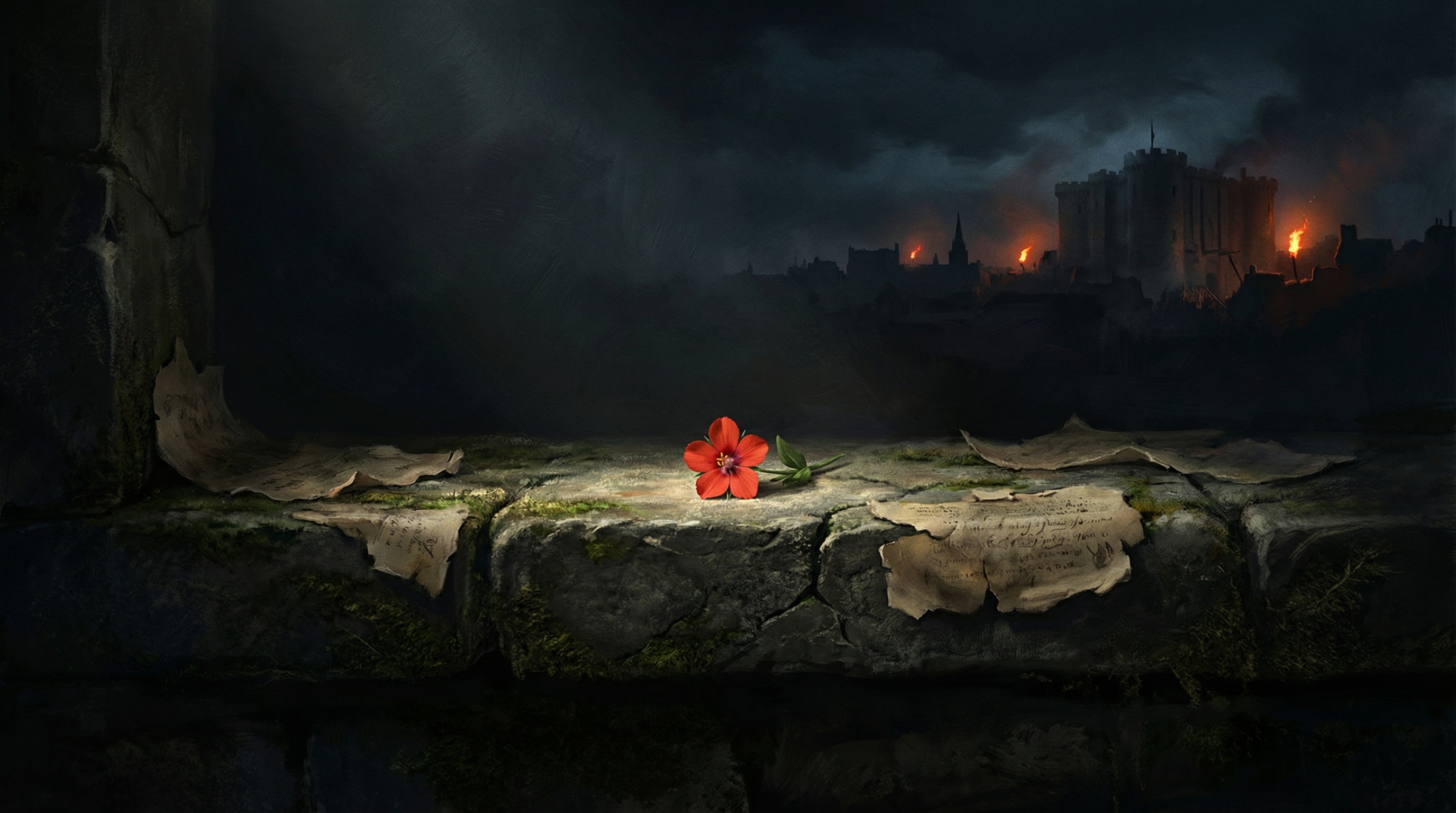
An excerpt from the original text.(complete · 2587 words)
ON THE TRACK
Never for a moment did Marguerite Blakeney hesitate. The last sounds
outside the “Chat Gris” had died away in the night. She had heard
Desgas giving orders to his men, and then starting off towards the
fort, to get a reinforcement of a dozen more men: six were not thought
sufficient to capture the cunning Englishman, whose resourceful brain
was even more dangerous than his valour and his strength.
Then a few minutes later, she heard the Jew’s husky voice again,
evidently shouting to his nag, then the rumble of wheels, and noise of
a rickety cart bumping over the rough road.
Inside the inn, everything was still. Brogard and his wife, terrified
of Chauvelin, had given no sign of life; they hoped to be forgotten,
and at any rate to remain unperceived: Marguerite could not even hear
their usual volleys of muttered oaths.
She waited a moment or two longer, then she quietly slipped down the
broken stairs, wrapped her dark cloak closely round her and slipped out
of the inn.
The night was fairly dark, sufficiently so at any rate to hide her dark
figure from view, whilst her keen ears kept count of the sound of the
cart going on ahead. She hoped by keeping well within the shadow of the
ditches which lined the road, that she would not be seen by Desgas’
men, when they approached, or by the patrols, which she concluded were
still on duty.
Thus she started to do this, the last stage of her weary journey,
alone, at night, and on foot. Nearly three leagues to Miquelon, and
then on to the Père Blanchard’s hut, wherever that fatal spot might be,
probably over rough roads: she cared not.
The Jew’s nag could not get on very fast, and though she was weary with
mental fatigue and nerve strain, she knew that she could easily keep up
with it, on a hilly road, where the poor beast, who was sure to be
half-starved, would have to be allowed long and frequent rests. The
road lay some distance from the sea, bordered on either side by shrubs
and stunted trees, sparsely covered with meagre foliage, all turning
away from the North, with their branches looking in the semi-darkness,
like stiff, ghostly hair, blown by a perpetual wind.
Fortunately, the moon showed no desire to peep between the clouds, and
Marguerite hugging the edge of the road, and keeping close to the low
line of shrubs, was fairly safe from view. Everything around her was so
still: only from far, very far away, there came like a long, soft moan,
the sound of the distant sea.
The air was keen and full of brine; after that enforced period of
inactivity, inside the evil-smelling, squalid inn, Marguerite would
have enjoyed the sweet scent of this autumnal night, and the distant
melancholy rumble of the waves; she would have revelled in the calm and
stillness of this lonely spot, a calm, broken only at intervals by the
strident and mournful cry of some distant gull, and by the creaking of
the wheels, some way down the road: she would have loved the cool
atmosphere, the peaceful immensity of Nature, in this lonely part of
the coast: but her heart was too full of cruel foreboding, of a great
ache and longing for a being who had become infinitely dear to her.
Her feet slipped on the grassy bank, for she thought it safest not to
walk near the centre of the road, and she found it difficult to keep up
a sharp pace along the muddy incline. She even thought it best not to
keep too near to the cart; everything was so still, that the rumble of
the wheels could not fail to be a safe guide.
The loneliness was absolute. Already the few dim lights of Calais lay
far behind, and on this road there was not a sign of human habitation,
not even the hut of a fisherman or of a woodcutter anywhere near; far
away on her right was the edge of the cliff, below it the rough beach,
against which the incoming tide was dashing itself with its constant,
distant murmur. And ahead the rumble of the wheels, bearing an
implacable enemy to his triumph.
Marguerite wondered at what particular spot, on this lonely coast,
Percy could be at this moment. Not very far surely, for he had had less
than a quarter of an hour’s start of Chauvelin. She wondered if he knew
that in this cool, ocean-scented bit of France, there lurked many
spies, all eager to sight his tall figure, to track him to where his
unsuspecting friends waited for him, and then, to close the net over
him and them.
Chauvelin, on ahead, jolted and jostled in the Jew’s vehicle, was
nursing comfortable thoughts. He rubbed his hands together, with
content, as he thought of the web which he had woven, and through which
that ubiquitous and daring Englishman could not hope to escape. As the
time went on, and the old Jew drove him leisurely but surely along the
dark road, he felt more and more eager for the grand finale of this
exciting chase after the mysterious Scarlet Pimpernel.
The capture of the audacious plotter would be the finest leaf in
Citoyen Chauvelin’s wreath of glory. Caught, red-handed, on the spot,
in the very act of aiding and abetting the traitors against the
Republic of France, the Englishman could claim no protection from his
own country. Chauvelin had, in any case, fully made up his mind that
all intervention should come too late.
Never for a moment did the slightest remorse enter his heart, as to the
terrible position in which he had placed the unfortunate wife, who had
unconsciously betrayed her husband. As a matter of fact, Chauvelin had
ceased even to think of her: she had been a useful tool, that was all.
The Jew’s lean nag did little more than walk. She was going along at a
slow jog trot, and her driver had to give her long and frequent halts.
“Are we a long way yet from Miquelon?” asked Chauvelin from time to
time.
“Not very far, your Honour,” was the uniform placid reply.
“We have not yet come across your friend and mine, lying in a heap in
the roadway,” was Chauvelin’s sarcastic comment.
“Patience, noble Excellency,” rejoined the son of Moses, “they are
ahead of us. I can see the imprint of the cart wheels, driven by that
traitor, that son of the Amalekite.”
“You are sure of the road?”
“As sure as I am of the presence of those ten gold pieces in the noble
Excellency’s pockets, which I trust will presently be mine.”
“As soon as I have shaken hands with my friend the tall stranger, they
will certainly be yours.”
“Hark, what was that?” said the Jew suddenly.
Through the stillness, which had been absolute, there could now be
heard distinctly the sound of horses’ hoofs on the muddy road.
“They are soldiers,” he added in an awed whisper.
“Stop a moment, I want to hear,” said Chauvelin.
Marguerite had also heard the sound of galloping hoofs, coming towards
the cart, and towards herself. For some time she had been on the alert
thinking that Desgas and his squad would soon overtake them, but these
came from the opposite direction, presumably from Miquelon. The
darkness lent her sufficient cover. She had perceived that the cart had
stopped, and with utmost caution, treading noiselessly on the soft
road, she crept a little nearer.
Her heart was beating fast, she was trembling in every limb; already
she had guessed what news these mounted men would bring. “Every
stranger on these roads or on the beach must be shadowed, especially if
he be tall or stoops as if he would disguise his height; when sighted a
mounted messenger must at once ride back and report.” Those had been
Chauvelin’s orders. Had then the tall stranger been sighted, and was
this the mounted messenger, come to bring the great news, that the
hunted hare had run its head into the noose at last?
Marguerite, realising that the cart had come to a standstill, managed
to slip nearer to it in the darkness; she crept close up, hoping to get
within earshot, to hear what the messenger had to say.
She heard the quick words of challenge—
“Liberté, Fraternité, Egalité!” then Chauvelin’s quick query:—
“What news?”
Two men on horseback had halted beside the vehicle.
Marguerite could see them silhouetted against the midnight sky. She
could hear their voices, and the snorting of their horses, and now,
behind her, some little distance off, the regular and measured tread of
a body of advancing men: Desgas and his soldiers.
There had been a long pause, during which, no doubt, Chauvelin
satisfied the men as to his identity, for presently, questions and
answers followed each other in quick succession.
“You have seen the stranger?” asked Chauvelin, eagerly.
“No, citoyen, we have seen no tall stranger; we came by the edge of the
cliff.”
“Then?”
“Less than a quarter of a league beyond Miquelon, we came across a
rough construction of wood, which looked like the hut of a fisherman,
where he might keep his tools and nets. When we first sighted it, it
seemed to be empty, and at first we thought that there was nothing
suspicious about it, until we saw some smoke issuing through an
aperture at the side. I dismounted and crept close to it. It was then
empty, but in one corner of the hut, there was a charcoal fire, and a
couple of stools were also in the hut. I consulted with my comrades,
and we decided that they should take cover with the horses, well out of
sight, and that I should remain on the watch, which I did.”
“Well! and did you see anything?”
“About half an hour later, I heard voices, citoyen, and presently, two
men came along towards the edge of the cliff; they seemed to me to have
come from the Lille Road. One was young, the other quite old. They were
talking in a whisper, to one another, and I could not hear what they
said.”
One was young, the other quite old. Marguerite’s aching heart almost stopped
beating as she listened: was the young one Armand?—her brother?—and the old one
de Tournay—were they the two fugitives who, unconsciously, were used as a
decoy, to entrap their fearless and noble rescuer.
“The two men presently went into the hut,” continued the soldier,
whilst Marguerite’s aching nerves seemed to catch the sound of
Chauvelin’s triumphant chuckle, “and I crept nearer to it then. The hut
is very roughly built, and I caught snatches of their conversation.”
“Yes?—Quick!—What did you hear?”
“The old man asked the young one if he were sure that was the right
place. ‘Oh, yes,’ he replied, ‘’tis the place sure enough,’ and by the
light of the charcoal fire he showed to his companion a paper, which he
carried. ‘Here is the plan,’ he said, ‘which he gave me before I left
London. We were to adhere strictly to that plan, unless I had contrary
orders, and I have had none. Here is the road we followed, see . . .
here the fork . . . here we cut across the St. Martin Road . . . and
here is the footpath which brought us to the edge of the cliff.’ I must
have made a slight noise then, for the young man came to the door of
the hut, and peered anxiously all round him. When he again joined his
companion, they whispered so low, that I could no longer hear them.”
“Well?—and?” asked Chauvelin, impatiently.
“There were six of us altogether, patrolling that part of the beach, so
we consulted together, and thought it best that four should remain
behind and keep the hut in sight, and I and my comrade rode back at
once to make report of what we had seen.”
“You saw nothing of the tall stranger?”
“Nothing, citoyen.”
“If your comrades see him, what would they do?”
“Not lose sight of him for a moment, and if he showed signs of escape,
or any boat came in sight, they would close in on him, and, if
necessary, they would shoot: the firing would bring the rest of the
patrol to the spot. In any case they would not let the stranger go.”
“Aye! but I did not want the stranger hurt—not just yet,” murmured
Chauvelin, savagely, “but there, you’ve done your best. The Fates grant
that I may not be too late . . .”
“We met half a dozen men just now, who have been patrolling this road
for several hours.”
“Well?”
“They have seen no stranger either.”
“Yet he is on ahead somewhere, in a cart or else . . . . Here! there is
not a moment to lose. How far is that hut from here?”
“About a couple of leagues, citoyen.”
“You can find it again?—at once?—without hesitation?”
“I have absolutely no doubt, citoyen.”
“The footpath, to the edge of the cliff?—Even in the dark?”
“It is not a dark night, citoyen, and I know I can find my way,”
repeated the soldier firmly.
“Fall in behind then. Let your comrade take both your horses back to
Calais. You won’t want them. Keep beside the cart, and direct the Jew
to drive straight ahead; then stop him, within a quarter of a league of
the footpath; see that he takes the most direct road.”
Whilst Chauvelin spoke, Desgas and his men were fast approaching, and
Marguerite could hear their footsteps within a hundred yards behind her
now. She thought it unsafe to stay where she was, and unnecessary too,
as she had heard enough. She seemed suddenly to have lost all faculty
even for suffering: her heart, her nerves, her brain seemed to have
become numb after all these hours of ceaseless anguish, culminating in
this awful despair.
For now there was absolutely not the faintest hope. Within two short
leagues of this spot, the fugitives were waiting for their brave
deliverer. He was on his way, somewhere on this lonely road, and
presently he would join them; then the well-laid trap would close, two
dozen men, led by one whose hatred was as deadly as his cunning was
malicious, would close round the small band of fugitives, and their
daring leader. They would all be captured. Armand, according to
Chauvelin’s pledged word, would be restored to her, but her husband,
Percy, whom with every breath she drew she seemed to love and worship
more and more, he would fall into the hands of a remorseless enemy, who
had no pity for a brave heart, no admiration for the courage of a noble
soul, who would show nothing but hatred for the cunning antagonist, who
had baffled him so long.
She heard the soldier giving a few brief directions to the Jew, then
she retired quickly to the edge of the road, and cowered behind some
low shrubs, whilst Desgas and his men came up.
All fell in noiselessly behind the cart, and slowly they all started
down the dark road. Marguerite waited until she reckoned that they were
well outside the range of earshot, then, she too in the darkness, which
suddenly seemed to have become more intense, crept noiselessly along.
Master this chapter. Complete your experience
Purchase the complete book to access all chapters and support classic literature
As an Amazon Associate, we earn a small commission from qualifying purchases at no additional cost to you.
Available in paperback, hardcover, and e-book formats
Let's Analyse the Pattern
When you cannot prevent disaster, your power lies in staying present to gather crucial information that others miss.
Why This Matters
Connect literature to life
This chapter teaches how to transform helpless observation into active intelligence gathering during crisis.
Practice This Today
This week, notice when you feel powerless to stop something bad—practice staying present to document what you observe rather than fleeing or freezing.
Now let's explore the literary elements.
Key Quotes & Analysis
"Never for a moment did Marguerite Blakeney hesitate."
Context: As Marguerite decides to follow the enemy convoy into the night
This shows her complete transformation from the conflicted woman of earlier chapters. When crisis hits, she becomes decisive and brave, even when the odds are impossible.
In Today's Words:
She didn't even think twice about it.
"Six were not thought sufficient to capture the cunning Englishman, whose resourceful brain was even more dangerous than his valour and his strength."
Context: Explaining why Desgas calls for reinforcements
Even his enemies recognize that Percy's greatest weapon is his intelligence, not just his physical abilities. It shows the respect he's earned through his clever escapes.
In Today's Words:
They knew he was too smart to take down with just a few guys.
"She hoped by keeping well within the shadow of the ditches which lined the road, that she would not be seen."
Context: As Marguerite begins following the convoy
This physical image of staying in shadows reflects her emotional state - she's operating in darkness, unseen, gathering information she may never be able to act on.
In Today's Words:
She stuck to the shadows, hoping nobody would spot her.
Thematic Threads
Information as Power
In This Chapter
Marguerite transforms from helpless wife to strategic intelligence gatherer, overhearing crucial details about the ambush
Development
Evolution from earlier chapters where information was used as weapon—now it becomes shield
In Your Life:
You might recognize this when you're the one who actually listens during family crises while others panic.
Love Through Action
In This Chapter
Marguerite's love expresses itself through dangerous witness-bearing rather than dramatic rescue attempts
Development
Deepening from romantic idealization to practical devotion requiring real sacrifice
In Your Life:
You see this when you stay present for someone's difficult journey instead of trying to fix everything.
Courage Under Powerlessness
In This Chapter
Following the enemy convoy knowing she cannot change the outcome but refusing to abandon her post
Development
Building from earlier physical courage to this more complex moral courage
In Your Life:
You experience this when you choose to witness difficult situations at work or home rather than flee.
Class and Vulnerability
In This Chapter
Aristocratic fugitives reduced to sitting ducks in a hut, while working-class Marguerite becomes the active agent
Development
Continued reversal of expected class roles and power dynamics
In Your Life:
You might notice this when formal authority figures become helpless and unexpected people step up.
Strategic Patience
In This Chapter
Marguerite resists the urge to rush ahead or interfere, instead maintaining disciplined observation
Development
Growing from earlier impulsive actions to calculated strategic thinking
In Your Life:
You use this when you resist the urge to jump in immediately and instead gather information first.
You now have the context. Time to form your own thoughts.
Discussion Questions
- 1
What specific information does Marguerite gather while following Chauvelin's convoy, and why does she choose to keep following despite knowing she can't stop what's happening?
analysis • surface - 2
How does Marguerite's role transform from desperate wife trying to save her husband to strategic observer gathering intelligence? What does this shift reveal about her character?
analysis • medium - 3
Think of a situation where someone you know had to witness something difficult they couldn't prevent—a layoff, a family crisis, a community problem. How did their presence and attention matter even when they couldn't fix things?
application • medium - 4
When you're facing a situation you can't control or stop, how do you decide whether to look away or bear witness? What factors help you determine when observation becomes your most powerful tool?
application • deep - 5
What does Marguerite's choice to follow the convoy teach us about the difference between helplessness and strategic positioning in crisis situations?
reflection • deep
Critical Thinking Exercise
Map Your Witness Moments
Think of three situations in your life where you had to witness something difficult you couldn't prevent or fix. For each situation, write down what information you gathered, how your presence mattered, and what you learned that helped later. Consider work conflicts, family struggles, community issues, or personal relationships where staying present was your only option.
Consider:
- •Focus on times when your observation provided value even without direct action
- •Notice how bearing witness positioned you differently than those who looked away or fled
- •Consider what information or insights your attention provided that others missed
Journaling Prompt
Write about a current situation where you feel powerless to change outcomes but could position yourself as a strategic witness. What would you need to observe? How might your presence and attention create value even if you can't fix the problem?
Coming Up Next...
Chapter 28: The Trap Closes
The trap is set and the players are moving into position. At Père Blanchard's hut, the final confrontation between the Scarlet Pimpernel and his greatest enemy is about to unfold—but who will spring the trap on whom?



