
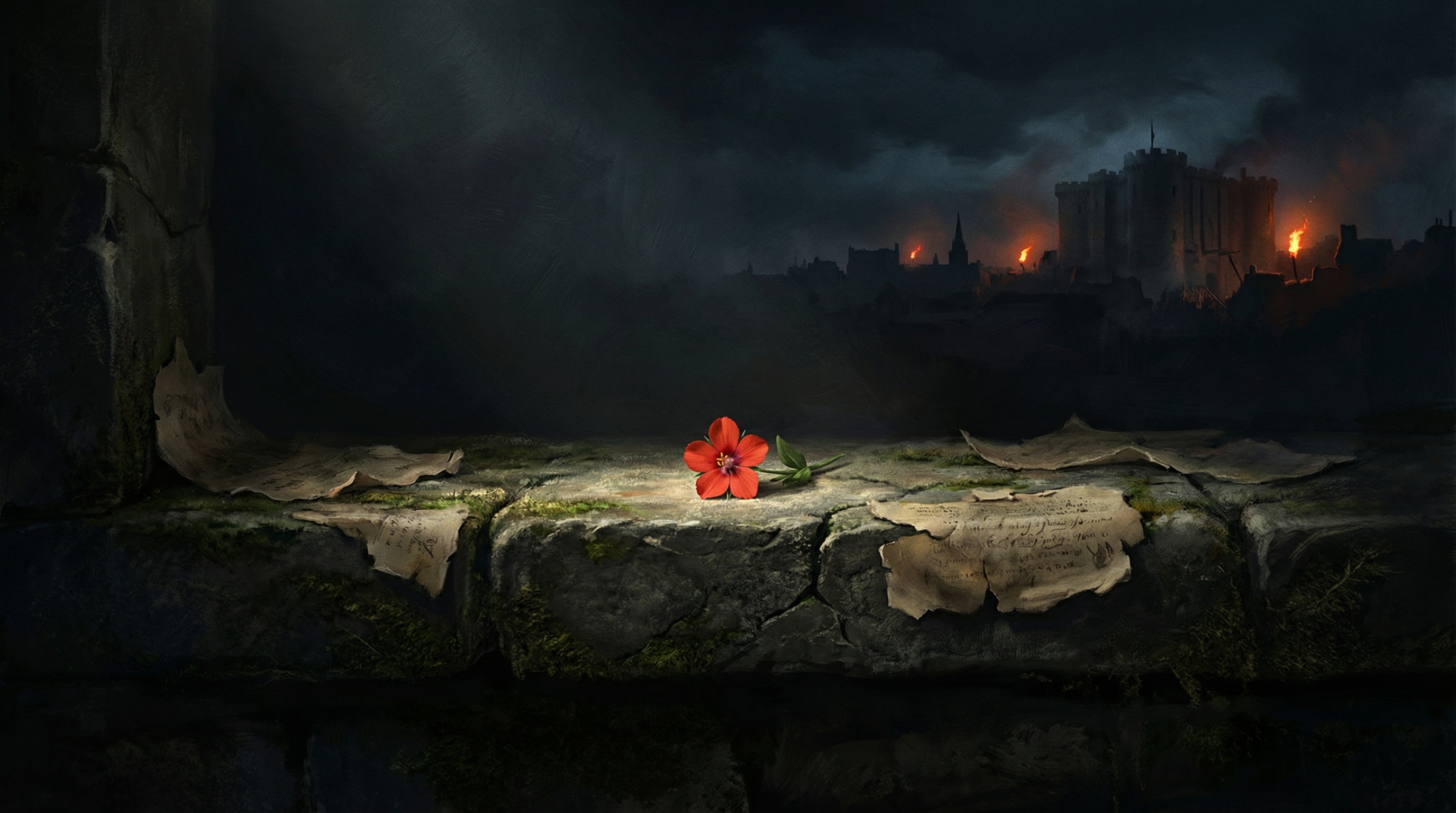
An excerpt from the original text.(complete · 2744 words)
ARIS: SEPTEMBER, 1792
A surging, seething, murmuring crowd of beings that are human only in
name, for to the eye and ear they seem naught but savage creatures,
animated by vile passions and by the lust of vengeance and of hate. The
hour, some little time before sunset, and the place, the West
Barricade, at the very spot where, a decade later, a proud tyrant
raised an undying monument to the nation’s glory and his own vanity.
During the greater part of the day the guillotine had been kept busy at
its ghastly work: all that France had boasted of in the past centuries,
of ancient names, and blue blood, had paid toll to her desire for
liberty and for fraternity. The carnage had only ceased at this late
hour of the day because there were other more interesting sights for
the people to witness, a little while before the final closing of the
barricades for the night.
And so the crowd rushed away from the Place de la Grève and made for
the various barricades in order to watch this interesting and amusing
sight.
It was to be seen every day, for those aristos were such fools! They
were traitors to the people of course, all of them, men, women, and
children, who happened to be descendants of the great men who since the
Crusades had made the glory of France: her old noblesse. Their
ancestors had oppressed the people, had crushed them under the scarlet
heels of their dainty buckled shoes, and now the people had become the
rulers of France and crushed their former masters—not beneath their
heel, for they went shoeless mostly in these days—but beneath a more
effectual weight, the knife of the guillotine.
And daily, hourly, the hideous instrument of torture claimed its many
victims—old men, young women, tiny children, even until the day when it
would finally demand the head of a King and of a beautiful young Queen.
But this was as it should be: were not the people now the rulers of
France? Every aristocrat was a traitor, as his ancestors had been
before him: for two hundred years now the people had sweated, and
toiled, and starved, to keep a lustful court in lavish extravagance;
now the descendants of those who had helped to make those courts
brilliant had to hide for their lives—to fly, if they wished to avoid
the tardy vengeance of the people.
And they did try to hide, and tried to fly: that was just the fun of
the whole thing. Every afternoon before the gates closed and the market
carts went out in procession by the various barricades, some fool of an
aristo endeavoured to evade the clutches of the Committee of Public
Safety. In various disguises, under various pretexts, they tried to
slip through the barriers which were so well guarded by citizen
soldiers of the Republic. Men in women’s clothes, women in male attire,
children disguised in beggars’ rags: there were some of all sorts:
ci-devant counts, marquises, even dukes, who wanted to fly from
France, reach England or some other equally accursed country, and there
try to rouse foreign feeling against the glorious Revolution, or to
raise an army in order to liberate the wretched prisoners in the
Temple, who had once called themselves sovereigns of France.
But they were nearly always caught at the barricades. Sergeant Bibot
especially at the West Gate had a wonderful nose for scenting an aristo
in the most perfect disguise. Then, of course, the fun began. Bibot
would look at his prey as a cat looks upon the mouse, play with him,
sometimes for quite a quarter of an hour, pretend to be hoodwinked by
the disguise, by the wigs and other bits of theatrical make-up which
hid the identity of a ci-devant noble marquise or count.
Oh! Bibot had a keen sense of humour, and it was well worth hanging
round that West Barricade, in order to see him catch an aristo in the
very act of trying to flee from the vengeance of the people.
Sometimes Bibot would let his prey actually out by the gates, allowing
him to think for the space of two minutes at least that he really had
escaped out of Paris, and might even manage to reach the coast of
England in safety, but Bibot would let the unfortunate wretch walk
about ten mètres towards the open country, then he would send two men
after him and bring him back, stripped of his disguise.
Oh! that was extremely funny, for as often as not the fugitive would
prove to be a woman, some proud marchioness, who looked terribly
comical when she found herself in Bibot’s clutches after all, and knew
that a summary trial would await her the next day and after that, the
fond embrace of Madame la Guillotine.
No wonder that on this fine afternoon in September the crowd round
Bibot’s gate was eager and excited. The lust of blood grows with its
satisfaction, there is no satiety: the crowd had seen a hundred noble
heads fall beneath the guillotine to-day, it wanted to make sure that
it would see another hundred fall on the morrow.
Bibot was sitting on an overturned and empty cask close by the gate of
the barricade; a small detachment of citoyen soldiers was under his
command. The work had been very hot lately. Those cursed aristos were
becoming terrified and tried their hardest to slip out of Paris: men,
women and children, whose ancestors, even in remote ages, had served
those traitorous Bourbons, were all traitors themselves and right food
for the guillotine. Every day Bibot had had the satisfaction of
unmasking some fugitive royalists and sending them back to be tried by
the Committee of Public Safety, presided over by that good patriot,
Citoyen Foucquier-Tinville.
Robespierre and Danton both had commended Bibot for his zeal, and Bibot
was proud of the fact that he on his own initiative had sent at least
fifty aristos to the guillotine.
But to-day all the sergeants in command at the various barricades had
had special orders. Recently a very great number of aristos had
succeeded in escaping out of France and in reaching England safely.
There were curious rumours about these escapes; they had become very
frequent and singularly daring; the people’s minds were becoming
strangely excited about it all. Sergeant Grospierre had been sent to
the guillotine for allowing a whole family of aristos to slip out of
the North Gate under his very nose.
It was asserted that these escapes were organised by a band of
Englishmen, whose daring seemed to be unparalleled, and who, from sheer
desire to meddle in what did not concern them, spent their spare time
in snatching away lawful victims destined for Madame la Guillotine.
These rumours soon grew in extravagance; there was no doubt that this
band of meddlesome Englishmen did exist; moreover, they seemed to be
under the leadership of a man whose pluck and audacity were almost
fabulous. Strange stories were afloat of how he and those aristos whom
he rescued became suddenly invisible as they reached the barricades and
escaped out of the gates by sheer supernatural agency.
No one had seen these mysterious Englishmen; as for their leader, he
was never spoken of, save with a superstitious shudder. Citoyen
Foucquier-Tinville would in the course of the day receive a scrap of
paper from some mysterious source; sometimes he would find it in the
pocket of his coat, at others it would be handed to him by someone in
the crowd, whilst he was on his way to the sitting of the Committee of
Public Safety. The paper always contained a brief notice that the band
of meddlesome Englishmen were at work, and it was always signed with a
device drawn in red—a little star-shaped flower, which we in England
call the Scarlet Pimpernel. Within a few hours of the receipt of this
impudent notice, the citoyens of the Committee of Public Safety would
hear that so many royalists and aristocrats had succeeded in reaching
the coast, and were on their way to England and safety.
The guards at the gates had been doubled, the sergeants in command had
been threatened with death, whilst liberal rewards were offered for the
capture of these daring and impudent Englishmen. There was a sum of
five thousand francs promised to the man who laid hands on the
mysterious and elusive Scarlet Pimpernel.
Everyone felt that Bibot would be that man, and Bibot allowed that
belief to take firm root in everybody’s mind; and so, day after day,
people came to watch him at the West Gate, so as to be present when he
laid hands on any fugitive aristo who perhaps might be accompanied by
that mysterious Englishman.
“Bah!” he said to his trusted corporal, “Citoyen Grospierre was a fool!
Had it been me now, at that North Gate last week . . .”
Citoyen Bibot spat on the ground to express his contempt for his
comrade’s stupidity.
“How did it happen, citoyen?” asked the corporal.
“Grospierre was at the gate, keeping good watch,” began Bibot,
pompously, as the crowd closed in round him, listening eagerly to his
narrative. “We’ve all heard of this meddlesome Englishman, this
accursed Scarlet Pimpernel. He won’t get through my gate, morbleu!
unless he be the devil himself. But Grospierre was a fool. The market
carts were going through the gates; there was one laden with casks, and
driven by an old man, with a boy beside him. Grospierre was a bit
drunk, but he thought himself very clever; he looked into the
casks—most of them, at least—and saw they were empty, and let the cart
go through.”
A murmur of wrath and contempt went round the group of ill-clad
wretches, who crowded round Citoyen Bibot.
“Half an hour later,” continued the sergeant, “up comes a captain of
the guard with a squad of some dozen soldiers with him. ‘Has a cart
gone through?’ he asks of Grospierre, breathlessly. ‘Yes,’ says
Grospierre, ‘not half an hour ago.’ ‘And you have let them escape,’
shouts the captain furiously. ‘You’ll go to the guillotine for this,
citoyen sergeant! that cart held concealed the ci-devant Duc de
Chalis and all his family!’ ‘What!’ thunders Grospierre, aghast. ‘Aye!
and the driver was none other than that cursed Englishman, the Scarlet
Pimpernel.’”
A howl of execration greeted this tale. Citoyen Grospierre had paid for
his blunder on the guillotine, but what a fool! oh! what a fool!
Bibot was laughing so much at his own tale that it was some time before
he could continue.
“‘After them, my men,’ shouts the captain,” he said, after a while,
“‘remember the reward; after them, they cannot have gone far!’ And with
that he rushes through the gate, followed by his dozen soldiers.”
“But it was too late!” shouted the crowd, excitedly.
“They never got them!”
“Curse that Grospierre for his folly!”
“He deserved his fate!”
“Fancy not examining those casks properly!”
But these sallies seemed to amuse Citoyen Bibot exceedingly; he laughed
until his sides ached, and the tears streamed down his cheeks.
“Nay, nay!” he said at last, “those aristos weren’t in the cart; the
driver was not the Scarlet Pimpernel!”
“What?”
“No! The captain of the guard was that damned Englishman in disguise,
and every one of his soldiers aristos!”
The crowd this time said nothing: the story certainly savoured of the
supernatural, and though the Republic had abolished God, it had not
quite succeeded in killing the fear of the supernatural in the hearts
of the people. Truly that Englishman must be the devil himself.
The sun was sinking low down in the west. Bibot prepared himself to
close the gates.
“En avant the carts,” he said.
Some dozen covered carts were drawn up in a row, ready to leave town,
in order to fetch the produce from the country close by, for market the
next morning. They were mostly well known to Bibot, as they went
through his gate twice every day on their way to and from the town. He
spoke to one or two of their drivers—mostly women—and was at great
pains to examine the inside of the carts.
“You never know,” he would say, “and I’m not going to be caught like
that fool Grospierre.”
The women who drove the carts usually spent their day on the Place de
la Grève, beneath the platform of the guillotine, knitting and
gossiping, whilst they watched the rows of tumbrils arriving with the
victims the Reign of Terror claimed every day. It was great fun to see
the aristos arriving for the reception of Madame la Guillotine, and the
places close by the platform were very much sought after. Bibot, during
the day, had been on duty on the Place. He recognized most of the old
hags, “tricotteuses,” as they were called, who sat there and knitted,
whilst head after head fell beneath the knife, and they themselves got
quite bespattered with the blood of those cursed aristos.
“Hé! la mère!” said Bibot to one of these horrible hags, “what have you
got there?”
He had seen her earlier in the day, with her knitting and the whip of
her cart close beside her. Now she had fastened a row of curly locks to
the whip handle, all colours, from gold to silver, fair to dark, and
she stroked them with her huge, bony fingers as she laughed at Bibot.
“I made friends with Madame Guillotine’s lover,” she said with a coarse
laugh, “he cut these off for me from the heads as they rolled down. He
has promised me some more to-morrow, but I don’t know if I shall be at
my usual place.”
“Ah! how is that, la mère?” asked Bibot, who, hardened soldier though
he was, could not help shuddering at the awful loathsomeness of this
semblance of a woman, with her ghastly trophy on the handle of her
whip.
“My grandson has got the small-pox,” she said with a jerk of her thumb
towards the inside of her cart, “some say it’s the plague! If it is, I
sha’n’t be allowed to come into Paris to-morrow.”
At the first mention of the word small-pox, Bibot had stepped hastily
backwards, and when the old hag spoke of the plague, he retreated from
her as fast as he could.
“Curse you!” he muttered, whilst the whole crowd hastily avoided the
cart, leaving it standing all alone in the midst of the place.
The old hag laughed.
“Curse you, citoyen, for being a coward,” she said. “Bah! what a man to
be afraid of sickness.”
“Morbleu! the plague!”
Everyone was awe-struck and silent, filled with horror for the
loathsome malady, the one thing which still had the power to arouse
terror and disgust in these savage, brutalised creatures.
“Get out with you and with your plague-stricken brood!” shouted Bibot,
hoarsely.
And with another rough laugh and coarse jest, the old hag whipped up
her lean nag and drove her cart out of the gate.
This incident had spoilt the afternoon. The people were terrified of
these two horrible curses, the two maladies which nothing could cure,
and which were the precursors of an awful and lonely death. They hung
about the barricades, silent and sullen for a while, eyeing one another
suspiciously, avoiding each other as if by instinct, lest the plague
lurked already in their midst. Presently, as in the case of Grospierre,
a captain of the guard appeared suddenly. But he was known to Bibot,
and there was no fear of his turning out to be a sly Englishman in
disguise.
“A cart, . . .” he shouted breathlessly, even before he had reached the
gates.
“What cart?” asked Bibot, roughly.
“Driven by an old hag. . . . A covered cart . . .”
“There were a dozen . . .”
“An old hag who said her son had the plague?”
“Yes . . .”
“You have not let them go?”
“Morbleu!” said Bibot, whose purple cheeks had suddenly become white
with fear.
“The cart contained the ci-devant Comtesse de Tournay and her two
children, all of them traitors and condemned to death.”
“And their driver?” muttered Bibot, as a superstitious shudder ran down
his spine.
“Sacré tonnerre,” said the captain, “but it is feared that it was
that accursed Englishman himself—the Scarlet Pimpernel.”
Master this chapter. Complete your experience
Purchase the complete book to access all chapters and support classic literature
As an Amazon Associate, we earn a small commission from qualifying purchases at no additional cost to you.
Available in paperback, hardcover, and e-book formats
Let's Analyse the Pattern
Professional pride and reputation create predictable blind spots that others can exploit.
Why This Matters
Connect literature to life
This chapter teaches how manipulators exploit our predictable reactions—our pride, our fears, our need to maintain professional image—to make us defeat ourselves.
Practice This Today
This week, notice when someone's request or behavior seems designed to trigger a specific reaction from you, especially if it involves your expertise or reputation.
Now let's explore the literary elements.
Key Quotes & Analysis
"A surging, seething, murmuring crowd of beings that are human only in name, for to the eye and ear they seem naught but savage creatures, animated by vile passions and by the lust of vengeance and of hate."
Context: Describing the bloodthirsty crowd gathered to watch for escaping aristocrats
Shows how mob mentality can turn ordinary people into something frightening. The narrator suggests that hatred and revenge have stripped away their humanity.
In Today's Words:
The crowd had become like wild animals, driven only by hatred and the desire for revenge.
"Sacré tonnerre! If I had guessed... but it is too late now... that cart contained the CI-DEVANT Comtesse de Tournay and her two children, all of them condemned to death."
Context: Revealing to Bibot that the plague cart contained escaped aristocrats
The moment of devastating realization that shows how the Pimpernel's psychological manipulation worked perfectly. Fear of disease overcame duty.
In Today's Words:
Holy hell! If I had known... but it's too late now... that cart had the former Countess and her kids, all sentenced to die.
"Mon Dieu! They are all so clever, these spies of the accursed Englishman. One never knows... but this time I think our friend was a little careless."
Context: Bragging about how he thinks he's caught the Pimpernel's pattern
Shows Bibot's fatal overconfidence. He thinks he understands his enemy, but this pride makes him vulnerable to being outsmarted again.
In Today's Words:
God! These English spies are so smart. You never know... but this time I think our enemy slipped up.
Thematic Threads
Class
In This Chapter
The revolutionary guards hunt aristocrats not just for political reasons, but to prove their own worth and power
Development
Introduced here
In Your Life:
You might feel the need to prove yourself by putting down people you see as privileged or different
Identity
In This Chapter
Bibot's entire sense of self is tied to his reputation as an expert at catching disguised nobles
Development
Introduced here
In Your Life:
Your professional identity might become so central that threats to it feel like threats to who you are
Deception
In This Chapter
The Scarlet Pimpernel succeeds by understanding human psychology better than using force or tricks
Development
Introduced here
In Your Life:
People might manipulate you by appealing to your fears, pride, or desire to look competent
Fear
In This Chapter
Fear of disease overrides professional duty, showing how primal fears trump rational thinking
Development
Introduced here
In Your Life:
Your deepest fears might be used against you, especially when you're trying to maintain professional composure
Power
In This Chapter
Bibot enjoys his authority and the crowd's attention, making him perform rather than focus on his job
Development
Introduced here
In Your Life:
When you have expertise or authority, you might prioritize looking good over doing good
You now have the context. Time to form your own thoughts.
Discussion Questions
- 1
What specific mistakes did Sergeant Bibot make that allowed the Scarlet Pimpernel to escape with the aristocrats?
analysis • surface - 2
How did the Scarlet Pimpernel use Bibot's professional pride and the crowd's expectations against him?
analysis • medium - 3
Where have you seen someone's expertise or reputation become a blind spot in your workplace, school, or family?
application • medium - 4
If you were training someone to avoid Bibot's mistakes, what specific habits or systems would you teach them?
application • deep - 5
What does this scene reveal about how fear and pride can be manipulated, and why are these emotions so powerful?
reflection • deep
Critical Thinking Exercise
Design Your Own Escape Plan
You need to get past an expert who knows your usual methods. Pick any situation - sneaking past a strict supervisor, getting a tough teacher to approve your project, or convincing a skeptical family member. Study their patterns like the Scarlet Pimpernel studied Bibot. What do they pride themselves on? What makes them uncomfortable? Design a strategy that uses their expertise against them.
Consider:
- •What does this person see as their greatest professional strength?
- •What situations make them rush their judgment or act predictably?
- •How could you make them want to avoid closer examination?
Journaling Prompt
Write about a time when your own expertise or confidence led you to make a mistake you should have caught. What warning signs did you ignore, and how could you build better checks into your process?
Coming Up Next...
Chapter 2: The Fisherman's Rest Tavern
The scene shifts to England, where we'll meet the mysterious hero behind these daring rescues and discover the elegant English society that harbors secrets about the Scarlet Pimpernel's true identity.



