
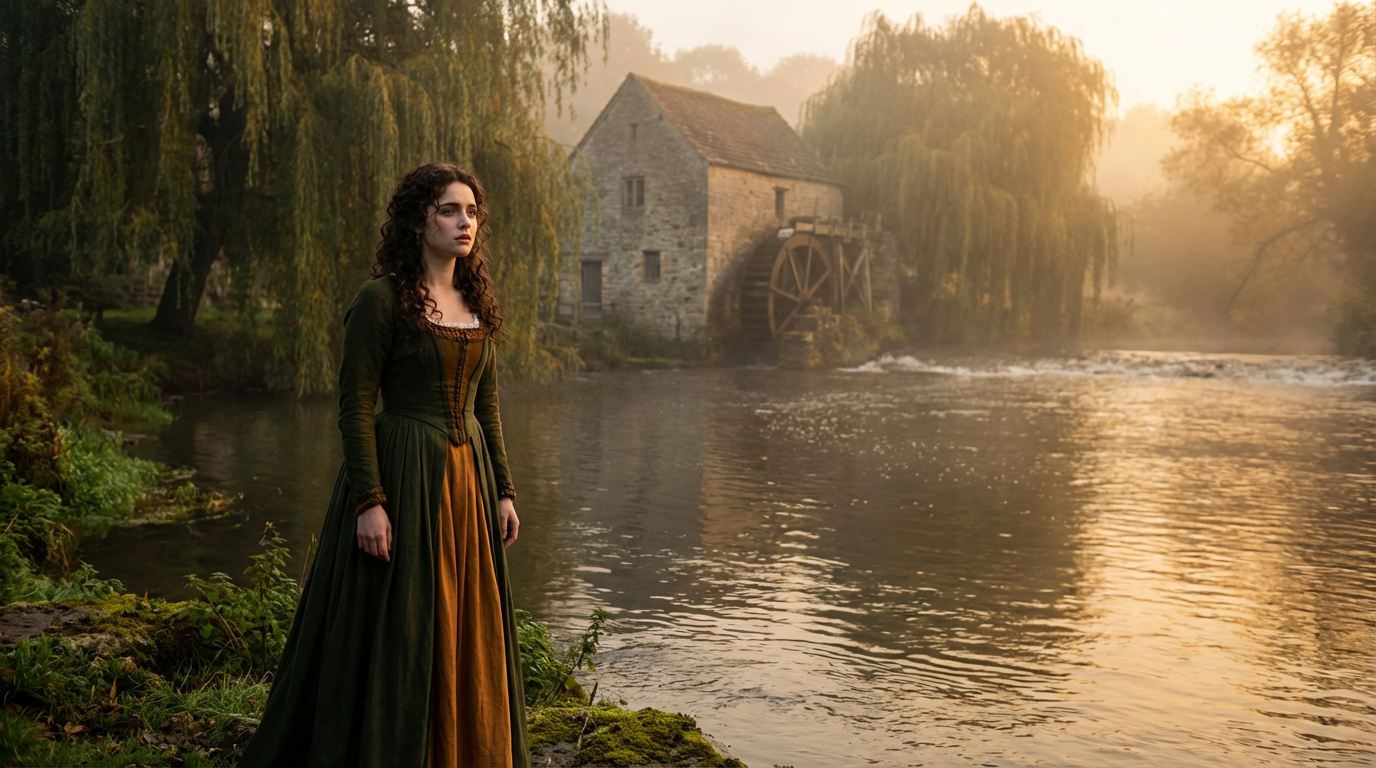
An excerpt from the original text.(complete · 4021 words)
r Tulliver Shows His Weaker Side
“Suppose sister Glegg should call her money in; it ’ud be very awkward
for you to have to raise five hundred pounds now,” said Mrs Tulliver to
her husband that evening, as she took a plaintive review of the day.
Mrs Tulliver had lived thirteen years with her husband, yet she
retained in all the freshness of her early married life a facility of
saying things which drove him in the opposite direction to the one she
desired. Some minds are wonderful for keeping their bloom in this way,
as a patriarchal goldfish apparently retains to the last its youthful
illusion that it can swim in a straight line beyond the encircling
glass. Mrs Tulliver was an amiable fish of this kind, and after running
her head against the same resisting medium for thirteen years would go
at it again to-day with undulled alacrity.
This observation of hers tended directly to convince Mr Tulliver that
it would not be at all awkward for him to raise five hundred pounds;
and when Mrs Tulliver became rather pressing to know how he would
raise it without mortgaging the mill and the house which he had said he
never would mortgage, since nowadays people were none so ready to
lend money without security, Mr Tulliver, getting warm, declared that
Mrs Glegg might do as she liked about calling in her money, he should
pay it in whether or not. He was not going to be beholden to his wife’s
sisters. When a man had married into a family where there was a whole
litter of women, he might have plenty to put up with if he chose. But
Mr Tulliver did not choose.
Mrs Tulliver cried a little in a trickling, quiet way as she put on her
nightcap; but presently sank into a comfortable sleep, lulled by the
thought that she would talk everything over with her sister Pullet
to-morrow, when she was to take the children to Garum Firs to tea. Not
that she looked forward to any distinct issue from that talk; but it
seemed impossible that past events should be so obstinate as to remain
unmodified when they were complained against.
Her husband lay awake rather longer, for he too was thinking of a visit
he would pay on the morrow; and his ideas on the subject were not of so
vague and soothing a kind as those of his amiable partner.
Mr Tulliver, when under the influence of a strong feeling, had a
promptitude in action that may seem inconsistent with that painful
sense of the complicated, puzzling nature of human affairs under which
his more dispassionate deliberations were conducted; but it is really
not improbable that there was a direct relation between these
apparently contradictory phenomena, since I have observed that for
getting a strong impression that a skein is tangled there is nothing
like snatching hastily at a single thread. It was owing to this
promptitude that Mr Tulliver was on horseback soon after dinner the
next day (he was not dyspeptic) on his way to Basset to see his sister
Moss and her husband. For having made up his mind irrevocably that he
would pay Mrs Glegg her loan of five hundred pounds, it naturally
occurred to him that he had a promissory note for three hundred pounds
lent to his brother-in-law Moss; and if the said brother-in-law could
manage to pay in the money within a given time, it would go far to
lessen the fallacious air of inconvenience which Mr Tulliver’s spirited
step might have worn in the eyes of weak people who require to know
precisely how a thing is to be done before they are strongly
confident that it will be easy.
For Mr Tulliver was in a position neither new nor striking, but, like
other everyday things, sure to have a cumulative effect that will be
felt in the long run: he was held to be a much more substantial man
than he really was. And as we are all apt to believe what the world
believes about us, it was his habit to think of failure and ruin with
the same sort of remote pity with which a spare, long-necked man hears
that his plethoric short-necked neighbour is stricken with apoplexy. He
had been always used to hear pleasant jokes about his advantages as a
man who worked his own mill, and owned a pretty bit of land; and these
jokes naturally kept up his sense that he was a man of considerable
substance. They gave a pleasant flavour to his glass on a market-day,
and if it had not been for the recurrence of half-yearly payments, Mr
Tulliver would really have forgotten that there was a mortgage of two
thousand pounds on his very desirable freehold. That was not altogether
his own fault, since one of the thousand pounds was his sister’s
fortune, which he had to pay on her marriage; and a man who has
neighbours that will go to law with him is not likely to pay off his
mortgages, especially if he enjoys the good opinion of acquaintances
who want to borrow a hundred pounds on security too lofty to be
represented by parchment. Our friend Mr Tulliver had a good-natured
fibre in him, and did not like to give harsh refusals even to his
sister, who had not only come in to the world in that superfluous way
characteristic of sisters, creating a necessity for mortgages, but had
quite thrown herself away in marriage, and had crowned her mistakes by
having an eighth baby. On this point Mr Tulliver was conscious of being
a little weak; but he apologised to himself by saying that poor Gritty
had been a good-looking wench before she married Moss; he would
sometimes say this even with a slight tremulousness in his voice. But
this morning he was in a mood more becoming a man of business, and in
the course of his ride along the Basset lanes, with their deep
ruts,—lying so far away from a market-town that the labour of drawing
produce and manure was enough to take away the best part of the profits
on such poor land as that parish was made of,—he got up a due amount of
irritation against Moss as a man without capital, who, if murrain and
blight were abroad, was sure to have his share of them, and who, the
more you tried to help him out of the mud, would sink the further in.
It would do him good rather than harm, now, if he were obliged to raise
this three hundred pounds; it would make him look about him better, and
not act so foolishly about his wool this year as he did the last; in
fact, Mr Tulliver had been too easy with his brother-in-law, and
because he had let the interest run on for two years, Moss was likely
enough to think that he should never be troubled about the principal.
But Mr Tulliver was determined not to encourage such shuffling people
any longer; and a ride along the Basset lanes was not likely to
enervate a man’s resolution by softening his temper. The deep-trodden
hoof-marks, made in the muddiest days of winter, gave him a shake now
and then which suggested a rash but stimulating snarl at the father of
lawyers, who, whether by means of his hoof or otherwise, had doubtless
something to do with this state of the roads; and the abundance of foul
land and neglected fences that met his eye, though they made no part of
his brother Moss’s farm, strongly contributed to his dissatisfaction
with that unlucky agriculturist. If this wasn’t Moss’s fallow, it might
have been; Basset was all alike; it was a beggarly parish, in Mr
Tulliver’s opinion, and his opinion was certainly not groundless.
Basset had a poor soil, poor roads, a poor non-resident landlord, a
poor non-resident vicar, and rather less than half a curate, also poor.
If any one strongly impressed with the power of the human mind to
triumph over circumstances will contend that the parishioners of Basset
might nevertheless have been a very superior class of people, I have
nothing to urge against that abstract proposition; I only know that, in
point of fact, the Basset mind was in strict keeping with its
circumstances. The muddy lanes, green or clayey, that seemed to the
unaccustomed eye to lead nowhere but into each other, did really lead,
with patience, to a distant high-road; but there were many feet in
Basset which they led more frequently to a centre of dissipation,
spoken of formerly as the “Markis o’ Granby,” but among intimates as
“Dickison’s.” A large low room with a sanded floor; a cold scent of
tobacco, modified by undetected beer-dregs; Mr Dickison leaning against
the door-post with a melancholy pimpled face, looking as irrelevant to
the daylight as a last night’s guttered candle,—all this may not seem a
very seductive form of temptation; but the majority of men in Basset
found it fatally alluring when encountered on their road toward four
o’clock on a wintry afternoon; and if any wife in Basset wished to
indicate that her husband was not a pleasure-seeking man, she could
hardly do it more emphatically than by saying that he didn’t spend a
shilling at Dickison’s from one Whitsuntide to another. Mrs Moss had
said so of her husband more than once, when her brother was in a mood
to find fault with him, as he certainly was to-day. And nothing could
be less pacifying to Mr Tulliver than the behaviour of the farmyard
gate, which he no sooner attempted to push open with his riding-stick
than it acted as gates without the upper hinge are known to do, to the
peril of shins, whether equine or human. He was about to get down and
lead his horse through the damp dirt of the hollow farmyard, shadowed
drearily by the large half-timbered buildings, up to the long line of
tumble-down dwelling-houses standing on a raised causeway; but the
timely appearance of a cowboy saved him that frustration of a plan he
had determined on,—namely, not to get down from his horse during this
visit. If a man means to be hard, let him keep in his saddle and speak
from that height, above the level of pleading eyes, and with the
command of a distant horizon. Mrs Moss heard the sound of the horse’s
feet, and, when her brother rode up, was already outside the kitchen
door, with a half-weary smile on her face, and a black-eyed baby in her
arms. Mrs Moss’s face bore a faded resemblance to her brother’s; baby’s
little fat hand, pressed against her cheek, seemed to show more
strikingly that the cheek was faded.
“Brother, I’m glad to see you,” she said, in an affectionate tone. “I
didn’t look for you to-day. How do you do?”
“Oh, pretty well, Mrs Moss, pretty well,” answered the brother, with
cool deliberation, as if it were rather too forward of her to ask that
question. She knew at once that her brother was not in a good humour;
he never called her Mrs Moss except when he was angry, and when they
were in company. But she thought it was in the order of nature that
people who were poorly off should be snubbed. Mrs Moss did not take her
stand on the equality of the human race; she was a patient, prolific,
loving-hearted woman.
“Your husband isn’t in the house, I suppose?” added Mr Tulliver after a
grave pause, during which four children had run out, like chickens
whose mother has been suddenly in eclipse behind the hen-coop.
“No,” said Mrs Moss, “but he’s only in the potato-field yonders.
Georgy, run to the Far Close in a minute, and tell father your uncle’s
come. You’ll get down, brother, won’t you, and take something?”
“No, no; I can’t get down. I must be going home again directly,” said
Mr Tulliver, looking at the distance.
“And how’s Mrs Tulliver and the children?” said Mrs Moss, humbly, not
daring to press her invitation.
“Oh, pretty well. Tom’s going to a new school at Midsummer,—a deal of
expense to me. It’s bad work for me, lying out o’ my money.”
“I wish you’d be so good as let the children come and see their cousins
some day. My little uns want to see their cousin Maggie so as never
was. And me her godmother, and so fond of her; there’s nobody ’ud make
a bigger fuss with her, according to what they’ve got. And I know she
likes to come, for she’s a loving child, and how quick and clever she
is, to be sure!”
If Mrs Moss had been one of the most astute women in the world, instead
of being one of the simplest, she could have thought of nothing more
likely to propitiate her brother than this praise of Maggie. He seldom
found any one volunteering praise of “the little wench”; it was usually
left entirely to himself to insist on her merits. But Maggie always
appeared in the most amiable light at her aunt Moss’s; it was her
Alsatia, where she was out of the reach of law,—if she upset anything,
dirtied her shoes, or tore her frock, these things were matters of
course at her aunt Moss’s. In spite of himself, Mr Tulliver’s eyes got
milder, and he did not look away from his sister as he said,—
“Ay; she’s fonder o’ you than o’ the other aunts, I think. She takes
after our family: not a bit of her mother’s in her.”
“Moss says she’s just like what I used to be,” said Mrs Moss, “though I
was never so quick and fond o’ the books. But I think my Lizzy’s like
her; she’s sharp. Come here, Lizzy, my dear, and let your uncle see
you; he hardly knows you, you grow so fast.”
Lizzy, a black-eyed child of seven, looked very shy when her mother
drew her forward, for the small Mosses were much in awe of their uncle
from Dorlcote Mill. She was inferior enough to Maggie in fire and
strength of expression to make the resemblance between the two entirely
flattering to Mr Tulliver’s fatherly love.
“Ay, they’re a bit alike,” he said, looking kindly at the little figure
in the soiled pinafore. “They both take after our mother. You’ve got
enough o’ gells, Gritty,” he added, in a tone half compassionate, half
reproachful.
“Four of ’em, bless ’em!” said Mrs Moss, with a sigh, stroking Lizzy’s
hair on each side of her forehead; “as many as there’s boys. They’ve
got a brother apiece.”
“Ah, but they must turn out and fend for themselves,” said Mr Tulliver,
feeling that his severity was relaxing and trying to brace it by
throwing out a wholesome hint “They mustn’t look to hanging on their
brothers.”
“No; but I hope their brothers ’ull love the poor things, and remember
they came o’ one father and mother; the lads ’ull never be the poorer
for that,” said Mrs Moss, flashing out with hurried timidity, like a
half-smothered fire.
Mr Tulliver gave his horse a little stroke on the flank, then checked
it, and said angrily, “Stand still with you!” much to the astonishment
of that innocent animal.
“And the more there is of ’em, the more they must love one another,”
Mrs Moss went on, looking at her children with a didactic purpose. But
she turned toward her brother again to say, “Not but what I hope your
boy ’ull allays be good to his sister, though there’s but two of ’em,
like you and me, brother.”
The arrow went straight to Mr Tulliver’s heart. He had not a rapid
imagination, but the thought of Maggie was very near to him, and he was
not long in seeing his relation to his own sister side by side with
Tom’s relation to Maggie. Would the little wench ever be poorly off,
and Tom rather hard upon her?
“Ay, ay, Gritty,” said the miller, with a new softness in his tone;
“but I’ve allays done what I could for you,” he added, as if
vindicating himself from a reproach.
“I’m not denying that, brother, and I’m noways ungrateful,” said poor
Mrs Moss, too fagged by toil and children to have strength left for any
pride. “But here’s the father. What a while you’ve been, Moss!”
“While, do you call it?” said Mr Moss, feeling out of breath and
injured. “I’ve been running all the way. Won’t you ’light, Mr
Tulliver?”
“Well, I’ll just get down and have a bit o’ talk with you in the
garden,” said Mr Tulliver, thinking that he should be more likely to
show a due spirit of resolve if his sister were not present.
He got down, and passed with Mr Moss into the garden, toward an old
yew-tree arbour, while his sister stood tapping her baby on the back
and looking wistfully after them.
Their entrance into the yew-tree arbour surprised several fowls that
were recreating themselves by scratching deep holes in the dusty
ground, and at once took flight with much pother and cackling. Mr
Tulliver sat down on the bench, and tapping the ground curiously here
and there with his stick, as if he suspected some hollowness, opened
the conversation by observing, with something like a snarl in his
tone,—
“Why, you’ve got wheat again in that Corner Close, I see; and never a
bit o’ dressing on it. You’ll do no good with it this year.”
Mr Moss, who, when he married Miss Tulliver, had been regarded as the
buck of Basset, now wore a beard nearly a week old, and had the
depressed, unexpectant air of a machine-horse. He answered in a
patient-grumbling tone, “Why, poor farmers like me must do as they can;
they must leave it to them as have got money to play with, to put half
as much into the ground as they mean to get out of it.”
“I don’t know who should have money to play with, if it isn’t them as
can borrow money without paying interest,” said Mr Tulliver, who wished
to get into a slight quarrel; it was the most natural and easy
introduction to calling in money.
“I know I’m behind with the interest,” said Mr Moss, “but I was so
unlucky wi’ the wool last year; and what with the Missis being laid up
so, things have gone awk’arder nor usual.”
“Ay,” snarled Mr Tulliver, “there’s folks as things ’ull allays go
awk’ard with; empty sacks ’ull never stand upright.”
“Well, I don’t know what fault you’ve got to find wi’ me, Mr Tulliver,”
said Mr Moss, deprecatingly; “I know there isn’t a day-labourer works
harder.”
“What’s the use o’ that,” said Mr Tulliver, sharply, “when a man
marries, and’s got no capital to work his farm but his wife’s bit o’
fortin? I was against it from the first; but you’d neither of you
listen to me. And I can’t lie out o’ my money any longer, for I’ve got
to pay five hundred o’ Mrs Glegg’s, and there’ll be Tom an expense to
me. I should find myself short, even saying I’d got back all as is my
own. You must look about and see how you can pay me the three hundred
pound.”
“Well, if that’s what you mean,” said Mr Moss, looking blankly before
him, “we’d better be sold up, and ha’ done with it; I must part wi’
every head o’ stock I’ve got, to pay you and the landlord too.”
Poor relations are undeniably irritating,—their existence is so
entirely uncalled for on our part, and they are almost always very
faulty people. Mr Tulliver had succeeded in getting quite as much
irritated with Mr Moss as he had desired, and he was able to say
angrily, rising from his seat,—
“Well, you must do as you can. I can’t find money for everybody else
as well as myself. I must look to my own business and my own family. I
can’t lie out o’ my money any longer. You must raise it as quick as you
can.”
Mr Tulliver walked abruptly out of the arbour as he uttered the last
sentence, and, without looking round at Mr Moss, went on to the kitchen
door, where the eldest boy was holding his horse, and his sister was
waiting in a state of wondering alarm, which was not without its
alleviations, for baby was making pleasant gurgling sounds, and
performing a great deal of finger practice on the faded face. Mrs Moss
had eight children, but could never overcome her regret that the twins
had not lived. Mr Moss thought their removal was not without its
consolations. “Won’t you come in, brother?” she said, looking anxiously
at her husband, who was walking slowly up, while Mr Tulliver had his
foot already in the stirrup.
“No, no; good-by,” said he, turning his horse’s head, and riding away.
No man could feel more resolute till he got outside the yard gate, and
a little way along the deep-rutted lane; but before he reached the next
turning, which would take him out of sight of the dilapidated
farm-buildings, he appeared to be smitten by some sudden thought. He
checked his horse, and made it stand still in the same spot for two or
three minutes, during which he turned his head from side to side in a
melancholy way, as if he were looking at some painful object on more
sides than one. Evidently, after his fit of promptitude, Mr Tulliver
was relapsing into the sense that this is a puzzling world. He turned
his horse, and rode slowly back, giving vent to the climax of feeling
which had determined this movement by saying aloud, as he struck his
horse, “Poor little wench! she’ll have nobody but Tom, belike, when I’m
gone.”
Mr Tulliver’s return into the yard was descried by several young
Mosses, who immediately ran in with the exciting news to their mother,
so that Mrs Moss was again on the door-step when her brother rode up.
She had been crying, but was rocking baby to sleep in her arms now, and
made no ostentatious show of sorrow as her brother looked at her, but
merely said:
“The father’s gone to the field, again, if you want him, brother.”
“No, Gritty, no,” said Mr Tulliver, in a gentle tone. “Don’t you
fret,—that’s all,—I’ll make a shift without the money a bit, only you
must be as clever and contriving as you can.”
Mrs Moss’s tears came again at this unexpected kindness, and she could
say nothing.
“Come, come!—the little wench shall come and see you. I’ll bring her
and Tom some day before he goes to school. You mustn’t fret. I’ll
allays be a good brother to you.”
“Thank you for that word, brother,” said Mrs Moss, drying her tears;
then turning to Lizzy, she said, “Run now, and fetch the coloured egg
for cousin Maggie.” Lizzy ran in, and quickly reappeared with a small
paper parcel.
“It’s boiled hard, brother, and coloured with thrums, very pretty; it
was done o’ purpose for Maggie. Will you please to carry it in your
pocket?”
“Ay, ay,” said Mr Tulliver, putting it carefully in his side pocket.
“Good-by.”
And so the respectable miller returned along the Basset lanes rather
more puzzled than before as to ways and means, but still with the sense
of a danger escaped. It had come across his mind that if he were hard
upon his sister, it might somehow tend to make Tom hard upon Maggie at
some distant day, when her father was no longer there to take her part;
for simple people, like our friend Mr Tulliver, are apt to clothe
unimpeachable feelings in erroneous ideas, and this was his confused
way of explaining to himself that his love and anxiety for “the little
wench” had given him a new sensibility toward his sister.
Master this chapter. Complete your experience
Purchase the complete book to access all chapters and support classic literature
As an Amazon Associate, we earn a small commission from qualifying purchases at no additional cost to you.
Available in paperback, hardcover, and e-book formats
Let's Analyse the Pattern
We often can't see our own cruelty until we imagine it directed at someone we love.
Why This Matters
Connect literature to life
This chapter teaches how to identify the exact moment when perspective shifts from justified hardness to genuine understanding.
Practice This Today
This week, notice when you catch yourself justifying harsh treatment of someone—then ask 'How would I feel if someone treated my loved one this way?'
Now let's explore the literary elements.
Key Quotes & Analysis
"Mrs Tulliver had lived thirteen years with her husband, yet she retained in all the freshness of her early married life a facility of saying things which drove him in the opposite direction to the one she desired."
Context: Describing how Mrs. Tulliver accidentally provokes her husband when trying to discuss their money problems
This reveals the tragic pattern in their marriage where her anxiety makes her say exactly what will make him more stubborn. It shows how financial stress can poison communication between partners who actually want the same thing - security.
In Today's Words:
After thirteen years of marriage, she still had a talent for saying exactly the wrong thing at the wrong time.
"He was not going to be beholden to his wife's family."
Context: Tulliver's defiant response to the suggestion that Sister Glegg might call in her loan
This shows how pride can override practical thinking when money threatens a man's sense of independence. His refusal to be 'beholden' drives him toward potentially ruinous decisions rather than swallowing his pride.
In Today's Words:
He wasn't going to owe his in-laws anything or let them have power over him.
"Suppose Tom should be such a husband to Maggie as I've been to my sister."
Context: The moment when Tulliver realizes his harsh treatment of his sister could be a model for how Tom might treat Maggie
This is the turning point where Tulliver's love for his daughter transforms his understanding of family obligation. He sees that protecting Maggie's future means modeling kindness toward vulnerable family members now.
In Today's Words:
What if Tom treats Maggie the same cold way I'm treating my sister?
Thematic Threads
Class
In This Chapter
The painful gap between Tulliver's modest success and his sister's grinding poverty creates tension and shame for both
Development
Building from earlier chapters showing class anxiety within the Tulliver family itself
In Your Life:
You might recognize this when family members at different economic levels struggle to relate without judgment or guilt
Family Loyalty
In This Chapter
Tulliver's love for Maggie becomes the key that unlocks his compassion for his sister
Development
Introduced here as a transformative force that overrides business logic
In Your Life:
You see this when thinking about your own children helps you understand how to treat other people's struggles
Financial Stress
In This Chapter
Money pressure initially hardens Tulliver's heart, making him cruel to those he'd normally protect
Development
Expanding from Tulliver's mill troubles to show how financial fear spreads to family relationships
In Your Life:
You might notice how your own money worries make you less generous or patient with people who need help
Moral Recognition
In This Chapter
Tulliver's sudden realization about the example he's setting reveals how we often act without seeing ourselves clearly
Development
Introduced here as a moment of moral clarity that changes behavior
In Your Life:
You experience this when you suddenly see your own actions from an outside perspective and don't like what you see
Gender and Protection
In This Chapter
Tulliver's concern for how Tom might treat Maggie reveals assumptions about women needing male family members' protection
Development
Building on earlier themes about Maggie's vulnerability in a male-dominated world
In Your Life:
You might see this in how family dynamics still often center on protecting women from other men's potential cruelty
You now have the context. Time to form your own thoughts.
Discussion Questions
- 1
What changes Mr. Tulliver's mind about collecting the money from his sister and brother-in-law?
analysis • surface - 2
Why does thinking about Tom and Maggie transform how Tulliver sees his sister's situation?
analysis • medium - 3
When have you seen someone become more compassionate after imagining their loved one in a similar situation?
application • medium - 4
How can you use Tulliver's 'flip the script' moment as a tool when you're frustrated with someone?
application • deep - 5
What does this chapter reveal about the difference between being fair and being kind?
reflection • deep
Critical Thinking Exercise
Practice the Mirror Test
Think of a recent situation where you felt justified in being harsh or unsympathetic toward someone. Write down your reasoning. Now imagine someone treating your child, parent, or best friend exactly the same way for exactly the same reasons. Notice what changes in your perspective and what stays the same.
Consider:
- •Your initial feelings were probably valid - this isn't about guilt
- •Look for the difference between being firm and being cruel
- •Consider how stress and fear might have affected your response
Journaling Prompt
Write about a time when someone showed you unexpected grace when you were struggling. How did it change your relationship with them? How might you offer that same grace to someone in your life right now?
Coming Up Next...
Chapter 9: The Weight of Family Expectations
While Mr. Tulliver grapples with family loyalty, his wife prepares for her own family visit to the Pullet household at Garum Firs, where different relatives will offer their own perspectives on the Tulliver family's growing troubles.



