
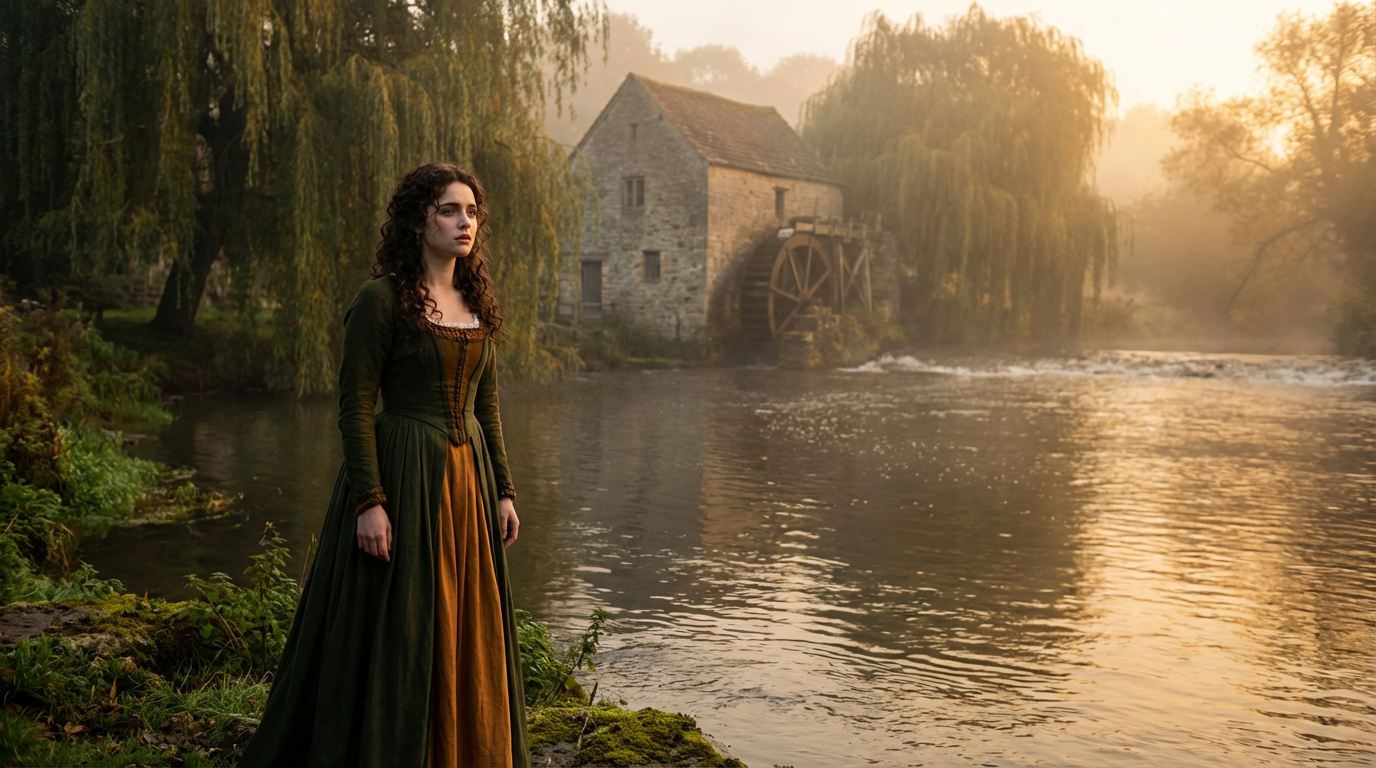
An excerpt from the original text.(complete · 7691 words)
he Last Conflict
In the second week of September, Maggie was again sitting in her lonely
room, battling with the old shadowy enemies that were forever slain and
rising again. It was past midnight, and the rain was beating heavily
against the window, driven with fitful force by the rushing,
loud-moaning wind. For the day after Lucy’s visit there had been a
sudden change in the weather; the heat and drought had given way to
cold variable winds, and heavy falls of rain at intervals; and she had
been forbidden to risk the contemplated journey until the weather
should become more settled. In the counties higher up the Floss the
rains had been continuous, and the completion of the harvest had been
arrested. And now, for the last two days, the rains on this lower
course of the river had been incessant, so that the old men had shaken
their heads and talked of sixty years ago, when the same sort of
weather, happening about the equinox, brought on the great floods,
which swept the bridge away, and reduced the town to great misery. But
the younger generation, who had seen several small floods, thought
lightly of these sombre recollections and forebodings; and Bob Jakin,
naturally prone to take a hopeful view of his own luck, laughed at his
mother when she regretted their having taken a house by the riverside,
observing that but for that they would have had no boats, which were
the most lucky of possessions in case of a flood that obliged them to
go to a distance for food.
But the careless and the fearful were alike sleeping in their beds now.
There was hope that the rain would abate by the morrow; threatenings of
a worse kind, from sudden thaws after falls of snow, had often passed
off, in the experience of the younger ones; and at the very worst, the
banks would be sure to break lower down the river when the tide came in
with violence, and so the waters would be carried off, without causing
more than temporary inconvenience, and losses that would be felt only
by the poorer sort, whom charity would relieve.
All were in their beds now, for it was past midnight; all except some
solitary watchers such as Maggie. She was seated in her little parlour
toward the river, with one candle, that left everything dim in the room
except a letter which lay before her on the table. That letter, which
had come to her to-day, was one of the causes that had kept her up far
on into the night, unconscious how the hours were going, careless of
seeking rest, with no image of rest coming across her mind, except of
that far, far off rest from which there would be no more waking for her
into this struggling earthly life.
Two days before Maggie received that letter, she had been to the
Rectory for the last time. The heavy rain would have prevented her from
going since; but there was another reason. Dr Kenn, at first
enlightened only by a few hints as to the new turn which gossip and
slander had taken in relation to Maggie, had recently been made more
fully aware of it by an earnest remonstrance from one of his male
parishioners against the indiscretion of persisting in the attempt to
overcome the prevalent feeling in the parish by a course of resistance.
Dr Kenn, having a conscience void of offence in the matter, was still
inclined to persevere,—was still averse to give way before a public
sentiment that was odious and contemptible; but he was finally wrought
upon by the consideration of the peculiar responsibility attached to
his office, of avoiding the appearance of evil,—an “appearance” that is
always dependent on the average quality of surrounding minds. Where
these minds are low and gross, the area of that “appearance” is
proportionately widened. Perhaps he was in danger of acting from
obstinacy; perhaps it was his duty to succumb. Conscientious people are
apt to see their duty in that which is the most painful course; and to
recede was always painful to Dr Kenn. He made up his mind that he must
advise Maggie to go away from St Ogg’s for a time; and he performed
that difficult task with as much delicacy as he could, only stating in
vague terms that he found his attempt to countenance her stay was a
source of discord between himself and his parishioners, that was likely
to obstruct his usefulness as a clergyman. He begged her to allow him
to write to a clerical friend of his, who might possibly take her into
his own family as governess; and, if not, would probably know of some
other available position for a young woman in whose welfare Dr Kenn
felt a strong interest.
Poor Maggie listened with a trembling lip; she could say nothing but a
faint “Thank you, I shall be grateful”; and she walked back to her
lodgings, through the driving rain, with a new sense of desolation. She
must be a lonely wanderer; she must go out among fresh faces, that
would look at her wonderingly, because the days did not seem joyful to
her; she must begin a new life, in which she would have to rouse
herself to receive new impressions; and she was so unspeakably,
sickeningly weary! There was no home, no help for the erring; even
those who pitied were constrained to hardness. But ought she to
complain? Ought she to shrink in this way from the long penance of
life, which was all the possibility she had of lightening the load to
some other sufferers, and so changing that passionate error into a new
force of unselfish human love? All the next day she sat in her lonely
room, with a window darkened by the cloud and the driving rain,
thinking of that future, and wrestling for patience; for what repose
could poor Maggie ever win except by wrestling?
And on the third day—this day of which she had just sat out the
close—the letter had come which was lying on the table before her.
The letter was from Stephen. He was come back from Holland; he was at
Mudport again, unknown to any of his friends, and had written to her
from that place, enclosing the letter to a person whom he trusted in St
Ogg’s. From beginning to end it was a passionate cry of reproach; an
appeal against her useless sacrifice of him, of herself, against that
perverted notion of right which led her to crush all his hopes, for the
sake of a mere idea, and not any substantial good,—his hopes, whom
she loved, and who loved her with that single overpowering passion,
that worship, which a man never gives to a woman more than once in his
life.
“They have written to me that you are to marry Kenn. As if I should
believe that! Perhaps they have told you some such fables about me.
Perhaps they tell you I’ve been ‘travelling.’ My body has been dragged
about somewhere; but I have never travelled from the hideous place
where you left me; where I started up from the stupor of helpless rage
to find you gone.
“Maggie! whose pain can have been like mine? Whose injury is like mine?
Who besides me has met that long look of love that has burnt itself
into my soul, so that no other image can come there? Maggie, call me
back to you! Call me back to life and goodness! I am banished from both
now. I have no motives; I am indifferent to everything. Two months have
only deepened the certainty that I can never care for life without you.
Write me one word; say ‘Come!’ In two days I should be with you.
Maggie, have you forgotten what it was to be together,—to be within
reach of a look, to be within hearing of each other’s voice?”
When Maggie first read this letter she felt as if her real temptation
had only just begun. At the entrance of the chill dark cavern, we turn
with unworn courage from the warm light; but how, when we have trodden
far in the damp darkness, and have begun to be faint and weary; how, if
there is a sudden opening above us, and we are invited back again to
the life-nourishing day? The leap of natural longing from under the
pressure of pain is so strong, that all less immediate motives are
likely to be forgotten—till the pain has been escaped from.
For hours Maggie felt as if her struggle had been in vain. For hours
every other thought that she strove to summon was thrust aside by the
image of Stephen waiting for the single word that would bring him to
her. She did not read the letter: she heard him uttering it, and the
voice shook her with its old strange power. All the day before she had
been filled with the vision of a lonely future through which she must
carry the burthen of regret, upheld only by clinging faith. And here,
close within her reach, urging itself upon her even as a claim, was
another future, in which hard endurance and effort were to be exchanged
for easy, delicious leaning on another’s loving strength! And yet that
promise of joy in the place of sadness did not make the dire force of
the temptation to Maggie.
It was Stephen’s tone of misery, it was the doubt in the justice of her
own resolve, that made the balance tremble, and made her once start
from her seat to reach the pen and paper, and write “Come!”
But close upon that decisive act, her mind recoiled; and the sense of
contradiction with her past self in her moments of strength and
clearness came upon her like a pang of conscious degradation. No, she
must wait; she must pray; the light that had forsaken her would come
again; she should feel again what she had felt when she had fled away,
under an inspiration strong enough to conquer agony,—to conquer love;
she should feel again what she had felt when Lucy stood by her, when
Philip’s letter had stirred all the fibres that bound her to the calmer
past.
She sat quite still, far on into the night, with no impulse to change
her attitude, without active force enough even for the mental act of
prayer; only waiting for the light that would surely come again. It
came with the memories that no passion could long quench; the long past
came back to her, and with it the fountains of self-renouncing pity and
affection, of faithfulness and resolve. The words that were marked by
the quiet hand in the little old book that she had long ago learned by
heart, rushed even to her lips, and found a vent for themselves in a
low murmur that was quite lost in the loud driving of the rain against
the window and the loud moan and roar of the wind. “I have received the
Cross, I have received it from Thy hand; I will bear it, and bear it
till death, as Thou hast laid it upon me.”
But soon other words rose that could find no utterance but in a
sob,—“Forgive me, Stephen! It will pass away. You will come back to
her.”
She took up the letter, held it to the candle, and let it burn slowly
on the hearth. To-morrow she would write to him the last word of
parting.
“I will bear it, and bear it till death. But how long it will be before
death comes! I am so young, so healthy. How shall I have patience and
strength? Am I to struggle and fall and repent again? Has life other
trials as hard for me still?”
With that cry of self-despair, Maggie fell on her knees against the
table, and buried her sorrow-stricken face. Her soul went out to the
Unseen Pity that would be with her to the end. Surely there was
something being taught her by this experience of great need; and she
must be learning a secret of human tenderness and long-suffering, that
the less erring could hardly know? “O God, if my life is to be long,
let me live to bless and comfort——”
At that moment Maggie felt a startling sensation of sudden cold about
her knees and feet; it was water flowing under her. She started up; the
stream was flowing under the door that led into the passage. She was
not bewildered for an instant; she knew it was the flood!
The tumult of emotion she had been enduring for the last twelve hours
seemed to have left a great calm in her; without screaming, she hurried
with the candle upstairs to Bob Jakin’s bedroom. The door was ajar; she
went in and shook him by the shoulder.
“Bob, the flood is come! it is in the house; let us see if we can make
the boats safe.”
She lighted his candle, while the poor wife, snatching up her baby,
burst into screams; and then she hurried down again to see if the
waters were rising fast. There was a step down into the room at the
door leading from the staircase; she saw that the water was already on
a level with the step. While she was looking, something came with a
tremendous crash against the window, and sent the leaded panes and the
old wooden framework inward in shivers, the water pouring in after it.
“It is the boat!” cried Maggie. “Bob, come down to get the boats!”
And without a moment’s shudder of fear, she plunged through the water,
which was rising fast to her knees, and by the glimmering light of the
candle she had left on the stairs, she mounted on to the window-sill,
and crept into the boat, which was left with the prow lodging and
protruding through the window. Bob was not long after her, hurrying
without shoes or stockings, but with the lanthorn in his hand.
“Why, they’re both here,—both the boats,” said Bob, as he got into the
one where Maggie was. “It’s wonderful this fastening isn’t broke too,
as well as the mooring.”
In the excitement of getting into the other boat, unfastening it, and
mastering an oar, Bob was not struck with the danger Maggie incurred.
We are not apt to fear for the fearless, when we are companions in
their danger, and Bob’s mind was absorbed in possible expedients for
the safety of the helpless indoors. The fact that Maggie had been up,
had waked him, and had taken the lead in activity, gave Bob a vague
impression of her as one who would help to protect, not need to be
protected. She too had got possession of an oar, and had pushed off, so
as to release the boat from the overhanging window-frame.
“The water’s rising so fast,” said Bob, “I doubt it’ll be in at the
chambers before long,—th’ house is so low. I’ve more mind to get Prissy
and the child and the mother into the boat, if I could, and trusten to
the water,—for th’ old house is none so safe. And if I let go the
boat—but you,” he exclaimed, suddenly lifting the light of his
lanthorn on Maggie, as she stood in the rain with the oar in her hand
and her black hair streaming.
Maggie had no time to answer, for a new tidal current swept along the
line of the houses, and drove both the boats out on to the wide water,
with a force that carried them far past the meeting current of the
river.
In the first moments Maggie felt nothing, thought of nothing, but that
she had suddenly passed away from that life which she had been
dreading; it was the transition of death, without its agony,—and she
was alone in the darkness with God.
The whole thing had been so rapid, so dreamlike, that the threads of
ordinary association were broken; she sank down on the seat clutching
the oar mechanically, and for a long while had no distinct conception
of her position. The first thing that waked her to fuller consciousness
was the cessation of the rain, and a perception that the darkness was
divided by the faintest light, which parted the overhanging gloom from
the immeasurable watery level below. She was driven out upon the
flood,—that awful visitation of God which her father used to talk of;
which had made the nightmare of her childish dreams. And with that
thought there rushed in the vision of the old home, and Tom, and her
mother,—they had all listened together.
“O God, where am I? Which is the way home?” she cried out, in the dim
loneliness.
What was happening to them at the Mill? The flood had once nearly
destroyed it. They might be in danger, in distress,—her mother and her
brother, alone there, beyond reach of help! Her whole soul was strained
now on that thought; and she saw the long-loved faces looking for help
into the darkness, and finding none.
She was floating in smooth water now,—perhaps far on the overflooded
fields. There was no sense of present danger to check the outgoing of
her mind to the old home; and she strained her eyes against the curtain
of gloom that she might seize the first sight of her whereabout,—that
she might catch some faint suggestion of the spot toward which all her
anxieties tended.
Oh, how welcome, the widening of that dismal watery level, the gradual
uplifting of the cloudy firmament, the slowly defining blackness of
objects above the glassy dark! Yes, she must be out on the fields;
those were the tops of hedgerow trees. Which way did the river lie?
Looking behind her, she saw the lines of black trees; looking before
her, there were none; then the river lay before her. She seized an oar
and began to paddle the boat forward with the energy of wakening hope;
the dawning seemed to advance more swiftly, now she was in action; and
she could soon see the poor dumb beasts crowding piteously on a mound
where they had taken refuge. Onward she paddled and rowed by turns in
the growing twilight; her wet clothes clung round her, and her
streaming hair was dashed about by the wind, but she was hardly
conscious of any bodily sensations,—except a sensation of strength,
inspired by mighty emotion. Along with the sense of danger and possible
rescue for those long-remembered beings at the old home, there was an
undefined sense of reconcilement with her brother; what quarrel, what
harshness, what unbelief in each other can subsist in the presence of a
great calamity, when all the artificial vesture of our life is gone,
and we are all one with each other in primitive mortal needs? Vaguely
Maggie felt this, in the strong resurgent love toward her brother that
swept away all the later impressions of hard, cruel offence and
misunderstanding, and left only the deep, underlying, unshakable
memories of early union.
But now there was a large dark mass in the distance, and near to her
Maggie could discern the current of the river. The dark mass must
be—yes, it was—St Ogg’s. Ah, now she knew which way to look for the
first glimpse of the well-known trees—the gray willows, the now
yellowing chestnuts—and above them the old roof! But there was no
colour, no shape yet; all was faint and dim. More and more strongly the
energies seemed to come and put themselves forth, as if her life were a
stored-up force that was being spent in this hour, unneeded for any
future.
She must get her boat into the current of the Floss, else she would
never be able to pass the Ripple and approach the house; this was the
thought that occurred to her, as she imagined with more and more
vividness the state of things round the old home. But then she might be
carried very far down, and be unable to guide her boat out of the
current again. For the first time distinct ideas of danger began to
press upon her; but there was no choice of courses, no room for
hesitation, and she floated into the current. Swiftly she went now
without effort; more and more clearly in the lessening distance and the
growing light she began to discern the objects that she knew must be
the well-known trees and roofs; nay, she was not far off a rushing,
muddy current that must be the strangely altered Ripple.
Great God! there were floating masses in it, that might dash against
her boat as she passed, and cause her to perish too soon. What were
those masses?
For the first time Maggie’s heart began to beat in an agony of dread.
She sat helpless, dimly conscious that she was being floated along,
more intensely conscious of the anticipated clash. But the horror was
transient; it passed away before the oncoming warehouses of St Ogg’s.
She had passed the mouth of the Ripple, then; now, she must use all
her skill and power to manage the boat and get it if possible out of
the current. She could see now that the bridge was broken down; she
could see the masts of a stranded vessel far out over the watery field.
But no boats were to be seen moving on the river,—such as had been laid
hands on were employed in the flooded streets.
With new resolution, Maggie seized her oar, and stood up again to
paddle; but the now ebbing tide added to the swiftness of the river,
and she was carried along beyond the bridge. She could hear shouts from
the windows overlooking the river, as if the people there were calling
to her. It was not till she had passed on nearly to Tofton that she
could get the boat clear of the current. Then with one yearning look
toward her uncle Deane’s house that lay farther down the river, she
took to both her oars and rowed with all her might across the watery
fields, back toward the Mill. Colour was beginning to awake now, and as
she approached the Dorlcote fields, she could discern the tints of the
trees, could see the old Scotch firs far to the right, and the home
chestnuts,—oh, how deep they lay in the water,—deeper than the trees on
this side the hill! And the roof of the Mill—where was it? Those heavy
fragments hurrying down the Ripple,—what had they meant? But it was not
the house,—the house stood firm; drowned up to the first story, but
still firm,—or was it broken in at the end toward the Mill?
With panting joy that she was there at last,—joy that overcame all
distress,—Maggie neared the front of the house. At first she heard no
sound; she saw no object moving. Her boat was on a level with the
upstairs window. She called out in a loud, piercing voice,—
“Tom, where are you? Mother, where are you? Here is Maggie!”
Soon, from the window of the attic in the central gable, she heard
Tom’s voice,—
“Who is it? Have you brought a boat?”
“It is I, Tom,—Maggie. Where is mother?”
“She is not here; she went to Garum the day before yesterday. I’ll come
down to the lower window.”
“Alone, Maggie?” said Tom, in a voice of deep astonishment, as he
opened the middle window, on a level with the boat.
“Yes, Tom; God has taken care of me, to bring me to you. Get in
quickly. Is there no one else?”
“No,” said Tom, stepping into the boat; “I fear the man is drowned; he
was carried down the Ripple, I think, when part of the Mill fell with
the crash of trees and stones against it; I’ve shouted again and again,
and there has been no answer. Give me the oars, Maggie.”
It was not till Tom had pushed off and they were on the wide water,—he
face to face with Maggie,—that the full meaning of what had happened
rushed upon his mind. It came with so overpowering a force,—it was such
a new revelation to his spirit, of the depths in life that had lain
beyond his vision, which he had fancied so keen and clear,—that he was
unable to ask a question. They sat mutely gazing at each other,—Maggie
with eyes of intense life looking out from a weary, beaten face; Tom
pale, with a certain awe and humiliation. Thought was busy though the
lips were silent; and though he could ask no question, he guessed a
story of almost miraculous, divinely protected effort. But at last a
mist gathered over the blue-gray eyes, and the lips found a word they
could utter,—the old childish “Magsie!”
Maggie could make no answer but a long, deep sob of that mysterious,
wondrous happiness that is one with pain.
As soon as she could speak, she said, “We will go to Lucy, Tom; we’ll
go and see if she is safe, and then we can help the rest.”
Tom rowed with untired vigor, and with a different speed from poor
Maggie’s. The boat was soon in the current of the river again, and soon
they would be at Tofton.
“Park House stands high up out of the flood,” said Maggie. “Perhaps
they have got Lucy there.”
Nothing else was said; a new danger was being carried toward them by
the river. Some wooden machinery had just given way on one of the
wharves, and huge fragments were being floated along. The sun was
rising now, and the wide area of watery desolation was spread out in
dreadful clearness around them; in dreadful clearness floated onward
the hurrying, threatening masses. A large company in a boat that was
working its way along under the Tofton houses observed their danger,
and shouted, “Get out of the current!”
But that could not be done at once; and Tom, looking before him, saw
death rushing on them. Huge fragments, clinging together in fatal
fellowship, made one wide mass across the stream.
“It is coming, Maggie!” Tom said, in a deep, hoarse voice, loosing the
oars, and clasping her.
The next instant the boat was no longer seen upon the water, and the
huge mass was hurrying on in hideous triumph.
But soon the keel of the boat reappeared, a black speck on the golden
water.
The boat reappeared, but brother and sister had gone down in an embrace
never to be parted; living through again in one supreme moment the days
when they had clasped their little hands in love, and roamed the
daisied fields together.
Conclusion
Nature repairs her ravages,—repairs them with her sunshine, and with
human labour. The desolation wrought by that flood had left little
visible trace on the face of the earth, five years after. The fifth
autumn was rich in golden cornstacks, rising in thick clusters among
the distant hedgerows; the wharves and warehouses on the Floss were
busy again, with echoes of eager voices, with hopeful lading and
unlading.
And every man and woman mentioned in this history was still living,
except those whose end we know.
Nature repairs her ravages, but not all. The uptorn trees are not
rooted again; the parted hills are left scarred; if there is a new
growth, the trees are not the same as the old, and the hills underneath
their green vesture bear the marks of the past rending. To the eyes
that have dwelt on the past, there is no thorough repair.
Dorlcote Mill was rebuilt. And Dorlcote churchyard—where the brick
grave that held a father whom we know, was found with the stone laid
prostrate upon it after the flood—had recovered all its grassy order
and decent quiet.
Near that brick grave there was a tomb erected, very soon after the
flood, for two bodies that were found in close embrace; and it was
visited at different moments by two men who both felt that their
keenest joy and keenest sorrow were forever buried there.
One of them visited the tomb again with a sweet face beside him; but
that was years after.
The other was always solitary. His great companionship was among the
trees of the Red Deeps, where the buried joy seemed still to hover,
like a revisiting spirit.
The tomb bore the names of Tom and Maggie Tulliver, and below the names
it was written,—
“In their death they were not divided.”
*** END OF THE PROJECT GUTENBERG EBOOK THE MILL ON THE FLOSS ***
Updated editions will replace the previous one—the old editions will
be renamed.
Creating the works from print editions not protected by U.S. copyright
law means that no one owns a United States copyright in these works,
so the Foundation (and you!) can copy and distribute it in the United
States without permission and without paying copyright
royalties. Special rules, set forth in the General Terms of Use part
of this license, apply to copying and distributing Project
Gutenberg™ electronic works to protect the PROJECT GUTENBERG™
concept and trademark. Project Gutenberg is a registered trademark,
and may not be used if you charge for an eBook, except by following
the terms of the trademark license, including paying royalties for use
of the Project Gutenberg trademark. If you do not charge anything for
copies of this eBook, complying with the trademark license is very
easy. You may use this eBook for nearly any purpose such as creation
of derivative works, reports, performances and research. Project
Gutenberg eBooks may be modified and printed and given away—you may
do practically ANYTHING in the United States with eBooks not protected
by U.S. copyright law. Redistribution is subject to the trademark
license, especially commercial redistribution.
START: FULL LICENSE
THE FULL PROJECT GUTENBERG LICENSE
PLEASE READ THIS BEFORE YOU DISTRIBUTE OR USE THIS WORK
To protect the Project Gutenberg™ mission of promoting the free
distribution of electronic works, by using or distributing this work
(or any other work associated in any way with the phrase “Project
Gutenberg”), you agree to comply with all the terms of the Full
Project Gutenberg™ License available with this file or online at
www.gutenberg.org/license.
Section 1. General Terms of Use and Redistributing Project Gutenberg™
electronic works
1.A. By reading or using any part of this Project Gutenberg™
electronic work, you indicate that you have read, understand, agree to
and accept all the terms of this license and intellectual property
(trademark/copyright) agreement. If you do not agree to abide by all
the terms of this agreement, you must cease using and return or
destroy all copies of Project Gutenberg™ electronic works in your
possession. If you paid a fee for obtaining a copy of or access to a
Project Gutenberg™ electronic work and you do not agree to be bound
by the terms of this agreement, you may obtain a refund from the person
or entity to whom you paid the fee as set forth in paragraph 1.E.8.
1.B. “Project Gutenberg” is a registered trademark. It may only be
used on or associated in any way with an electronic work by people who
agree to be bound by the terms of this agreement. There are a few
things that you can do with most Project Gutenberg™ electronic works
even without complying with the full terms of this agreement. See
paragraph 1.C below. There are a lot of things you can do with Project
Gutenberg™ electronic works if you follow the terms of this
agreement and help preserve free future access to Project Gutenberg™
electronic works. See paragraph 1.E below.
1.C. The Project Gutenberg Literary Archive Foundation (“the
Foundation” or PGLAF), owns a compilation copyright in the collection
of Project Gutenberg™ electronic works. Nearly all the individual
works in the collection are in the public domain in the United
States. If an individual work is unprotected by copyright law in the
United States and you are located in the United States, we do not
claim a right to prevent you from copying, distributing, performing,
displaying or creating derivative works based on the work as long as
all references to Project Gutenberg are removed. Of course, we hope
that you will support the Project Gutenberg™ mission of promoting
free access to electronic works by freely sharing Project Gutenberg™
works in compliance with the terms of this agreement for keeping the
Project Gutenberg™ name associated with the work. You can easily
comply with the terms of this agreement by keeping this work in the
same format with its attached full Project Gutenberg™ License when
you share it without charge with others.
1.D. The copyright laws of the place where you are located also govern
what you can do with this work. Copyright laws in most countries are
in a constant state of change. If you are outside the United States,
check the laws of your country in addition to the terms of this
agreement before downloading, copying, displaying, performing,
distributing or creating derivative works based on this work or any
other Project Gutenberg™ work. The Foundation makes no
representations concerning the copyright status of any work in any
country other than the United States.
1.E. Unless you have removed all references to Project Gutenberg:
1.E.1. The following sentence, with active links to, or other
immediate access to, the full Project Gutenberg™ License must appear
prominently whenever any copy of a Project Gutenberg™ work (any work
on which the phrase “Project Gutenberg” appears, or with which the
phrase “Project Gutenberg” is associated) is accessed, displayed,
performed, viewed, copied or distributed:
This eBook is for the use of anyone anywhere in the United States and most
other parts of the world at no cost and with almost no restrictions
whatsoever. You may copy it, give it away or re-use it under the terms
of the Project Gutenberg License included with this eBook or online
at www.gutenberg.org. If you
are not located in the United States, you will have to check the laws
of the country where you are located before using this eBook.
1.E.2. If an individual Project Gutenberg™ electronic work is
derived from texts not protected by U.S. copyright law (does not
contain a notice indicating that it is posted with permission of the
copyright holder), the work can be copied and distributed to anyone in
the United States without paying any fees or charges. If you are
redistributing or providing access to a work with the phrase “Project
Gutenberg” associated with or appearing on the work, you must comply
either with the requirements of paragraphs 1.E.1 through 1.E.7 or
obtain permission for the use of the work and the Project Gutenberg™
trademark as set forth in paragraphs 1.E.8 or 1.E.9.
1.E.3. If an individual Project Gutenberg™ electronic work is posted
with the permission of the copyright holder, your use and distribution
must comply with both paragraphs 1.E.1 through 1.E.7 and any
additional terms imposed by the copyright holder. Additional terms
will be linked to the Project Gutenberg™ License for all works
posted with the permission of the copyright holder found at the
beginning of this work.
1.E.4. Do not unlink or detach or remove the full Project Gutenberg™
License terms from this work, or any files containing a part of this
work or any other work associated with Project Gutenberg™.
1.E.5. Do not copy, display, perform, distribute or redistribute this
electronic work, or any part of this electronic work, without
prominently displaying the sentence set forth in paragraph 1.E.1 with
active links or immediate access to the full terms of the Project
Gutenberg™ License.
1.E.6. You may convert to and distribute this work in any binary,
compressed, marked up, nonproprietary or proprietary form, including
any word processing or hypertext form. However, if you provide access
to or distribute copies of a Project Gutenberg™ work in a format
other than “Plain Vanilla ASCII” or other format used in the official
version posted on the official Project Gutenberg™ website
(www.gutenberg.org), you must, at no additional cost, fee or expense
to the user, provide a copy, a means of exporting a copy, or a means
of obtaining a copy upon request, of the work in its original “Plain
Vanilla ASCII” or other form. Any alternate format must include the
full Project Gutenberg™ License as specified in paragraph 1.E.1.
1.E.7. Do not charge a fee for access to, viewing, displaying,
performing, copying or distributing any Project Gutenberg™ works
unless you comply with paragraph 1.E.8 or 1.E.9.
1.E.8. You may charge a reasonable fee for copies of or providing
access to or distributing Project Gutenberg™ electronic works
provided that:
• You pay a royalty fee of 20% of the gross profits you derive from
the use of Project Gutenberg™ works calculated using the method
you already use to calculate your applicable taxes. The fee is owed
to the owner of the Project Gutenberg™ trademark, but he has
agreed to donate royalties under this paragraph to the Project
Gutenberg Literary Archive Foundation. Royalty payments must be paid
within 60 days following each date on which you prepare (or are
legally required to prepare) your periodic tax returns. Royalty
payments should be clearly marked as such and sent to the Project
Gutenberg Literary Archive Foundation at the address specified in
Section 4, “Information about donations to the Project Gutenberg
Literary Archive Foundation.”
• You provide a full refund of any money paid by a user who notifies
you in writing (or by e-mail) within 30 days of receipt that s/he
does not agree to the terms of the full Project Gutenberg™
License. You must require such a user to return or destroy all
copies of the works possessed in a physical medium and discontinue
all use of and all access to other copies of Project Gutenberg™
works.
• You provide, in accordance with paragraph 1.F.3, a full refund of
any money paid for a work or a replacement copy, if a defect in the
electronic work is discovered and reported to you within 90 days of
receipt of the work.
• You comply with all other terms of this agreement for free
distribution of Project Gutenberg™ works.
1.E.9. If you wish to charge a fee or distribute a Project
Gutenberg™ electronic work or group of works on different terms than
are set forth in this agreement, you must obtain permission in writing
from the Project Gutenberg Literary Archive Foundation, the manager of
the Project Gutenberg™ trademark. Contact the Foundation as set
forth in Section 3 below.
1.F.
1.F.1. Project Gutenberg volunteers and employees expend considerable
effort to identify, do copyright research on, transcribe and proofread
works not protected by U.S. copyright law in creating the Project
Gutenberg™ collection. Despite these efforts, Project Gutenberg™
electronic works, and the medium on which they may be stored, may
contain “Defects,” such as, but not limited to, incomplete, inaccurate
or corrupt data, transcription errors, a copyright or other
intellectual property infringement, a defective or damaged disk or
other medium, a computer virus, or computer codes that damage or
cannot be read by your equipment.
1.F.2. LIMITED WARRANTY, DISCLAIMER OF DAMAGES - Except for the “Right
of Replacement or Refund” described in paragraph 1.F.3, the Project
Gutenberg Literary Archive Foundation, the owner of the Project
Gutenberg™ trademark, and any other party distributing a Project
Gutenberg™ electronic work under this agreement, disclaim all
liability to you for damages, costs and expenses, including legal
fees. YOU AGREE THAT YOU HAVE NO REMEDIES FOR NEGLIGENCE, STRICT
LIABILITY, BREACH OF WARRANTY OR BREACH OF CONTRACT EXCEPT THOSE
PROVIDED IN PARAGRAPH 1.F.3. YOU AGREE THAT THE FOUNDATION, THE
TRADEMARK OWNER, AND ANY DISTRIBUTOR UNDER THIS AGREEMENT WILL NOT BE
LIABLE TO YOU FOR ACTUAL, DIRECT, INDIRECT, CONSEQUENTIAL, PUNITIVE OR
INCIDENTAL DAMAGES EVEN IF YOU GIVE NOTICE OF THE POSSIBILITY OF SUCH
DAMAGE.
1.F.3. LIMITED RIGHT OF REPLACEMENT OR REFUND - If you discover a
defect in this electronic work within 90 days of receiving it, you can
receive a refund of the money (if any) you paid for it by sending a
written explanation to the person you received the work from. If you
received the work on a physical medium, you must return the medium
with your written explanation. The person or entity that provided you
with the defective work may elect to provide a replacement copy in
lieu of a refund. If you received the work electronically, the person
or entity providing it to you may choose to give you a second
opportunity to receive the work electronically in lieu of a refund. If
the second copy is also defective, you may demand a refund in writing
without further opportunities to fix the problem.
1.F.4. Except for the limited right of replacement or refund set forth
in paragraph 1.F.3, this work is provided to you ‘AS-IS’, WITH NO
OTHER WARRANTIES OF ANY KIND, EXPRESS OR IMPLIED, INCLUDING BUT NOT
LIMITED TO WARRANTIES OF MERCHANTABILITY OR FITNESS FOR ANY PURPOSE.
1.F.5. Some states do not allow disclaimers of certain implied
warranties or the exclusion or limitation of certain types of
damages. If any disclaimer or limitation set forth in this agreement
violates the law of the state applicable to this agreement, the
agreement shall be interpreted to make the maximum disclaimer or
limitation permitted by the applicable state law. The invalidity or
unenforceability of any provision of this agreement shall not void the
remaining provisions.
1.F.6. INDEMNITY - You agree to indemnify and hold the Foundation, the
trademark owner, any agent or employee of the Foundation, anyone
providing copies of Project Gutenberg™ electronic works in
accordance with this agreement, and any volunteers associated with the
production, promotion and distribution of Project Gutenberg™
electronic works, harmless from all liability, costs and expenses,
including legal fees, that arise directly or indirectly from any of
the following which you do or cause to occur: (a) distribution of this
or any Project Gutenberg™ work, (b) alteration, modification, or
additions or deletions to any Project Gutenberg™ work, and (c) any
Defect you cause.
Section 2. Information about the Mission of Project Gutenberg™
Project Gutenberg™ is synonymous with the free distribution of
electronic works in formats readable by the widest variety of
computers including obsolete, old, middle-aged and new computers. It
exists because of the efforts of hundreds of volunteers and donations
from people in all walks of life.
Volunteers and financial support to provide volunteers with the
assistance they need are critical to reaching Project Gutenberg™’s
goals and ensuring that the Project Gutenberg™ collection will
remain freely available for generations to come. In 2001, the Project
Gutenberg Literary Archive Foundation was created to provide a secure
and permanent future for Project Gutenberg™ and future
generations. To learn more about the Project Gutenberg Literary
Archive Foundation and how your efforts and donations can help, see
Sections 3 and 4 and the Foundation information page at www.gutenberg.org.
Section 3. Information about the Project Gutenberg Literary Archive Foundation
The Project Gutenberg Literary Archive Foundation is a non-profit
501(c)(3) educational corporation organized under the laws of the
state of Mississippi and granted tax exempt status by the Internal
Revenue Service. The Foundation’s EIN or federal tax identification
number is 64-6221541. Contributions to the Project Gutenberg Literary
Archive Foundation are tax deductible to the full extent permitted by
U.S. federal laws and your state’s laws.
The Foundation’s business office is located at 809 North 1500 West,
Salt Lake City, UT 84116, (801) 596-1887. Email contact links and up
to date contact information can be found at the Foundation’s website
and official page at www.gutenberg.org/contact
Section 4. Information about Donations to the Project Gutenberg
Literary Archive Foundation
Project Gutenberg™ depends upon and cannot survive without widespread
public support and donations to carry out its mission of
increasing the number of public domain and licensed works that can be
freely distributed in machine-readable form accessible by the widest
array of equipment including outdated equipment. Many small donations
($1 to $5,000) are particularly important to maintaining tax exempt
status with the IRS.
The Foundation is committed to complying with the laws regulating
charities and charitable donations in all 50 states of the United
States. Compliance requirements are not uniform and it takes a
considerable effort, much paperwork and many fees to meet and keep up
with these requirements. We do not solicit donations in locations
where we have not received written confirmation of compliance. To SEND
DONATIONS or determine the status of compliance for any particular state
visit www.gutenberg.org/donate.
While we cannot and do not solicit contributions from states where we
have not met the solicitation requirements, we know of no prohibition
against accepting unsolicited donations from donors in such states who
approach us with offers to donate.
International donations are gratefully accepted, but we cannot make
any statements concerning tax treatment of donations received from
outside the United States. U.S. laws alone swamp our small staff.
Please check the Project Gutenberg web pages for current donation
methods and addresses. Donations are accepted in a number of other
ways including checks, online payments and credit card donations. To
donate, please visit: www.gutenberg.org/donate.
Section 5. General Information About Project Gutenberg™ electronic works
Professor Michael S. Hart was the originator of the Project
Gutenberg™ concept of a library of electronic works that could be
freely shared with anyone. For forty years, he produced and
distributed Project Gutenberg™ eBooks with only a loose network of
volunteer support.
Project Gutenberg™ eBooks are often created from several printed
editions, all of which are confirmed as not protected by copyright in
the U.S. unless a copyright notice is included. Thus, we do not
necessarily keep eBooks in compliance with any particular paper
edition.
Most people start at our website which has the main PG search
facility: www.gutenberg.org.
This website includes information about Project Gutenberg™,
including how to make donations to the Project Gutenberg Literary
Archive Foundation, how to help produce our new eBooks, and how to
subscribe to our email newsletter to hear about new eBooks.
Master this chapter. Complete your experience
Purchase the complete book to access all chapters and support classic literature
As an Amazon Associate, we earn a small commission from qualifying purchases at no additional cost to you.
Available in paperback, hardcover, and e-book formats
Let's Analyse the Pattern
When survival is threatened, our deepest values and authentic nature emerge, cutting through hesitation and revealing who we truly are.
Why This Matters
Connect literature to life
This chapter teaches how crisis eliminates deliberation and reveals authentic priorities through immediate action.
Practice This Today
Next time you face a family emergency or workplace crisis, notice your first instinct—that's your real priority speaking, not your daily compromises.
Now let's explore the literary elements.
Key Quotes & Analysis
"Come to me, dearest, I am waiting for you."
Context: Stephen's passionate plea for Maggie to abandon her principles and join him
This simple sentence carries the weight of everything Maggie wants but believes she cannot have. It represents the eternal conflict between desire and duty, showing how temptation often comes disguised as love and rescue.
In Today's Words:
Drop everything and be with me - I'll make it all okay.
"O God, where am I? Which is the way home?"
Context: Lost on the flood waters, trying to navigate back to the Mill
This cry captures both literal and spiritual disorientation. Maggie is physically lost in the flood but also metaphorically lost in life, seeking not just geographical home but emotional and moral grounding.
In Today's Words:
I'm completely lost and just want to get back to where I belong.
"Tom, forgive me - I have come back to you - forgive me!"
Context: Rescuing Tom from the flooded Mill
This moment of reunion strips away years of pride and conflict. Maggie's plea for forgiveness acknowledges all their past pain while her actions prove her love. It's both apology and declaration.
In Today's Words:
I know we've hurt each other, but I love you and I'm here now.
"Magsie, we shall go down together."
Context: As debris crashes toward their boat and death approaches
Tom's use of Maggie's childhood nickname in their final moment shows complete reconciliation. His calm acceptance transforms their death from tragedy to triumph - they die as they lived in childhood, united in love.
In Today's Words:
Whatever happens, we're in this together now.
Thematic Threads
Moral Choice
In This Chapter
Maggie chooses duty over desire, burning Stephen's letter and choosing the harder path of principle
Development
Culmination of her moral development throughout the novel—she finally acts on her convictions
In Your Life:
You face moments where doing right costs more than doing easy—these define who you become
Family Bonds
In This Chapter
Despite years of conflict, Maggie risks everything to save Tom, and they die reconciled
Development
The sibling relationship that began with deep love, fractured through misunderstanding, finds healing in crisis
In Your Life:
Family relationships can survive years of hurt if the fundamental love remains underneath
Social Exile
In This Chapter
Dr. Kenn advises Maggie to leave St. Ogg's due to gossip, completing her isolation
Development
Her social punishment reaches its peak—she's now completely cut off from community acceptance
In Your Life:
Sometimes standing by your principles means accepting that others will reject you
Redemptive Sacrifice
In This Chapter
Maggie's death saving Tom transforms their relationship and redeems their conflicts
Development
Her pattern of self-sacrifice throughout the novel reaches its ultimate expression
In Your Life:
The greatest acts of love often require giving up something precious for someone else's good
Natural Forces
In This Chapter
The flood serves as both destroyer and purifier, ending lives but also ending conflicts
Development
Nature, which has been a refuge for Maggie, now becomes the agent of final resolution
In Your Life:
Sometimes external forces beyond our control create the changes we couldn't make ourselves
You now have the context. Time to form your own thoughts.
Discussion Questions
- 1
What causes Maggie to finally stop wavering between Stephen's letter and her moral convictions?
analysis • surface - 2
Why does the flood reveal Maggie's true priorities more clearly than hours of deliberation could?
analysis • medium - 3
Where have you seen people's real character emerge during emergencies or crises in your own life?
application • medium - 4
How can you use smaller daily pressures to discover what you truly value before a major crisis hits?
application • deep - 5
What does Maggie and Tom's final reconciliation teach us about which relationships matter most when everything else falls away?
reflection • deep
Critical Thinking Exercise
Crisis Response Audit
Think of three recent moments when you felt pressured or stressed - maybe a work deadline, family emergency, or unexpected problem. Write down what your immediate instinct was in each situation. Did you want to help someone, protect something, or stand up for a principle? Compare these crisis responses to what you normally say your priorities are.
Consider:
- •Your first instinct often reveals your deepest values, not your second thoughts
- •Notice if you consistently respond to protect certain people or principles
- •Pay attention to any gap between your stated priorities and your crisis behavior
Journaling Prompt
Write about a time when a crisis or emergency showed you something important about yourself that you hadn't fully recognized before. What did that moment teach you about who you really are?



