
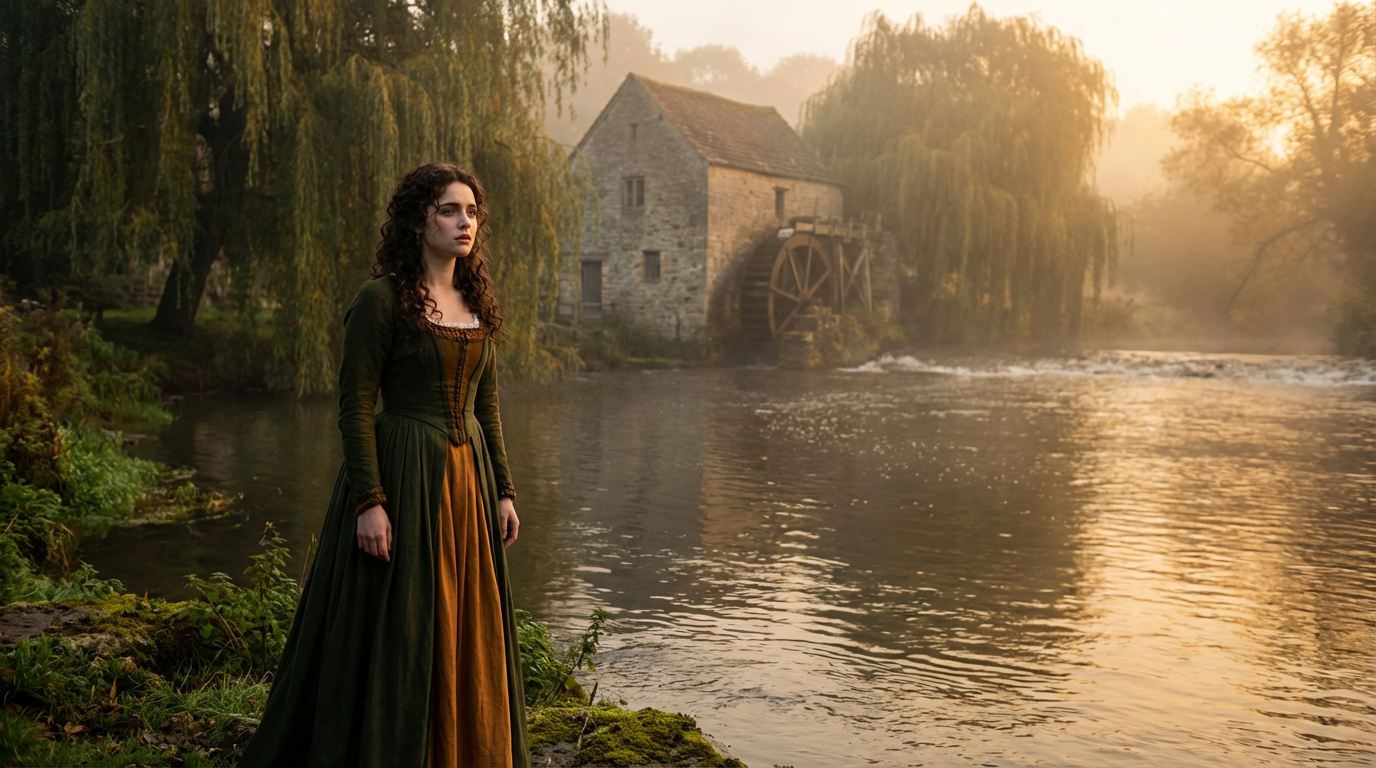
An excerpt from the original text.(complete · 2780 words)
akem in a New Light
Before three days had passed after the conversation you have just
overheard between Lucy and her father she had contrived to have a
private interview with Philip during a visit of Maggie’s to her aunt
Glegg. For a day and a night Philip turned over in his mind with
restless agitation all that Lucy had told him in that interview, till
he had thoroughly resolved on a course of action. He thought he saw
before him now a possibility of altering his position with respect to
Maggie, and removing at least one obstacle between them. He laid his
plan and calculated all his moves with the fervid deliberation of a
chess-player in the days of his first ardor, and was amazed himself at
his sudden genius as a tactician. His plan was as bold as it was
thoroughly calculated. Having watched for a moment when his father had
nothing more urgent on his hands than the newspaper, he went behind
him, laid a hand on his shoulder, and said,—
“Father, will you come up into my sanctum, and look at my new sketches?
I’ve arranged them now.”
“I’m getting terrible stiff in the joints, Phil, for climbing those
stairs of yours,” said Wakem, looking kindly at his son as he laid down
his paper. “But come along, then.”
“This is a nice place for you, isn’t it, Phil?—a capital light that
from the roof, eh?” was, as usual, the first thing he said on entering
the painting-room. He liked to remind himself and his son too that his
fatherly indulgence had provided the accommodation. He had been a good
father. Emily would have nothing to reproach him with there, if she
came back again from her grave.
“Come, come,” he said, putting his double eye-glass over his nose, and
seating himself to take a general view while he rested, “you’ve got a
famous show here. Upon my word, I don’t see that your things aren’t as
good as that London artist’s—what’s his name—that Leyburn gave so much
money for.”
Philip shook his head and smiled. He had seated himself on his
painting-stool, and had taken a lead pencil in his hand, with which he
was making strong marks to counteract the sense of tremulousness. He
watched his father get up, and walk slowly round, good-naturedly
dwelling on the pictures much longer than his amount of genuine taste
for landscape would have prompted, till he stopped before a stand on
which two pictures were placed,—one much larger than the other, the
smaller one in a leather case.
“Bless me! what have you here?” said Wakem, startled by a sudden
transition from landscape to portrait. “I thought you’d left off
figures. Who are these?”
“They are the same person,” said Philip, with calm promptness, “at
different ages.”
“And what person?” said Wakem, sharply fixing his eyes with a growing
look of suspicion on the larger picture.
“Miss Tulliver. The small one is something like what she was when I was
at school with her brother at King’s Lorton; the larger one is not
quite so good a likeness of what she was when I came from abroad.”
Wakem turned round fiercely, with a flushed face, letting his eye-glass
fall, and looking at his son with a savage expression for a moment, as
if he was ready to strike that daring feebleness from the stool. But he
threw himself into the armchair again, and thrust his hands into his
trouser-pockets, still looking angrily at his son, however. Philip did
not return the look, but sat quietly watching the point of his pencil.
“And do you mean to say, then, that you have had any acquaintance with
her since you came from abroad?” said Wakem, at last, with that vain
effort which rage always makes to throw as much punishment as it
desires to inflict into words and tones, since blows are forbidden.
“Yes; I saw a great deal of her for a whole year before her father’s
death. We met often in that thicket—the Red Deeps—near Dorlcote Mill. I
love her dearly; I shall never love any other woman. I have thought of
her ever since she was a little girl.”
“Go on, sir! And you have corresponded with her all this while?”
“No. I never told her I loved her till just before we parted, and she
promised her brother not to see me again or to correspond with me. I am
not sure that she loves me or would consent to marry me. But if she
would consent,—if she did love me well enough,—I should marry her.”
“And this is the return you make me for all the indulgences I’ve heaped
on you?” said Wakem, getting white, and beginning to tremble under an
enraged sense of impotence before Philip’s calm defiance and
concentration of purpose.
“No, father,” said Philip, looking up at him for the first time; “I
don’t regard it as a return. You have been an indulgent father to me;
but I have always felt that it was because you had an affectionate wish
to give me as much happiness as my unfortunate lot would admit, not
that it was a debt you expected me to pay by sacrificing all my chances
of happiness to satisfy feelings of yours which I can never share.”
“I think most sons would share their father’s feelings in this case,”
said Wakem, bitterly. “The girl’s father was an ignorant mad brute, who
was within an inch of murdering me. The whole town knows it. And the
brother is just as insolent, only in a cooler way. He forbade her
seeing you, you say; he’ll break every bone in your body, for your
greater happiness, if you don’t take care. But you seem to have made up
your mind; you have counted the consequences, I suppose. Of course you
are independent of me; you can marry this girl to-morrow, if you like;
you are a man of five-and-twenty,—you can go your way, and I can go
mine. We need have no more to do with each other.”
Wakem rose and walked toward the door, but something held him back, and
instead of leaving the room, he walked up and down it. Philip was slow
to reply, and when he spoke, his tone had a more incisive quietness and
clearness than ever.
“No; I can’t marry Miss Tulliver, even if she would have me, if I have
only my own resources to maintain her with. I have been brought up to
no profession. I can’t offer her poverty as well as deformity.”
“Ah, there is a reason for your clinging to me, doubtless,” said
Wakem, still bitterly, though Philip’s last words had given him a pang;
they had stirred a feeling which had been a habit for a quarter of a
century. He threw himself into the chair again.
“I expected all this,” said Philip. “I know these scenes are often
happening between father and son. If I were like other men of my age, I
might answer your angry words by still angrier; we might part; I should
marry the woman I love, and have a chance of being as happy as the
rest. But if it will be a satisfaction to you to annihilate the very
object of everything you’ve done for me, you have an advantage over
most fathers; you can completely deprive me of the only thing that
would make my life worth having.”
Philip paused, but his father was silent.
“You know best what satisfaction you would have, beyond that of
gratifying a ridiculous rancor worthy only of wandering savages.”
“Ridiculous rancor!” Wakem burst out. “What do you mean? Damn it! is a
man to be horsewhipped by a boor and love him for it? Besides, there’s
that cold, proud devil of a son, who said a word to me I shall not
forget when we had the settling. He would be as pleasant a mark for a
bullet as I know, if he were worth the expense.”
“I don’t mean your resentment toward them,” said Philip, who had his
reasons for some sympathy with this view of Tom, “though a feeling of
revenge is not worth much, that you should care to keep it. I mean your
extending the enmity to a helpless girl, who has too much sense and
goodness to share their narrow prejudices. She has never entered into
the family quarrels.”
“What does that signify? We don’t ask what a woman does; we ask whom
she belongs to. It’s altogether a degrading thing to you, to think of
marrying old Tulliver’s daughter.”
For the first time in the dialogue, Philip lost some of his
self-control, and coloured with anger.
“Miss Tulliver,” he said, with bitter incisiveness, “has the only
grounds of rank that anything but vulgar folly can suppose to belong to
the middle class; she is thoroughly refined, and her friends, whatever
else they may be, are respected for irreproachable honour and
integrity. All St Ogg’s, I fancy, would pronounce her to be more than
my equal.”
Wakem darted a glance of fierce question at his son; but Philip was not
looking at him, and with a certain penitent consciousness went on, in a
few moments, as if in amplification of his last words,—
“Find a single person in St Ogg’s who will not tell you that a
beautiful creature like her would be throwing herself away on a
pitiable object like me.”
“Not she!” said Wakem, rising again, and forgetting everything else in
a burst of resentful pride, half fatherly, half personal. “It would be
a deuced fine match for her. It’s all stuff about an accidental
deformity, when a girl’s really attached to a man.”
“But girls are not apt to get attached under those circumstances,” said
Philip.
“Well, then,” said Wakem, rather brutally, trying to recover his
previous position, “if she doesn’t care for you, you might have spared
yourself the trouble of talking to me about her, and you might have
spared me the trouble of refusing my consent to what was never likely
to happen.”
Wakem strode to the door, and without looking round again, banged it
after him.
Philip was not without confidence that his father would be ultimately
wrought upon as he had expected, by what had passed; but the scene had
jarred upon his nerves, which were as sensitive as a woman’s. He
determined not to go down to dinner; he couldn’t meet his father again
that day. It was Wakem’s habit, when he had no company at home, to go
out in the evening, often as early as half-past seven; and as it was
far on in the afternoon now, Philip locked up his room and went out for
a long ramble, thinking he would not return until his father was out of
the house again. He got into a boat, and went down the river to a
favourite village, where he dined, and lingered till it was late enough
for him to return. He had never had any sort of quarrel with his father
before, and had a sickening fear that this contest, just begun, might
go on for weeks; and what might not happen in that time? He would not
allow himself to define what that involuntary question meant. But if he
could once be in the position of Maggie’s accepted, acknowledged lover,
there would be less room for vague dread. He went up to his
painting-room again, and threw himself with a sense of fatigue into the
armchair, looking round absently at the views of water and rock that
were ranged around, till he fell into a doze, in which he fancied
Maggie was slipping down a glistening, green, slimy channel of a
waterfall, and he was looking on helpless, till he was awakened by what
seemed a sudden, awful crash.
It was the opening of the door, and he could hardly have dozed more
than a few moments, for there was no perceptible change in the evening
light. It was his father who entered; and when Philip moved to vacate
the chair for him, he said,—
“Sit still. I’d rather walk about.”
He stalked up and down the room once or twice, and then, standing
opposite Philip with his hands thrust in his side pockets, he said, as
if continuing a conversation that had not been broken off,—
“But this girl seems to have been fond of you, Phil, else she wouldn’t
have met you in that way.”
Philip’s heart was beating rapidly, and a transient flush passed over
his face like a gleam. It was not quite easy to speak at once.
“She liked me at King’s Lorton, when she was a little girl, because I
used to sit with her brother a great deal when he had hurt his foot.
She had kept that in her memory, and thought of me as a friend of a
long while ago. She didn’t think of me as a lover when she met me.”
“Well, but you made love to her at last. What did she say then?” said
Wakem, walking about again.
“She said she did love me then.”
“Confound it, then; what else do you want? Is she a jilt?”
“She was very young then,” said Philip, hesitatingly. “I’m afraid she
hardly knew what she felt. I’m afraid our long separation, and the idea
that events must always divide us, may have made a difference.”
“But she’s in the town. I’ve seen her at church. Haven’t you spoken to
her since you came back?”
“Yes, at Mr Deane’s. But I couldn’t renew my proposals to her on
several grounds. One obstacle would be removed if you would give your
consent,—if you would be willing to think of her as a daughter-in-law.”
Wakem was silent a little while, pausing before Maggie’s picture.
“She’s not the sort of woman your mother was, though, Phil,” he said,
at last. “I saw her at church,—she’s handsomer than this,—deuced fine
eyes and fine figure, I saw; but rather dangerous and unmanageable,
eh?”
“She’s very tender and affectionate, and so simple,—without the airs
and petty contrivances other women have.”
“Ah?” said Wakem. Then looking round at his son, “But your mother
looked gentler; she had that brown wavy hair and gray eyes, like yours.
You can’t remember her very well. It was a thousand pities I’d no
likeness of her.”
“Then, shouldn’t you be glad for me to have the same sort of happiness,
father, to sweeten my life for me? There can never be another tie so
strong to you as that which began eight-and-twenty years ago, when you
married my mother, and you have been tightening it ever since.”
“Ah, Phil, you’re the only fellow that knows the best of me,” said
Wakem, giving his hand to his son. “We must keep together if we can.
And now, what am I to do? You must come downstairs and tell me. Am I to
go and call on this dark-eyed damsel?”
The barrier once thrown down in this way, Philip could talk freely to
his father of their entire relation with the Tullivers,—of the desire
to get the mill and land back into the family, and of its transfer to
Guest & Co. as an intermediate step. He could venture now to be
persuasive and urgent, and his father yielded with more readiness than
he had calculated on.
“I don’t care about the mill,” he said at last, with a sort of angry
compliance. “I’ve had an infernal deal of bother lately about the mill.
Let them pay me for my improvements, that’s all. But there’s one thing
you needn’t ask me. I shall have no direct transactions with young
Tulliver. If you like to swallow him for his sister’s sake, you may;
but I’ve no sauce that will make him go down.”
I leave you to imagine the agreeable feelings with which Philip went to
Mr Deane the next day, to say that Mr Wakem was ready to open the
negotiations, and Lucy’s pretty triumph as she appealed to her father
whether she had not proved her great business abilities. Mr Deane was
rather puzzled, and suspected that there had been something “going on”
among the young people to which he wanted a clew. But to men of Mr
Deane’s stamp, what goes on among the young people is as extraneous to
the real business of life as what goes on among the birds and
butterflies, until it can be shown to have a malign bearing on monetary
affairs. And in this case the bearing appeared to be entirely
propitious.
Master this chapter. Complete your experience
Purchase the complete book to access all chapters and support classic literature
As an Amazon Associate, we earn a small commission from qualifying purchases at no additional cost to you.
Available in paperback, hardcover, and e-book formats
Let's Analyse the Pattern
Leading with weakness to disarm power holders and appeal to their protective instincts rather than triggering their defensive ones.
Why This Matters
Connect literature to life
This chapter teaches how to identify when someone's stated objections mask deeper emotional needs or fears.
Practice This Today
This week, notice when people say 'no' to requests—listen for what they're really protecting (pride, control, fear of being taken advantage of) rather than just their surface reasons.
Now let's explore the literary elements.
Key Quotes & Analysis
"He laid his plan and calculated all his moves with the fervid deliberation of a chess-player in the days of his first ardor"
Context: Describing Philip's mental preparation before confronting his father
This shows Philip approaching the conversation like a strategic game rather than an emotional outburst. The chess metaphor reveals he's thinking several moves ahead, considering his father's likely responses and planning counter-moves accordingly.
In Today's Words:
He planned this conversation like he was playing chess, thinking through every possible move and response.
"I'm getting terrible stiff in the joints, Phil, for climbing those stairs of yours"
Context: When Philip invites his father up to see his sketches
This casual complaint about physical limitation creates irony, since Philip is about to use his own physical limitations as part of his argument. It also shows the father's willingness to make an effort for his son despite discomfort.
In Today's Words:
Those stairs are killing my knees, but I'll do it for you.
"This is a nice place for you, isn't it, Phil?—a capital light that from the roof, eh?"
Context: Wakem's first comment upon entering Philip's studio
The father's immediate focus on the practical aspects of the space shows his care for Philip's comfort and success as an artist. This sets up the emotional foundation Philip will build on - his father wants him to be happy and fulfilled.
In Today's Words:
You've got a great setup here - perfect lighting for your work.
Thematic Threads
Power Dynamics
In This Chapter
Philip navigates his father's authority by reframing dependence as an asset rather than fighting it
Development
Evolved from earlier power struggles between families to personal negotiation within family
In Your Life:
You might recognize this when dealing with bosses, insurance companies, or family members who hold financial or emotional power over you
Strategic Thinking
In This Chapter
Philip orchestrates the entire confrontation, using portraits as props and timing his revelations for maximum impact
Development
Builds on earlier themes of calculation in relationships, showing how strategy can serve love
In Your Life:
You see this when planning difficult conversations at work or preparing to ask family for help
Identity
In This Chapter
Philip transforms his physical deformity from shame into a tool for gaining sympathy and leverage
Development
Continues exploration of how characters use their perceived limitations as unexpected strengths
In Your Life:
You might apply this when your background, education level, or circumstances could actually work in your favor if reframed
Love
In This Chapter
Philip appeals to his father's deep love for him as the ultimate trump card against family prejudice
Development
Shows how personal love can override social expectations and historical grudges
In Your Life:
You recognize this when family members' protective instincts clash with their stated principles
Class
In This Chapter
The family feud becomes secondary to personal relationships when love and vulnerability enter the equation
Development
Demonstrates how individual connections can transcend class-based conflicts
In Your Life:
You see this when workplace hierarchies soften through personal relationships or when economic differences matter less than human connection
You now have the context. Time to form your own thoughts.
Discussion Questions
- 1
What strategy does Philip use to tell his father about wanting to marry Maggie, and how does he prepare for the conversation?
analysis • surface - 2
Why does Philip emphasize his physical disability when talking to his father, and how does this change the power dynamic between them?
analysis • medium - 3
Think about a time when someone had power over a decision you cared about. How did you approach them - with demands, arguments, or something else?
application • medium - 4
Philip appeals to his father's pride and love rather than fighting the family feud directly. When might leading with vulnerability be more effective than showing strength?
application • deep - 5
What does Philip's success reveal about the difference between what people say they object to and what they really fear?
reflection • deep
Critical Thinking Exercise
Map Your Next Difficult Conversation
Think of a request you need to make of someone who holds power over the outcome - a boss, parent, landlord, or authority figure. Instead of planning your arguments, map out what this person really values and fears. What would make them feel important rather than threatened? Write out two approaches: your instinctive direct approach, and a Philip-inspired approach that leads with strategic vulnerability.
Consider:
- •What does this person need to feel respected and valued in the conversation?
- •What are they really afraid of beyond their stated objections?
- •How can you acknowledge their power while still advocating for yourself?
Journaling Prompt
Write about a time when someone approached you with a request. What made you want to say yes versus what made you want to say no? How did their approach affect your response?
Coming Up Next...
Chapter 48: The Weight of Social Performance
With one major obstacle removed, the path seems clearer for the Tullivers to reclaim their mill and for Philip to pursue Maggie. But as the next chapter reveals, good intentions and family machinations don't always account for the complexities of the human heart.



