
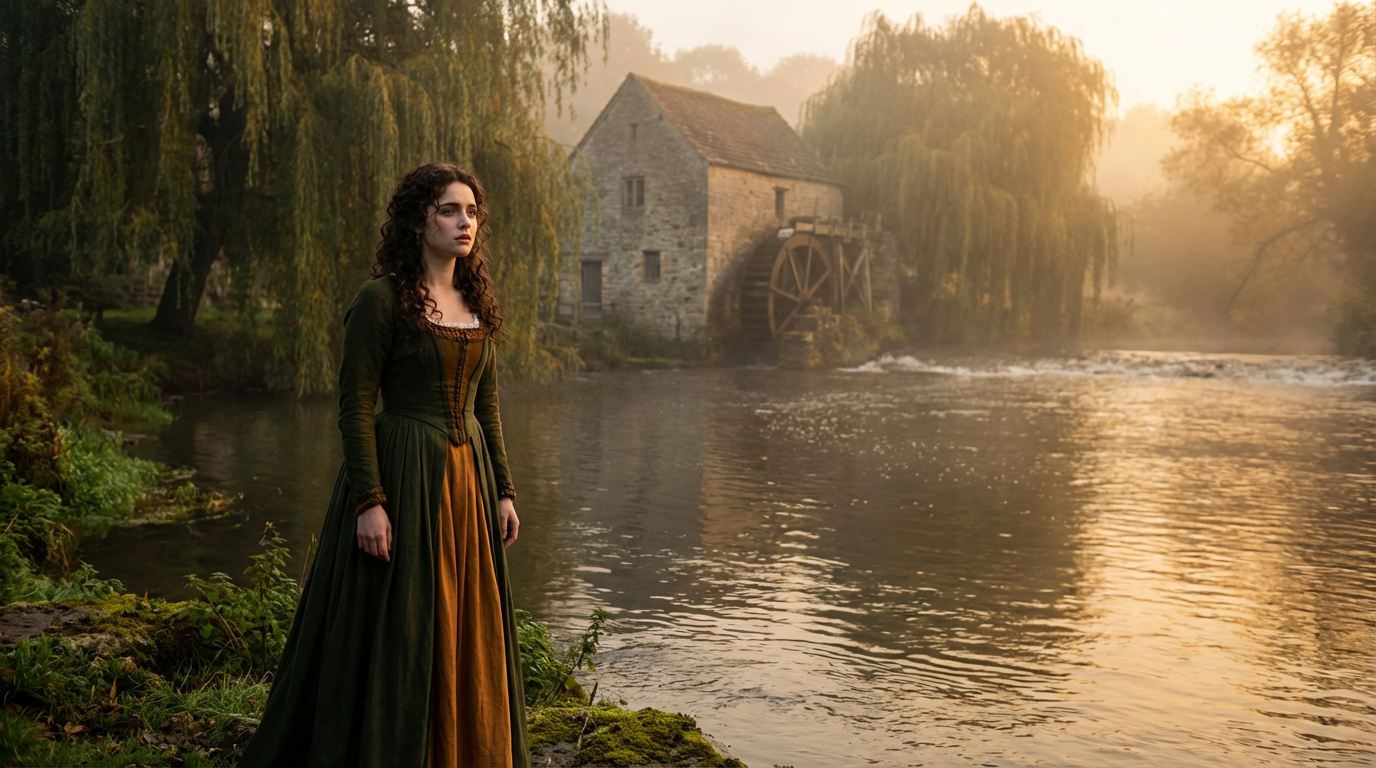
An excerpt from the original text.(complete · 5175 words)
irst Impressions
“He is very clever, Maggie,” said Lucy. She was kneeling on a footstool
at Maggie’s feet, after placing that dark lady in the large
crimson-velvet chair. “I feel sure you will like him. I hope you will.”
“I shall be very difficult to please,” said Maggie, smiling, and
holding up one of Lucy’s long curls, that the sunlight might shine
through it. “A gentleman who thinks he is good enough for Lucy must
expect to be sharply criticised.”
“Indeed, he’s a great deal too good for me. And sometimes, when he is
away, I almost think it can’t really be that he loves me. But I can
never doubt it when he is with me, though I couldn’t bear any one but
you to know that I feel in that way, Maggie.”
“Oh, then, if I disapprove of him you can give him up, since you are
not engaged,” said Maggie, with playful gravity.
“I would rather not be engaged. When people are engaged, they begin to
think of being married soon,” said Lucy, too thoroughly preoccupied to
notice Maggie’s joke; “and I should like everything to go on for a long
while just as it is. Sometimes I am quite frightened lest Stephen
should say that he has spoken to papa; and from something that fell
from papa the other day, I feel sure he and Mr Guest are expecting
that. And Stephen’s sisters are very civil to me now. At first, I think
they didn’t like his paying me attention; and that was natural. It
does seem out of keeping that I should ever live in a great place
like the Park House, such a little insignificant thing as I am.”
“But people are not expected to be large in proportion to the houses
they live in, like snails,” said Maggie, laughing. “Pray, are Mr
Guest’s sisters giantesses?”
“Oh no; and not handsome,—that is, not very,” said Lucy, half-penitent
at this uncharitable remark. “But he is—at least he is generally
considered very handsome.”
“Though you are unable to share that opinion?”
“Oh, I don’t know,” said Lucy, blushing pink over brow and neck. “It is
a bad plan to raise expectation; you will perhaps be disappointed. But
I have prepared a charming surprise for him; I shall have a glorious
laugh against him. I shall not tell you what it is, though.”
Lucy rose from her knees and went to a little distance, holding her
pretty head on one side, as if she had been arranging Maggie for a
portrait, and wished to judge of the general effect.
“Stand up a moment, Maggie.”
“What is your pleasure now?” said Maggie, smiling languidly as she rose
from her chair and looked down on her slight, aerial cousin, whose
figure was quite subordinate to her faultless drapery of silk and
crape.
Lucy kept her contemplative attitude a moment or two in silence, and
then said,—
“I can’t think what witchery it is in you, Maggie, that makes you look
best in shabby clothes; though you really must have a new dress now.
But do you know, last night I was trying to fancy you in a handsome,
fashionable dress, and do what I would, that old limp merino would come
back as the only right thing for you. I wonder if Marie Antoinette
looked all the grander when her gown was darned at the elbows. Now, if
I were to put anything shabby on, I should be quite unnoticeable. I
should be a mere rag.”
“Oh, quite,” said Maggie, with mock gravity. “You would be liable to be
swept out of the room with the cobwebs and carpet-dust, and to find
yourself under the grate, like Cinderella. Mayn’t I sit down now?”
“Yes, now you may,” said Lucy, laughing. Then, with an air of serious
reflection, unfastening her large jet brooch, “But you must change
brooches, Maggie; that little butterfly looks silly on you.”
“But won’t that mar the charming effect of my consistent shabbiness?”
said Maggie, seating herself submissively, while Lucy knelt again and
unfastened the contemptible butterfly. “I wish my mother were of your
opinion, for she was fretting last night because this is my best frock.
I’ve been saving my money to pay for some lessons; I shall never get a
better situation without more accomplishments.”
Maggie gave a little sigh.
“Now, don’t put on that sad look again,” said Lucy, pinning the large
brooch below Maggie’s fine throat. “You’re forgetting that you’ve left
that dreary schoolroom behind you, and have no little girls’ clothes to
mend.”
“Yes,” said Maggie. “It is with me as I used to think it would be with
the poor uneasy white bear I saw at the show. I thought he must have
got so stupid with the habit of turning backward and forward in that
narrow space that he would keep doing it if they set him free. One gets
a bad habit of being unhappy.”
“But I shall put you under a discipline of pleasure that will make you
lose that bad habit,” said Lucy, sticking the black butterfly absently
in her own collar, while her eyes met Maggie’s affectionately.
“You dear, tiny thing,” said Maggie, in one of her bursts of loving
admiration, “you enjoy other people’s happiness so much, I believe you
would do without any of your own. I wish I were like you.”
“I’ve never been tried in that way,” said Lucy. “I’ve always been so
happy. I don’t know whether I could bear much trouble; I never had any
but poor mamma’s death. You have been tried, Maggie; and I’m sure you
feel for other people quite as much as I do.”
“No, Lucy,” said Maggie, shaking her head slowly, “I don’t enjoy their
happiness as you do, else I should be more contented. I do feel for
them when they are in trouble; I don’t think I could ever bear to make
any one unhappy; and yet I often hate myself, because I get angry
sometimes at the sight of happy people. I think I get worse as I get
older, more selfish. That seems very dreadful.”
“Now, Maggie!” said Lucy, in a tone of remonstrance, “I don’t believe a
word of that. It is all a gloomy fancy, just because you are depressed
by a dull, wearisome life.”
“Well, perhaps it is,” said Maggie, resolutely clearing away the clouds
from her face with a bright smile, and throwing herself backward in her
chair. “Perhaps it comes from the school diet,—watery rice-pudding
spiced with Pinnock. Let us hope it will give way before my mother’s
custards and this charming Geoffrey Crayon.”
Maggie took up the “Sketch Book,” which lay by her on the table.
“Do I look fit to be seen with this little brooch?” said Lucy, going to
survey the effect in the chimney-glass.
“Oh no, Mr Guest will be obliged to go out of the room again if he sees
you in it. Pray make haste and put another on.”
Lucy hurried out of the room, but Maggie did not take the opportunity
of opening her book; she let it fall on her knees, while her eyes
wandered to the window, where she could see the sunshine falling on the
rich clumps of spring flowers and on the long hedge of laurels, and
beyond, the silvery breadth of the dear old Floss, that at this
distance seemed to be sleeping in a morning holiday. The sweet fresh
garden-scent came through the open window, and the birds were busy
flitting and alighting, gurgling and singing. Yet Maggie’s eyes began
to fill with tears. The sight of the old scenes had made the rush of
memories so painful that even yesterday she had only been able to
rejoice in her mother’s restored comfort and Tom’s brotherly
friendliness as we rejoice in good news of friends at a distance,
rather than in the presence of a happiness which we share. Memory and
imagination urged upon her a sense of privation too keen to let her
taste what was offered in the transient present. Her future, she
thought, was likely to be worse than her past, for after her years of
contented renunciation, she had slipped back into desire and longing;
she found joyless days of distasteful occupation harder and harder; she
found the image of the intense and varied life she yearned for, and
despaired of, becoming more and more importunate. The sound of the
opening door roused her, and hastily wiping away her tears, she began
to turn over the leaves of her book.
“There is one pleasure, I know, Maggie, that your deepest dismalness
will never resist,” said Lucy, beginning to speak as soon as she
entered the room. “That is music, and I mean you to have quite a
riotous feast of it. I mean you to get up your playing again, which
used to be so much better than mine, when we were at Laceham.”
“You would have laughed to see me playing the little girls’ tunes over
and over to them, when I took them to practise,” said Maggie, “just for
the sake of fingering the dear keys again. But I don’t know whether I
could play anything more difficult now than ‘Begone, dull care!’”
“I know what a wild state of joy you used to be in when the glee-men
came round,” said Lucy, taking up her embroidery; “and we might have
all those old glees that you used to love so, if I were certain that
you don’t feel exactly as Tom does about some things.”
“I should have thought there was nothing you might be more certain of,”
said Maggie, smiling.
“I ought rather to have said, one particular thing. Because if you feel
just as he does about that, we shall want our third voice. St Ogg’s is
so miserably provided with musical gentlemen. There are really only
Stephen and Philip Wakem who have any knowledge of music, so as to be
able to sing a part.”
Lucy had looked up from her work as she uttered the last sentence, and
saw that there was a change in Maggie’s face.
“Does it hurt you to hear the name mentioned, Maggie? If it does, I
will not speak of him again. I know Tom will not see him if he can
avoid it.”
“I don’t feel at all as Tom does on that subject,” said Maggie, rising
and going to the window as if she wanted to see more of the landscape.
“I’ve always liked Philip Wakem ever since I was a little girl, and saw
him at Lorton. He was so good when Tom hurt his foot.”
“Oh, I’m so glad!” said Lucy. “Then you won’t mind his coming
sometimes, and we can have much more music than we could without him.
I’m very fond of poor Philip, only I wish he were not so morbid about
his deformity. I suppose it is his deformity that makes him so sad,
and sometimes bitter. It is certainly very piteous to see his poor
little crooked body and pale face among great, strong people.”
“But, Lucy——” said Maggie, trying to arrest the prattling stream.
“Ah, there is the door-bell. That must be Stephen,” Lucy went on, not
noticing Maggie’s faint effort to speak. “One of the things I most
admire in Stephen is that he makes a greater friend of Philip than any
one.”
It was too late for Maggie to speak now; the drawingroom door was
opening, and Minny was already growling in a small way at the entrance
of a tall gentleman, who went up to Lucy and took her hand with a
half-polite, half-tender glance and tone of inquiry, which seemed to
indicate that he was unconscious of any other presence.
“Let me introduce you to my cousin, Miss Tulliver,” said Lucy, turning
with wicked enjoyment toward Maggie, who now approached from the
farther window. “This is Mr Stephen Guest.”
For one instant Stephen could not conceal his astonishment at the sight
of this tall, dark-eyed nymph with her jet-black coronet of hair; the
next, Maggie felt herself, for the first time in her life, receiving
the tribute of a very deep blush and a very deep bow from a person
toward whom she herself was conscious of timidity.
This new experience was very agreeable to her, so agreeable that it
almost effaced her previous emotion about Philip. There was a new
brightness in her eyes, and a very becoming flush on her cheek, as she
seated herself.
“I hope you perceive what a striking likeness you drew the day before
yesterday,” said Lucy, with a pretty laugh of triumph. She enjoyed her
lover’s confusion; the advantage was usually on his side.
“This designing cousin of yours quite deceived me, Miss Tulliver,” said
Stephen, seating himself by Lucy, and stooping to play with Minny, only
looking at Maggie furtively. “She said you had light hair and blue
eyes.”
“Nay, it was you who said so,” remonstrated Lucy. “I only refrained
from destroying your confidence in your own second-sight.”
“I wish I could always err in the same way,” said Stephen, “and find
reality so much more beautiful than my preconceptions.”
“Now you have proved yourself equal to the occasion,” said Maggie, “and
said what it was incumbent on you to say under the circumstances.”
She flashed a slightly defiant look at him; it was clear to her that he
had been drawing a satirical portrait of her beforehand. Lucy had said
he was inclined to be satirical, and Maggie had mentally supplied the
addition, “and rather conceited.”
“An alarming amount of devil there,” was Stephen’s first thought. The
second, when she had bent over her work, was, “I wish she would look at
me again.” The next was to answer,—
“I suppose all phrases of mere compliment have their turn to be true. A
man is occasionally grateful when he says ‘Thank you.’ It’s rather hard
upon him that he must use the same words with which all the world
declines a disagreeable invitation, don’t you think so, Miss Tulliver?”
“No,” said Maggie, looking at him with her direct glance; “if we use
common words on a great occasion, they are the more striking, because
they are felt at once to have a particular meaning, like old banners,
or everyday clothes, hung up in a sacred place.”
“Then my compliment ought to be eloquent,” said Stephen, really not
quite knowing what he said while Maggie looked at him, “seeing that the
words were so far beneath the occasion.”
“No compliment can be eloquent, except as an expression of
indifference,” said Maggie, flushing a little.
Lucy was rather alarmed; she thought Stephen and Maggie were not going
to like each other. She had always feared lest Maggie should appear too
old and clever to please that critical gentleman. “Why, dear Maggie,”
she interposed, “you have always pretended that you are too fond of
being admired; and now, I think, you are angry because some one
ventures to admire you.”
“Not at all,” said Maggie; “I like too well to feel that I am admired,
but compliments never make me feel that.”
“I will never pay you a compliment again, Miss Tulliver,” said Stephen.
“Thank you; that will be a proof of respect.”
Poor Maggie! She was so unused to society that she could take nothing
as a matter of course, and had never in her life spoken from the lips
merely, so that she must necessarily appear absurd to more experienced
ladies, from the excessive feeling she was apt to throw into very
trivial incidents. But she was even conscious herself of a little
absurdity in this instance. It was true she had a theoretic objection
to compliments, and had once said impatiently to Philip that she didn’t
see why women were to be told with a simper that they were beautiful,
any more than old men were to be told that they were venerable; still,
to be so irritated by a common practice in the case of a stranger like
Mr Stephen Guest, and to care about his having spoken slightingly of
her before he had seen her, was certainly unreasonable, and as soon as
she was silent she began to be ashamed of herself. It did not occur to
her that her irritation was due to the pleasanter emotion which
preceded it, just as when we are satisfied with a sense of glowing
warmth an innocent drop of cold water may fall upon us as a sudden
smart.
Stephen was too well bred not to seem unaware that the previous
conversation could have been felt embarrassing, and at once began to
talk of impersonal matters, asking Lucy if she knew when the bazaar was
at length to take place, so that there might be some hope of seeing her
rain the influence of her eyes on objects more grateful than those
worsted flowers that were growing under her fingers.
“Some day next month, I believe,” said Lucy. “But your sisters are
doing more for it than I am; they are to have the largest stall.”
“Ah yes; but they carry on their manufactures in their own
sitting-room, where I don’t intrude on them. I see you are not addicted
to the fashionable vice of fancy-work, Miss Tulliver,” said Stephen,
looking at Maggie’s plain hemming.
“No,” said Maggie, “I can do nothing more difficult or more elegant
than shirt-making.”
“And your plain sewing is so beautiful, Maggie,” said Lucy, “that I
think I shall beg a few specimens of you to show as fancy-work. Your
exquisite sewing is quite a mystery to me, you used to dislike that
sort of work so much in old days.”
“It is a mystery easily explained, dear,” said Maggie, looking up
quietly. “Plain sewing was the only thing I could get money by, so I
was obliged to try and do it well.”
Lucy, good and simple as she was, could not help blushing a little. She
did not quite like that Stephen should know that; Maggie need not have
mentioned it. Perhaps there was some pride in the confession,—the pride
of poverty that will not be ashamed of itself. But if Maggie had been
the queen of coquettes she could hardly have invented a means of giving
greater piquancy to her beauty in Stephen’s eyes; I am not sure that
the quiet admission of plain sewing and poverty would have done alone,
but assisted by the beauty, they made Maggie more unlike other women
even than she had seemed at first.
“But I can knit, Lucy,” Maggie went on, “if that will be of any use for
your bazaar.”
“Oh yes, of infinite use. I shall set you to work with scarlet wool
to-morrow. But your sister is the most enviable person,” continued
Lucy, turning to Stephen, “to have the talent of modelling. She is
doing a wonderful bust of Dr Kenn entirely from memory.”
“Why, if she can remember to put the eyes very near together, and the
corners of the mouth very far apart, the likeness can hardly fail to be
striking in St Ogg’s.”
“Now that is very wicked of you,” said Lucy, looking rather hurt. “I
didn’t think you would speak disrespectfully of Dr Kenn.”
“I say anything disrespectful of Dr Kenn? Heaven forbid! But I am not
bound to respect a libellous bust of him. I think Kenn one of the
finest fellows in the world. I don’t care much about the tall
candlesticks he has put on the communion-table, and I shouldn’t like to
spoil my temper by getting up to early prayers every morning. But he’s
the only man I ever knew personally who seems to me to have anything of
the real apostle in him,—a man who has eight hundred a-year and is
contented with deal furniture and boiled beef because he gives away
two-thirds of his income. That was a very fine thing of him,—taking
into his house that poor lad Grattan, who shot his mother by accident.
He sacrifices more time than a less busy man could spare, to save the
poor fellow from getting into a morbid state of mind about it. He takes
the lad out with him constantly, I see.”
“That is beautiful,” said Maggie, who had let her work fall, and was
listening with keen interest. “I never knew any one who did such
things.”
“And one admires that sort of action in Kenn all the more,” said
Stephen, “because his manners in general are rather cold and severe.
There’s nothing sugary and maudlin about him.”
“Oh, I think he’s a perfect character!” said Lucy, with pretty
enthusiasm.
“No; there I can’t agree with you,” said Stephen, shaking his head with
sarcastic gravity.
“Now, what fault can you point out in him?”
“He’s an Anglican.”
“Well, those are the right views, I think,” said Lucy, gravely.
“That settles the question in the abstract,” said Stephen, “but not
from a parliamentary point of view. He has set the Dissenters and the
Church people by the ears; and a rising senator like myself, of whose
services the country is very much in need, will find it inconvenient
when he puts up for the honour of representing St Ogg’s in Parliament.”
“Do you really think of that?” said Lucy, her eyes brightening with a
proud pleasure that made her neglect the argumentative interests of
Anglicanism.
“Decidedly, whenever old Mr Leyburn’s public spirit and gout induce him
to give way. My father’s heart is set on it; and gifts like mine, you
know”—here Stephen drew himself up, and rubbed his large white hands
over his hair with playful self-admiration—“gifts like mine involve
great responsibilities. Don’t you think so, Miss Tulliver?”
“Yes,” said Maggie, smiling, but not looking up; “so much fluency and
self-possession should not be wasted entirely on private occasions.”
“Ah, I see how much penetration you have,” said Stephen. “You have
discovered already that I am talkative and impudent. Now superficial
people never discern that, owing to my manner, I suppose.”
“She doesn’t look at me when I talk of myself,” he thought, while his
listeners were laughing. “I must try other subjects.”
Did Lucy intend to be present at the meeting of the Book Club next
week? was the next question. Then followed the recommendation to choose
Southey’s “Life of Cowper,” unless she were inclined to be
philosophical, and startle the ladies of St Ogg’s by voting for one of
the Bridgewater Treatises. Of course Lucy wished to know what these
alarmingly learned books were; and as it is always pleasant to improve
the minds of ladies by talking to them at ease on subjects of which
they know nothing, Stephen became quite brilliant in an account of
Buckland’s Treatise, which he had just been reading. He was rewarded by
seeing Maggie let her work fall, and gradually get so absorbed in his
wonderful geological story that she sat looking at him, leaning forward
with crossed arms, and with an entire absence of self-consciousness, as
if he had been the snuffiest of old professors, and she a downy-lipped
alumna. He was so fascinated by the clear, large gaze that at last he
forgot to look away from it occasionally toward Lucy; but she, sweet
child, was only rejoicing that Stephen was proving to Maggie how clever
he was, and that they would certainly be good friends after all.
“I will bring you the book, shall I, Miss Tulliver?” said Stephen, when
he found the stream of his recollections running rather shallow. “There
are many illustrations in it that you will like to see.”
“Oh, thank you,” said Maggie, blushing with returning
self-consciousness at this direct address, and taking up her work
again.
“No, no,” Lucy interposed. “I must forbid your plunging Maggie in
books. I shall never get her away from them; and I want her to have
delicious do-nothing days, filled with boating and chatting and riding
and driving; that is the holiday she needs.”
“Apropos!” said Stephen, looking at his watch. “Shall we go out for a
row on the river now? The tide will suit for us to the Tofton way, and
we can walk back.”
That was a delightful proposition to Maggie, for it was years since she
had been on the river. When she was gone to put on her bonnet, Lucy
lingered to give an order to the servant, and took the opportunity of
telling Stephen that Maggie had no objection to seeing Philip, so that
it was a pity she had sent that note the day before yesterday. But she
would write another to-morrow and invite him.
“I’ll call and beat him up to-morrow,” said Stephen, “and bring him
with me in the evening, shall I? My sisters will want to call on you
when I tell them your cousin is with you. I must leave the field clear
for them in the morning.”
“Oh yes, pray bring him,” said Lucy. “And you will like Maggie,
sha’n’t you?” she added, in a beseeching tone. “Isn’t she a dear,
noble-looking creature?”
“Too tall,” said Stephen, smiling down upon her, “and a little too
fiery. She is not my type of woman, you know.”
Gentlemen, you are aware, are apt to impart these imprudent confidences
to ladies concerning their unfavourable opinion of sister fair ones.
That is why so many women have the advantage of knowing that they are
secretly repulsive to men who have self-denyingly made ardent love to
them. And hardly anything could be more distinctively characteristic of
Lucy than that she both implicitly believed what Stephen said, and was
determined that Maggie should not know it. But you, who have a higher
logic than the verbal to guide you, have already foreseen, as the
direct sequence to that unfavourable opinion of Stephen’s, that he
walked down to the boathouse calculating, by the aid of a vivid
imagination, that Maggie must give him her hand at least twice in
consequence of this pleasant boating plan, and that a gentleman who
wishes ladies to look at him is advantageously situated when he is
rowing them in a boat. What then? Had he fallen in love with this
surprising daughter of Mrs Tulliver at first sight? Certainly not. Such
passions are never heard of in real life. Besides, he was in love
already, and half-engaged to the dearest little creature in the world;
and he was not a man to make a fool of himself in any way. But when one
is five-and-twenty, one has not chalk-stones at one’s finger-ends that
the touch of a handsome girl should be entirely indifferent. It was
perfectly natural and safe to admire beauty and enjoy looking at it,—at
least under such circumstances as the present. And there was really
something very interesting about this girl, with her poverty and
troubles; it was gratifying to see the friendship between the two
cousins. Generally, Stephen admitted, he was not fond of women who had
any peculiarity of character, but here the peculiarity seemed really of
a superior kind, and provided one is not obliged to marry such women,
why, they certainly make a variety in social intercourse.
Maggie did not fulfil Stephen’s hope by looking at him during the first
quarter of an hour; her eyes were too full of the old banks that she
knew so well. She felt lonely, cut off from Philip,—the only person who
had ever seemed to love her devotedly, as she had always longed to be
loved. But presently the rhythmic movement of the oars attracted her,
and she thought she should like to learn how to row. This roused her
from her reverie, and she asked if she might take an oar. It appeared
that she required much teaching, and she became ambitious. The exercise
brought the warm blood into her cheeks, and made her inclined to take
her lesson merrily.
“I shall not be satisfied until I can manage both oars, and row you and
Lucy,” she said, looking very bright as she stepped out of the boat.
Maggie, we know, was apt to forget the thing she was doing, and she had
chosen an inopportune moment for her remark; her foot slipped, but
happily Mr Stephen Guest held her hand, and kept her up with a firm
grasp.
“You have not hurt yourself at all, I hope?” he said, bending to look
in her face with anxiety. It was very charming to be taken care of in
that kind, graceful manner by some one taller and stronger than one’s
self. Maggie had never felt just in the same way before.
When they reached home again, they found uncle and aunt Pullet seated
with Mrs Tulliver in the drawing-room, and Stephen hurried away, asking
leave to come again in the evening.
“And pray bring with you the volume of Purcell that you took away,”
said Lucy. “I want Maggie to hear your best songs.”
Aunt Pullet, under the certainty that Maggie would be invited to go out
with Lucy, probably to Park House, was much shocked at the shabbiness
of her clothes, which when witnessed by the higher society of St Ogg’s,
would be a discredit to the family, that demanded a strong and prompt
remedy; and the consultation as to what would be most suitable to this
end from among the superfluities of Mrs Pullet’s wardrobe was one that
Lucy as well as Mrs Tulliver entered into with some zeal. Maggie must
really have an evening dress as soon as possible, and she was about the
same height as aunt Pullet.
“But she’s so much broader across the shoulders than I am, it’s very
ill-convenient,” said Mrs Pullet, “else she might wear that beautiful
black brocade o’ mine without any alteration; and her arms are beyond
everything,” added Mrs Pullet, sorrowfully, as she lifted Maggie’s
large round arm, “She’d never get my sleeves on.”
“Oh, never mind that, aunt; send us the dress,” said Lucy. “I don’t
mean Maggie to have long sleeves, and I have abundance of black lace
for trimming. Her arms will look beautiful.”
“Maggie’s arms are a pretty shape,” said Mrs Tulliver. “They’re like
mine used to be, only mine was never brown; I wish she’d had our
family skin.”
“Nonsense, aunty!” said Lucy, patting her aunt Tulliver’s shoulder,
“you don’t understand those things. A painter would think Maggie’s
complexion beautiful.”
“Maybe, my dear,” said Mrs Tulliver, submissively. “You know better
than I do. Only when I was young a brown skin wasn’t thought well on
among respectable folks.”
“No,” said uncle Pullet, who took intense interest in the ladies’
conversation as he sucked his lozenges. “Though there was a song about
the ‘Nut-brown Maid’ too; I think she was crazy,—crazy Kate,—but I
can’t justly remember.”
“Oh dear, dear!” said Maggie, laughing, but impatient; “I think that
will be the end of my brown skin, if it is always to be talked about
so much.”
Master this chapter. Complete your experience
Purchase the complete book to access all chapters and support classic literature
As an Amazon Associate, we earn a small commission from qualifying purchases at no additional cost to you.
Available in paperback, hardcover, and e-book formats
Let's Analyse the Pattern
When someone sees our true worth beyond our protective identity, we often resist because recognition demands we outgrow our limitations.
Why This Matters
Connect literature to life
This chapter teaches how to distinguish between empty compliments and genuine recognition of your worth.
Practice This Today
This week, notice when praise makes you uncomfortable—that discomfort often signals the compliment hit something real and valuable about who you are.
Now let's explore the literary elements.
Key Quotes & Analysis
"I would rather not be engaged. When people are engaged, they begin to think of being married soon, and I should like everything to go on for a long while just as it is."
Context: Lucy explains to Maggie why she's in no hurry to formalize her relationship with Stephen
Shows Lucy's contentment with the romantic phase of courtship and her fear that marriage will change the pleasant dynamic. It reveals her innocence about the complexities of adult relationships.
In Today's Words:
I like how things are now - why rush into something that might mess up what we have?
"A gentleman who thinks he is good enough for Lucy must expect to be sharply criticised."
Context: Maggie warns Lucy that she'll judge Stephen harshly when they meet
Reveals Maggie's protective instincts toward Lucy and her skeptical attitude toward men, especially wealthy ones. It sets up the tension of their first meeting.
In Today's Words:
Any guy who thinks he deserves my cousin better be ready for me to grill him.
"I feel sure you will like him. I hope you will."
Context: Lucy expresses her desire for Maggie to approve of Stephen before they meet
Shows how much Lucy values Maggie's opinion and wants the two most important people in her life to get along. The repetition reveals her anxiety about their meeting.
In Today's Words:
Please like my boyfriend - your opinion really matters to me.
Thematic Threads
Class Barriers
In This Chapter
Stephen's casual mention of parliamentary ambitions and family wealth highlights the vast gulf between his world and Maggie's economic necessity
Development
Building from earlier chapters showing the Tulliver family's financial struggles
In Your Life:
You might recognize this when someone's casual comments about money or opportunities reveal how different your worlds really are
Defensive Pride
In This Chapter
Maggie challenges Stephen's compliments and smooth manner, suspicious of his earlier dismissive comments about her appearance
Development
Evolved from childhood scenes where Maggie learned to protect herself through defiance
In Your Life:
You might see this when you automatically bristle at kindness because you've learned to expect judgment
Dangerous Attraction
In This Chapter
The immediate chemistry between Maggie and Stephen threatens established relationships and social boundaries
Development
Introduced here as a new complication to Maggie's carefully constructed life
In Your Life:
You might experience this when you feel drawn to someone who represents everything you think you can't or shouldn't have
Hidden Intelligence
In This Chapter
Stephen is surprised and unsettled by Maggie's sharp mind, so different from conventional women he knows
Development
Continues the theme of Maggie's intellect being undervalued due to her circumstances
In Your Life:
You might recognize this when people are surprised by your insights because they judged you by your job or background first
Social Performance
In This Chapter
Lucy orchestrates the introduction with playful confidence, innocent of the undercurrents she's creating
Development
Shows Lucy's privileged position allows her to treat relationships as pleasant games
In Your Life:
You might see this when someone with advantages treats serious situations as entertainment because they don't face the same consequences
You now have the context. Time to form your own thoughts.
Discussion Questions
- 1
Why does Maggie become defensive when Stephen compliments her, and what does her reaction reveal about how she sees herself?
analysis • surface - 2
How do Maggie's years of financial hardship show up in her skills and attitudes, and why does this make Stephen see her differently than other women he knows?
analysis • medium - 3
Where do you see people today getting uncomfortable when others recognize their true worth or potential beyond their circumstances?
application • medium - 4
When someone sees past your protective identity to who you really are, how do you decide whether to embrace that recognition or defend against it?
application • deep - 5
What does this chapter suggest about why we sometimes resist the very recognition and opportunities we claim to want?
reflection • deep
Critical Thinking Exercise
Map Your Protective Identity
Think about an identity you've built around your circumstances - 'the practical one,' 'the single mom,' 'the night shift worker.' Write down three ways this identity protects you and three ways it might limit you. Then identify one compliment or recognition that made you uncomfortable recently and explore why.
Consider:
- •Notice when defensiveness signals that someone has seen something real about you
- •Consider how circumstances can become cages even when they once provided safety
- •Examine whether your protective identity serves your current life or just your past survival
Journaling Prompt
Write about a time when someone saw potential in you that you weren't ready to acknowledge. What were you protecting by staying smaller than their vision of you?
Coming Up Next...
Chapter 42: The Weight of Secrets and Promises
Private conversations will reveal deeper truths about desires and loyalties, as the characters navigate the treacherous waters between friendship and attraction.



