
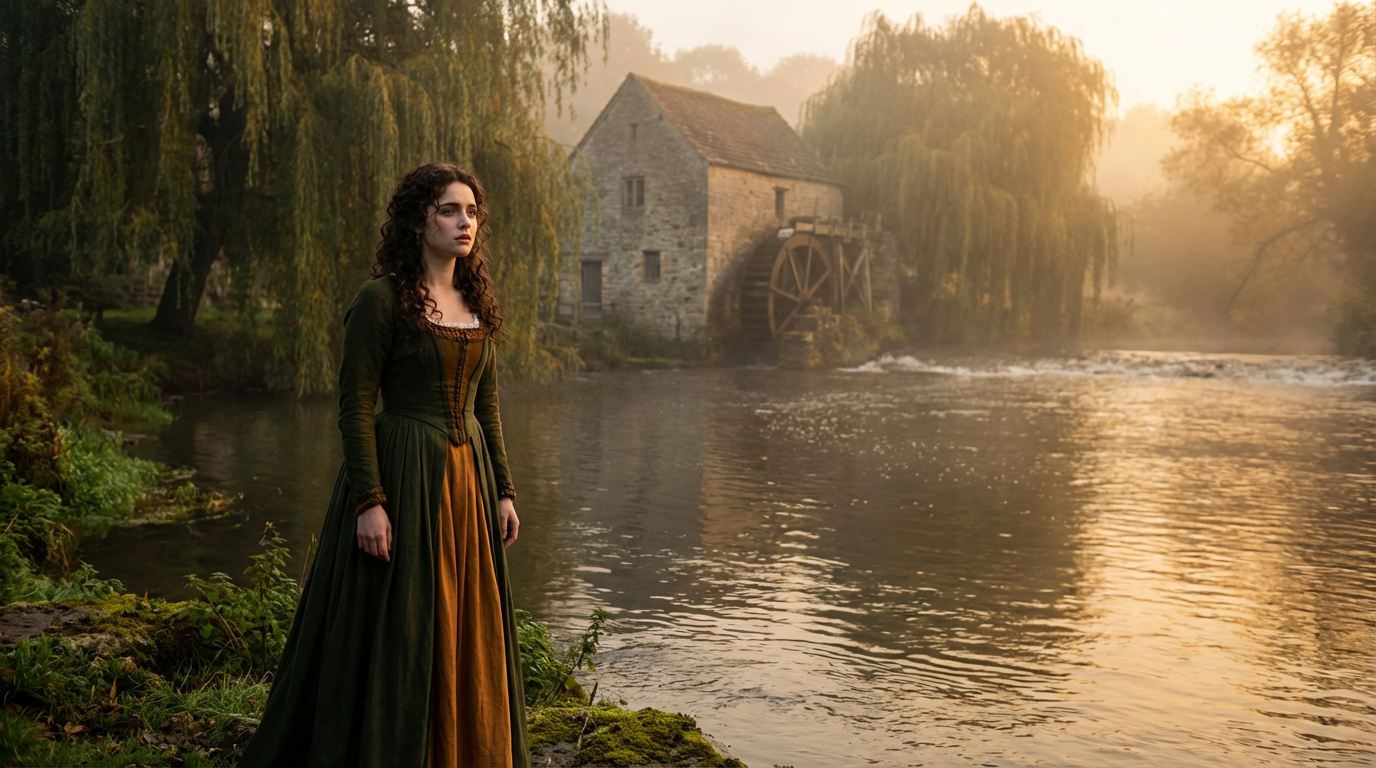
An excerpt from the original text.(complete · 5066 words)
the Red Deeps
The family sitting-room was a long room with a window at each end; one
looking toward the croft and along the Ripple to the banks of the
Floss, the other into the mill-yard. Maggie was sitting with her work
against the latter window when she saw Mr Wakem entering the yard, as
usual, on his fine black horse; but not alone, as usual. Some one was
with him,—a figure in a cloak, on a handsome pony. Maggie had hardly
time to feel that it was Philip come back, before they were in front of
the window, and he was raising his hat to her; while his father,
catching the movement by a side-glance, looked sharply round at them
both.
Maggie hurried away from the window and carried her work upstairs; for
Mr Wakem sometimes came in and inspected the books, and Maggie felt
that the meeting with Philip would be robbed of all pleasure in the
presence of the two fathers. Some day, perhaps, she could see him when
they could just shake hands, and she could tell him that she remembered
his goodness to Tom, and the things he had said to her in the old days,
though they could never be friends any more. It was not at all
agitating to Maggie to see Philip again; she retained her childish
gratitude and pity toward him, and remembered his cleverness; and in
the early weeks of her loneliness she had continually recalled the
image of him among the people who had been kind to her in life, often
wishing she had him for a brother and a teacher, as they had fancied it
might have been, in their talk together. But that sort of wishing had
been banished along with other dreams that savored of seeking her own
will; and she thought, besides, that Philip might be altered by his
life abroad,—he might have become worldly, and really not care about
her saying anything to him now. And yet his face was wonderfully little
altered,—it was only a larger, more manly copy of the pale,
small-featured boy’s face, with the gray eyes, and the boyish waving
brown hair; there was the old deformity to awaken the old pity; and
after all her meditations, Maggie felt that she really should like to
say a few words to him. He might still be melancholy, as he always used
to be, and like her to look at him kindly. She wondered if he
remembered how he used to like her eyes; with that thought Maggie
glanced toward the square looking-glass which was condemned to hang
with its face toward the wall, and she half started from her seat to
reach it down; but she checked herself and snatched up her work, trying
to repress the rising wishes by forcing her memory to recall snatches
of hymns, until she saw Philip and his father returning along the road,
and she could go down again.
It was far on in June now, and Maggie was inclined to lengthen the
daily walk which was her one indulgence; but this day and the following
she was so busy with work which must be finished that she never went
beyond the gate, and satisfied her need of the open air by sitting out
of doors. One of her frequent walks, when she was not obliged to go to
St Ogg’s, was to a spot that lay beyond what was called the “Hill,”—an
insignificant rise of ground crowned by trees, lying along the side of
the road which ran by the gates of Dorlcote Mill. Insignificant I call
it, because in height it was hardly more than a bank; but there may
come moments when Nature makes a mere bank a means toward a fateful
result; and that is why I ask you to imagine this high bank crowned
with trees, making an uneven wall for some quarter of a mile along the
left side of Dorlcote Mill and the pleasant fields behind it, bounded
by the murmuring Ripple. Just where this line of bank sloped down again
to the level, a by-road turned off and led to the other side of the
rise, where it was broken into very capricious hollows and mounds by
the working of an exhausted stone-quarry, so long exhausted that both
mounds and hollows were now clothed with brambles and trees, and here
and there by a stretch of grass which a few sheep kept close-nibbled.
In her childish days Maggie held this place, called the Red Deeps, in
very great awe, and needed all her confidence in Tom’s bravery to
reconcile her to an excursion thither,—visions of robbers and fierce
animals haunting every hollow. But now it had the charm for her which
any broken ground, any mimic rock and ravine, have for the eyes that
rest habitually on the level; especially in summer, when she could sit
on a grassy hollow under the shadow of a branching ash, stooping aslant
from the steep above her, and listen to the hum of insects, like
tiniest bells on the garment of Silence, or see the sunlight piercing
the distant boughs, as if to chase and drive home the truant heavenly
blue of the wild hyacinths. In this June time, too, the dog-roses were
in their glory, and that was an additional reason why Maggie should
direct her walk to the Red Deeps, rather than to any other spot, on the
first day she was free to wander at her will,—a pleasure she loved so
well, that sometimes, in her ardors of renunciation, she thought she
ought to deny herself the frequent indulgence in it.
You may see her now, as she walks down the favourite turning and enters
the Deeps by a narrow path through a group of Scotch firs, her tall
figure and old lavender gown visible through an hereditary black silk
shawl of some wide-meshed net-like material; and now she is sure of
being unseen she takes off her bonnet and ties it over her arm. One
would certainly suppose her to be farther on in life than her
seventeenth year—perhaps because of the slow resigned sadness of the
glance from which all search and unrest seem to have departed; perhaps
because her broad-chested figure has the mould of early womanhood.
Youth and health have withstood well the involuntary and voluntary
hardships of her lot, and the nights in which she has lain on the hard
floor for a penance have left no obvious trace; the eyes are liquid,
the brown cheek is firm and round, the full lips are red. With her dark
colouring and jet crown surmounting her tall figure, she seems to have
a sort of kinship with the grand Scotch firs, at which she is looking
up as if she loved them well. Yet one has a sense of uneasiness in
looking at her,—a sense of opposing elements, of which a fierce
collision is imminent; surely there is a hushed expression, such as one
often sees in older faces under borderless caps, out of keeping with
the resistant youth, which one expects to flash out in a sudden,
passionate glance, that will dissipate all the quietude, like a damp
fire leaping out again when all seemed safe.
But Maggie herself was not uneasy at this moment. She was calmly
enjoying the free air, while she looked up at the old fir-trees, and
thought that those broken ends of branches were the records of past
storms, which had only made the red stems soar higher. But while her
eyes were still turned upward, she became conscious of a moving shadow
cast by the evening sun on the grassy path before her, and looked down
with a startled gesture to see Philip Wakem, who first raised his hat,
and then, blushing deeply, came forward to her and put out his hand.
Maggie, too, coloured with surprise, which soon gave way to pleasure.
She put out her hand and looked down at the deformed figure before her
with frank eyes, filled for the moment with nothing but the memory of
her child’s feelings,—a memory that was always strong in her. She was
the first to speak.
“You startled me,” she said, smiling faintly; “I never meet any one
here. How came you to be walking here? Did you come to meet me?”
It was impossible not to perceive that Maggie felt herself a child
again.
“Yes, I did,” said Philip, still embarrassed; “I wished to see you very
much. I watched a long while yesterday on the bank near your house to
see if you would come out, but you never came. Then I watched again
to-day, and when I saw the way you took, I kept you in sight and came
down the bank, behind there. I hope you will not be displeased with
me.”
“No,” said Maggie, with simple seriousness, walking on as if she meant
Philip to accompany her, “I’m very glad you came, for I wished very
much to have an opportunity of speaking to you. I’ve never forgotten
how good you were long ago to Tom, and me too; but I was not sure that
you would remember us so well. Tom and I have had a great deal of
trouble since then, and I think that makes one think more of what
happened before the trouble came.”
“I can’t believe that you have thought of me so much as I have thought
of you,” said Philip, timidly. “Do you know, when I was away, I made a
picture of you as you looked that morning in the study when you said
you would not forget me.”
Philip drew a large miniature-case from his pocket, and opened it.
Maggie saw her old self leaning on a table, with her black locks
hanging down behind her ears, looking into space, with strange, dreamy
eyes. It was a water-colour sketch, of real merit as a portrait.
“Oh dear,” said Maggie, smiling, and flushed with pleasure, “what a
queer little girl I was! I remember myself with my hair in that way, in
that pink frock. I really was like a gypsy. I dare say I am now,” she
added, after a little pause; “am I like what you expected me to be?”
The words might have been those of a coquette, but the full, bright
glance Maggie turned on Philip was not that of a coquette. She really
did hope he liked her face as it was now, but it was simply the rising
again of her innate delight in admiration and love. Philip met her eyes
and looked at her in silence for a long moment, before he said quietly,
“No, Maggie.”
The light died out a little from Maggie’s face, and there was a slight
trembling of the lip. Her eyelids fell lower, but she did not turn away
her head, and Philip continued to look at her. Then he said slowly:
“You are very much more beautiful than I thought you would be.”
“Am I?” said Maggie, the pleasure returning in a deeper flush. She
turned her face away from him and took some steps, looking straight
before her in silence, as if she were adjusting her consciousness to
this new idea. Girls are so accustomed to think of dress as the main
ground of vanity, that, in abstaining from the looking-glass, Maggie
had thought more of abandoning all care for adornment than of
renouncing the contemplation of her face. Comparing herself with
elegant, wealthy young ladies, it had not occurred to her that she
could produce any effect with her person. Philip seemed to like the
silence well. He walked by her side, watching her face, as if that
sight left no room for any other wish. They had passed from among the
fir-trees, and had now come to a green hollow almost surrounded by an
amphitheatre of the pale pink dog-roses. But as the light about them
had brightened, Maggie’s face had lost its glow.
She stood still when they were in the hollows, and looking at Philip
again, she said in a serious, sad voice:
“I wish we could have been friends,—I mean, if it would have been good
and right for us. But that is the trial I have to bear in everything; I
may not keep anything I used to love when I was little. The old books
went; and Tom is different, and my father. It is like death. I must
part with everything I cared for when I was a child. And I must part
with you; we must never take any notice of each other again. That was
what I wanted to speak to you for. I wanted to let you know that Tom
and I can’t do as we like about such things, and that if I behave as if
I had forgotten all about you, it is not out of envy or pride—or—or any
bad feeling.”
Maggie spoke with more and more sorrowful gentleness as she went on,
and her eyes began to fill with tears. The deepening expression of pain
on Philip’s face gave him a stronger resemblance to his boyish self,
and made the deformity appeal more strongly to her pity.
“I know; I see all that you mean,” he said, in a voice that had become
feebler from discouragement; “I know what there is to keep us apart on
both sides. But it is not right, Maggie,—don’t you be angry with me, I
am so used to call you Maggie in my thoughts,—it is not right to
sacrifice everything to other people’s unreasonable feelings. I would
give up a great deal for my father; but I would not give up a
friendship or—or an attachment of any sort, in obedience to any wish of
his that I didn’t recognise as right.”
“I don’t know,” said Maggie, musingly. “Often, when I have been angry
and discontented, it has seemed to me that I was not bound to give up
anything; and I have gone on thinking till it has seemed to me that I
could think away all my duty. But no good has ever come of that; it was
an evil state of mind. I’m quite sure that whatever I might do, I
should wish in the end that I had gone without anything for myself,
rather than have made my father’s life harder to him.”
“But would it make his life harder if we were to see each other
sometimes?” said Philip. He was going to say something else, but
checked himself.
“Oh, I’m sure he wouldn’t like it. Don’t ask me why, or anything about
it,” said Maggie, in a distressed tone. “My father feels so strongly
about some things. He is not at all happy.”
“No more am I,” said Philip, impetuously; “I am not happy.”
“Why?” said Maggie, gently. “At least—I ought not to ask—but I’m very,
very sorry.”
Philip turned to walk on, as if he had not patience to stand still any
longer, and they went out of the hollow, winding amongst the trees and
bushes in silence. After that last word of Philip’s, Maggie could not
bear to insist immediately on their parting.
“I’ve been a great deal happier,” she said at last, timidly, “since I
have given up thinking about what is easy and pleasant, and being
discontented because I couldn’t have my own will. Our life is
determined for us; and it makes the mind very free when we give up
wishing, and only think of bearing what is laid upon us, and doing what
is given us to do.”
“But I can’t give up wishing,” said Philip, impatiently. “It seems to
me we can never give up longing and wishing while we are thoroughly
alive. There are certain things we feel to be beautiful and good, and
we must hunger after them. How can we ever be satisfied without them
until our feelings are deadened? I delight in fine pictures; I long to
be able to paint such. I strive and strive, and can’t produce what I
want. That is pain to me, and always will be pain, until my faculties
lose their keenness, like aged eyes. Then there are many other things I
long for,”—here Philip hesitated a little, and then said,—“things that
other men have, and that will always be denied me. My life will have
nothing great or beautiful in it; I would rather not have lived.”
“Oh, Philip,” said Maggie, “I wish you didn’t feel so.” But her heart
began to beat with something of Philip’s discontent.
“Well, then,” said he, turning quickly round and fixing his gray eyes
entreatingly on her face, “I should be contented to live, if you would
let me see you sometimes.” Then, checked by a fear which her face
suggested, he looked away again and said more calmly, “I have no friend
to whom I can tell everything, no one who cares enough about me; and if
I could only see you now and then, and you would let me talk to you a
little, and show me that you cared for me, and that we may always be
friends in heart, and help each other, then I might come to be glad of
life.”
“But how can I see you, Philip?” said Maggie, falteringly. (Could she
really do him good? It would be very hard to say “good-by” this day,
and not speak to him again. Here was a new interest to vary the days;
it was so much easier to renounce the interest before it came.)
“If you would let me see you here sometimes,—walk with you here,—I
would be contented if it were only once or twice in a month. That
could injure no one’s happiness, and it would sweeten my life.
Besides,” Philip went on, with all the inventive astuteness of love at
one-and-twenty, “if there is any enmity between those who belong to us,
we ought all the more to try and quench it by our friendship; I mean,
that by our influence on both sides we might bring about a healing of
the wounds that have been made in the past, if I could know everything
about them. And I don’t believe there is any enmity in my own father’s
mind; I think he has proved the contrary.”
Maggie shook her head slowly, and was silent, under conflicting
thoughts. It seemed to her inclination, that to see Philip now and
then, and keep up the bond of friendship with him, was something not
only innocent, but good; perhaps she might really help him to find
contentment as she had found it. The voice that said this made sweet
music to Maggie; but athwart it there came an urgent, monotonous
warning from another voice which she had been learning to obey,—the
warning that such interviews implied secrecy; implied doing something
she would dread to be discovered in, something that, if discovered,
must cause anger and pain; and that the admission of anything so near
doubleness would act as a spiritual blight. Yet the music would swell
out again, like chimes borne onward by a recurrent breeze, persuading
her that the wrong lay all in the faults and weaknesses of others, and
that there was such a thing as futile sacrifice for one to the injury
of another. It was very cruel for Philip that he should be shrunk from,
because of an unjustifiable vindictiveness toward his father,—poor
Philip, whom some people would shrink from only because he was
deformed. The idea that he might become her lover or that her meeting
him could cause disapproval in that light, had not occurred to her; and
Philip saw the absence of this idea clearly enough, saw it with a
certain pang, although it made her consent to his request the less
unlikely. There was bitterness to him in the perception that Maggie was
almost as frank and unconstrained toward him as when she was a child.
“I can’t say either yes or no,” she said at last, turning round and
walking toward the way she come; “I must wait, lest I should decide
wrongly. I must seek for guidance.”
“May I come again, then, to-morrow, or the next day, or next week?”
“I think I had better write,” said Maggie, faltering again. “I have to
go to St Ogg’s sometimes, and I can put the letter in the post.”
“Oh no,” said Philip eagerly; “that would not be so well. My father
might see the letter—and—he has not any enmity, I believe, but he views
things differently from me; he thinks a great deal about wealth and
position. Pray let me come here once more. Tell me when it shall be;
or if you can’t tell me, I will come as often as I can till I do see
you.”
“I think it must be so, then,” said Maggie, “for I can’t be quite
certain of coming here any particular evening.”
Maggie felt a great relief in adjourning the decision. She was free now
to enjoy the minutes of companionship; she almost thought she might
linger a little; the next time they met she should have to pain Philip
by telling him her determination.
“I can’t help thinking,” she said, looking smilingly at him, after a
few moments of silence, “how strange it is that we should have met and
talked to each other, just as if it had been only yesterday when we
parted at Lorton. And yet we must both be very much altered in those
five years,—I think it is five years. How was it you seemed to have a
sort of feeling that I was the same Maggie? I was not quite so sure
that you would be the same; I know you are so clever, and you must have
seen and learnt so much to fill your mind; I was not quite sure you
would care about me now.”
“I have never had any doubt that you would be the same, whenever I
might see you,” said Philip,—“I mean, the same in everything that made
me like you better than any one else. I don’t want to explain that; I
don’t think any of the strongest effects our natures are susceptible of
can ever be explained. We can neither detect the process by which they
are arrived at, nor the mode in which they act on us. The greatest of
painters only once painted a mysteriously divine child; he couldn’t
have told how he did it, and we can’t tell why we feel it to be divine.
I think there are stores laid up in our human nature that our
understandings can make no complete inventory of. Certain strains of
music affect me so strangely; I can never hear them without their
changing my whole attitude of mind for a time, and if the effect would
last, I might be capable of heroisms.”
“Ah! I know what you mean about music; I feel so,” said Maggie,
clasping her hands with her old impetuosity. “At least,” she added, in
a saddened tone, “I used to feel so when I had any music; I never have
any now except the organ at church.”
“And you long for it, Maggie?” said Philip, looking at her with
affectionate pity. “Ah, you can have very little that is beautiful in
your life. Have you many books? You were so fond of them when you were
a little girl.”
They were come back to the hollow, round which the dog-roses grew, and
they both paused under the charm of the faëry evening light, reflected
from the pale pink clusters.
“No, I have given up books,” said Maggie, quietly, “except a very, very
few.”
Philip had already taken from his pocket a small volume, and was
looking at the back as he said:
“Ah, this is the second volume, I see, else you might have liked to
take it home with you. I put it in my pocket because I am studying a
scene for a picture.”
Maggie had looked at the back too, and saw the title; it revived an old
impression with overmastering force.
“‘The Pirate,’” she said, taking the book from Philip’s hands. “Oh, I
began that once; I read to where Minna is walking with Cleveland, and I
could never get to read the rest. I went on with it in my own head, and
I made several endings; but they were all unhappy. I could never make a
happy ending out of that beginning. Poor Minna! I wonder what is the
real end. For a long while I couldn’t get my mind away from the
Shetland Isles,—I used to feel the wind blowing on me from the rough
sea.”
Maggie spoke rapidly, with glistening eyes.
“Take that volume home with you, Maggie,” said Philip, watching her
with delight. “I don’t want it now. I shall make a picture of you
instead,—you, among the Scotch firs and the slanting shadows.”
Maggie had not heard a word he had said; she was absorbed in a page at
which she had opened. But suddenly she closed the book, and gave it
back to Philip, shaking her head with a backward movement, as if to say
“avaunt” to floating visions.
“Do keep it, Maggie,” said Philip, entreatingly; “it will give you
pleasure.”
“No, thank you,” said Maggie, putting it aside with her hand and
walking on. “It would make me in love with this world again, as I used
to be; it would make me long to see and know many things; it would make
me long for a full life.”
“But you will not always be shut up in your present lot; why should you
starve your mind in that way? It is narrow asceticism; I don’t like to
see you persisting in it, Maggie. Poetry and art and knowledge are
sacred and pure.”
“But not for me, not for me,” said Maggie, walking more hurriedly;
“because I should want too much. I must wait; this life will not last
long.”
“Don’t hurry away from me without saying ‘good-by,’ Maggie,” said
Philip, as they reached the group of Scotch firs, and she continued
still to walk along without speaking. “I must not go any farther, I
think, must I?”
“Oh no, I forgot; good-by,” said Maggie, pausing, and putting out her
hand to him. The action brought her feeling back in a strong current to
Philip; and after they had stood looking at each other in silence for a
few moments, with their hands clasped, she said, withdrawing her hand:
“I’m very grateful to you for thinking of me all those years. It is
very sweet to have people love us. What a wonderful, beautiful thing it
seems that God should have made your heart so that you could care about
a queer little girl whom you only knew for a few weeks! I remember
saying to you that I thought you cared for me more than Tom did.”
“Ah, Maggie,” said Philip, almost fretfully, “you would never love me
so well as you love your brother.”
“Perhaps not,” said Maggie, simply; “but then, you know, the first
thing I ever remember in my life is standing with Tom by the side of
the Floss, while he held my hand; everything before that is dark to me.
But I shall never forget you, though we must keep apart.”
“Don’t say so, Maggie,” said Philip. “If I kept that little girl in my
mind for five years, didn’t I earn some part in her? She ought not to
take herself quite away from me.”
“Not if I were free,” said Maggie; “but I am not, I must submit.” She
hesitated a moment, and then added, “And I wanted to say to you, that
you had better not take more notice of my brother than just bowing to
him. He once told me not to speak to you again, and he doesn’t change
his mind—Oh dear, the sun is set. I am too long away. Good-by.” She
gave him her hand once more.
“I shall come here as often as I can till I see you again, Maggie. Have
some feeling for me as well as for others.”
“Yes, yes, I have,” said Maggie, hurrying away, and quickly
disappearing behind the last fir-tree; though Philip’s gaze after her
remained immovable for minutes as if he saw her still.
Maggie went home, with an inward conflict already begun; Philip went
home to do nothing but remember and hope. You can hardly help blaming
him severely. He was four or five years older than Maggie, and had a
full consciousness of his feeling toward her to aid him in foreseeing
the character his contemplated interviews with her would bear in the
opinion of a third person. But you must not suppose that he was capable
of a gross selfishness, or that he could have been satisfied without
persuading himself that he was seeking to infuse some happiness into
Maggie’s life,—seeking this even more than any direct ends for himself.
He could give her sympathy; he could give her help. There was not the
slightest promise of love toward him in her manner; it was nothing more
than the sweet girlish tenderness she had shown him when she was
twelve. Perhaps she would never love him; perhaps no woman ever could
love him. Well, then, he would endure that; he should at least have the
happiness of seeing her, of feeling some nearness to her. And he
clutched passionately the possibility that she might love him;
perhaps the feeling would grow, if she could come to associate him with
that watchful tenderness which her nature would be so keenly alive to.
If any woman could love him, surely Maggie was that woman; there was
such wealth of love in her, and there was no one to claim it all. Then,
the pity of it, that a mind like hers should be withering in its very
youth, like a young forest-tree, for want of the light and space it was
formed to flourish in! Could he not hinder that, by persuading her out
of her system of privation? He would be her guardian angel; he would do
anything, bear anything, for her sake—except not seeing her.
Master this chapter. Complete your experience
Purchase the complete book to access all chapters and support classic literature
As an Amazon Associate, we earn a small commission from qualifying purchases at no additional cost to you.
Available in paperback, hardcover, and e-book formats
Let's Analyse the Pattern
Extreme self-denial creates emotional vulnerability that compromises judgment when someone offers what we've been denying ourselves.
Why This Matters
Connect literature to life
This chapter teaches how manipulators target our unmet needs and offer themselves as the solution.
Practice This Today
This week, notice when someone offers you exactly what you've been denying yourself—then ask why now, why them, and what they might want in return.
Now let's explore the literary elements.
Key Quotes & Analysis
"It would make me long for a full life."
Context: When Philip offers her a book and she explains why she can't accept it
This reveals the core tragedy of Maggie's situation - she's deliberately starving herself of intellectual and emotional nourishment because she's afraid wanting more will make her unhappy. She's choosing numbness over the risk of unfulfilled desire.
In Today's Words:
If I start wanting things again, I'll just end up disappointed and miserable.
"You were so good to Tom, and I remember all the things you said to me in the old days, though we can never be friends any more."
Context: Her thoughts about what she might say to Philip if they could meet safely
Shows Maggie's genuine gratitude and affection for Philip, but also her resignation to the family feud's constraints. She's already decided their friendship is impossible before even talking to him.
In Today's Words:
I appreciate everything you did for us back then, but you know we can't hang out anymore because of all the family drama.
"I have thought of you constantly during these five years - I have painted your portrait from memory."
Context: When he confesses how much she's meant to him during their separation
Reveals the intensity of Philip's feelings and how he's romanticized Maggie during their separation. The painted portrait shows he's been living with an idealized image of her, which puts pressure on their reunion.
In Today's Words:
You've been on my mind this whole time - I've basically been obsessing over you for five years.
Thematic Threads
Self-Denial
In This Chapter
Maggie has given up books, music, and intellectual pleasures, believing this will bring peace through renunciation
Development
Evolved from her earlier impulsive nature into rigid self-suppression
In Your Life:
You might recognize this when you're sacrificing all personal needs to avoid conflict or appear virtuous.
Isolation
In This Chapter
Both Maggie and Philip are emotionally isolated—she by family constraints, he by physical difference and social rejection
Development
Introduced here as a driving force behind their dangerous attraction
In Your Life:
You might see this when loneliness makes you overlook red flags in relationships or situations.
Class Barriers
In This Chapter
The Tulliver-Wakem family feud represents how class and economic conflicts poison personal relationships
Development
Continues the book's exploration of how social position shapes personal choices
In Your Life:
You might experience this when family loyalties conflict with personal connections across different backgrounds.
Intellectual Hunger
In This Chapter
Maggie's brief excitement over the book reveals her suppressed need for mental stimulation and growth
Development
Builds on her earlier love of learning, now complicated by her attempt at renunciation
In Your Life:
You might recognize this when you realize you've been denying yourself learning or growth opportunities.
Manipulation
In This Chapter
Philip deliberately seeks Maggie out and uses her emotional needs to draw her into secret meetings
Development
Introduced here as Philip's romantic strategy disguised as friendship
In Your Life:
You might encounter this when someone uses your unmet needs to pull you into situations you know are problematic.
You now have the context. Time to form your own thoughts.
Discussion Questions
- 1
Why does Maggie agree to consider meeting Philip again despite knowing her family would disapprove?
analysis • surface - 2
How has Maggie's attempt to find peace through self-denial actually made her more vulnerable to Philip's influence?
analysis • medium - 3
Where do you see people today becoming vulnerable because they've denied themselves something important for too long?
application • medium - 4
What's the difference between healthy self-discipline and self-denial that becomes self-harm? How can you tell when you've crossed that line?
application • deep - 5
What does this chapter reveal about how emotional starvation affects our judgment and decision-making?
reflection • deep
Critical Thinking Exercise
Identify Your Starvation Points
Make two lists: things you've been denying yourself 'for good reasons' and people or situations that suddenly seem appealing because they offer what you've been missing. Look for patterns between the lists. This isn't about judgment—it's about awareness before vulnerability becomes a problem.
Consider:
- •Consider both big denials (career dreams, relationships) and small ones (hobbies, rest, social time)
- •Notice if your 'good reasons' for denial are actually fear, guilt, or people-pleasing in disguise
- •Ask whether someone offering what you're starving for has their own agenda or complicated circumstances
Journaling Prompt
Write about a time when you were so grateful someone offered what you'd been denying yourself that you ignored red flags or potential consequences. What would you do differently now?
Coming Up Next...
Chapter 34: Bob's Silver Tongue and Business Dreams
While Maggie wrestles with her conscience about Philip, family dynamics shift as Aunt Glegg discovers something unexpected about Bob Jakin that could change how the Tullivers view their loyal friend.



