
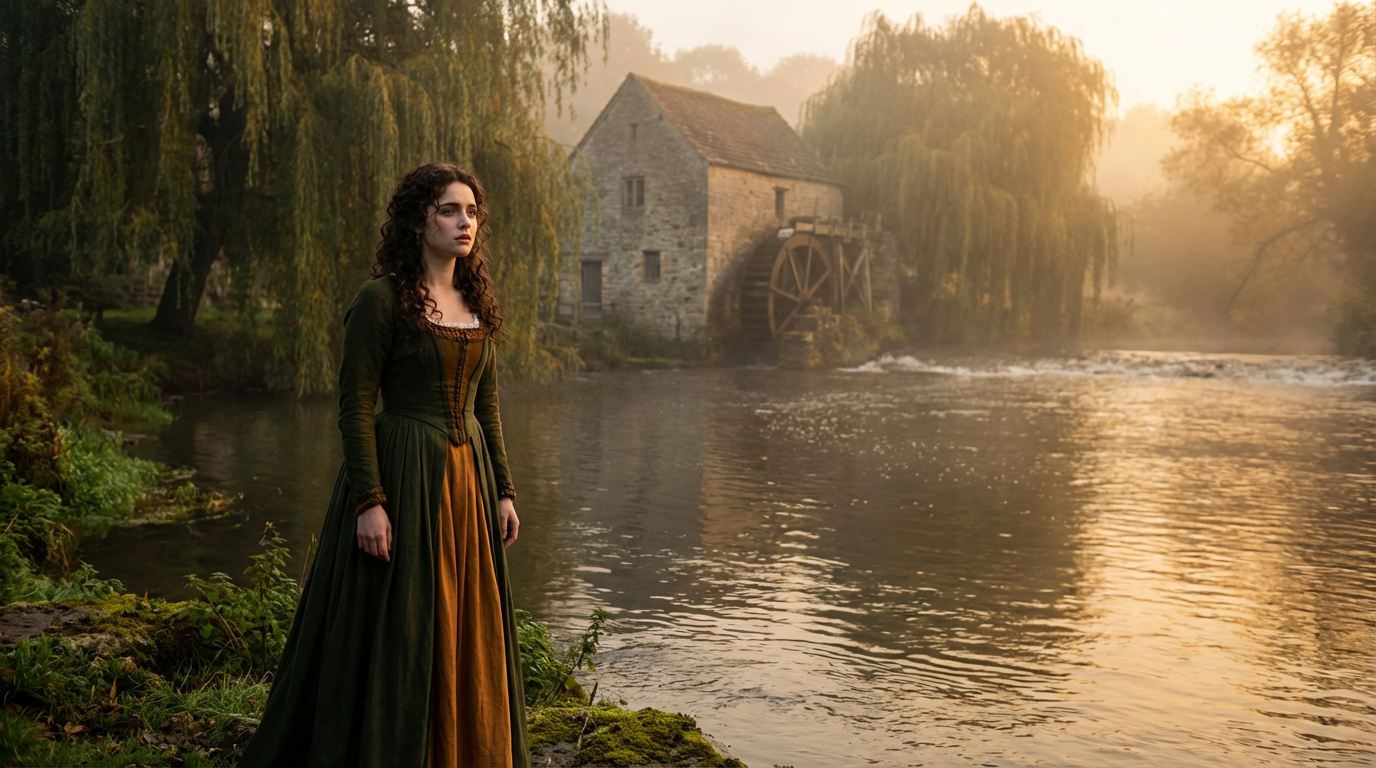
An excerpt from the original text.(complete · 2625 words)
hat Had Happened at Home
When Mr Tulliver first knew the fact that the lawsuit was decided
against him, and that Pivart and Wakem were triumphant, every one who
happened to observe him at the time thought that, for so confident and
hot-tempered a man, he bore the blow remarkably well. He thought so
himself; he thought he was going to show that if Wakem or anybody else
considered him crushed, they would find themselves mistaken. He could
not refuse to see that the costs of this protracted suit would take
more than he possessed to pay them; but he appeared to himself to be
full of expedients by which he could ward off any results but such as
were tolerable, and could avoid the appearance of breaking down in the
world. All the obstinacy and defiance of his nature, driven out of
their old channel, found a vent for themselves in the immediate
formation of plans by which he would meet his difficulties, and remain
Mr Tulliver of Dorlcote Mill in spite of them. There was such a rush of
projects in his brain, that it was no wonder his face was flushed when
he came away from his talk with his attorney, Mr Gore, and mounted his
horse to ride home from Lindum. There was Furley, who held the mortgage
on the land,—a reasonable fellow, who would see his own interest, Mr
Tulliver was convinced, and who would be glad not only to purchase the
whole estate, including the mill and homestead, but would accept Mr
Tulliver as tenant, and be willing to advance money to be repaid with
high interest out of the profits of the business, which would be made
over to him, Mr Tulliver only taking enough barely to maintain himself
and his family. Who would neglect such a profitable investment?
Certainly not Furley, for Mr Tulliver had determined that Furley should
meet his plans with the utmost alacrity; and there are men whoses
brains have not yet been dangerously heated by the loss of a lawsuit,
who are apt to see in their own interest or desires a motive for other
men’s actions. There was no doubt (in the miller’s mind) that Furley
would do just what was desirable; and if he did—why, things would not
be so very much worse. Mr Tulliver and his family must live more
meagrely and humbly, but it would only be till the profits of the
business had paid off Furley’s advances, and that might be while Mr
Tulliver had still a good many years of life before him. It was clear
that the costs of the suit could be paid without his being obliged to
turn out of his old place, and look like a ruined man. It was certainly
an awkward moment in his affairs. There was that suretyship for poor
Riley, who had died suddenly last April, and left his friend saddled
with a debt of two hundred and fifty pounds,—a fact which had helped to
make Mr Tulliver’s banking book less pleasant reading than a man might
desire toward Christmas. Well! he had never been one of those
poor-spirited sneaks who would refuse to give a helping hand to a
fellow-traveller in this puzzling world. The really vexatious business
was the fact that some months ago the creditor who had lent him the
five hundred pounds to repay Mrs Glegg had become uneasy about his
money (set on by Wakem, of course), and Mr Tulliver, still confident
that he should gain his suit, and finding it eminently inconvenient to
raise the said sum until that desirable issue had taken place, had
rashly acceded to the demand that he should give a bill of sale on his
household furniture and some other effects, as security in lieu of the
bond. It was all one, he had said to himself; he should soon pay off
the money, and there was no harm in giving that security any more than
another. But now the consequences of this bill of sale occurred to him
in a new light, and he remembered that the time was close at hand when
it would be enforced unless the money were repaid. Two months ago he
would have declared stoutly that he would never be beholden to his
wife’s friends; but now he told himself as stoutly that it was nothing
but right and natural that Bessy should go to the Pullets and explain
the thing to them; they would hardly let Bessy’s furniture be sold, and
it might be security to Pullet if he advanced the money,—there would,
after all, be no gift or favour in the matter. Mr Tulliver would never
have asked for anything from so poor-spirited a fellow for himself, but
Bessy might do so if she liked.
It is precisely the proudest and most obstinate men who are the most
liable to shift their position and contradict themselves in this sudden
manner; everything is easier to them than to face the simple fact that
they have been thoroughly defeated, and must begin life anew. And Mr
Tulliver, you perceive, though nothing more than a superior miller and
maltster, was as proud and obstinate as if he had been a very lofty
personage, in whom such dispositions might be a source of that
conspicuous, far-echoing tragedy, which sweeps the stage in regal
robes, and makes the dullest chronicler sublime. The pride and
obstinacy of millers and other insignificant people, whom you pass
unnoticingly on the road every day, have their tragedy too; but it is
of that unwept, hidden sort that goes on from generation to generation,
and leaves no record,—such tragedy, perhaps, as lies in the conflicts
of young souls, hungry for joy, under a lot made suddenly hard to them,
under the dreariness of a home where the morning brings no promise with
it, and where the unexpectant discontent of worn and disappointed
parents weighs on the children like a damp, thick air, in which all the
functions of life are depressed; or such tragedy as lies in the slow or
sudden death that follows on a bruised passion, though it may be a
death that finds only a parish funeral. There are certain animals to
which tenacity of position is a law of life,—they can never flourish
again, after a single wrench: and there are certain human beings to
whom predominance is a law of life,—they can only sustain humiliation
so long as they can refuse to believe in it, and, in their own
conception, predominate still.
Mr Tulliver was still predominating, in his own imagination, as he
approached St Ogg’s, through which he had to pass on his way homeward.
But what was it that suggested to him, as he saw the Laceham coach
entering the town, to follow it to the coach-office, and get the clerk
there to write a letter, requiring Maggie to come home the very next
day? Mr Tulliver’s own hand shook too much under his excitement for him
to write himself, and he wanted the letter to be given to the coachman
to deliver at Miss Firniss’s school in the morning. There was a craving
which he would not account for to himself, to have Maggie near him,
without delay,—she must come back by the coach to-morrow.
To Mrs Tulliver, when he got home, he would admit no difficulties, and
scolded down her burst of grief on hearing that the lawsuit was lost,
by angry assertions that there was nothing to grieve about. He said
nothing to her that night about the bill of sale and the application to
Mrs Pullet, for he had kept her in ignorance of the nature of that
transaction, and had explained the necessity for taking an inventory of
the goods as a matter connected with his will. The possession of a wife
conspicuously one’s inferior in intellect is, like other high
privileges, attended with a few inconveniences, and, among the rest,
with the occasional necessity for using a little deception.
The next day Mr Tulliver was again on horseback in the afternoon, on
his way to Mr Gore’s office at St Ogg’s. Gore was to have seen Furley
in the morning, and to have sounded him in relation to Mr Tulliver’s
affairs. But he had not gone half-way when he met a clerk from Mr
Gore’s office, who was bringing a letter to Mr Tulliver. Mr Gore had
been prevented by a sudden call of business from waiting at his office
to see Mr Tulliver, according to appointment, but would be at his
office at eleven to-morrow morning, and meanwhile had sent some
important information by letter.
“Oh!” said Mr Tulliver, taking the letter, but not opening it. “Then
tell Gore I’ll see him to-morrow at eleven”; and he turned his horse.
The clerk, struck with Mr Tulliver’s glistening, excited glance, looked
after him for a few moments, and then rode away. The reading of a
letter was not the affair of an instant to Mr Tulliver; he took in the
sense of a statement very slowly through the medium of written or even
printed characters; so he had put the letter in his pocket, thinking he
would open it in his armchair at home. But by-and-by it occurred to him
that there might be something in the letter Mrs Tulliver must not know
about, and if so, it would be better to keep it out of her sight
altogether. He stopped his horse, took out the letter, and read it. It
was only a short letter; the substance was, that Mr Gore had
ascertained, on secret, but sure authority, that Furley had been lately
much straitened for money, and had parted with his securities,—among
the rest, the mortgage on Mr Tulliver’s property, which he had
transferred to——Wakem.
In half an hour after this Mr Tulliver’s own wagoner found him lying by
the roadside insensible, with an open letter near him, and his gray
horse snuffing uneasily about him.
When Maggie reached home that evening, in obedience to her father’s
call, he was no longer insensible. About an hour before he had become
conscious, and after vague, vacant looks around him, had muttered
something about “a letter,” which he presently repeated impatiently. At
the instance of Mr Turnbull, the medical man, Gore’s letter was brought
and laid on the bed, and the previous impatience seemed to be allayed.
The stricken man lay for some time with his eyes fixed on the letter,
as if he were trying to knit up his thoughts by its help. But presently
a new wave of memory seemed to have come and swept the other away; he
turned his eyes from the letter to the door, and after looking
uneasily, as if striving to see something his eyes were too dim for, he
said, “The little wench.”
He repeated the words impatiently from time to time, appearing entirely
unconscious of everything except this one importunate want, and giving
no sign of knowing his wife or any one else; and poor Mrs Tulliver, her
feeble faculties almost paralyzed by this sudden accumulation of
troubles, went backward and forward to the gate to see if the Laceham
coach were coming, though it was not yet time.
But it came at last, and set down the poor anxious girl, no longer the
“little wench,” except to her father’s fond memory.
“Oh, mother, what is the matter?” Maggie said, with pale lips, as her
mother came toward her crying. She didn’t think her father was ill,
because the letter had come at his dictation from the office at St
Ogg’s.
But Mr Turnbull came now to meet her; a medical man is the good angel
of the troubled house, and Maggie ran toward the kind old friend, whom
she remembered as long as she could remember anything, with a
trembling, questioning look.
“Don’t alarm yourself too much, my dear,” he said, taking her hand.
“Your father has had a sudden attack, and has not quite recovered his
memory. But he has been asking for you, and it will do him good to see
you. Keep as quiet as you can; take off your things, and come upstairs
with me.”
Maggie obeyed, with that terrible beating of the heart which makes
existence seem simply a painful pulsation. The very quietness with
which Mr Turnbull spoke had frightened her susceptible imagination. Her
father’s eyes were still turned uneasily toward the door when she
entered and met the strange, yearning, helpless look that had been
seeking her in vain. With a sudden flash and movement, he raised
himself in the bed; she rushed toward him, and clasped him with
agonised kisses.
Poor child! it was very early for her to know one of those supreme
moments in life when all we have hoped or delighted in, all we can
dread or endure, falls away from our regard as insignificant; is lost,
like a trivial memory, in that simple, primitive love which knits us to
the beings who have been nearest to us, in their times of helplessness
or of anguish.
But that flash of recognition had been too great a strain on the
father’s bruised, enfeebled powers. He sank back again in renewed
insensibility and rigidity, which lasted for many hours, and was only
broken by a flickering return of consciousness, in which he took
passively everything that was given to him, and seemed to have a sort
of infantine satisfaction in Maggie’s near presence,—such satisfaction
as a baby has when it is returned to the nurse’s lap.
Mrs Tulliver sent for her sisters, and there was much wailing and
lifting up of hands below stairs. Both uncles and aunts saw that the
ruin of Bessy and her family was as complete as they had ever foreboded
it, and there was a general family sense that a judgment had fallen on
Mr Tulliver, which it would be an impiety to counteract by too much
kindness. But Maggie heard little of this, scarcely ever leaving her
father’s bedside, where she sat opposite him with her hand on his. Mrs
Tulliver wanted to have Tom fetched home, and seemed to be thinking
more of her boy even than of her husband; but the aunts and uncles
opposed this. Tom was better at school, since Mr Turnbull said there
was no immediate danger, he believed. But at the end of the second day,
when Maggie had become more accustomed to her father’s fits of
insensibility, and to the expectation that he would revive from them,
the thought of Tom had become urgent with her too; and when her
mother sate crying at night and saying, “My poor lad—it’s nothing but
right he should come home,” Maggie said, “Let me go for him, and tell
him, mother; I’ll go to-morrow morning if father doesn’t know me and
want me. It would be so hard for Tom to come home and not know anything
about it beforehand.”
And the next morning Maggie went, as we have seen. Sitting on the coach
on their way home, the brother and sister talked to each other in sad,
interrupted whispers.
“They say Mr Wakem has got a mortgage or something on the land, Tom,”
said Maggie. “It was the letter with that news in it that made father
ill, they think.”
“I believe that scoundrel’s been planning all along to ruin my father,”
said Tom, leaping from the vaguest impressions to a definite
conclusion. “I’ll make him feel for it when I’m a man. Mind you never
speak to Philip again.”
“Oh, Tom!” said Maggie, in a tone of sad remonstrance; but she had no
spirit to dispute anything then, still less to vex Tom by opposing him.
Master this chapter. Complete your experience
Purchase the complete book to access all chapters and support classic literature
As an Amazon Associate, we earn a small commission from qualifying purchases at no additional cost to you.
Available in paperback, hardcover, and e-book formats
Let's Analyse the Pattern
When our identity becomes so tied to never losing that we can't accept reality, leading to increasingly desperate denial until complete collapse.
Why This Matters
Connect literature to life
This chapter teaches how to spot the dangerous moment when someone's ego becomes more important than their reality.
Practice This Today
This week, notice when you or someone close starts making elaborate excuses instead of facing a difficult truth—that's the warning sign before the breakdown.
Now let's explore the literary elements.
Key Quotes & Analysis
"He thought he was going to show that if Wakem or anybody else considered him crushed, they would find themselves mistaken."
Context: After learning he lost the lawsuit and faces financial ruin
Shows how pride can blind us to reality. Tulliver's need to appear strong prevents him from taking practical steps to protect his family. His focus is on proving others wrong rather than solving the actual problem.
In Today's Words:
He was determined to prove he wasn't beaten, even though he totally was.
"There was such a rush of projects in his brain, that it was no wonder his face was flushed."
Context: Tulliver spinning fantasies about how he'll survive his financial disaster
Eliot shows us the manic energy of denial - when reality is too painful, our minds create elaborate alternative scenarios. The physical description hints at the stroke to come.
In Today's Words:
His mind was racing with crazy schemes because he couldn't face the truth.
"Father, father!"
Context: When she finds her father collapsed and barely conscious
The simple repetition shows Maggie's desperation and the role reversal happening - she's now trying to reach him like a parent calling to a child. It captures the moment when family dynamics shift forever.
In Today's Words:
Dad, please, talk to me!
Thematic Threads
Pride
In This Chapter
Tulliver's inability to accept defeat leads him to create impossible fantasies rather than face his financial ruin
Development
Evolved from earlier displays of stubbornness into complete reality denial and physical breakdown
In Your Life:
You might see this when you can't admit a mistake at work and keep digging yourself deeper instead of coming clean early.
Class
In This Chapter
Tulliver considers asking his wife's 'inferior' family for help, something his pride previously forbade
Development
Developed from his constant assertions of superiority over his wife's relatives to desperate consideration of their aid
In Your Life:
You might face this when financial troubles force you to ask for help from people you've looked down on.
Power
In This Chapter
A man who defined himself by control becomes helpless and childlike, calling for his 'little wench'
Development
Complete reversal from the dominating patriarch to dependent victim
In Your Life:
You might experience this when illness, job loss, or aging forces you from independence to needing care from others.
Family
In This Chapter
Maggie's fierce love becomes the anchor as her father collapses, showing how relationships sustain us through crisis
Development
Builds on the established father-daughter bond, now tested by his vulnerability
In Your Life:
You might find this when a family crisis reveals who truly shows up and how love transcends roles and expectations.
Reality
In This Chapter
The gap between Tulliver's fantasies and actual circumstances becomes so wide it breaks his mind
Development
Escalated from minor self-deceptions to complete psychological breakdown when faced with unacceptable truth
In Your Life:
You might recognize this when you've been avoiding a difficult conversation or decision so long that facing it feels impossible.
You now have the context. Time to form your own thoughts.
Discussion Questions
- 1
What specific events trigger Mr. Tulliver's physical collapse, and how does his body respond to information his mind can't accept?
analysis • surface - 2
Why does Tulliver create fantasies about Furley and his wife's family instead of facing his financial reality directly?
analysis • medium - 3
Where do you see this same pattern today - people creating elaborate explanations or fantasies rather than accepting difficult truths?
application • medium - 4
When you've had to deliver bad news to someone whose pride was invested in a different outcome, what strategies helped them hear the truth?
application • deep - 5
What does Tulliver's breakdown reveal about the relationship between our identity and our ability to process reality?
reflection • deep
Critical Thinking Exercise
Pride Reality Check
Think of an area in your life where your pride might be making it hard to see the truth clearly. Write down three facts about this situation that you don't want to admit, then imagine you're advising your best friend facing the exact same circumstances. What would you tell them to do?
Consider:
- •Notice the difference between how you talk to yourself versus how you'd talk to someone you care about
- •Pay attention to any physical tension or resistance when writing down the uncomfortable facts
- •Consider what small step you could take today that acknowledges reality without requiring a complete identity shift
Journaling Prompt
Write about a time when admitting you were wrong or accepting a limitation actually made you stronger. What did that experience teach you about the difference between pride and self-respect?
Coming Up Next...
Chapter 22: When Everything Falls Apart
As the Tulliver family faces the loss of their home and possessions, Mrs. Tulliver must confront the painful reality of giving up her most treasured belongings. What we cling to in crisis reveals who we really are.



