
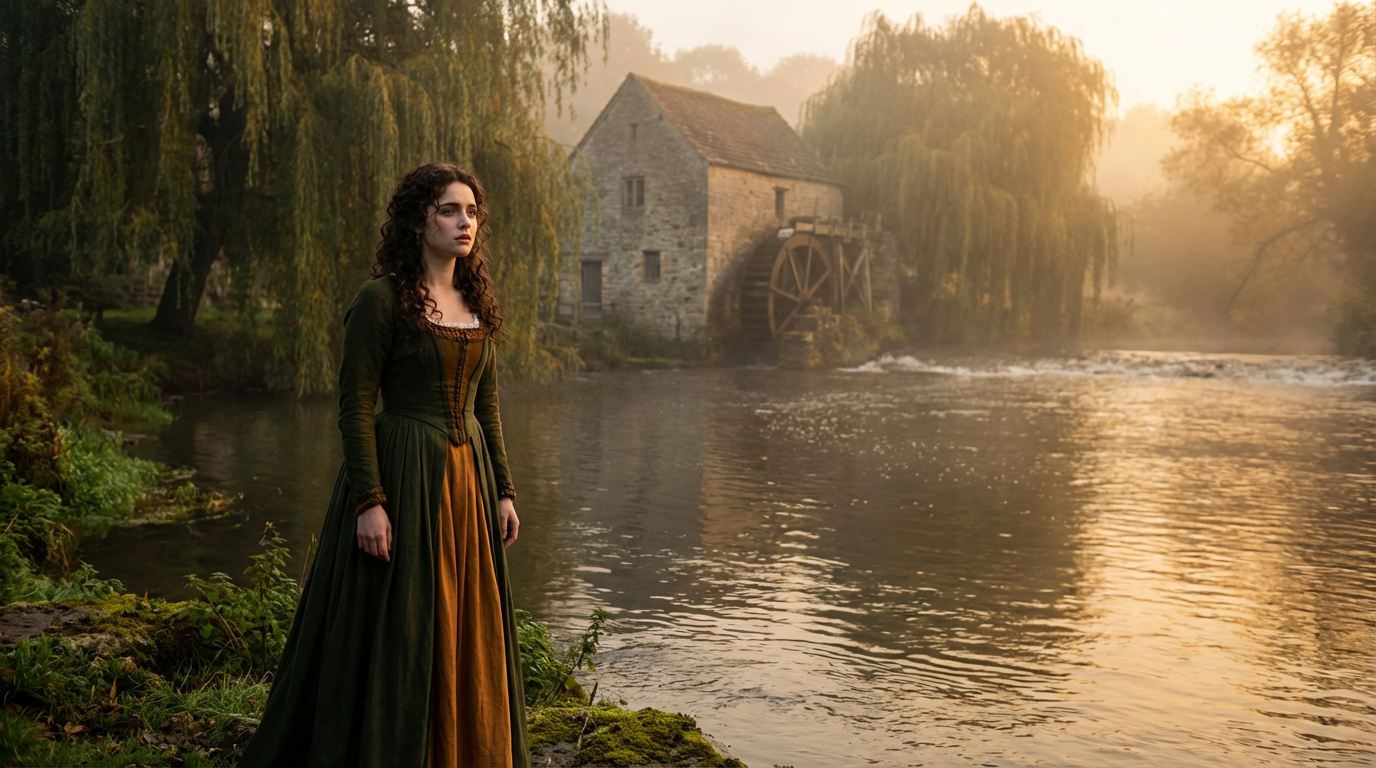
An excerpt from the original text.(complete · 1838 words)
aggie’s Second Visit
This last breach between the two lads was not readily mended, and for
some time they spoke to each other no more than was necessary. Their
natural antipathy of temperament made resentment an easy passage to
hatred, and in Philip the transition seemed to have begun; there was no
malignity in his disposition, but there was a susceptibility that made
him peculiarly liable to a strong sense of repulsion. The ox—we may
venture to assert it on the authority of a great classic—is not given
to use his teeth as an instrument of attack, and Tom was an excellent
bovine lad, who ran at questionable objects in a truly ingenious bovine
manner; but he had blundered on Philip’s tenderest point, and had
caused him as much acute pain as if he had studied the means with the
nicest precision and the most envenomed spite. Tom saw no reason why
they should not make up this quarrel as they had done many others, by
behaving as if nothing had happened; for though he had never before
said to Philip that his father was a rogue, this idea had so habitually
made part of his feeling as to the relation between himself and his
dubious schoolfellow, whom he could neither like nor dislike, that the
mere utterance did not make such an epoch to him as it did to Philip.
And he had a right to say so when Philip hectored over him, and
called him names. But perceiving that his first advances toward amity
were not met, he relapsed into his least favourable disposition toward
Philip, and resolved never to appeal to him either about drawing or
exercise again. They were only so far civil to each other as was
necessary to prevent their state of feud from being observed by Mr
Stelling, who would have “put down” such nonsense with great vigor.
When Maggie came, however, she could not help looking with growing
interest at the new schoolfellow, although he was the son of that
wicked Lawyer Wakem, who made her father so angry. She had arrived in
the middle of school-hours, and had sat by while Philip went through
his lessons with Mr Stelling. Tom, some weeks ago, had sent her word
that Philip knew no end of stories,—not stupid stories like hers; and
she was convinced now from her own observation that he must be very
clever; she hoped he would think her rather clever too, when she came
to talk to him. Maggie, moreover, had rather a tenderness for deformed
things; she preferred the wry-necked lambs, because it seemed to her
that the lambs which were quite strong and well made wouldn’t mind so
much about being petted; and she was especially fond of petting objects
that would think it very delightful to be petted by her. She loved Tom
very dearly, but she often wished that he cared more about her loving
him.
“I think Philip Wakem seems a nice boy, Tom,” she said, when they went
out of the study together into the garden, to pass the interval before
dinner. “He couldn’t choose his father, you know; and I’ve read of very
bad men who had good sons, as well as good parents who had bad
children. And if Philip is good, I think we ought to be the more sorry
for him because his father is not a good man. You like him, don’t
you?”
“Oh, he’s a queer fellow,” said Tom, curtly, “and he’s as sulky as can
be with me, because I told him his father was a rogue. And I’d a right
to tell him so, for it was true; and he began it, with calling me
names. But you stop here by yourself a bit, Maggie, will you? I’ve got
something I want to do upstairs.”
“Can’t I go too?” said Maggie, who in this first day of meeting again
loved Tom’s shadow.
“No, it’s something I’ll tell you about by-and-by, not yet,” said Tom,
skipping away.
In the afternoon the boys were at their books in the study, preparing
the morrow’s lessons that they might have a holiday in the evening in
honour of Maggie’s arrival. Tom was hanging over his Latin grammar,
moving his lips inaudibly like a strict but impatient Catholic
repeating his tale of paternosters; and Philip, at the other end of the
room, was busy with two volumes, with a look of contented diligence
that excited Maggie’s curiosity; he did not look at all as if he were
learning a lesson. She sat on a low stool at nearly a right angle with
the two boys, watching first one and then the other; and Philip,
looking off his book once toward the fire-place, caught the pair of
questioning dark eyes fixed upon him. He thought this sister of
Tulliver’s seemed a nice little thing, quite unlike her brother; he
wished he had a little sister. What was it, he wondered, that made
Maggie’s dark eyes remind him of the stories about princesses being
turned into animals? I think it was that her eyes were full of
unsatisfied intelligence, and unsatisfied beseeching affection.
“I say, Magsie,” said Tom at last, shutting his books and putting them
away with the energy and decision of a perfect master in the art of
leaving off, “I’ve done my lessons now. Come upstairs with me.”
“What is it?” said Maggie, when they were outside the door, a slight
suspicion crossing her mind as she remembered Tom’s preliminary visit
upstairs. “It isn’t a trick you’re going to play me, now?”
“No, no, Maggie,” said Tom, in his most coaxing tone; “It’s something
you’ll like ever so.”
He put his arm round her neck, and she put hers round his waist, and
twined together in this way, they went upstairs.
“I say, Magsie, you must not tell anybody, you know,” said Tom, “else I
shall get fifty lines.”
“Is it alive?” said Maggie, whose imagination had settled for the
moment on the idea that Tom kept a ferret clandestinely.
“Oh, I sha’n’t tell you,” said he. “Now you go into that corner and
hide your face, while I reach it out,” he added, as he locked the
bedroom door behind them. “I’ll tell you when to turn round. You
mustn’t squeal out, you know.”
“Oh, but if you frighten me, I shall,” said Maggie, beginning to look
rather serious.
“You won’t be frightened, you silly thing,” said Tom. “Go and hide your
face, and mind you don’t peep.”
“Of course I sha’n’t peep,” said Maggie, disdainfully; and she buried
her face in the pillow like a person of strict honour.
But Tom looked round warily as he walked to the closet; then he stepped
into the narrow space, and almost closed the door. Maggie kept her face
buried without the aid of principle, for in that dream-suggestive
attitude she had soon forgotten where she was, and her thoughts were
busy with the poor deformed boy, who was so clever, when Tom called
out, “Now then, Magsie!”
Nothing but long meditation and preconcerted arrangement of effects
could have enabled Tom to present so striking a figure as he did to
Maggie when she looked up. Dissatisfied with the pacific aspect of a
face which had no more than the faintest hint of flaxen eyebrow,
together with a pair of amiable blue-gray eyes and round pink cheeks
that refused to look formidable, let him frown as he would before the
looking-glass (Philip had once told him of a man who had a horseshoe
frown, and Tom had tried with all his frowning might to make a
horseshoe on his forehead), he had had recourse to that unfailing
source of the terrible, burnt cork, and had made himself a pair of
black eyebrows that met in a satisfactory manner over his nose, and
were matched by a less carefully adjusted blackness about the chin. He
had wound a red handkerchief round his cloth cap to give it the air of
a turban, and his red comforter across his breast as a scarf,—an amount
of red which, with the tremendous frown on his brow, and the decision
with which he grasped the sword, as he held it with its point resting
on the ground, would suffice to convey an approximate idea of his
fierce and bloodthirsty disposition.
Maggie looked bewildered for a moment, and Tom enjoyed that moment
keenly; but in the next she laughed, clapped her hands together, and
said, “Oh, Tom, you’ve made yourself like Bluebeard at the show.”
It was clear she had not been struck with the presence of the sword,—it
was not unsheathed. Her frivolous mind required a more direct appeal to
its sense of the terrible, and Tom prepared for his master-stroke.
Frowning with a double amount of intention, if not of corrugation, he
(carefully) drew the sword from its sheath, and pointed it at Maggie.
“Oh, Tom, please don’t!” exclaimed Maggie, in a tone of suppressed
dread, shrinking away from him into the opposite corner. “I shall
scream—I’m sure I shall! Oh, don’t I wish I’d never come upstairs!”
The corners of Tom’s mouth showed an inclination to a smile of
complacency that was immediately checked as inconsistent with the
severity of a great warrior. Slowly he let down the scabbard on the
floor, lest it should make too much noise, and then said sternly,—
“I’m the Duke of Wellington! March!” stamping forward with the right
leg a little bent, and the sword still pointing toward Maggie, who,
trembling, and with tear-filled eyes, got upon the bed, as the only
means of widening the space between them.
Tom, happy in this spectator of his military performances, even though
the spectator was only Maggie, proceeded, with the utmost exertion of
his force, to such an exhibition of the cut and thrust as would
necessarily be expected of the Duke of Wellington.
“Tom, I will not bear it, I will scream,” said Maggie, at the first
movement of the sword. “You’ll hurt yourself; you’ll cut your head
off!”
“One—two,” said Tom, resolutely, though at “two” his wrist trembled a
little. “Three” came more slowly, and with it the sword swung downward,
and Maggie gave a loud shriek. The sword had fallen, with its edge on
Tom’s foot, and in a moment after he had fallen too. Maggie leaped from
the bed, still shrieking, and immediately there was a rush of footsteps
toward the room. Mr Stelling, from his upstairs study, was the first to
enter. He found both the children on the floor. Tom had fainted, and
Maggie was shaking him by the collar of his jacket, screaming, with
wild eyes. She thought he was dead, poor child! and yet she shook him,
as if that would bring him back to life. In another minute she was
sobbing with joy because Tom opened his eyes. She couldn’t sorrow yet
that he had hurt his foot; it seemed as if all happiness lay in his
being alive.
Master this chapter. Complete your experience
Purchase the complete book to access all chapters and support classic literature
As an Amazon Associate, we earn a small commission from qualifying purchases at no additional cost to you.
Available in paperback, hardcover, and e-book formats
Let's Analyse the Pattern
We create emotional distance from others to protect ourselves or our loyalties, often missing opportunities for genuine connection and growth.
Why This Matters
Connect literature to life
This chapter teaches how to distinguish between necessary boundaries and defensive walls that hurt everyone involved.
Practice This Today
This week, notice when someone's coldness or aggression might actually be fear—ask yourself what they're trying to protect before responding.
Now let's explore the literary elements.
Key Quotes & Analysis
"The ox is not given to use his teeth as an instrument of attack, and Tom was an excellent bovine lad, who ran at questionable objects in a truly ingenious bovine manner"
Context: Describing how Tom handles conflicts with Philip
Eliot compares Tom to a bull to show he's not malicious, just blunt and direct. He charges at problems without subtlety, hurting people without meaning to through sheer force rather than calculated cruelty.
In Today's Words:
Tom wasn't mean-spirited, just the type who bulldozes through situations without thinking about the damage he causes
"He had blundered on Philip's tenderest point, and had caused him as much acute pain as if he had studied the means with the nicest precision"
Context: Explaining how Tom's thoughtless comment about Philip's father wounded Philip deeply
This shows how accidental cruelty can be just as devastating as intentional cruelty. Tom hit Philip's biggest insecurity without even trying, which almost makes it worse because it shows how little Tom thinks about Philip's feelings.
In Today's Words:
He accidentally hit Philip's biggest sore spot and hurt him as badly as if he'd planned it that way
"Tom saw no reason why they should not make up this quarrel as they had done many others, by behaving as if nothing had happened"
Context: Describing Tom's attitude toward their fight
This reveals Tom's emotional limitations - he thinks you can just ignore serious hurts and move on. He doesn't understand that some wounds need acknowledgment and healing, not just time.
In Today's Words:
Tom figured they'd just pretend nothing happened and everything would go back to normal, like always
Thematic Threads
Loyalty
In This Chapter
Tom's loyalty to his family prevents him from seeing Philip as an individual, while Maggie's broader loyalty to humanity creates conflict with family expectations
Development
Building from earlier chapters where family loyalty was protective, now showing how it can become limiting
In Your Life:
You might find yourself dismissing coworkers' ideas because they're from a different department or 'opposing' team.
Power
In This Chapter
Tom uses his warrior costume and sword-play to practice feeling powerful and in control, but the sword ultimately wounds him
Development
Expanding from Tom's need to be right to his need to feel physically and socially dominant
In Your Life:
You might recognize times when you've used your expertise or position to shut down conversations that make you uncomfortable.
Empathy
In This Chapter
Maggie instinctively understands Philip's vulnerability while Tom cannot allow himself to see it
Development
Deepening the contrast between Maggie's expansive emotional intelligence and Tom's protective narrowness
In Your Life:
You might notice how your capacity for empathy changes based on whether someone is 'your people' or not.
Identity
In This Chapter
Tom needs to be the heroic protector, Philip struggles with being seen beyond his disability, Maggie wants to be the peacemaker
Development
Each character's identity becomes more defined through conflict and social pressure
In Your Life:
You might find yourself playing familiar roles even when they no longer serve you or the situation.
Consequences
In This Chapter
Tom's need to demonstrate power through sword-play literally backfires, injuring him in front of those he wanted to impress
Development
Introduced here as a theme about how our protective mechanisms can become self-destructive
In Your Life:
You might recognize how your attempts to appear strong or in control sometimes create the very problems you're trying to avoid.
You now have the context. Time to form your own thoughts.
Discussion Questions
- 1
Why does Tom dismiss Philip's hurt feelings after their fight, while Philip feels wounded much more deeply?
analysis • surface - 2
What's really happening when Tom shuts down Maggie's attempt to defend Philip? What is Tom protecting?
analysis • medium - 3
Where do you see this pattern of 'protecting ourselves by not seeing others fully' in your workplace, family, or community?
application • medium - 4
How could Tom have acknowledged Philip's humanity while still maintaining his loyalty to his family?
application • deep - 5
What does Tom's warrior costume reveal about how people use displays of power when they feel emotionally threatened?
reflection • deep
Critical Thinking Exercise
Map Your Protection Patterns
Think of someone you've dismissed or kept at distance (coworker, neighbor, family member of someone who hurt you). Write down what you're protecting by not seeing them fully. Then identify one human detail about them you could acknowledge without abandoning your boundaries.
Consider:
- •Protection can be necessary and healthy - the goal isn't to be vulnerable to everyone
- •Notice the difference between conscious boundaries and unconscious dismissal
- •Small acknowledgments of humanity don't require friendship or trust
Journaling Prompt
Write about a time when someone dismissed you to protect themselves or their group. How did it feel? What would you have wanted them to see about you as an individual?
Coming Up Next...
Chapter 19: When Pain Breaks Down Walls
With Tom injured and emotions running high, the stage is set for deeper connections to form. The next chapter promises revelations about love and relationships that will reshape the dynamics between all three young people.



