
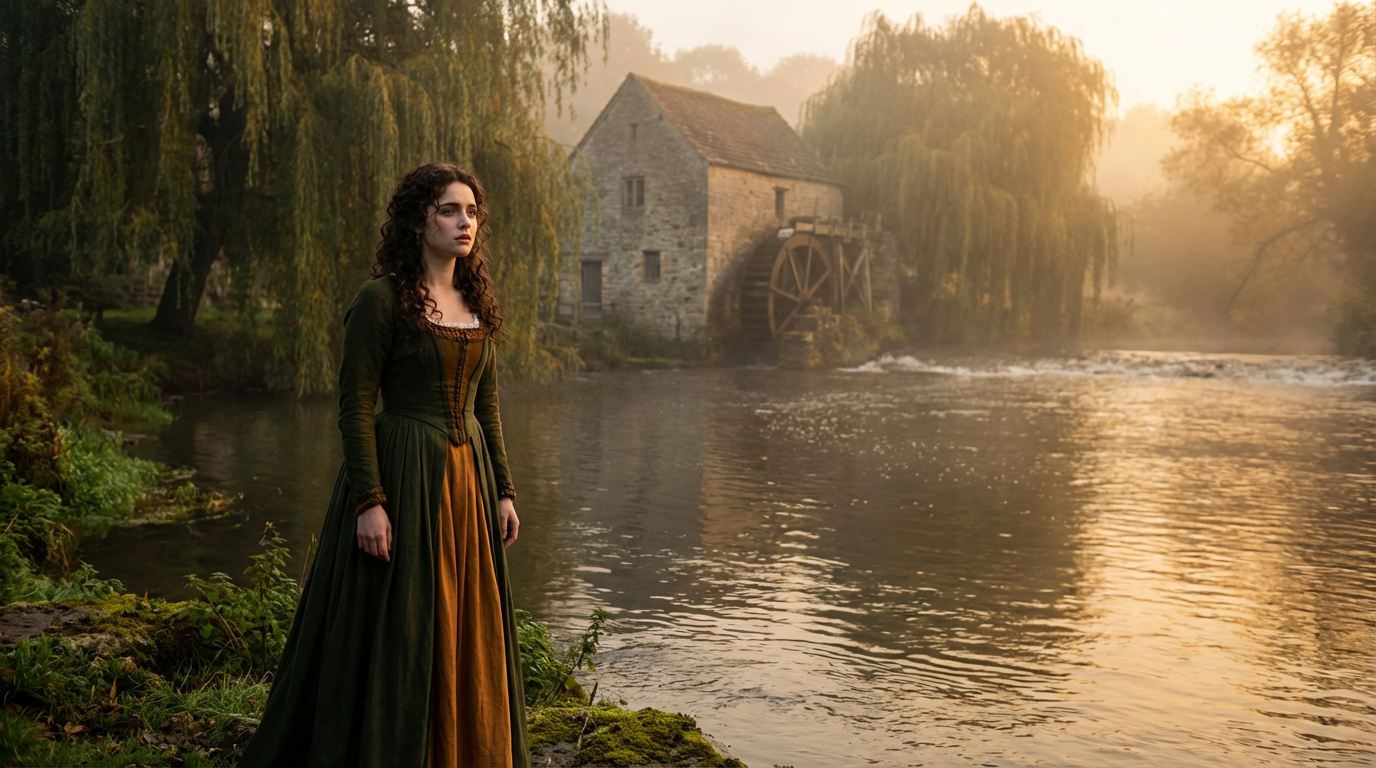
An excerpt from the original text.(complete · 5215 words)
r and Mrs Glegg at Home
In order to see Mr and Mrs Glegg at home, we must enter the town of St
Ogg’s,—that venerable town with the red fluted roofs and the broad
warehouse gables, where the black ships unlade themselves of their
burthens from the far north, and carry away, in exchange, the precious
inland products, the well-crushed cheese and the soft fleeces which my
refined readers have doubtless become acquainted with through the
medium of the best classic pastorals.
It is one of those old, old towns which impress one as a continuation
and outgrowth of nature, as much as the nests of the bower-birds or the
winding galleries of the white ants; a town which carries the traces of
its long growth and history like a millennial tree, and has sprung up
and developed in the same spot between the river and the low hill from
the time when the Roman legions turned their backs on it from the camp
on the hillside, and the long-haired sea-kings came up the river and
looked with fierce, eager eyes at the fatness of the land. It is a town
“familiar with forgotten years.” The shadow of the Saxon hero-king
still walks there fitfully, reviewing the scenes of his youth and
love-time, and is met by the gloomier shadow of the dreadful heathen
Dane, who was stabbed in the midst of his warriors by the sword of an
invisible avenger, and who rises on autumn evenings like a white mist
from his tumulus on the hill, and hovers in the court of the old hall
by the river-side, the spot where he was thus miraculously slain in the
days before the old hall was built. It was the Normans who began to
build that fine old hall, which is, like the town, telling of the
thoughts and hands of widely sundered generations; but it is all so old
that we look with loving pardon at its inconsistencies, and are well
content that they who built the stone oriel, and they who built the
Gothic façade and towers of finest small brickwork with the trefoil
ornament, and the windows and battlements defined with stone, did not
sacrilegiously pull down the ancient half-timbered body with its
oak-roofed banqueting-hall.
But older even than this old hall is perhaps the bit of wall now built
into the belfry of the parish church, and said to be a remnant of the
original chapel dedicated to St Ogg, the patron saint of this ancient
town, of whose history I possess several manuscript versions. I incline
to the briefest, since, if it should not be wholly true, it is at least
likely to contain the least falsehood. “Ogg the son of Beorl,” says my
private hagiographer, “was a boatman who gained a scanty living by
ferrying passengers across the river Floss. And it came to pass, one
evening when the winds were high, that there sat moaning by the brink
of the river a woman with a child in her arms; and she was clad in
rags, and had a worn and withered look, and she craved to be rowed
across the river. And the men thereabout questioned her, and said,
‘Wherefore dost thou desire to cross the river? Tarry till the morning,
and take shelter here for the night; so shalt thou be wise and not
foolish.’ Still she went on to mourn and crave. But Ogg the son of
Beorl came up and said, ‘I will ferry thee across; it is enough that
thy heart needs it.’ And he ferried her across. And it came to pass,
when she stepped ashore, that her rags were turned into robes of
flowing white, and her face became bright with exceeding beauty, and
there was a glory around it, so that she shed a light on the water like
the moon in its brightness. And she said, ‘Ogg, the son of Beorl, thou
art blessed in that thou didst not question and wrangle with the
heart’s need, but wast smitten with pity, and didst straightway relieve
the same. And from henceforth whoso steps into thy boat shall be in no
peril from the storm; and whenever it puts forth to the rescue, it
shall save the lives both of men and beasts.’ And when the floods came,
many were saved by reason of that blessing on the boat. But when Ogg
the son of Beorl died, behold, in the parting of his soul, the boat
loosed itself from its moorings, and was floated with the ebbing tide
in great swiftness to the ocean, and was seen no more. Yet it was
witnessed in the floods of aftertime, that at the coming on of
eventide, Ogg the son of Beorl was always seen with his boat upon the
wide-spreading waters, and the Blessed Virgin sat in the prow, shedding
a light around as of the moon in its brightness, so that the rowers in
the gathering darkness took heart and pulled anew.”
This legend, one sees, reflects from a far-off time the visitation of
the floods, which, even when they left human life untouched, were
widely fatal to the helpless cattle, and swept as sudden death over all
smaller living things. But the town knew worse troubles even than the
floods,—troubles of the civil wars, when it was a continual
fighting-place, where first Puritans thanked God for the blood of the
Loyalists, and then Loyalists thanked God for the blood of the
Puritans. Many honest citizens lost all their possessions for
conscience’ sake in those times, and went forth beggared from their
native town. Doubtless there are many houses standing now on which
those honest citizens turned their backs in sorrow,—quaint-gabled
houses looking on the river, jammed between newer warehouses, and
penetrated by surprising passages, which turn and turn at sharp angles
till they lead you out on a muddy strand overflowed continually by the
rushing tide. Everywhere the brick houses have a mellow look, and in
Mrs Glegg’s day there was no incongruous new-fashioned smartness, no
plate-glass in shop-windows, no fresh stucco-facing or other fallacious
attempt to make fine old red St Ogg’s wear the air of a town that
sprang up yesterday. The shop-windows were small and unpretending; for
the farmers’ wives and daughters who came to do their shopping on
market-days were not to be withdrawn from their regular well-known
shops; and the tradesmen had no wares intended for customers who would
go on their way and be seen no more. Ah! even Mrs Glegg’s day seems far
back in the past now, separated from us by changes that widen the
years. War and the rumor of war had then died out from the minds of
men, and if they were ever thought of by the farmers in drab
greatcoats, who shook the grain out of their sample-bags and buzzed
over it in the full market-place, it was as a state of things that
belonged to a past golden age when prices were high. Surely the time
was gone forever when the broad river could bring up unwelcome ships;
Russia was only the place where the linseed came from,—the more the
better,—making grist for the great vertical millstones with their
scythe-like arms, roaring and grinding and carefully sweeping as if an
informing soul were in them. The Catholics, bad harvests, and the
mysterious fluctuations of trade were the three evils mankind had to
fear; even the floods had not been great of late years. The mind of St
Ogg’s did not look extensively before or after. It inherited a long
past without thinking of it, and had no eyes for the spirits that walk
the streets. Since the centuries when St Ogg with his boat and the
Virgin Mother at the prow had been seen on the wide water, so many
memories had been left behind, and had gradually vanished like the
receding hilltops! And the present time was like the level plain where
men lose their belief in volcanoes and earthquakes, thinking to-morrow
will be as yesterday, and the giant forces that used to shake the earth
are forever laid to sleep. The days were gone when people could be
greatly wrought upon by their faith, still less change it; the
Catholics were formidable because they would lay hold of government and
property, and burn men alive; not because any sane and honest
parishioner of St Ogg’s could be brought to believe in the Pope. One
aged person remembered how a rude multitude had been swayed when John
Wesley preached in the cattle-market; but for a long while it had not
been expected of preachers that they should shake the souls of men. An
occasional burst of fervor in Dissenting pulpits on the subject of
infant baptism was the only symptom of a zeal unsuited to sober times
when men had done with change. Protestantism sat at ease, unmindful of
schisms, careless of proselytism: Dissent was an inheritance along with
a superior pew and a business connection; and Churchmanship only
wondered contemptuously at Dissent as a foolish habit that clung
greatly to families in the grocery and chandlering lines, though not
incompatible with prosperous wholesale dealing. But with the Catholic
Question had come a slight wind of controversy to break the calm: the
elderly rector had become occasionally historical and argumentative;
and Mr Spray, the Independent minister, had begun to preach political
sermons, in which he distinguished with much subtlety between his
fervent belief in the right of the Catholics to the franchise and his
fervent belief in their eternal perdition. Most of Mr Spray’s hearers,
however, were incapable of following his subtleties, and many
old-fashioned Dissenters were much pained by his “siding with the
Catholics”; while others thought he had better let politics alone.
Public spirit was not held in high esteem at St Ogg’s, and men who
busied themselves with political questions were regarded with some
suspicion, as dangerous characters; they were usually persons who had
little or no business of their own to manage, or, if they had, were
likely enough to become insolvent.
This was the general aspect of things at St Ogg’s in Mrs Glegg’s day,
and at that particular period in her family history when she had had
her quarrel with Mr Tulliver. It was a time when ignorance was much
more comfortable than at present, and was received with all the honours
in very good society, without being obliged to dress itself in an
elaborate costume of knowledge; a time when cheap periodicals were not,
and when country surgeons never thought of asking their female patients
if they were fond of reading, but simply took it for granted that they
preferred gossip; a time when ladies in rich silk gowns wore large
pockets, in which they carried a mutton-bone to secure them against
cramp. Mrs Glegg carried such a bone, which she had inherited from her
grandmother with a brocaded gown that would stand up empty, like a suit
of armor, and a silver-headed walking-stick; for the Dodson family had
been respectable for many generations.
Mrs Glegg had both a front and a back parlour in her excellent house at
St Ogg’s, so that she had two points of view from which she could
observe the weakness of her fellow-beings, and reinforce her
thankfulness for her own exceptional strength of mind. From her front
window she could look down the Tofton Road, leading out of St Ogg’s,
and note the growing tendency to “gadding about” in the wives of men
not retired from business, together with a practice of wearing woven
cotton stockings, which opened a dreary prospect for the coming
generation; and from her back windows she could look down the pleasant
garden and orchard which stretched to the river, and observe the folly
of Mr Glegg in spending his time among “them flowers and vegetables.”
For Mr Glegg, having retired from active business as a wool-stapler for
the purpose of enjoying himself through the rest of his life, had found
this last occupation so much more severe than his business, that he had
been driven into amateur hard labour as a dissipation, and habitually
relaxed by doing the work of two ordinary gardeners. The economizing of
a gardener’s wages might perhaps have induced Mrs Glegg to wink at this
folly, if it were possible for a healthy female mind even to simulate
respect for a husband’s hobby. But it is well known that this conjugal
complacency belongs only to the weaker portion of the sex, who are
scarcely alive to the responsibilities of a wife as a constituted check
on her husband’s pleasures, which are hardly ever of a rational or
commendable kind.
Mr Glegg on his side, too, had a double source of mental occupation,
which gave every promise of being inexhaustible. On the one hand, he
surprised himself by his discoveries in natural history, finding that
his piece of garden-ground contained wonderful caterpillars, slugs, and
insects, which, so far as he had heard, had never before attracted
human observation; and he noticed remarkable coincidences between these
zoological phenomena and the great events of that time,—as, for
example, that before the burning of York Minster there had been
mysterious serpentine marks on the leaves of the rose-trees, together
with an unusual prevalence of slugs, which he had been puzzled to know
the meaning of, until it flashed upon him with this melancholy
conflagration. (Mr Glegg had an unusual amount of mental activity,
which, when disengaged from the wool business, naturally made itself a
pathway in other directions.) And his second subject of meditation was
the “contrairiness” of the female mind, as typically exhibited in Mrs
Glegg. That a creature made—in a genealogical sense—out of a man’s rib,
and in this particular case maintained in the highest respectability
without any trouble of her own, should be normally in a state of
contradiction to the blandest propositions and even to the most
accommodating concessions, was a mystery in the scheme of things to
which he had often in vain sought a clew in the early chapters of
Genesis. Mr Glegg had chosen the eldest Miss Dodson as a handsome
embodiment of female prudence and thrift, and being himself of a
money-getting, money-keeping turn, had calculated on much conjugal
harmony. But in that curious compound, the feminine character, it may
easily happen that the flavour is unpleasant in spite of excellent
ingredients; and a fine systematic stinginess may be accompanied with a
seasoning that quite spoils its relish. Now, good Mr Glegg himself was
stingy in the most amiable manner; his neighbours called him “near,”
which always means that the person in question is a lovable skinflint.
If you expressed a preference for cheese-parings, Mr Glegg would
remember to save them for you, with a good-natured delight in
gratifying your palate, and he was given to pet all animals which
required no appreciable keep. There was no humbug or hypocrisy about Mr
Glegg; his eyes would have watered with true feeling over the sale of a
widow’s furniture, which a five-pound note from his side pocket would
have prevented; but a donation of five pounds to a person “in a small
way of life” would have seemed to him a mad kind of lavishness rather
than “charity,” which had always presented itself to him as a
contribution of small aids, not a neutralizing of misfortune. And Mr
Glegg was just as fond of saving other people’s money as his own; he
would have ridden as far round to avoid a turnpike when his expenses
were to be paid for him, as when they were to come out of his own
pocket, and was quite zealous in trying to induce indifferent
acquaintances to adopt a cheap substitute for blacking. This
inalienable habit of saving, as an end in itself, belonged to the
industrious men of business of a former generation, who made their
fortunes slowly, almost as the tracking of the fox belongs to the
harrier,—it constituted them a “race,” which is nearly lost in these
days of rapid money-getting, when lavishness comes close on the back of
want. In old-fashioned times an “independence” was hardly ever made
without a little miserliness as a condition, and you would have found
that quality in every provincial district, combined with characters as
various as the fruits from which we can extract acid. The true
Harpagons were always marked and exceptional characters; not so the
worthy tax-payers, who, having once pinched from real necessity,
retained even in the midst of their comfortable retirement, with their
wallfruit and wine-bins, the habit of regarding life as an ingenious
process of nibbling out one’s livelihood without leaving any
perceptible deficit, and who would have been as immediately prompted to
give up a newly taxed luxury when they had had their clear five hundred
a year, as when they had only five hundred pounds of capital. Mr Glegg
was one of these men, found so impracticable by chancellors of the
exchequer; and knowing this, you will be the better able to understand
why he had not swerved from the conviction that he had made an eligible
marriage, in spite of the too pungent seasoning that nature had given
to the eldest Miss Dodson’s virtues. A man with an affectionate
disposition, who finds a wife to concur with his fundamental idea of
life, easily comes to persuade himself that no other woman would have
suited him so well, and does a little daily snapping and quarrelling
without any sense of alienation. Mr Glegg, being of a reflective turn,
and no longer occupied with wool, had much wondering meditation on the
peculiar constitution of the female mind as unfolded to him in his
domestic life; and yet he thought Mrs Glegg’s household ways a model
for her sex. It struck him as a pitiable irregularity in other women if
they did not roll up their table-napkins with the same tightness and
emphasis as Mrs Glegg did, if their pastry had a less leathery
consistence, and their damson cheese a less venerable hardness than
hers; nay, even the peculiar combination of grocery and druglike odors
in Mrs Glegg’s private cupboard impressed him as the only right thing
in the way of cupboard smells. I am not sure that he would not have
longed for the quarrelling again, if it had ceased for an entire week;
and it is certain that an acquiescent, mild wife would have left his
meditations comparatively jejune and barren of mystery.
Mr Glegg’s unmistakable kind-heartedness was shown in this, that it
pained him more to see his wife at variance with others,—even with
Dolly, the servant,—than to be in a state of cavil with her himself;
and the quarrel between her and Mr Tulliver vexed him so much that it
quite nullified the pleasure he would otherwise have had in the state
of his early cabbages, as he walked in his garden before breakfast the
next morning. Still, he went in to breakfast with some slight hope
that, now Mrs Glegg had “slept upon it,” her anger might be subdued
enough to give way to her usually strong sense of family decorum. She
had been used to boast that there had never been any of those deadly
quarrels among the Dodsons which had disgraced other families; that no
Dodson had ever been “cut off with a shilling,” and no cousin of the
Dodsons disowned; as, indeed, why should they be? For they had no
cousins who had not money out at use, or some houses of their own, at
the very least.
There was one evening-cloud which had always disappeared from Mrs
Glegg’s brow when she sat at the breakfast-table. It was her fuzzy
front of curls; for as she occupied herself in household matters in the
morning it would have been a mere extravagance to put on anything so
superfluous to the making of leathery pastry as a fuzzy curled front.
By half-past ten decorum demanded the front; until then Mrs Glegg could
economise it, and society would never be any the wiser. But the absence
of that cloud only left it more apparent that the cloud of severity
remained; and Mr Glegg, perceiving this, as he sat down to his
milkporridge, which it was his old frugal habit to stem his morning
hunger with, prudently resolved to leave the first remark to Mrs Glegg,
lest, to so delicate an article as a lady’s temper, the slightest touch
should do mischief. People who seem to enjoy their ill temper have a
way of keeping it in fine condition by inflicting privations on
themselves. That was Mrs Glegg’s way. She made her tea weaker than
usual this morning, and declined butter. It was a hard case that a
vigorous mood for quarrelling, so highly capable of using an
opportunity, should not meet with a single remark from Mr Glegg on
which to exercise itself. But by and by it appeared that his silence
would answer the purpose, for he heard himself apostrophised at last in
that tone peculiar to the wife of one’s bosom.
“Well, Mr Glegg! it’s a poor return I get for making you the wife I’ve
made you all these years. If this is the way I’m to be treated, I’d
better ha’ known it before my poor father died, and then, when I’d
wanted a home, I should ha’ gone elsewhere, as the choice was offered
me.”
Mr Glegg paused from his porridge and looked up, not with any new
amazement, but simply with that quiet, habitual wonder with which we
regard constant mysteries.
“Why, Mrs G., what have I done now?”
“Done now, Mr Glegg? done now?—I’m sorry for you.”
Not seeing his way to any pertinent answer, Mr Glegg reverted to his
porridge.
“There’s husbands in the world,” continued Mrs Glegg, after a pause,
“as ’ud have known how to do something different to siding with
everybody else against their own wives. Perhaps I’m wrong and you can
teach me better. But I’ve allays heard as it’s the husband’s place to
stand by the wife, instead o’ rejoicing and triumphing when folks
insult her.”
“Now, what call have you to say that?” said Mr Glegg, rather warmly,
for though a kind man, he was not as meek as Moses. “When did I rejoice
or triumph over you?”
“There’s ways o’ doing things worse than speaking out plain, Mr Glegg.
I’d sooner you’d tell me to my face as you make light of me, than try
to make out as everybody’s in the right but me, and come to your
breakfast in the morning, as I’ve hardly slept an hour this night, and
sulk at me as if I was the dirt under your feet.”
“Sulk at you?” said Mr Glegg, in a tone of angry facetiousness. “You’re
like a tipsy man as thinks everybody’s had too much but himself.”
“Don’t lower yourself with using coarse language to me, Mr Glegg! It
makes you look very small, though you can’t see yourself,” said Mrs
Glegg, in a tone of energetic compassion. “A man in your place should
set an example, and talk more sensible.”
“Yes; but will you listen to sense?” retorted Mr Glegg, sharply. “The
best sense I can talk to you is what I said last night,—as you’re i’
the wrong to think o’ calling in your money, when it’s safe enough if
you’d let it alone, all because of a bit of a tiff, and I was in hopes
you’d ha’ altered your mind this morning. But if you’d like to call it
in, don’t do it in a hurry now, and breed more enmity in the family,
but wait till there’s a pretty mortgage to be had without any trouble.
You’d have to set the lawyer to work now to find an investment, and
make no end o’ expense.”
Mrs Glegg felt there was really something in this, but she tossed her
head and emitted a guttural interjection to indicate that her silence
was only an armistice, not a peace. And, in fact hostilities soon broke
out again.
“I’ll thank you for my cup o’ tea, now, Mrs G.,” said Mr Glegg, seeing
that she did not proceed to give it him as usual, when he had finished
his porridge. She lifted the teapot with a slight toss of the head, and
said,—
“I’m glad to hear you’ll thank me, Mr Glegg. It’s little thanks I
get for what I do for folks i’ this world. Though there’s never a woman
o’ your side o’ the family, Mr Glegg, as is fit to stand up with me,
and I’d say it if I was on my dying bed. Not but what I’ve allays
conducted myself civil to your kin, and there isn’t one of ’em can say
the contrary, though my equils they aren’t, and nobody shall make me
say it.”
“You’d better leave finding fault wi’ my kin till you’ve left off
quarrelling with your own, Mrs G.,” said Mr Glegg, with angry sarcasm.
“I’ll trouble you for the milk-jug.”
“That’s as false a word as ever you spoke, Mr Glegg,” said the lady,
pouring out the milk with unusual profuseness, as much as to say, if he
wanted milk he should have it with a vengeance. “And you know it’s
false. I’m not the woman to quarrel with my own kin; you may, for
I’ve known you to do it.”
“Why, what did you call it yesterday, then, leaving your sister’s house
in a tantrum?”
“I’d no quarrel wi’ my sister, Mr Glegg, and it’s false to say it. Mr
Tulliver’s none o’ my blood, and it was him quarrelled with me, and
drove me out o’ the house. But perhaps you’d have had me stay and be
swore at, Mr Glegg; perhaps you was vexed not to hear more abuse and
foul language poured out upo’ your own wife. But, let me tell you, it’s
your disgrace.”
“Did ever anybody hear the like i’ this parish?” said Mr Glegg, getting
hot. “A woman, with everything provided for her, and allowed to keep
her own money the same as if it was settled on her, and with a gig new
stuffed and lined at no end o’ expense, and provided for when I die
beyond anything she could expect—to go on i’ this way, biting and
snapping like a mad dog! It’s beyond everything, as God A ’mighty
should ha’ made women so.” (These last words were uttered in a tone
of sorrowful agitation. Mr Glegg pushed his tea from him, and tapped
the table with both his hands.)
“Well, Mr Glegg, if those are your feelings, it’s best they should be
known,” said Mrs Glegg, taking off her napkin, and folding it in an
excited manner. “But if you talk o’ my being provided for beyond what I
could expect, I beg leave to tell you as I’d a right to expect a many
things as I don’t find. And as to my being like a mad dog, it’s well if
you’re not cried shame on by the county for your treatment of me, for
it’s what I can’t bear, and I won’t bear——”
Here Mrs Glegg’s voice intimated that she was going to cry, and
breaking off from speech, she rang the bell violently.
“Sally,” she said, rising from her chair, and speaking in rather a
choked voice, “light a fire up-stairs, and put the blinds down. Mr
Glegg, you’ll please to order what you’d like for dinner. I shall have
gruel.”
Mrs Glegg walked across the room to the small book-case, and took down
Baxter’s “Saints’ Everlasting Rest,” which she carried with her
up-stairs. It was the book she was accustomed to lay open before her on
special occasions,—on wet Sunday mornings, or when she heard of a death
in the family, or when, as in this case, her quarrel with Mr Glegg had
been set an octave higher than usual.
But Mrs Glegg carried something else up-stairs with her, which,
together with the “Saints’ Rest” and the gruel, may have had some
influence in gradually calming her feelings, and making it possible for
her to endure existence on the ground-floor, shortly before tea-time.
This was, partly, Mr Glegg’s suggestion that she would do well to let
her five hundred lie still until a good investment turned up; and,
further, his parenthetic hint at his handsome provision for her in case
of his death. Mr Glegg, like all men of his stamp, was extremely
reticent about his will; and Mrs Glegg, in her gloomier moments, had
forebodings that, like other husbands of whom she had heard, he might
cherish the mean project of heightening her grief at his death by
leaving her poorly off, in which case she was firmly resolved that she
would have scarcely any weeper on her bonnet, and would cry no more
than if he had been a second husband. But if he had really shown her
any testamentary tenderness, it would be affecting to think of him,
poor man, when he was gone; and even his foolish fuss about the flowers
and garden-stuff, and his insistence on the subject of snails, would be
touching when it was once fairly at an end. To survive Mr Glegg, and
talk eulogistically of him as a man who might have his weaknesses, but
who had done the right thing by her, not-withstanding his numerous poor
relations; to have sums of interest coming in more frequently, and
secrete it in various corners, baffling to the most ingenious of
thieves (for, to Mrs Glegg’s mind, banks and strong-boxes would have
nullified the pleasure of property; she might as well have taken her
food in capsules); finally, to be looked up to by her own family and
the neighbourhood, so as no woman can ever hope to be who has not the
præterite and present dignity comprised in being a “widow well
left,”—all this made a flattering and conciliatory view of the future.
So that when good Mr Glegg, restored to good humour by much hoeing, and
moved by the sight of his wife’s empty chair, with her knitting rolled
up in the corner, went up-stairs to her, and observed that the bell had
been tolling for poor Mr Morton, Mrs Glegg answered magnanimously,
quite as if she had been an uninjured woman: “Ah! then, there’ll be a
good business for somebody to take to.”
Baxter had been open at least eight hours by this time, for it was
nearly five o’clock; and if people are to quarrel often, it follows as
a corollary that their quarrels cannot be protracted beyond certain
limits.
Mr and Mrs Glegg talked quite amicably about the Tullivers that
evening. Mr Glegg went the length of admitting that Tulliver was a sad
man for getting into hot water, and was like enough to run through his
property; and Mrs Glegg, meeting this acknowledgment half-way, declared
that it was beneath her to take notice of such a man’s conduct, and
that, for her sister’s sake, she would let him keep the five hundred a
while longer, for when she put it out on a mortgage she should only get
four per cent.
Master this chapter. Complete your experience
Purchase the complete book to access all chapters and support classic literature
As an Amazon Associate, we earn a small commission from qualifying purchases at no additional cost to you.
Available in paperback, hardcover, and e-book formats
Let's Analyse the Pattern
Using your resources, presence, or cooperation as punishment when feeling disrespected or unheard, often hurting yourself in the process.
Why This Matters
Connect literature to life
This chapter teaches how to recognize when people use their resources as emotional weapons rather than practical tools.
Practice This Today
This week, notice when someone threatens to withdraw something valuable—time, money, cooperation—and ask yourself what they're really trying to communicate.
Now let's explore the literary elements.
Key Quotes & Analysis
"I'm not going to find fault with my own sister's husband, I'll say that for him."
Context: She says this sarcastically while clearly preparing to do exactly that - find fault with Tulliver.
This shows Mrs. Glegg's passive-aggressive communication style. She positions herself as reasonable and family-loyal while simultaneously attacking. It's a classic manipulation tactic.
In Today's Words:
I'm not one to talk bad about family, but...
"You women never know the value of money - you think, everybody must be ruined to satisfy your spite."
Context: He says this when frustrated with his wife's threat to call in the loan over hurt feelings.
This reveals the gender dynamics of their marriage and era. He dismisses her emotional needs as 'spite' while focusing only on financial practicality, showing how couples can completely miss each other's real concerns.
In Today's Words:
You're being emotional and you don't understand how money actually works.
"I shall call it in, you may depend - I shall certainly call it in. I don't know what you call security when a man's going to law about the water-course."
Context: She's threatening to demand immediate repayment of the money she loaned to Tulliver.
This shows how financial decisions become weapons in family conflicts. She's not really worried about the money - she's using the loan as leverage to punish Tulliver for disrespecting her.
In Today's Words:
I'm taking back every penny I gave him, and he can figure out how to pay me back right now.
Thematic Threads
Power
In This Chapter
Mrs. Glegg wields financial control as her primary source of power in family dynamics
Development
Introduced here - shows how economic leverage becomes emotional weapon
In Your Life:
You might recognize this when someone uses their money, skills, or presence to control situations instead of addressing conflicts directly.
Pride
In This Chapter
Mrs. Glegg's wounded pride drives her to extreme threats that could harm the whole family
Development
Building on Tom's pride themes - now showing how pride operates in marriage
In Your Life:
You see this when your hurt feelings make you want to 'show them' even if it costs you something important.
Marriage
In This Chapter
The Gleggs use conflict as their primary form of communication and connection
Development
Introduced here - contrasts with other relationship dynamics in the story
In Your Life:
You might recognize couples who seem to need drama or arguments to feel engaged with each other.
Class
In This Chapter
The Gleggs' social position gives them financial power over working families like the Tullivers
Development
Continues class exploration - now showing how money flows between social levels
In Your Life:
You see this in how people with more resources can make or break those with less, often without considering the human cost.
Communication
In This Chapter
Important feelings get expressed through dramatic gestures rather than direct conversation
Development
Introduced here - shows indirect communication patterns
In Your Life:
You might catch yourself making big statements or threats when what you really need is to be heard and understood.
You now have the context. Time to form your own thoughts.
Discussion Questions
- 1
What does Mrs. Glegg threaten to do when she feels disrespected, and why does this give her power over the family?
analysis • surface - 2
Why does Mrs. Glegg use the loan as a weapon instead of directly addressing her hurt feelings with her husband?
analysis • medium - 3
Where do you see this pattern of 'weaponized withdrawal' in modern workplaces, families, or relationships?
application • medium - 4
If you were Mr. Glegg, how would you address your wife's real needs without giving in to the threat?
application • deep - 5
What does the Glegg marriage teach us about how people communicate when they don't know how to ask for what they really need?
reflection • deep
Critical Thinking Exercise
Map the Power Dynamic
Think of a recent conflict where someone (including yourself) used withdrawal or threats as leverage. Draw or write out what each person really wanted versus what they actually said or did. Then identify what kind of power each person had and how they used it.
Consider:
- •What was the surface issue versus the deeper emotional need?
- •What resources or leverage did each person control?
- •How did the conflict actually resolve, and what patterns emerged?
Journaling Prompt
Write about a time when you felt powerless in a situation and considered using withdrawal or threats to regain control. What were you really hoping to achieve, and what might have worked better?
Coming Up Next...
Chapter 13: Pride's Expensive Price Tag
While the Gleggs settle their domestic dispute, Mr. Tulliver is about to make decisions that will entangle his family's fate even more deeply. His pride and stubbornness are leading him toward choices that will have lasting consequences for Tom and Maggie.



