
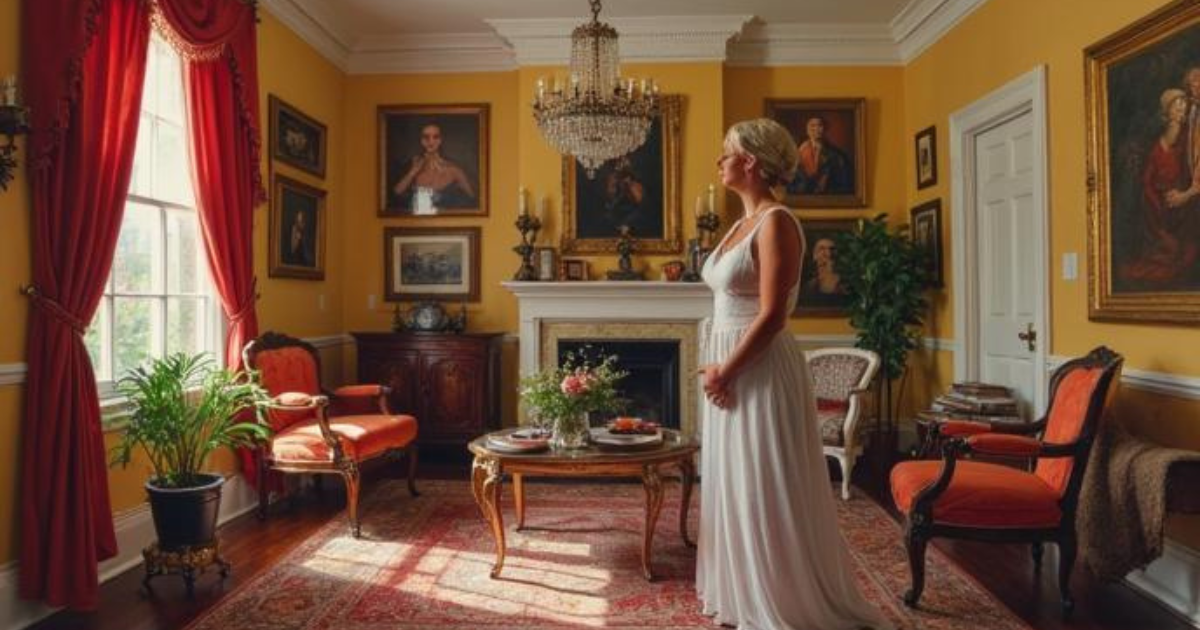
An excerpt from the original text.(complete · 2269 words)
t happened sometimes when Edna went to see Mademoiselle Reisz that the
little musician was absent, giving a lesson or making some small
necessary household purchase. The key was always left in a secret
hiding-place in the entry, which Edna knew. If Mademoiselle happened to
be away, Edna would usually enter and wait for her return.
When she knocked at Mademoiselle Reisz’s door one afternoon there was
no response; so unlocking the door, as usual, she entered and found the
apartment deserted, as she had expected. Her day had been quite filled
up, and it was for a rest, for a refuge, and to talk about Robert, that
she sought out her friend.
She had worked at her canvas—a young Italian character study—all the
morning, completing the work without the model; but there had been many
interruptions, some incident to her modest housekeeping, and others of
a social nature.
Madame Ratignolle had dragged herself over, avoiding the too public
thoroughfares, she said. She complained that Edna had neglected her
much of late. Besides, she was consumed with curiosity to see the
little house and the manner in which it was conducted. She wanted to
hear all about the dinner party; Monsieur Ratignolle had left so
early. What had happened after he left? The champagne and grapes which
Edna sent over were too delicious. She had so little appetite; they
had refreshed and toned her stomach. Where on earth was she going to
put Mr. Pontellier in that little house, and the boys? And then she
made Edna promise to go to her when her hour of trial overtook her.
“At any time—any time of the day or night, dear,” Edna assured her.
Before leaving Madame Ratignolle said:
“In some way you seem to me like a child, Edna. You seem to act without
a certain amount of reflection which is necessary in this life. That is
the reason I want to say you mustn’t mind if I advise you to be a
little careful while you are living here alone. Why don’t you have some
one come and stay with you? Wouldn’t Mademoiselle Reisz come?”
“No; she wouldn’t wish to come, and I shouldn’t want her always with
me.”
“Well, the reason—you know how evil-minded the world is—some one was
talking of Alcée Arobin visiting you. Of course, it wouldn’t matter if
Mr. Arobin had not such a dreadful reputation. Monsieur Ratignolle was
telling me that his attentions alone are considered enough to ruin a
woman’s name.”
“Does he boast of his successes?” asked Edna, indifferently, squinting
at her picture.
“No, I think not. I believe he is a decent fellow as far as that goes.
But his character is so well known among the men. I shan’t be able to
come back and see you; it was very, very imprudent to-day.”
“Mind the step!” cried Edna.
“Don’t neglect me,” entreated Madame Ratignolle; “and don’t mind what I
said about Arobin, or having some one to stay with you.”
“Of course not,” Edna laughed. “You may say anything you like to me.”
They kissed each other good-by. Madame Ratignolle had not far to go,
and Edna stood on the porch a while watching her walk down the street.
Then in the afternoon Mrs. Merriman and Mrs. Highcamp had made their
“party call.” Edna felt that they might have dispensed with the
formality. They had also come to invite her to play vingt-et-un one
evening at Mrs. Merriman’s. She was asked to go early, to dinner, and
Mr. Merriman or Mr. Arobin would take her home. Edna accepted in a
half-hearted way. She sometimes felt very tired of Mrs. Highcamp and
Mrs. Merriman.
Late in the afternoon she sought refuge with Mademoiselle Reisz, and
stayed there alone, waiting for her, feeling a kind of repose invade
her with the very atmosphere of the shabby, unpretentious little room.
Edna sat at the window, which looked out over the house-tops and across
the river. The window frame was filled with pots of flowers, and she
sat and picked the dry leaves from a rose geranium. The day was warm,
and the breeze which blew from the river was very pleasant. She removed
her hat and laid it on the piano. She went on picking the leaves and
digging around the plants with her hat pin. Once she thought she heard
Mademoiselle Reisz approaching. But it was a young black girl, who came
in, bringing a small bundle of laundry, which she deposited in the
adjoining room, and went away.
Edna seated herself at the piano, and softly picked out with one hand
the bars of a piece of music which lay open before her. A half-hour
went by. There was the occasional sound of people going and coming in
the lower hall. She was growing interested in her occupation of picking
out the aria, when there was a second rap at the door. She vaguely
wondered what these people did when they found Mademoiselle’s door
locked.
“Come in,” she called, turning her face toward the door. And this time
it was Robert Lebrun who presented himself. She attempted to rise; she
could not have done so without betraying the agitation which mastered
her at sight of him, so she fell back upon the stool, only exclaiming,
“Why, Robert!”
He came and clasped her hand, seemingly without knowing what he was
saying or doing.
“Mrs. Pontellier! How do you happen—oh! how well you look! Is
Mademoiselle Reisz not here? I never expected to see you.”
“When did you come back?” asked Edna in an unsteady voice, wiping her
face with her handkerchief. She seemed ill at ease on the piano stool,
and he begged her to take the chair by the window.
She did so, mechanically, while he seated himself on the stool.
“I returned day before yesterday,” he answered, while he leaned his arm
on the keys, bringing forth a crash of discordant sound.
“Day before yesterday!” she repeated, aloud; and went on thinking to
herself, “day before yesterday,” in a sort of an uncomprehending way.
She had pictured him seeking her at the very first hour, and he had
lived under the same sky since day before yesterday; while only by
accident had he stumbled upon her. Mademoiselle must have lied when she
said, “Poor fool, he loves you.”
“Day before yesterday,” she repeated, breaking off a spray of
Mademoiselle’s geranium; “then if you had not met me here to-day you
wouldn’t—when—that is, didn’t you mean to come and see me?”
“Of course, I should have gone to see you. There have been so many
things—” he turned the leaves of Mademoiselle’s music nervously. “I
started in at once yesterday with the old firm. After all there is as
much chance for me here as there was there—that is, I might find it
profitable some day. The Mexicans were not very congenial.”
So he had come back because the Mexicans were not congenial; because
business was as profitable here as there; because of any reason, and
not because he cared to be near her. She remembered the day she sat on
the floor, turning the pages of his letter, seeking the reason which
was left untold.
She had not noticed how he looked—only feeling his presence; but she
turned deliberately and observed him. After all, he had been absent but
a few months, and was not changed. His hair—the color of hers—waved
back from his temples in the same way as before. His skin was not more
burned than it had been at Grand Isle. She found in his eyes, when he
looked at her for one silent moment, the same tender caress, with an
added warmth and entreaty which had not been there before—the same
glance which had penetrated to the sleeping places of her soul and
awakened them.
A hundred times Edna had pictured Robert’s return, and imagined their
first meeting. It was usually at her home, whither he had sought her
out at once. She always fancied him expressing or betraying in some way
his love for her. And here, the reality was that they sat ten feet
apart, she at the window, crushing geranium leaves in her hand and
smelling them, he twirling around on the piano stool, saying:
“I was very much surprised to hear of Mr. Pontellier’s absence; it’s a
wonder Mademoiselle Reisz did not tell me; and your moving—mother told
me yesterday. I should think you would have gone to New York with him,
or to Iberville with the children, rather than be bothered here with
housekeeping. And you are going abroad, too, I hear. We shan’t have you
at Grand Isle next summer; it won’t seem—do you see much of
Mademoiselle Reisz? She often spoke of you in the few letters she
wrote.”
“Do you remember that you promised to write to me when you went away?”
A flush overspread his whole face.
“I couldn’t believe that my letters would be of any interest to you.”
“That is an excuse; it isn’t the truth.” Edna reached for her hat on
the piano. She adjusted it, sticking the hat pin through the heavy coil
of hair with some deliberation.
“Are you not going to wait for Mademoiselle Reisz?” asked Robert.
“No; I have found when she is absent this long, she is liable not to
come back till late.” She drew on her gloves, and Robert picked up his
hat.
“Won’t you wait for her?” asked Edna.
“Not if you think she will not be back till late,” adding, as if
suddenly aware of some discourtesy in his speech, “and I should miss
the pleasure of walking home with you.” Edna locked the door and put
the key back in its hiding-place.
They went together, picking their way across muddy streets and
sidewalks encumbered with the cheap display of small tradesmen. Part of
the distance they rode in the car, and after disembarking, passed the
Pontellier mansion, which looked broken and half torn asunder. Robert
had never known the house, and looked at it with interest.
“I never knew you in your home,” he remarked.
“I am glad you did not.”
“Why?” She did not answer. They went on around the corner, and it
seemed as if her dreams were coming true after all, when he followed
her into the little house.
“You must stay and dine with me, Robert. You see I am all alone, and it
is so long since I have seen you. There is so much I want to ask you.”
She took off her hat and gloves. He stood irresolute, making some
excuse about his mother who expected him; he even muttered something
about an engagement. She struck a match and lit the lamp on the table;
it was growing dusk. When he saw her face in the lamp-light, looking
pained, with all the soft lines gone out of it, he threw his hat aside
and seated himself.
“Oh! you know I want to stay if you will let me!” he exclaimed. All the
softness came back. She laughed, and went and put her hand on his
shoulder.
“This is the first moment you have seemed like the old Robert. I’ll go
tell Celestine.” She hurried away to tell Celestine to set an extra
place. She even sent her off in search of some added delicacy which she
had not thought of for herself. And she recommended great care in
dripping the coffee and having the omelet done to a proper turn.
When she reentered, Robert was turning over magazines, sketches, and
things that lay upon the table in great disorder. He picked up a
photograph, and exclaimed:
“Alcée Arobin! What on earth is his picture doing here?”
“I tried to make a sketch of his head one day,” answered Edna, “and he
thought the photograph might help me. It was at the other house. I
thought it had been left there. I must have packed it up with my
drawing materials.”
“I should think you would give it back to him if you have finished with
it.”
“Oh! I have a great many such photographs. I never think of returning
them. They don’t amount to anything.” Robert kept on looking at the
picture.
“It seems to me—do you think his head worth drawing? Is he a friend of
Mr. Pontellier’s? You never said you knew him.”
“He isn’t a friend of Mr. Pontellier’s; he’s a friend of mine. I always
knew him—that is, it is only of late that I know him pretty well. But
I’d rather talk about you, and know what you have been seeing and doing
and feeling out there in Mexico.” Robert threw aside the picture.
“I’ve been seeing the waves and the white beach of Grand Isle; the
quiet, grassy street of the Chênière; the old fort at Grande Terre.
I’ve been working like a machine, and feeling like a lost soul. There
was nothing interesting.”
She leaned her head upon her hand to shade her eyes from the light.
“And what have you been seeing and doing and feeling all these days?”
he asked.
“I’ve been seeing the waves and the white beach of Grand Isle; the
quiet, grassy street of the Chênière Caminada; the old sunny fort at
Grande Terre. I’ve been working with a little more comprehension than a
machine, and still feeling like a lost soul. There was nothing
interesting.”
“Mrs. Pontellier, you are cruel,” he said, with feeling, closing his
eyes and resting his head back in his chair. They remained in silence
till old Celestine announced dinner.
Master this chapter. Complete your experience
Purchase the complete book to access all chapters and support classic literature
As an Amazon Associate, we earn a small commission from qualifying purchases at no additional cost to you.
Available in paperback, hardcover, and e-book formats
Let's Analyse the Pattern
Building up future encounters so perfectly in our minds that reality becomes a disappointment, causing us to perform rather than connect authentically.
Why This Matters
Connect literature to life
This chapter shows how fear of disappointing someone can make us become disappointing versions of ourselves.
Practice This Today
Next time you're nervous about seeing someone important, notice if you're rehearsing conversations—then focus on one genuine question about their actual life instead of trying to recreate imagined chemistry.
Now let's explore the literary elements.
Key Quotes & Analysis
"She had worked at her canvas—a young Italian character study—all the morning, completing the work without the model"
Context: Describing how Edna spent her morning before seeking refuge at Mademoiselle Reisz's apartment
This shows Edna's growing independence and artistic confidence - she no longer needs external validation or guidance to create. The fact that she can work 'without the model' suggests she's learning to trust her own vision and memory.
In Today's Words:
She was getting so good at her art that she could paint from memory instead of needing someone to pose for her
"It was for a rest, for a refuge, and to talk about Robert, that she sought out her friend"
Context: Explaining why Edna goes to Mademoiselle Reisz's apartment
This reveals how desperately Edna needs a space where she can be honest about her feelings. The word 'refuge' suggests she's fleeing something, and her need to talk about Robert shows how isolated she feels in her desires.
In Today's Words:
She needed somewhere she could actually talk about her feelings without being judged
"Where on earth was she going to put Mr. Pontellier in that little house"
Context: Questioning the practicality of Edna's new living arrangement
This seemingly innocent question reveals the assumption that Edna's independence is temporary - that she'll eventually return to her husband. It shows how society couldn't imagine a woman permanently choosing to live apart from her spouse.
In Today's Words:
How is your husband supposed to fit into this new life you're building?
"He had been with her, reading to her all the morning, and had never even mentioned such a place as the pigeon house"
Context: Edna realizing Robert has been back for days without contacting her
The pain in this realization cuts deep - while Edna has been thinking of Robert constantly, he's been back in town living his regular life without seeking her out. It shows the gap between her romantic fantasies and his actual behavior.
In Today's Words:
He'd been in town doing normal stuff and hadn't even bothered to text her
Thematic Threads
Vulnerability
In This Chapter
Both Edna and Robert protect themselves from potential rejection by avoiding authentic expression
Development
Evolved from Edna's growing self-awareness to now showing how fear of vulnerability affects both people
In Your Life:
You might recognize this when you avoid difficult conversations to protect yourself, only to create the distance you feared.
Expectations
In This Chapter
Edna's imagined reunion with Robert cannot match the awkward reality of their actual meeting
Development
Builds on earlier themes of societal expectations to show how personal expectations can be equally destructive
In Your Life:
You might see this when anticipated events—reunions, dates, job interviews—feel disappointing because you built them up too much.
Communication
In This Chapter
Robert and Edna talk around their feelings rather than expressing them directly, creating painful distance
Development
Develops from Edna's earlier struggles to express herself to showing how two people can fail to connect
In Your Life:
You might experience this when you and someone you care about both avoid saying what really matters, leaving both feeling misunderstood.
Self-Protection
In This Chapter
Robert stays away for two days and makes small talk to avoid risking emotional exposure
Development
Shows how the self-protection mechanisms Edna has been learning can backfire when overused
In Your Life:
You might recognize this when you avoid reaching out to people you miss because you're afraid they don't miss you back.
You now have the context. Time to form your own thoughts.
Discussion Questions
- 1
Why does Robert avoid seeing Edna for two days after returning from Mexico, and how does their actual reunion compare to what Edna expected?
analysis • surface - 2
What role does fear play in making both Edna and Robert act distant and formal with each other, despite their obvious feelings?
analysis • medium - 3
When have you seen people build up a reunion, conversation, or event so much in their minds that the reality felt disappointing? What made it awkward?
application • medium - 4
If you were counseling Edna and Robert on how to have an authentic conversation instead of this stilted exchange, what specific advice would you give them?
application • deep - 5
What does this chapter reveal about how our own expectations and fears can sabotage the very connections we most want to protect?
reflection • deep
Critical Thinking Exercise
Rewrite the Reunion
Imagine you're a relationship counselor coaching Edna and Robert before their reunion. Write a brief script showing how their conversation could have gone if they'd focused on genuine curiosity instead of self-protection. What questions might they ask? What small, real things might they share instead of making awkward small talk about business and Mexico?
Consider:
- •Think about how fear of vulnerability creates the very distance we're afraid of finding
- •Consider what makes conversations feel authentic versus performed
- •Notice how lowering the stakes can actually increase genuine connection
Journaling Prompt
Write about a time when you built up an interaction so much in your mind that the reality felt disappointing. What were you protecting yourself from, and how did that protection backfire? What would you do differently now?
Coming Up Next...
Chapter 34: When Love Feels Like Distance
Over dinner in Edna's intimate new home, the barriers between her and Robert begin to crumble. But will they finally speak the truths they've been avoiding, or will old patterns keep them apart?



