
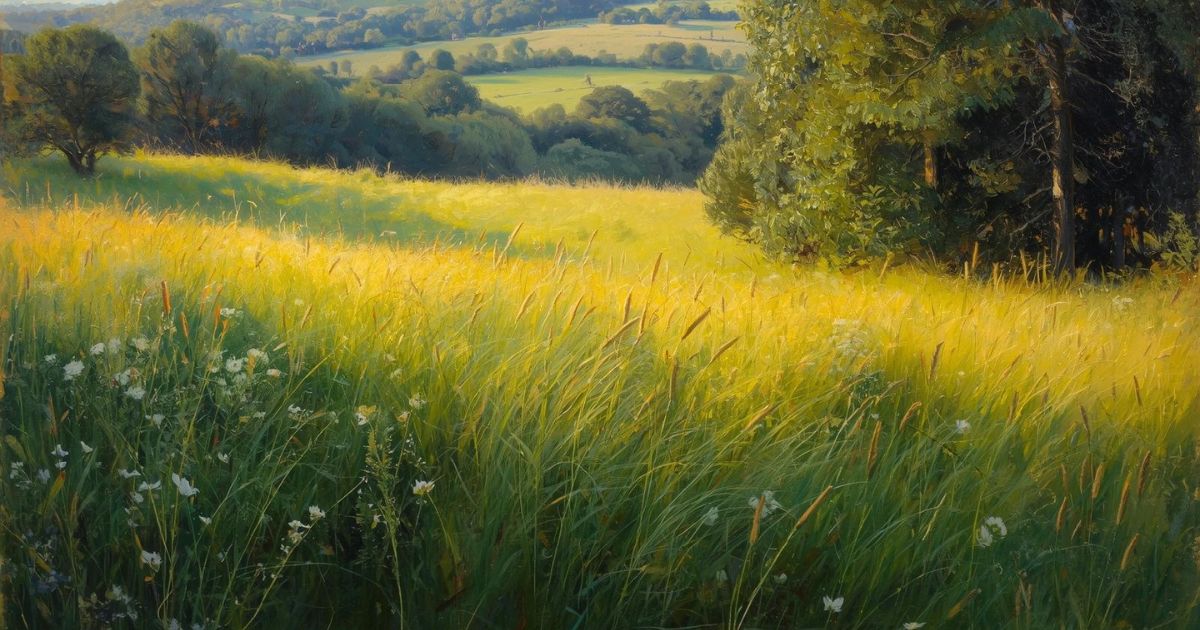
An excerpt from the original text.(complete · 4256 words)
ot many days after this, on a mild sunny morning—rather soft under
foot; for the last fall of snow was only just wasted away, leaving yet
a thin ridge, here and there, lingering on the fresh green grass
beneath the hedges; but beside them already, the young primroses were
peeping from among their moist, dark foliage, and the lark above was
singing of summer, and hope, and love, and every heavenly thing—I was
out on the hill-side, enjoying these delights, and looking after the
well-being of my young lambs and their mothers, when, on glancing round
me, I beheld three persons ascending from the vale below. They were
Eliza Millward, Fergus, and Rose; so I crossed the field to meet them;
and, being told they were going to Wildfell Hall, I declared myself
willing to go with them, and offering my arm to Eliza, who readily
accepted it in lieu of my brother’s, told the latter he might go back,
for I would accompany the ladies.
“I beg your pardon!” exclaimed he. “It’s the ladies that are
accompanying me, not I them. You had all had a peep at this wonderful
stranger but me, and I could endure my wretched ignorance no
longer—come what would, I must be satisfied; so I begged Rose to go
with me to the Hall, and introduce me to her at once. She swore she
would not, unless Miss Eliza would go too; so I ran to the vicarage and
fetched her; and we’ve come hooked all the way, as fond as a pair of
lovers—and now you’ve taken her from me; and you want to deprive me of
my walk and my visit besides. Go back to your fields and your cattle,
you lubberly fellow; you’re not fit to associate with ladies and
gentlemen like us, that have nothing to do but to run snooking about to
our neighbours’ houses, peeping into their private corners, and
scenting out their secrets, and picking holes in their coats, when we
don’t find them ready made to our hands—you don’t understand such
refined sources of enjoyment.”
“Can’t you both go?” suggested Eliza, disregarding the latter half of
the speech.
“Yes, both, to be sure!” cried Rose; “the more the merrier—and I’m sure
we shall want all the cheerfulness we can carry with us to that great,
dark, gloomy room, with its narrow latticed windows, and its dismal old
furniture—unless she shows us into her studio again.”
So we went all in a body; and the meagre old maid-servant, that opened
the door, ushered us into an apartment such as Rose had described to me
as the scene of her first introduction to Mrs. Graham, a tolerably
spacious and lofty room, but obscurely lighted by the old-fashioned
windows, the ceiling, panels, and chimney-piece of grim black oak—the
latter elaborately but not very tastefully carved,—with tables and
chairs to match, an old bookcase on one side of the fire-place, stocked
with a motley assemblage of books, and an elderly cabinet piano on the
other.
The lady was seated in a stiff, high-backed arm-chair, with a small
round table, containing a desk and a work-basket on one side of her,
and her little boy on the other, who stood leaning his elbow on her
knee, and reading to her, with wonderful fluency, from a small volume
that lay in her lap; while she rested her hand on his shoulder, and
abstractedly played with the long, wavy curls that fell on his ivory
neck. They struck me as forming a pleasing contrast to all the
surrounding objects; but of course their position was immediately
changed on our entrance. I could only observe the picture during the
few brief seconds that Rachel held the door for our admittance.
I do not think Mrs. Graham was particularly delighted to see us: there
was something indescribably chilly in her quiet, calm civility; but I
did not talk much to her. Seating myself near the window, a little back
from the circle, I called Arthur to me, and he and I and Sancho amused
ourselves very pleasantly together, while the two young ladies baited
his mother with small talk, and Fergus sat opposite with his legs
crossed and his hands in his breeches-pockets, leaning back in his
chair, and staring now up at the ceiling, now straight forward at his
hostess (in a manner that made me strongly inclined to kick him out of
the room), now whistling sotto voce to himself a snatch of a favourite
air, now interrupting the conversation, or filling up a pause (as the
case might be) with some most impertinent question or remark. At one
time it was,—“It, amazes me, Mrs. Graham, how you could choose such a
dilapidated, rickety old place as this to live in. If you couldn’t
afford to occupy the whole house, and have it mended up, why couldn’t
you take a neat little cottage?”
“Perhaps I was too proud, Mr. Fergus,” replied she, smiling; “perhaps I
took a particular fancy for this romantic, old-fashioned place—but,
indeed, it has many advantages over a cottage—in the first place, you
see, the rooms are larger and more airy; in the second place, the
unoccupied apartments, which I don’t pay for, may serve as
lumber-rooms, if I have anything to put in them; and they are very
useful for my little boy to run about in on rainy days when he can’t go
out; and then there is the garden for him to play in, and for me to
work in. You see I have effected some little improvement already,”
continued she, turning to the window. “There is a bed of young
vegetables in that corner, and here are some snowdrops and primroses
already in bloom—and there, too, is a yellow crocus just opening in the
sunshine.”
“But then how can you bear such a situation—your nearest neighbours two
miles distant, and nobody looking in or passing by? Rose would go stark
mad in such a place. She can’t put on life unless she sees half a dozen
fresh gowns and bonnets a day—not to speak of the faces within; but you
might sit watching at these windows all day long, and never see so much
as an old woman carrying her eggs to market.”
“I am not sure the loneliness of the place was not one of its chief
recommendations. I take no pleasure in watching people pass the
windows; and I like to be quiet.”
“Oh! as good as to say you wish we would all of us mind our own
business, and let you alone.”
“No, I dislike an extensive acquaintance; but if I have a few friends,
of course I am glad to see them occasionally. No one can be happy in
eternal solitude. Therefore, Mr. Fergus, if you choose to enter my
house as a friend, I will make you welcome; if not, I must confess, I
would rather you kept away.” She then turned and addressed some
observation to Rose or Eliza.
“And, Mrs. Graham,” said he again, five minutes after, “we were
disputing, as we came along, a question that you can readily decide for
us, as it mainly regarded yourself—and, indeed, we often hold
discussions about you; for some of us have nothing better to do than to
talk about our neighbours’ concerns, and we, the indigenous plants of
the soil, have known each other so long, and talked each other over so
often, that we are quite sick of that game; so that a stranger coming
amongst us makes an invaluable addition to our exhausted sources of
amusement. Well, the question, or questions, you are requested to
solve—”
“Hold your tongue, Fergus!” cried Rose, in a fever of apprehension and
wrath.
“I won’t, I tell you. The questions you are requested to solve are
these:—First, concerning your birth, extraction, and previous
residence. Some will have it that you are a foreigner, and some an
Englishwoman; some a native of the north country, and some of the
south; some say—”
“Well, Mr. Fergus, I’ll tell you. I’m an Englishwoman—and I don’t see
why any one should doubt it—and I was born in the country, neither in
the extreme north nor south of our happy isle; and in the country I
have chiefly passed my life, and now I hope you are satisfied; for I am
not disposed to answer any more questions at present.”
“Except this—”
“No, not one more!” laughed she, and, instantly quitting her seat, she
sought refuge at the window by which I was seated, and, in very
desperation, to escape my brother’s persecutions, endeavoured to draw
me into conversation.
“Mr. Markham,” said she, her rapid utterance and heightened colour too
plainly evincing her disquietude, “have you forgotten the fine sea-view
we were speaking of some time ago? I think I must trouble you, now, to
tell me the nearest way to it; for if this beautiful weather continue,
I shall, perhaps, be able to walk there, and take my sketch; I have
exhausted every other subject for painting; and I long to see it.”
I was about to comply with her request, but Rose would not suffer me to
proceed.
“Oh, don’t tell her, Gilbert!” cried she; “she shall go with us. It’s
—— Bay you are thinking about, I suppose, Mrs. Graham? It is a very
long walk, too far for you, and out of the question for Arthur. But we
were thinking about making a picnic to see it some fine day; and, if
you will wait till the settled fine weather comes, I’m sure we shall
all be delighted to have you amongst us.”
Poor Mrs. Graham looked dismayed, and attempted to make excuses, but
Rose, either compassionating her lonely life, or anxious to cultivate
her acquaintance, was determined to have her; and every objection was
overruled. She was told it would only be a small party, and all
friends, and that the best view of all was from —— Cliffs, full five
miles distant.
“Just a nice walk for the gentlemen,” continued Rose; “but the ladies
will drive and walk by turns; for we shall have our pony-carriage,
which will be plenty large enough to contain little Arthur and three
ladies, together with your sketching apparatus, and our provisions.”
So the proposal was finally acceded to; and, after some further
discussion respecting the time and manner of the projected excursion,
we rose, and took our leave.
But this was only March: a cold, wet April, and two weeks of May passed
over before we could venture forth on our expedition with the
reasonable hope of obtaining that pleasure we sought in pleasant
prospects, cheerful society, fresh air, good cheer and exercise,
without the alloy of bad roads, cold winds, or threatening clouds.
Then, on a glorious morning, we gathered our forces and set forth. The
company consisted of Mrs. and Master Graham, Mary and Eliza Millward,
Jane and Richard Wilson, and Rose, Fergus, and Gilbert Markham.
Mr. Lawrence had been invited to join us, but, for some reason best
known to himself, had refused to give us his company. I had solicited
the favour myself. When I did so, he hesitated, and asked who were
going. Upon my naming Miss Wilson among the rest, he seemed half
inclined to go, but when I mentioned Mrs. Graham, thinking it might be
a further inducement, it appeared to have a contrary effect, and he
declined it altogether, and, to confess the truth, the decision was not
displeasing to me, though I could scarcely tell you why.
It was about midday when we reached the place of our destination. Mrs.
Graham walked all the way to the cliffs; and little Arthur walked the
greater part of it too; for he was now much more hardy and active than
when he first entered the neighbourhood, and he did not like being in
the carriage with strangers, while all his four friends, mamma, and
Sancho, and Mr. Markham, and Miss Millward, were on foot, journeying
far behind, or passing through distant fields and lanes.
I have a very pleasant recollection of that walk, along the hard,
white, sunny road, shaded here and there with bright green trees, and
adorned with flowery banks and blossoming hedges of delicious
fragrance; or through pleasant fields and lanes, all glorious in the
sweet flowers and brilliant verdure of delightful May. It was true,
Eliza was not beside me; but she was with her friends in the
pony-carriage, as happy, I trusted, as I was; and even when we
pedestrians, having forsaken the highway for a short cut across the
fields, beheld the little carriage far away, disappearing amid the
green, embowering trees, I did not hate those trees for snatching the
dear little bonnet and shawl from my sight, nor did I feel that all
those intervening objects lay between my happiness and me; for, to
confess the truth, I was too happy in the company of Mrs. Graham to
regret the absence of Eliza Millward.
The former, it is true, was most provokingly unsociable at
first—seemingly bent upon talking to no one but Mary Millward and
Arthur. She and Mary journeyed along together, generally with the child
between them;—but where the road permitted, I always walked on the
other side of her, Richard Wilson taking the other side of Miss
Millward, and Fergus roving here and there according to his fancy; and,
after a while, she became more friendly, and at length I succeeded in
securing her attention almost entirely to myself—and then I was happy
indeed; for whenever she did condescend to converse, I liked to listen.
Where her opinions and sentiments tallied with mine, it was her extreme
good sense, her exquisite taste and feeling, that delighted me; where
they differed, it was still her uncompromising boldness in the avowal
or defence of that difference, her earnestness and keenness, that
piqued my fancy: and even when she angered me by her unkind words or
looks, and her uncharitable conclusions respecting me, it only made me
the more dissatisfied with myself for having so unfavourably impressed
her, and the more desirous to vindicate my character and disposition in
her eyes, and, if possible, to win her esteem.
At length our walk was ended. The increasing height and boldness of the
hills had for some time intercepted the prospect; but, on gaining the
summit of a steep acclivity, and looking downward, an opening lay
before us—and the blue sea burst upon our sight!—deep violet blue—not
deadly calm, but covered with glinting breakers—diminutive white specks
twinkling on its bosom, and scarcely to be distinguished, by the
keenest vision, from the little seamews that sported above, their white
wings glittering in the sunshine: only one or two vessels were visible,
and those were far away.
I looked at my companion to see what she thought of this glorious
scene. She said nothing: but she stood still, and fixed her eyes upon
it with a gaze that assured me she was not disappointed. She had very
fine eyes, by-the-by—I don’t know whether I have told you before, but
they were full of soul, large, clear, and nearly black—not brown, but
very dark grey. A cool, reviving breeze blew from the sea—soft, pure,
salubrious: it waved her drooping ringlets, and imparted a livelier
colour to her usually too pallid lip and cheek. She felt its
exhilarating influence, and so did I—I felt it tingling through my
frame, but dared not give way to it while she remained so quiet. There
was an aspect of subdued exhilaration in her face, that kindled into
almost a smile of exalted, glad intelligence as her eye met mine. Never
had she looked so lovely: never had my heart so warmly cleaved to her
as now. Had we been left two minutes longer standing there alone, I
cannot answer for the consequences. Happily for my discretion, perhaps
for my enjoyment during the remainder of the day, we were speedily
summoned to the repast—a very respectable collation, which Rose,
assisted by Miss Wilson and Eliza, who, having shared her seat in the
carriage, had arrived with her a little before the rest, had set out
upon an elevated platform overlooking the sea, and sheltered from the
hot sun by a shelving rock and overhanging trees.
Mrs. Graham seated herself at a distance from me. Eliza was my nearest
neighbour. She exerted herself to be agreeable, in her gentle,
unobtrusive way, and was, no doubt, as fascinating and charming as
ever, if I could only have felt it. But soon my heart began to warm
towards her once again; and we were all very merry and happy
together—as far as I could see—throughout the protracted social meal.
When that was over, Rose summoned Fergus to help her to gather up the
fragments, and the knives, dishes, &c., and restore them to the
baskets; and Mrs. Graham took her camp-stool and drawing materials; and
having begged Miss Millward to take charge of her precious son, and
strictly enjoined him not to wander from his new guardian’s side, she
left us and proceeded along the steep, stony hill, to a loftier, more
precipitous eminence at some distance, whence a still finer prospect
was to be had, where she preferred taking her sketch, though some of
the ladies told her it was a frightful place, and advised her not to
attempt it.
When she was gone, I felt as if there was to be no more fun—though it
is difficult to say what she had contributed to the hilarity of the
party. No jests, and little laughter, had escaped her lips; but her
smile had animated my mirth; a keen observation or a cheerful word from
her had insensibly sharpened my wits, and thrown an interest over all
that was done and said by the rest. Even my conversation with Eliza had
been enlivened by her presence, though I knew it not; and now that she
was gone, Eliza’s playful nonsense ceased to amuse me—nay, grew
wearisome to my soul, and I grew weary of amusing her: I felt myself
drawn by an irresistible attraction to that distant point where the
fair artist sat and plied her solitary task—and not long did I attempt
to resist it: while my little neighbour was exchanging a few words with
Miss Wilson, I rose and cannily slipped away. A few rapid strides, and
a little active clambering, soon brought me to the place where she was
seated—a narrow ledge of rock at the very verge of the cliff, which
descended with a steep, precipitous slant, quite down to the rocky
shore.
She did not hear me coming: the falling of my shadow across her paper
gave her an electric start; and she looked hastily round—any other lady
of my acquaintance would have screamed under such a sudden alarm.
“Oh! I didn’t know it was you.—Why did you startle me so?” said she,
somewhat testily. “I hate anybody to come upon me so unexpectedly.”
“Why, what did you take me for?” said I: “if I had known you were so
nervous, I would have been more cautious; but—”
“Well, never mind. What did you come for? are they all coming?”
“No; this little ledge could scarcely contain them all.”
“I’m glad, for I’m tired of talking.”
“Well, then, I won’t talk. I’ll only sit and watch your drawing.”
“Oh, but you know I don’t like that.”
“Then I’ll content myself with admiring this magnificent prospect.”
She made no objection to this; and, for some time, sketched away in
silence. But I could not help stealing a glance, now and then, from the
splendid view at our feet to the elegant white hand that held the
pencil, and the graceful neck and glossy raven curls that drooped over
the paper.
“Now,” thought I, “if I had but a pencil and a morsel of paper, I could
make a lovelier sketch than hers, admitting I had the power to
delineate faithfully what is before me.”
But, though this satisfaction was denied me, I was very well content to
sit beside her there, and say nothing.
“Are you there still, Mr. Markham?” said she at length, looking round
upon me—for I was seated a little behind on a mossy projection of the
cliff.—“Why don’t you go and amuse yourself with your friends?”
“Because I am tired of them, like you; and I shall have enough of them
to-morrow—or at any time hence; but you I may not have the pleasure of
seeing again for I know not how long.”
“What was Arthur doing when you came away?”
“He was with Miss Millward, where you left him—all right, but hoping
mamma would not be long away. You didn’t intrust him to me, by-the-by,”
I grumbled, “though I had the honour of a much longer acquaintance; but
Miss Millward has the art of conciliating and amusing children,” I
carelessly added, “if she is good for nothing else.”
“Miss Millward has many estimable qualities, which such as you cannot
be expected to perceive or appreciate. Will you tell Arthur that I
shall come in a few minutes?”
“If that be the case, I will wait, with your permission, till those few
minutes are past; and then I can assist you to descend this difficult
path.”
“Thank you—I always manage best, on such occasions, without
assistance.”
“But, at least, I can carry your stool and sketch-book.”
She did not deny me this favour; but I was rather offended at her
evident desire to be rid of me, and was beginning to repent of my
pertinacity, when she somewhat appeased me by consulting my taste and
judgment about some doubtful matter in her drawing. My opinion,
happily, met her approbation, and the improvement I suggested was
adopted without hesitation.
“I have often wished in vain,” said she, “for another’s judgment to
appeal to when I could scarcely trust the direction of my own eye and
head, they having been so long occupied with the contemplation of a
single object as to become almost incapable of forming a proper idea
respecting it.”
“That,” replied I, “is only one of many evils to which a solitary life
exposes us.”
“True,” said she; and again we relapsed into silence.
About two minutes after, however, she declared her sketch completed,
and closed the book.
On returning to the scene of our repast we found all the company had
deserted it, with the exception of three—Mary Millward, Richard Wilson,
and Arthur Graham. The younger gentleman lay fast asleep with his head
pillowed on the lady’s lap; the other was seated beside her with a
pocket edition of some classic author in his hand. He never went
anywhere without such a companion wherewith to improve his leisure
moments: all time seemed lost that was not devoted to study, or
exacted, by his physical nature, for the bare support of life. Even now
he could not abandon himself to the enjoyment of that pure air and
balmy sunshine—that splendid prospect, and those soothing sounds, the
music of the waves and of the soft wind in the sheltering trees above
him—not even with a lady by his side (though not a very charming one, I
will allow)—he must pull out his book, and make the most of his time
while digesting his temperate meal, and reposing his weary limbs,
unused to so much exercise.
Perhaps, however, he spared a moment to exchange a word or a glance
with his companion now and then—at any rate, she did not appear at all
resentful of his conduct; for her homely features wore an expression of
unusual cheerfulness and serenity, and she was studying his pale,
thoughtful face with great complacency when we arrived.
The journey homeward was by no means so agreeable to me as the former
part of the day: for now Mrs. Graham was in the carriage, and Eliza
Millward was the companion of my walk. She had observed my preference
for the young widow, and evidently felt herself neglected. She did not
manifest her chagrin by keen reproaches, bitter sarcasms, or pouting
sullen silence—any or all of these I could easily have endured, or
lightly laughed away; but she showed it by a kind of gentle melancholy,
a mild, reproachful sadness that cut me to the heart. I tried to cheer
her up, and apparently succeeded in some degree, before the walk was
over; but in the very act my conscience reproved me, knowing, as I did,
that, sooner or later, the tie must be broken, and this was only
nourishing false hopes and putting off the evil day.
When the pony-carriage had approached as near Wildfell Hall as the road
would permit—unless, indeed, it proceeded up the long rough lane, which
Mrs. Graham would not allow—the young widow and her son alighted,
relinquishing the driver’s seat to Rose; and I persuaded Eliza to take
the latter’s place. Having put her comfortably in, bid her take care of
the evening air, and wished her a kind good-night, I felt considerably
relieved, and hastened to offer my services to Mrs. Graham to carry her
apparatus up the fields, but she had already hung her camp-stool on her
arm and taken her sketch-book in her hand, and insisted upon bidding me
adieu then and there, with the rest of the company. But this time she
declined my proffered aid in so kind and friendly a manner that I
almost forgave her.
Master this chapter. Complete your experience
Purchase the complete book to access all chapters and support classic literature
As an Amazon Associate, we earn a small commission from qualifying purchases at no additional cost to you.
Available in paperback, hardcover, and e-book formats
Let's Analyse the Pattern
The ability to maintain personal limits while preserving relationships through controlled deflection rather than confrontation.
Why This Matters
Connect literature to life
This chapter teaches how to deflect unwanted questions without creating enemies or drama.
Practice This Today
This week, notice when someone asks invasive questions—try acknowledging their curiosity without satisfying it, then redirect to safer topics.
Now let's explore the literary elements.
Key Quotes & Analysis
"I beg your pardon! It's the ladies that are accompanying me, not I them."
Context: When Gilbert offers to escort the ladies to Wildfell Hall instead of Fergus
This shows Fergus's sense of entitlement and his view that this visit is all about satisfying his curiosity. He sees the women as tools to help him meet Mrs. Graham rather than people with their own agency.
In Today's Words:
Excuse me! They're here to help ME meet her, not the other way around.
"You had all had a peep at this wonderful stranger but me, and I could endure my wretched ignorance no longer."
Context: Explaining why he insisted on visiting Mrs. Graham
Fergus treats Mrs. Graham like a curiosity or entertainment rather than a person deserving respect. His dramatic language reveals how the community has turned her into a source of gossip and speculation.
In Today's Words:
Everyone's met the mysterious new neighbor except me, and I can't stand being left out anymore.
"Are you not afraid to stand so near the edge?"
Context: When he finds Mrs. Graham sketching alone on the dangerous cliff ledge
This moment shows Gilbert's genuine care for Mrs. Graham's safety and creates an opportunity for private conversation. It also symbolizes how she lives on the edge emotionally and socially.
In Today's Words:
Aren't you worried about standing so close to that drop?
Thematic Threads
Social Boundaries
In This Chapter
Mrs. Graham skillfully deflects Fergus's intrusive questions while remaining polite
Development
Building from her initial mysterious arrival, now showing active boundary management
In Your Life:
You see this when coworkers ask personal questions or family members pry into your choices.
Class Expectations
In This Chapter
Fergus feels entitled to answers because of his social position and gender
Development
Continues the theme of assumed male privilege from earlier interactions
In Your Life:
You encounter this when people assume their status gives them access to your private information.
Attraction Through Respect
In This Chapter
Gilbert is drawn to Mrs. Graham precisely because she maintains her dignity under pressure
Development
His interest deepens as he observes her character rather than just her appearance
In Your Life:
You notice how respect and boundaries actually increase rather than decrease genuine attraction.
Natural Connection
In This Chapter
The coastal setting strips away social pretenses, allowing genuine conversation
Development
First time we see Mrs. Graham and Gilbert connect outside social constraints
In Your Life:
You find that real connections often happen away from formal social settings.
Loneliness and Isolation
In This Chapter
Mrs. Graham's solitary sketching reveals her emotional isolation despite social interactions
Development
Her mysterious past continues to separate her from community belonging
In Your Life:
You understand how past experiences can make you feel alone even in a crowd.
You now have the context. Time to form your own thoughts.
Discussion Questions
- 1
How does Mrs. Graham handle Fergus's rude questions about her past, and what specific techniques does she use to protect her privacy?
analysis • surface - 2
Why does Mrs. Graham's approach to boundary-setting work better than arguing or storming off would have?
analysis • medium - 3
Where do you see people crossing boundaries in modern workplaces, families, or social media, and how do most people respond?
application • medium - 4
If someone at work kept asking about your salary or personal relationships despite your discomfort, how would you apply Mrs. Graham's techniques?
application • deep - 5
What does this chapter reveal about the difference between being polite and being a pushover?
reflection • deep
Critical Thinking Exercise
Practice the Boundary Response
Think of a recent situation where someone pushed for information you didn't want to share or crossed a boundary. Write out three different responses: one that argues back, one that gives in, and one that uses Mrs. Graham's approach of acknowledging without satisfying, then redirecting. Notice how each response would likely play out.
Consider:
- •Focus on maintaining your dignity while being clear about your limits
- •Consider how your tone and body language would support your words
- •Think about whether you need to physically create distance like Mrs. Graham did
Journaling Prompt
Write about a time when you wish you had set a boundary more effectively. What would you do differently now, and what fears or beliefs held you back from protecting your privacy?
Coming Up Next...
Chapter 8: The Gift That Almost Ruined Everything
Six weeks pass, and it's now late June with hay-cutting season in full swing. Gilbert is working in the fields when something significant happens that will further develop his relationship with Mrs. Graham and the mystery surrounding her past.



